
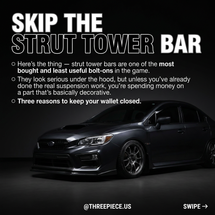
Strut Tower Bar Problems: 3 Reasons NOT to Buy One
Strut tower bars are one of the most oversold bolt-ons in the sport-compact world. They look purposeful under the hood, they're cheap enough to impulse-buy, and every parts-store checkout page recommends one. But real-world forum threads — from Z32 owners to E36 M3 track builds — tell a different story. Your strut tower bar is probably doing nothing, and in some cases it's actively making things worse. Here are three documented reasons to keep your wallet closed.

Quick links
- Your Stock Bushings Neutralize the Brace
- Cheap Strut Bars Cause Real Damage
- A Strut Bar Can Wreck Your Chassis Balance
- Where to Spend That $150–$300 Instead
- When a Strut Tower Bar Actually Makes Sense
Your Stock Bushings Neutralize the Brace
This is the part nobody selling strut bars wants you to hear. On a stock or mostly-stock car, your factory rubber strut mounts and chassis bushings flex far more than the strut towers themselves. You're bolting a rigid bar across two towers that are already connected through a structure that's flexing at every other junction point.
RSX owners on Honda-Tech figured this out the hard way — stock rubber bushings absorb so much compliance that the strut bar's contribution to turn-in response is effectively invisible. WRX owners on ClubWRX echoed the same thing: "The front strut tower bar did little to help in handling other than the 'feel' of the car… it's not really worth it for street driving." On the RX-7 forums, an owner doing 1.19g cornering on track said he couldn't tell the difference with or without the brace. If you can't feel it at 1.19g, you're definitely not feeling it on your commute. For more context on how WRX suspension geometry affects handling, we've covered that separately.
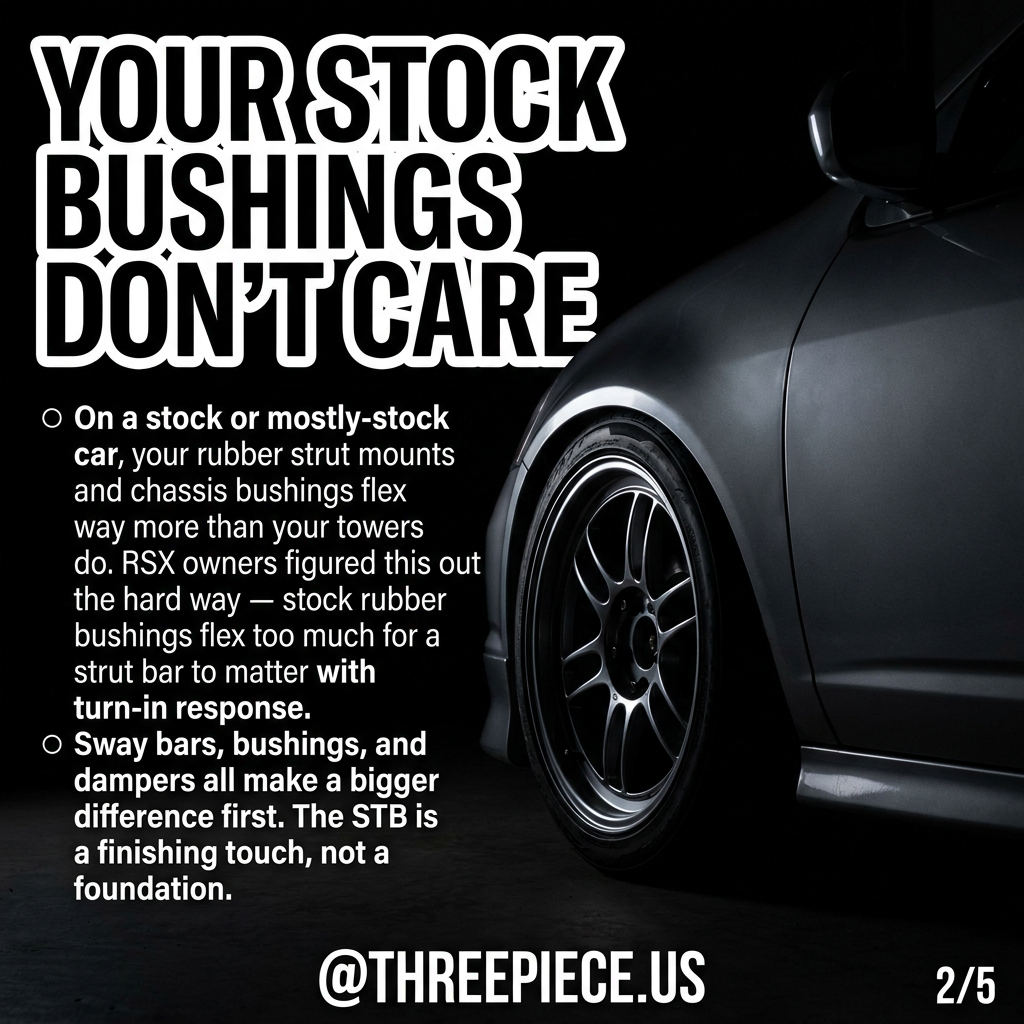
The hierarchy matters. Sway bars, dampers, bushings, and rear camber arms all move the needle before a strut tower bar enters the conversation. The STB is a finishing touch, not a foundation — and most builds never get far enough to need it.
Cheap Strut Bars Cause Real Damage
hood forced up, clearance completely wrong, brackets misaligned. These aren't outliers. Universal and budget bars use hinged joints and slotted brackets to try fitting multiple platforms, and the result is a bar that sits too high, too close to other components, or at the wrong angle entirely.
But fitment isn't even the worst part. On older platforms with thin factory sheet metal — E36 M3s are the textbook example — owners report cracked shock towers after sustained track use with a strut brace. The brace concentrates stress in areas that were never engineered for that load. Bimmerfest threads document tower cracks requiring welded reinforcement plates at $800–$1,500 per side in fab labor. On vintage Datsun Z-cars, builders on Skillard's forums specify minimum 1.5″ diameter DOM steel tubing with 1/8″ wall thickness — anything less is purely cosmetic. If your bar uses thin-wall stamped steel or sub-1″ tubing, it flexes under load and does nothing structurally. That's not a suspension upgrade. That's an engine bay accessory.
If you're running a Nissan platform and want to avoid these headaches, start with parts actually designed for your chassis. And if your build involves 3-piece wheels, make sure the hardware is right too — proper assembly bolts matter more than most people think.
A Strut Bar Can Wreck Your Chassis Balance
Here's the one nobody thinks about until it's too late. On front-heavy FWD cars, stiffening the front end without touching the rear increases understeer. You've just made one end of the car more rigid while the other end stays stock. The chassis balance shifts, and the car pushes harder in corners — the opposite of what you wanted.
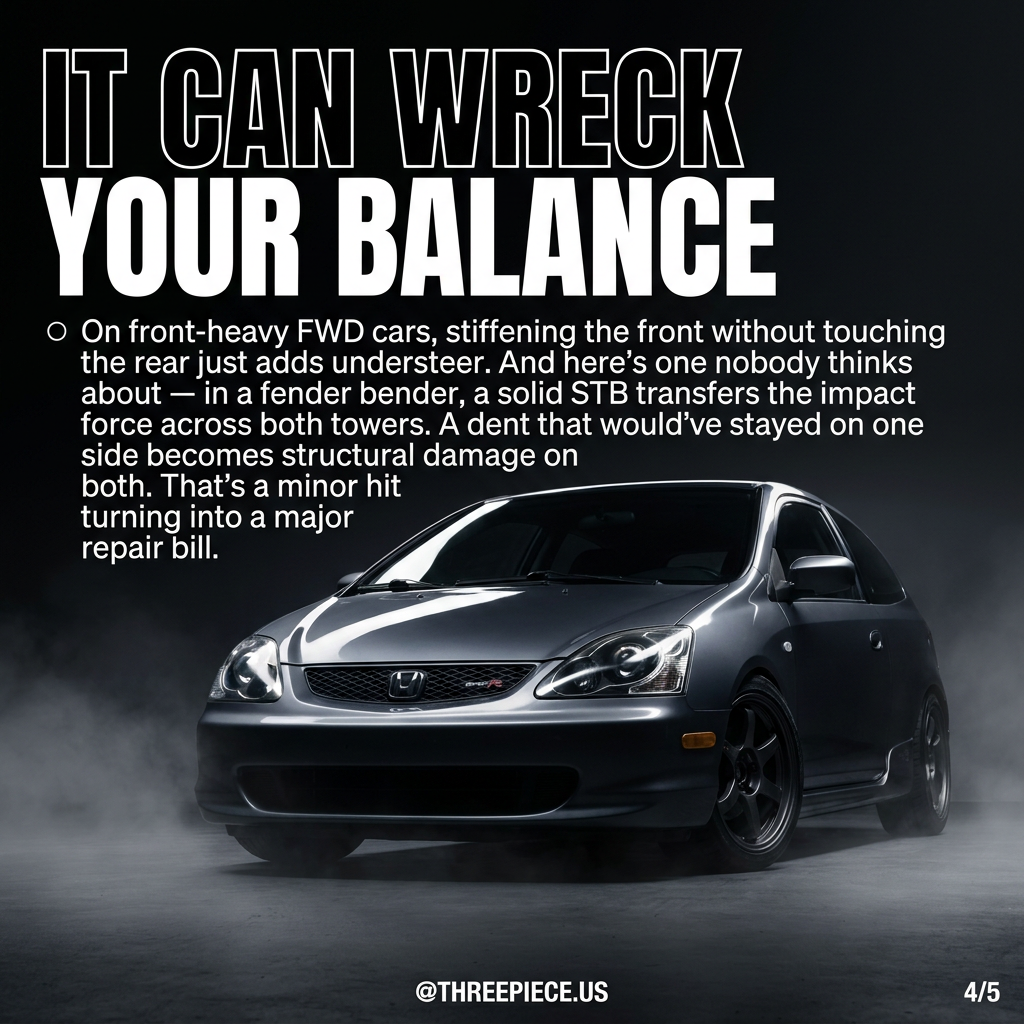
Honda CR-Z and Civic owners on Reddit confirmed this: adding a front tower bar without addressing the rear made the car feel worse, not better. The engineered compliance in the factory chassis exists for a reason. When you stiffen one point without understanding the whole system, you're not upgrading — you're unbalancing.
And then there's the collision problem. A solid strut tower bar creates a rigid bridge between both towers. In a minor fender bender, impact force that would normally stay on one side transfers directly across to the opposite tower. A dent that would've been a $500 panel repair becomes structural damage on both sides — potentially totaling the car. That's not a theoretical concern; it's documented in insurance forums and owner threads. For a part that costs $150–$300 and provides marginal handling benefit on the street, that's a terrible risk-reward trade.
If you're worried about chassis rigidity and you're lowered, you're better off reading up on hub-centric vs. lug-centric wheels — vibrations from improperly centered wheels create more handling issues than tower flex ever will.
Where to Spend That $150–$300 Instead
If you want sharper turn-in and better cornering, here's the actual mod order that works. Every one of these makes a bigger difference than a strut tower bar on a street-driven car:
1. Front sway bar upgrade. This is the single most effective handling mod for reducing body roll. The aFe Control Sway Bar Set for F80/F82 M3/M4 at $743.98 is a complete front-and-rear set that transforms chassis balance. For MK7 GTI owners, the aFe CONTROL Series Rear Sway Bar at $422.53 addresses the factory's biggest weakness. Even the GTI's known handling issues improve dramatically with proper sway bars.
2. Polyurethane bushings. Replace the stock rubber that's eating your inputs. The Energy Suspension 24mm front sway bar bushings for the FC RX-7 are just $44.79 and eliminate the slop that makes factory sway bars feel vague. For strut-bar-to-chassis mounting compliance on older platforms, the SuperPro Strut Bar To Chassis Bushing Kit at $59.15 solves the exact flex problem that cheap strut bars can't.
3. Quality dampers. A proper shock or coilover does more for handling than any brace. The Bilstein B12 complete suspension kit for the F30 335i at $1,036.77 includes matched springs and dampers — the kind of upgrade that actually changes how the car corners. Browse the full suspension catalog for your platform.
4. Good tires on proper wheels. Tires are the single largest variable in grip. A set of quality rubber on well-fitted wheels — check the wheel catalog — will outperform any chassis brace on the street. If you're running 3-piece wheels and want the fitment dialed, our 370Z fitment guide and RX-8 fitment guide are good starting points for common sport-compact platforms.
When a Strut Tower Bar Actually Makes Sense
This isn't a blanket condemnation. Strut tower bars have a real function — after you've done everything else. If you've upgraded sway bars, installed polyurethane or spherical bushings, run quality coilovers, reinforced your subframe, and you're pushing hard at the track, a properly engineered one-piece welded bar can sharpen the last few percent of turn-in response. The Cusco Strut Bar Type ST for the Miata at $179.15 is the kind of quality, platform-specific unit that actually works — one-piece construction, proper clearance, designed for that specific chassis. For Evo 8/9 owners, the Cusco OS Front 3-Point with BCS at $278.15 adds a third mounting point for genuine triangulated rigidity. Even the Cusco ST for the MA70 Supra at $160.13 is purpose-built for that platform.
The key distinction: a quality, model-specific strut bar on a fully sorted chassis is a legitimate upgrade. Know where you are in the build before you buy.
Need help dialing in fitment for your build? Browse the vehicle gallery for real-world examples, or check out our breakdown of whether downpipes are worth it — another mod that gets oversold to people who aren't ready for it yet.