
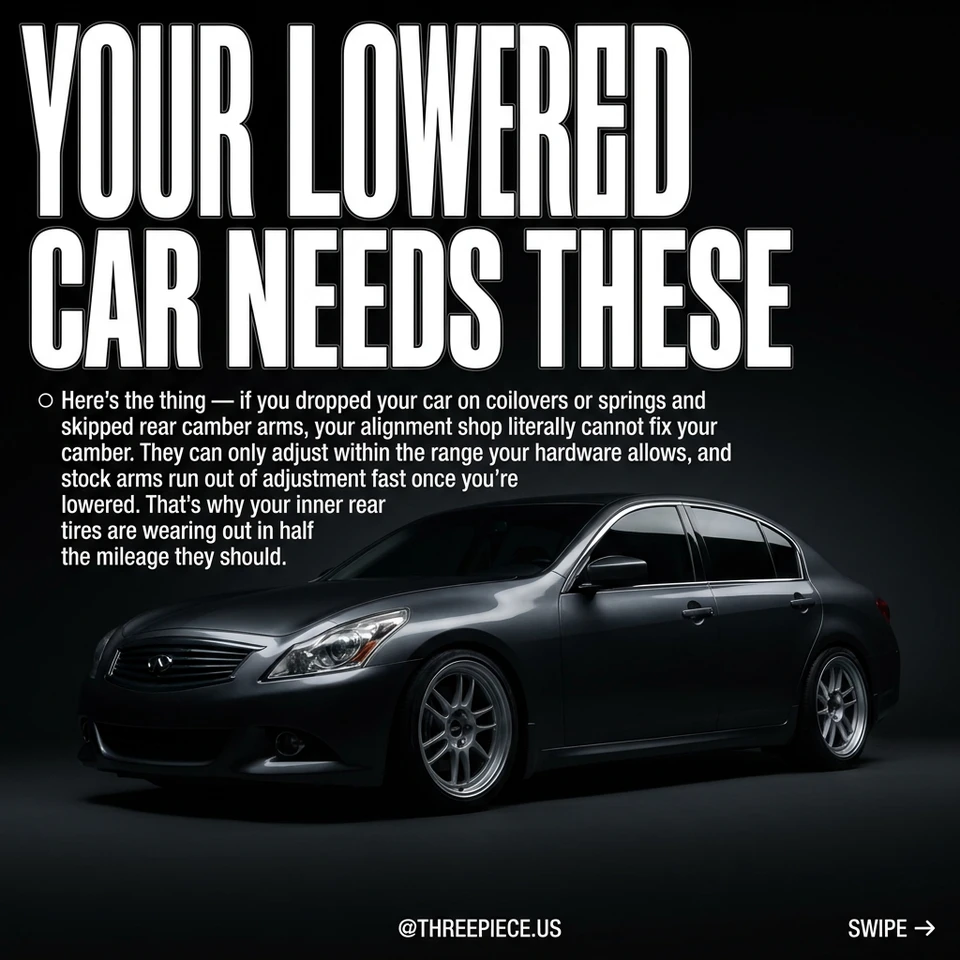
Rear camber arms are one of the most skipped — and most necessary — upgrades on any lowered car. If you dropped your ride on coilovers or lowering springs and never installed adjustable rear arms, your alignment shop literally cannot fix your camber. They can only adjust within the range your hardware allows, and stock arms run out of adjustment fast once you're below factory ride height. The result? Inner rear tires chewed through in half the mileage they should last, a vague rear end in corners, and an alignment tech who keeps telling you there's nothing they can do. Here's what rear camber arms actually are, why bushing choice matters more than most people realize, and when you need to install a set.

Quick links
- What rear camber arms actually are
- Why stock arms can't keep up
- Bushing choice changes everything
- When you actually need them
- What to look for when buying
- Get the alignment right
What Rear Camber Arms Actually Are
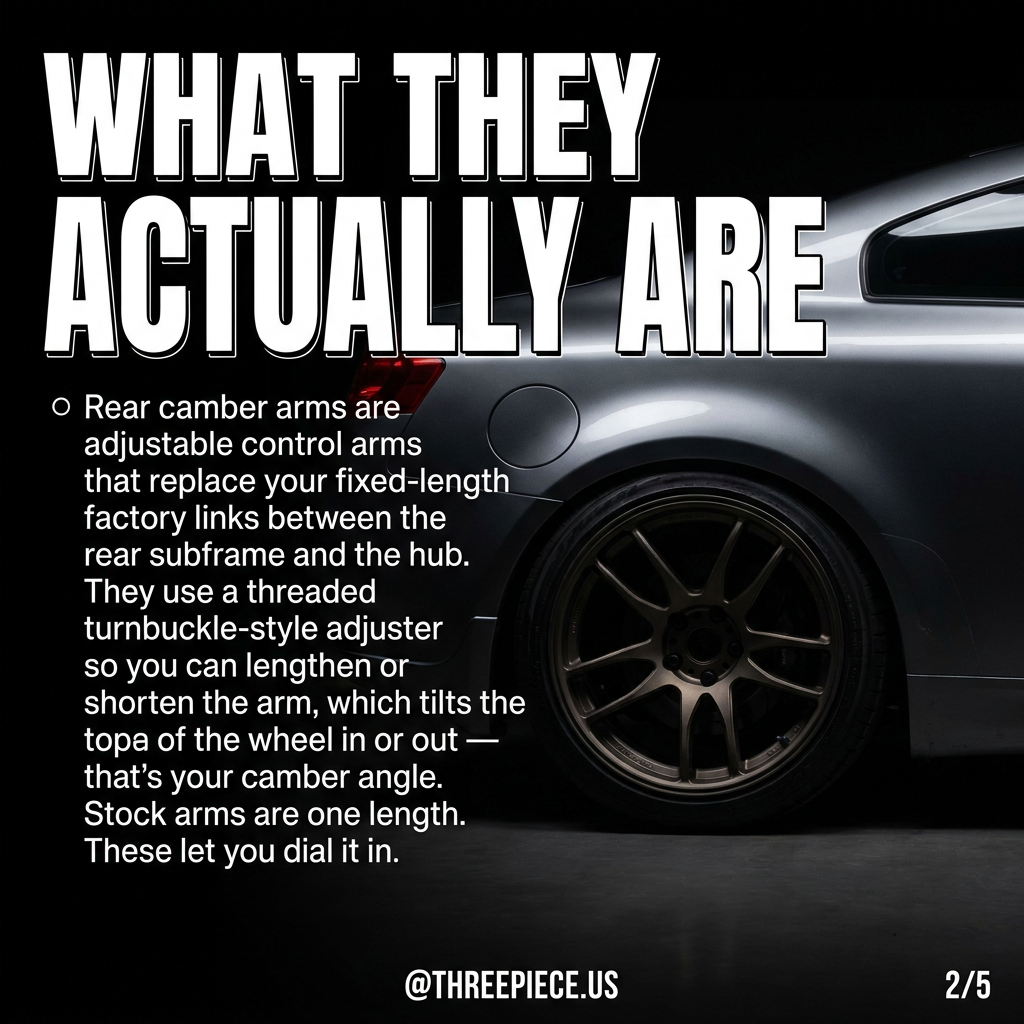
Rear camber arms are adjustable control arms that replace your fixed-length factory links between the rear subframe and the wheel hub or knuckle. The stock arm is a single, non-adjustable length — it was designed for one ride height, and it holds the wheel at a specific angle relative to the chassis. An aftermarket camber arm uses a threaded turnbuckle-style adjuster so you can lengthen or shorten the arm, which tilts the top of the wheel inward or outward. That tilt is your camber angle.
Camber is measured in degrees. Negative camber means the top of the wheel leans inward toward the car. Positive camber means it leans outward. Most street cars run a slight negative camber for cornering stability, typically around -0.5° to -1.5° in the rear. The problem starts when lowering pushes that number well beyond what's usable — and stock arms can't bring it back.
Most aftermarket rear camber arms are made from 6061-T6 aluminum for stiffness and weight savings, though some budget options use steel. Each end connects via a joint — either a rubber bushing, polyurethane bushing, or spherical bearing (rod end / heim joint). The adjuster typically sits in the middle of the arm, allowing you to dial in camber with a wrench while the car is on the ground or on an alignment rack. If you're running a 3-piece wheel setup and want to protect that investment, proper camber is non-negotiable — check out the wheels available at ThreePiece.us and understand that uneven tire wear from bad camber will wreck any setup.
Why Stock Arms Can't Keep Up
Your factory rear suspension geometry was engineered for stock ride height. Some OEM setups use eccentric bolts that allow a small range of camber adjustment — maybe ±0.5° to ±0.75° — but that range assumes you're within about half an inch of factory height. Lower a car more than about 1 to 1.5 inches and the rear camber goes deep negative. Owners regularly report ending up at -3° to -4° on stock arms with no way to bring it back.
At -3° or worse, the inner edges of your rear tires are carrying a disproportionate share of the contact patch. You'll see the inner tread worn smooth while the outer edge still has full depth. That's not just cosmetic — it means reduced grip, unpredictable handling (especially in the wet), and tires that need replacing at half their rated mileage. If you're running quality rubber like a set of 245/40R18 tires, you're burning money every mile you drive with uncorrected camber.
Aftermarket adjustable camber arms typically offer ±1° to ±3° of correction relative to stock position, depending on the brand and platform. That's enough to bring a moderately lowered car back to -1° to -1.5° in the rear — the sweet spot where tires last, the rear end feels planted, and your alignment shop can actually do their job. If you've already invested in a proper coilover setup with the right spring rates, skipping camber arms undoes half the work.

Bushing Choice Changes Everything
The adjuster gets all the attention, but the bushing at each end of the arm is what determines how the arm actually performs over time. There are three main options, and the differences are not subtle.
Rubber bushings are the quietest and most compliant. They absorb road vibrations and NVH well, which is why OEMs use them. But rubber wears out — especially under the increased stress of a lowered suspension. Owners on platforms like the 7th-gen Civic and Focus RS report rubber-bushed aftermarket arms failing by 20,000 miles: cracked, developing radial play of ~2mm, and allowing camber to drift under load. Some owners report losing 2-3° of camber during hard cornering because the bushing deflects. That's not adjustability — that's failure.
Spherical bearings (rod ends / heim joints) are the opposite end of the spectrum. Zero deflection, zero play, and they hold camber precisely under load. Track cars and aggressive street builds use these because they provide the most consistent geometry. The trade-off is road noise — every bump transmits directly through the chassis. They also require periodic inspection for wear, though quality units from brands like GKTech (with 5/8-inch Teflon-lined pillowball rod ends) routinely last past 25,000+ miles with zero play.
PTFE-lined rod ends split the difference. They're stiff enough to hold alignment precisely, quiet enough to daily drive without going insane, and durable enough that they don't develop the play issues of rubber. SPL's Elantra N rear upper camber arms, for example, use FK PTFE-lined rod ends with electroless nickel-plated 4130 chromoly double adjusters and titanium hardware. That's the kind of engineering that holds up on both the street and the track.
For platforms like the RX-8, the SuperPro RX-8 Camber Adjustable Front UCA Inner Bushing Kit at $95.20 shows how even bushing upgrades alone can restore adjustability — and that's just the front. Rear camber arm bushing quality matters even more because the rear suspension on most sport-compact platforms has less built-in compliance to begin with. If you're exploring the RX-8 platform specifically, our RX-8 wheel fitment guide covers how camber correction ties into wheel sizing.

When You Actually Need Them
There's a simple rule: if your car is lowered, running aggressive wheel fitment, or being tracked, adjustable rear camber arms aren't optional. Here's the breakdown:
Lowered on coilovers or springs: Even a modest 1.5-inch drop can push rear camber outside of factory adjustment range. If your alignment printout shows -2° or more in the rear and the tech says they can't bring it back, you need camber arms. Period. If you're shopping coilovers and haven't pulled the trigger yet, check out options like the F2 Function & Form Genesis Coupe Coilovers or the F2 Function & Form Honda Accord CB Coilovers — but budget for camber arms at the same time. Coilovers without camber correction is an incomplete suspension setup.
Aggressive wheel fitment: Wider wheels, lower offsets, and stretched tires all change how the tire sits in the wheel well. Camber arms let you fine-tune the angle so the tire clears the fender without rubbing. If you're running a staggered setup, this is even more critical — our guide on what forged wheels actually are explains why protecting a premium wheel investment starts with proper alignment hardware.
Track or autocross use: Specific rear camber values directly affect cornering balance. Too much negative camber in the rear reduces the contact patch on the inside tire during straight-line braking. Too little and the outside tire overloads in corners. Camber arms let you dial in the exact angle your driving style and tire compound demand. Most track-focused builds target -1.5° to -2.5° in the rear depending on the platform and tire.
Uneven rear tire wear: If your inner rear tread is wearing faster than the outer, that's excessive negative camber. An alignment can only fix it if the hardware allows it. If your alignment tech says you're maxed out on adjustment, camber arms are the fix.
For Acura MDX owners dealing with rear alignment issues after lowering, the MOOG 14-19 Acura MDX Rear Alignment Camber/Toe Kit at $51.87 is a direct-fit solution that gives you the adjustment range the factory setup lacks.

What to Look for When Buying
Not all rear camber arms are created equal, and cheap arms with sloppy tolerances are genuinely worse than stock. Owners have reported jam nuts backing off, threads wearing out, and a quarter-inch of wheel play developing after 20,000 miles on budget arms. Here's what separates good hardware from junk:
Material: Look for 6061-T6 aluminum or 4130 chromoly steel. Avoid unmarked or generic steel arms with no material spec listed — they're usually the ones that flex or corrode.
Joint type: Match the joint to your use case. Rubber for a quiet daily that never sees a track. PTFE-lined rod ends for a daily-driven car that also gets spirited driving or occasional track days. Full spherical bearings for dedicated track use or aggressive street builds where NVH isn't a concern.
Adjustment range: Make sure the arm provides enough correction for your drop. A ±1° arm works for mild drops of about an inch. If you're lower than that, look for arms with ±2° to ±3° of range. SPC arms for the Accord/TSX/TLX platform give about +1° of correction, which is enough for most street setups on those cars.
Hardware quality: Titanium hardware and electroless nickel plating aren't just marketing — they resist corrosion and fatigue better than bare steel. If you live in a salt-belt state, this matters more than you think.
If you're building a platform like the 350Z or G35, our 370Z wheel fitment guide and 350Z buying guide both cover how camber correction fits into the broader suspension and wheel picture on those platforms. For BMW E46 M3 owners, the E46 M3 build guide covers proper mod order — and camber arms should come at the same time as coilovers, not as an afterthought. The SuperPro BMW 323Ci Front Alloy Lower Control Arm Set at $615.20 is an example of what proper alloy suspension arms look like — precision-machined, correct geometry, and built to last.
Get the Alignment Right
Rear camber arms are only half the equation. Once they're installed, you need a full four-corner alignment with camber and toe set together. Adjusting camber without checking toe will introduce handling problems that are worse than what you started with. Find a shop with a Hunter alignment rack and a tech who understands aftermarket suspension — not every shop does.
If you're building a lowered car the right way, camber arms belong in the same order as your coilovers. Not six months later when your tires are already wrecked. Browse the suspension category at ThreePiece.us for coilovers and alignment hardware, and check the vehicle gallery for builds that got the fitment right from the start. Your tires, your handling, and your wheel investment will all be better for it.
Still shopping for the coilovers themselves? BC Racing BR-Series kits are in stock at ThreePiece.us — sort out the ride height first, then come back for the camber arms.