
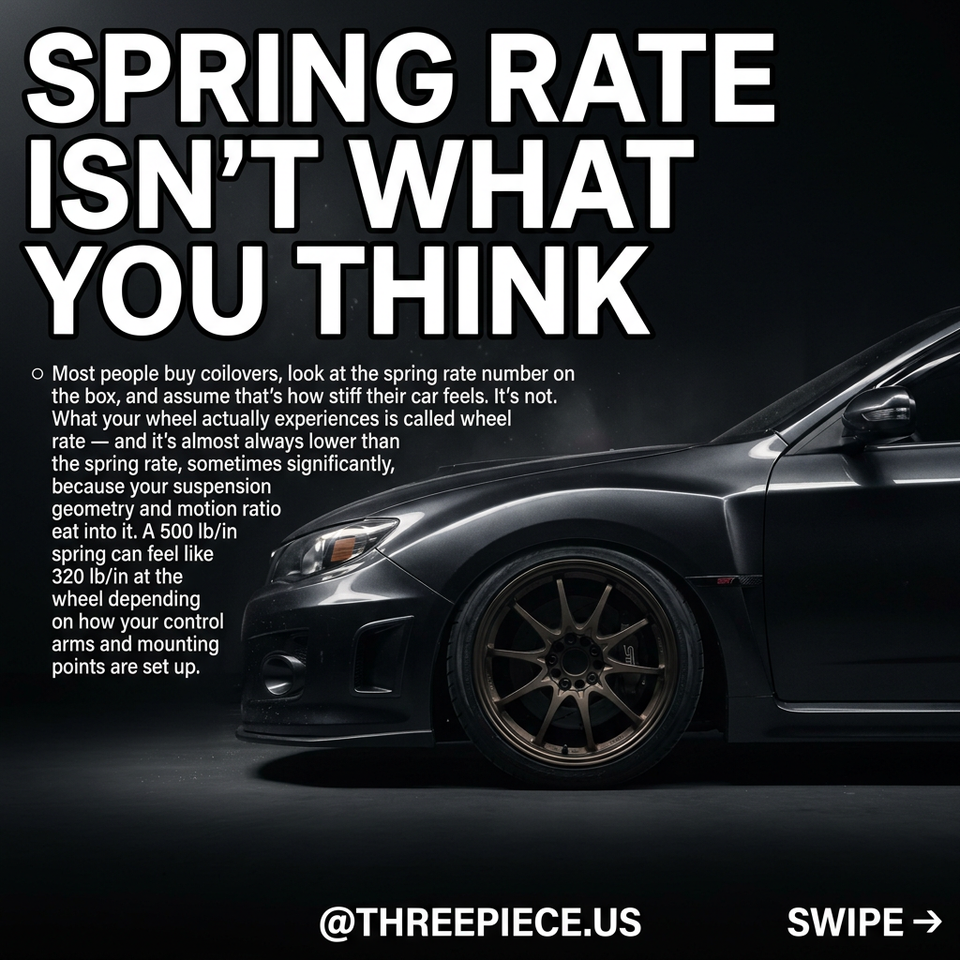
Coilover spring rate is probably the most misunderstood number in the entire suspension game. Most people buy a set of coilovers, read the rate printed on the box, and assume that's what their car feels. It's not — and the gap between what you think you're running and what the wheel actually experiences is where most suspension setups go wrong. Whether you're building a street-and-track sport compact or trying to figure out why your current setup rides like garbage, understanding spring rate — and more importantly, wheel rate — is the difference between a car that puts down and one that just looks lowered.
Quick links
- Spring Rate vs. Wheel Rate: The Number That Actually Matters
- Motion Ratio: Why Identical Springs Feel Different
- Too Stiff Costs You Grip
- Dampers Have to Match Your Springs
- How to Actually Pick Your Spring Rates
- Real-World Spring Rate Numbers from Builds
- Common Mistakes That Wreck Your Setup
- Get the Foundation Right
Spring Rate vs. Wheel Rate: The Number That Actually Matters
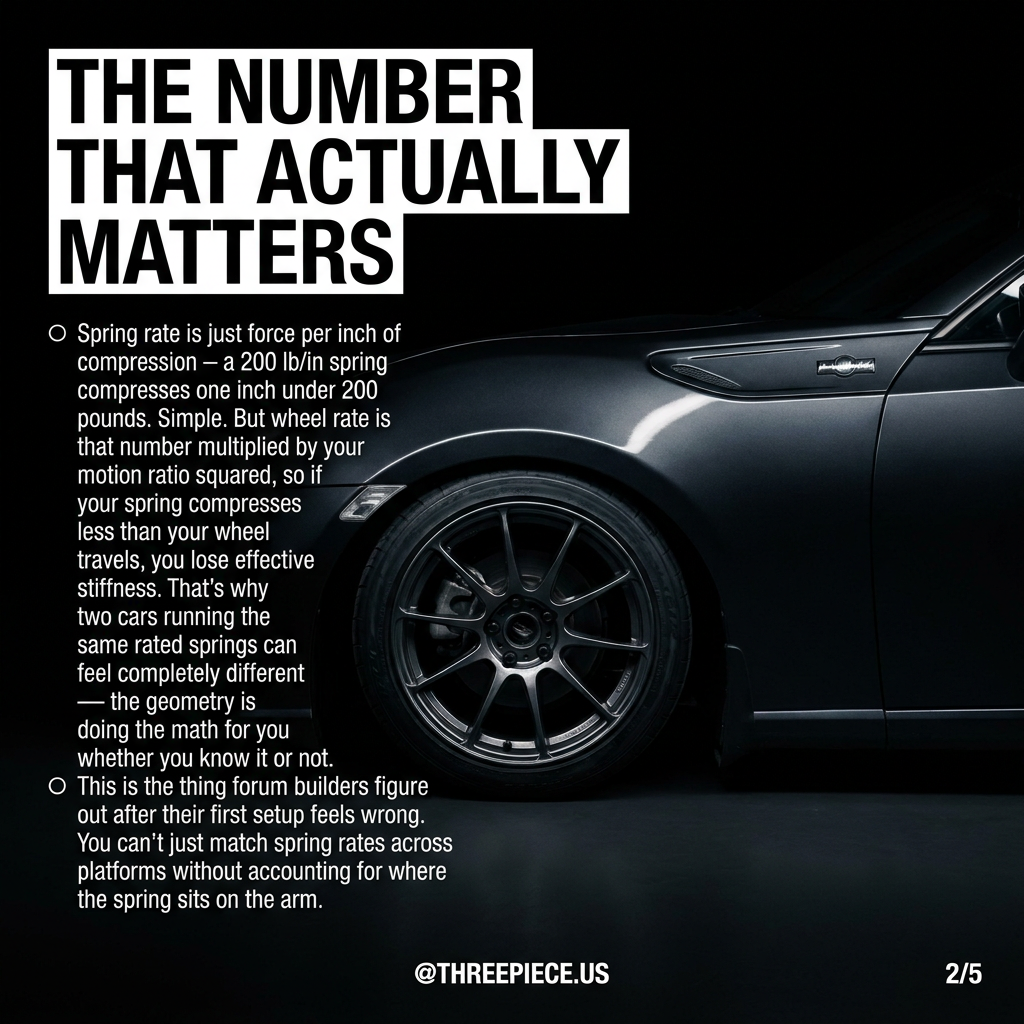
Spring rate is straightforward: it's the force required to compress a spring by one unit of distance. A 200 lb/in spring compresses one inch under 200 pounds of force. A 500 lb/in spring takes 500 pounds to compress one inch. Linear springs maintain this rate throughout their travel — every additional pound compresses by the same fraction. Progressive springs start softer and get stiffer as they compress, which complicates tuning significantly.
But here's the thing forum builders figure out after their first setup feels wrong: wheel rate is what your tire and contact patch actually experience, and it's almost always lower than the spring rate. The suspension geometry between your spring perch and the wheel hub acts as a lever, and that mechanical disadvantage means a 500 lb/in spring can feel like 320 lb/in at the wheel depending on your control arm geometry and mounting points. If you've ever wondered why two cars running the same rated springs feel completely different, this is why. If you're weighing whether coilovers even make sense for your build, our breakdown of whether coilovers are worth it on daily drivers covers the decision framework before you even get to spring rate selection.
Motion Ratio: Why Identical Springs Feel Different
Motion ratio is the relationship between wheel travel and spring/shock travel. If your wheel moves one inch but the spring only compresses 0.8 inches, your motion ratio is 0.8. The critical formula is:
Wheel Rate = Spring Rate × (Motion Ratio)²
That squared term matters enormously. With a motion ratio of 0.8, a 500 lb/in spring delivers a wheel rate of just 320 lb/in. Drop the motion ratio to 0.7 and that same spring feels like 245 lb/in at the contact patch. This is why you can't just copy spring rates from another platform and expect the same behavior — an Audi B8 with 590 lb/in front / 298 lb/in rear springs can feel relatively balanced once you account for the different motion ratios at each axle. Forum owners on Audizine confirmed this: the raw numbers look wildly mismatched, but the calculated wheel rates tell the real story.
For anyone running an Audi platform, the B8 S4 build guide covers how suspension fits into the broader mod order. The Bilstein B12 Audi A5 Quattro Complete Suspension Kit at $966 is a solid matched spring-and-damper package that eliminates the guesswork of pairing components — exactly the kind of setup that avoids the mismatch problems we're about to cover.
Too Stiff Costs You Grip
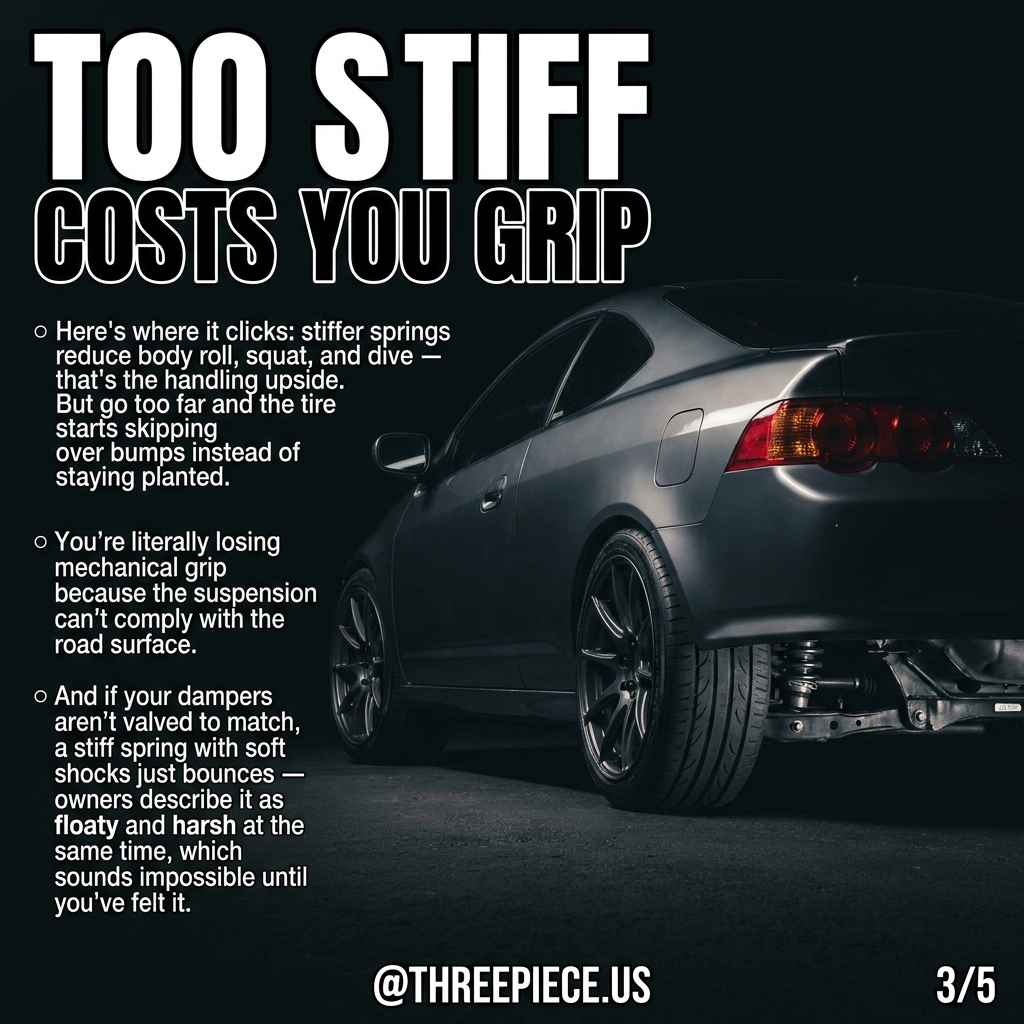
This is where it clicks for most people: stiffer springs reduce body roll, squat under acceleration, and nose dive under braking. That's the handling upside, and it's real. But go too far and the tire starts skipping over bumps instead of staying planted. You're literally losing mechanical grip because the suspension can't comply with the road surface. The tire needs to maintain contact to generate lateral force — every millisecond it's airborne over a bump is a millisecond you're not making grip.
And it gets worse with sticky tires. Higher-grip rubber generates more lateral load, which increases the demand on your springs and sway bars to manage weight transfer. So if you've upgraded to 245/40R18 performance tires, your suspension has to work harder than it did on all-seasons — but the answer isn't just cranking spring rate. It's finding the rate that controls body motion without overwhelming the tire's ability to stay in contact with imperfect pavement. Multiple track-day forum threads confirm: owners who went from 400 lb/in to 600+ lb/in on street-driven cars saw lap times go backwards on anything but glass-smooth surfaces.
Dampers Have to Match Your Springs
The single biggest mistake builders make is picking a spring rate without thinking about damping. Your shock absorber controls the speed at which the spring compresses and rebounds. Stiff springs paired with stock or soft dampers means the shock can't control rebound — the car skips, bounces, and somehow manages to feel both floaty and harsh at the same time. Owners describe it as impossible until you've experienced it firsthand.
Multiple forum builds confirm this pattern: owners running aggressive 500+ lb/in rates who then softened their damping to cope around town ended up with the worst of both worlds. The spring wants to push back hard, but the damper can't slow it down, so the car oscillates. Conversely, overdamped shocks with soft springs feel wooden and unresponsive — the damper fights the spring's ability to absorb impacts. The relationship has to be matched.
This is why quality coilover kits from companies like Bilstein engineer their spring rates and valving as a system. The Bilstein B12 BMW 335i Front and Rear Suspension Kit at $1,036 is a good example — springs and dampers tuned together for the F30 platform's specific weight distribution and motion ratios. If you're building an F30, our F30 335i N55 build guide walks through where suspension fits in the mod order relative to power mods. For E90 owners, the E90 335i N54 build guide covers the same ground on the older chassis. The Bilstein B4 OE Replacement Strut for F30 328i/335i at $635 is also worth considering if you're replacing worn dampers before upgrading springs — fresh valving on tired shocks can transform ride quality before you even change rates.

How to Actually Pick Your Spring Rates
Here's the process that real builders use — not guessing based on what your favorite Instagram build is running:
1. Weigh your car per corner. You need front and rear sprung weight (total weight minus unsprung mass like wheels, brakes, hubs). Corner scales are ideal. Without them, get axle weights and divide.
2. Define your use case. Be honest. A car that sees 90% street and two track days a year has completely different requirements than a dedicated weekend warrior. Road surface quality matters too — rough city streets demand more compliance than smooth highway miles.
3. Target a ride frequency. This is the number that ties everything together. Ride frequency (measured in Hz) describes how quickly the suspension oscillates. Most builders target 2.0–2.5 Hz for a street-and-track mix. Higher Hz means stiffer. A critical detail: set the rear frequency 10–20% higher than the front for flat, neutral handling balance. This prevents the rear from settling after the front on corner entry, which reduces the "porpoising" sensation.
4. Calculate wheel rate from frequency. The formula is: Wheel Rate = (2π × frequency)² × sprung weight at that corner / 386.4 (in lb/in, using Hz and lbs). Then convert wheel rate back to spring rate using your platform's motion ratio.
5. Match your dampers. If you're buying a complete coilover kit, the manufacturer has (hopefully) done this. If you're mixing springs and shocks, confirm the damper's valving range can handle your chosen rate. Budget coilovers with non-adjustable damping are the most common source of mismatched setups — read our deep dive on why 90% of coilover buyers make this expensive mistake before spending money.
For a street-driven sport compact, you're generally looking at 350–500 lb/in front and 400–600 lb/in rear as a starting window. Go stiffer for dedicated track use, softer for daily comfort. Browse the full suspension catalog for matched kits across platforms.
Real-World Spring Rate Numbers from Builds
Here's what actual owners are running, pulled from forums and build threads — not marketing spec sheets:
Subaru WRX STI (GD chassis): 5k front / 4k rear (kg/mm) is the sweet spot for road plus occasional track. Owners describe it as sporty but livable on bumpy roads. Above 6k/5k it starts getting harsh for daily use. Above 7k/6k you're in dedicated track territory with stiff, unforgiving behavior on the street. If you're building an 86/BRZ platform instead, the ZD8 BRZ build guide has suspension-specific recommendations, and the GR86 fitment guide covers how wheel and tire choices interact with your suspension geometry.
BMW Z4 3.0 (street + 5% track): Vendors suggest around 400 lb/in front and rear. Owners report 450 lb/in front is slightly harsh, 500 lb/in is noticeable, and 550+ lb/in gets uncomfortable for daily driving. Rates of 550 front / 600 rear were described as "nuts on street" — but people still run them.
E92 BMW (Ground Control / Koni): One owner swapped from 400/650 (front/rear) to 300/800 to shift the handling balance rearward. That's a massive rear bias, but with the E92's weight distribution and motion ratios, it brought the wheel rates closer to neutral. If you're considering the E92 M3 specifically, our E92 M3 buying guide and E46 vs E92 M3 comparison cover the chassis differences that affect suspension tuning.
Genesis Coupe (BK1/BK2): The F2 Function & Form Genesis Coupe Type 1 Coilovers are an entry-level option for owners who want adjustable ride height with matched damping out of the box — a much better starting point than mixing random springs with stock shocks.

Common Mistakes That Wreck Your Setup
Cranking preload to "stiffen" the ride. On a linear spring, preload adjusts initial ride height and droop position — it does not change the spring rate. The spring's stiffness is a fixed physical property determined by wire diameter, coil count, and material. Over-preloading compresses the spring at rest, reducing available droop travel, which can make the car feel harsh over dips and transitions. But the actual rate hasn't changed. This is one of the most common misconceptions in coilover ownership.
Coil bind. If your spring doesn't have enough free length for the shock's travel, the coils will stack solid before the damper reaches full compression. This sends a massive shock load through the chassis and can damage the shock body, mounts, and surrounding components. Always verify that your spring's solid height (all coils touching) leaves clearance for full shock travel.
Overspringing with stock dampers. This is the most common way to wreck a suspension setup. Stiff aftermarket springs on factory shocks that can't control the rebound speed means the car bounces, skips, and handles worse than stock. The shock's valving was designed for the OEM spring rate — doubling the rate without upgrading the damper is a recipe for a car that's simultaneously too harsh and too bouncy.
Copying rates across platforms. A 450 lb/in front spring on a Miata and a 450 lb/in front spring on an E46 M3 will feel completely different because the cars have different weights, weight distributions, motion ratios, and suspension geometries. Always calculate based on your platform's specifics. The E46 M3 build guide covers platform-specific suspension recommendations if you're on that chassis.
Ignoring front-to-rear balance. Too stiff in the rear relative to the front creates oversteer; too stiff in the front creates understeer. Many builders target rear wheel rates 10–20% higher than front for balanced handling, but this depends on weight distribution, tire sizing, and sway bar setup. Running a staggered setup on a lightweight RWD platform changes the equation compared to a heavier AWD sedan.
Get the Foundation Right
Spring rate isn't a number you pick from a forum post and bolt on. It's a calculated decision based on your car's weight, your suspension geometry, your damper capability, and what you actually do with the car. Get it right and your suspension works as a system — controlled body motion, planted tires, confidence in transitions. Get it wrong and you're leaving grip on the table while riding on something that feels worse than stock.
If you're spec'ing a coilover setup, start with the suspension kits in the ThreePiece.us catalog — matched spring-and-damper packages like the Bilstein B12 for the F30 335i or the F2 Function & Form kits for Honda platforms take the guesswork out of spring-to-damper matching. Once your suspension is sorted, the right wheels and tires complete the picture — lighter unsprung weight means your springs and dampers have less mass to control, which makes every rate choice more effective. Check the vehicle gallery for real builds that got the whole package right.
When you are ready to move from theory to hardware, BC Racing BR-Series coilover kits are in stock at ThreePiece.us — each kit is built for a specific chassis, so start from your car and go from there.