
E92 M3 6MT Buying Guide: S65 V8 Manual in 2026
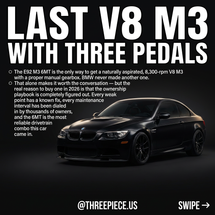
The E92 M3 6MT is the last naturally aspirated V8 BMW will ever put in an M3. The S65 makes 414 horsepower, revs to 8,300 rpm, and connects to a six-speed manual gearbox that avoids every reliability headache the DCT introduced. In 2026, clean examples are sitting in the mid-$20s to low $30s — less than a new Civic Type R — and the entire ownership playbook has been solved by a decade of forum documentation, specialist shops, and thousands of long-term builds. If you've been circling one, this is the guide that tells you exactly what to budget, what to inspect, and why the 6MT is the only version worth buying for the long haul.
Quick links
- Why the 6MT Over the DCT
- The S65 at Full Song — Nothing Else Compares
- Rod Bearings: The Big One
- Every Other Known Fix, Documented
- What to Budget Beyond the Purchase Price
- Tuning and Exhaust — The Mature Path
- Wheels and Fitment for the E92 M3
- Stop Waiting — Go Buy One
Why the 6MT Over the DCT
The E92 M3 came with two transmission options: a Getrag 6-speed manual and BMW's GS7D36SG dual-clutch (DCT). The DCT is faster on paper, but in 2026 the calculus is simple — the 6MT is the most reliable drivetrain combination this car was ever sold with. Fewer electronics, fewer solenoids, fewer failure modes. The DCT's mechatronic unit and clutch pack are expensive to service and increasingly difficult to source parts for. The manual gearbox, by contrast, is mechanically straightforward. Owners who keep the transmission fluid fresh report zero internal issues past 150,000+ miles. A fluid change runs $150–$250 and should happen every 50,000 miles — that's it.
The 6MT also puts you fully in control of the driving experience. The S65's character lives between 5,000 and 8,300 rpm, and rowing through that range yourself is the entire point of owning this car. If you're cross-shopping other analog sports cars from this era, our Honda S2000 CR AP2 buying guide covers another high-revving manual that's appreciating for the same reasons. The E92 gives you two more cylinders and a usable back seat.
The S65 at Full Song — Nothing Else Compares
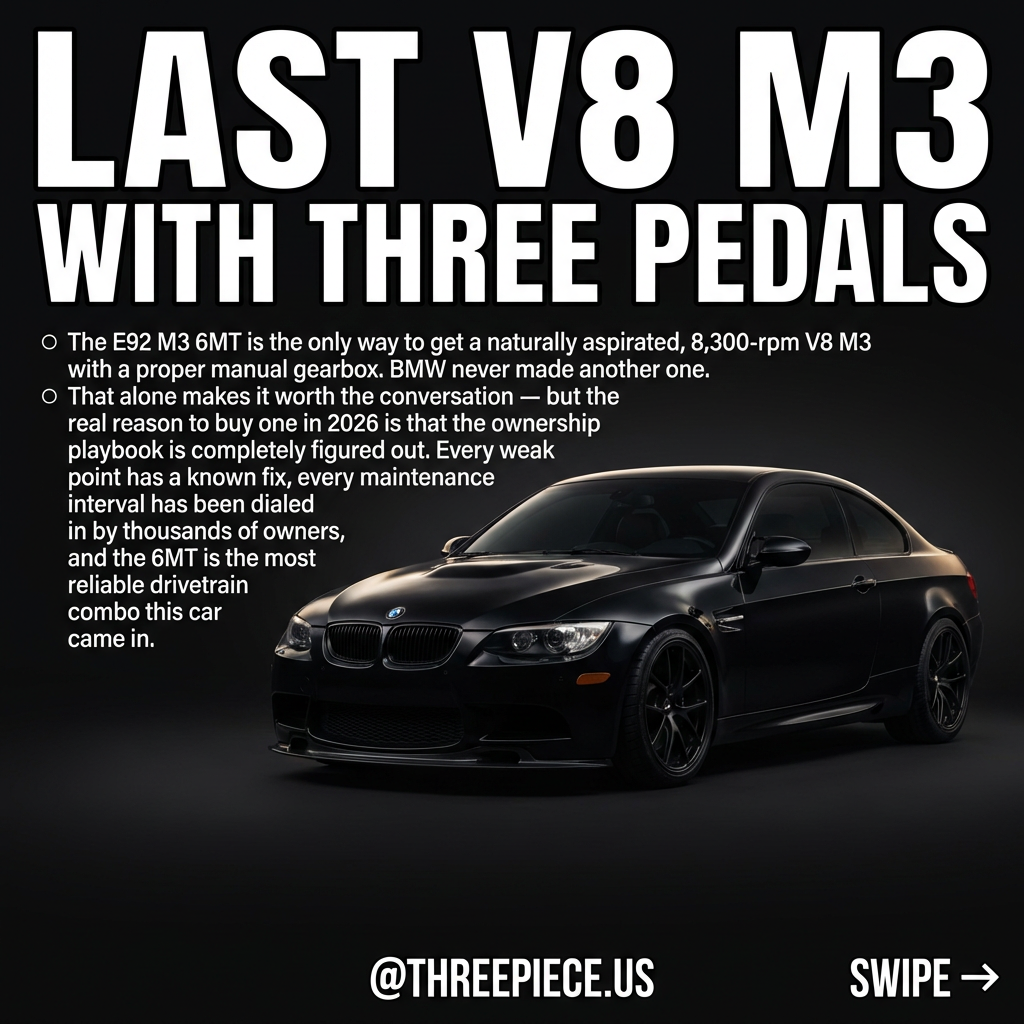
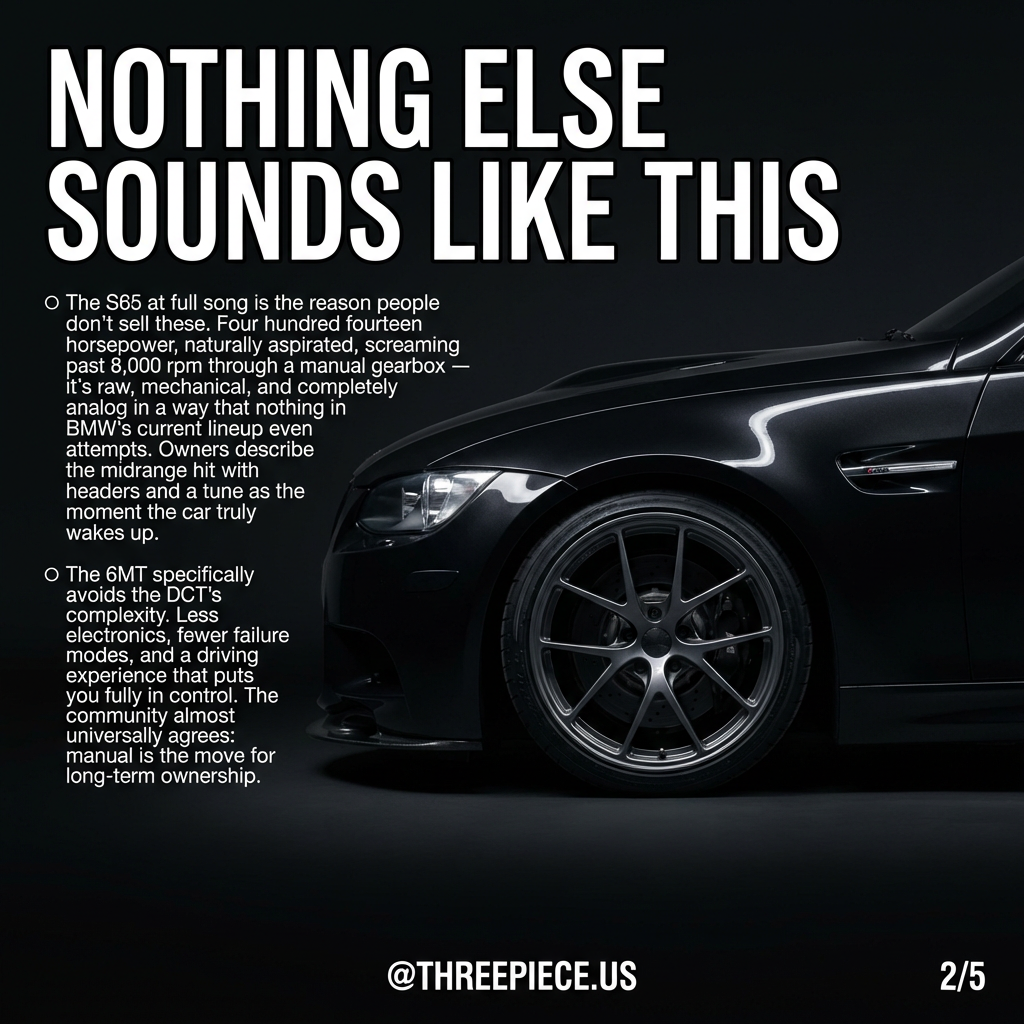
The S65B40 is a 4.0-liter naturally aspirated V8 with individual throttle bodies, a flat-plane-inspired firing order, and a redline that BMW's current turbocharged M cars can't touch. Owners describe the midrange hit with headers and a tune as the moment the car truly wakes up — the factory exhaust is restrained, but the engine's mechanical voice is genuinely special once you let it breathe. This isn't marketing hyperbole. The S65 shares its DNA with the S85 V10 from the E60 M5, scaled down and refined. It's the last M engine built purely around high-RPM naturally aspirated performance.
For context on how BMW's performance engines have evolved since, our E90 335i N55 buying guide covers the turbocharged side of BMW's lineup from the same era. The N55 is a great engine, but it's a fundamentally different experience — torque-focused, smooth, and quiet where the S65 is raw, mechanical, and screaming. If you want the analog experience, the S65 is the one.
Rod Bearings: The Big One
Every E92 M3 conversation starts and ends here, so let's get specific. The S65's rod bearings are its documented weak link. Early cars (2008–2009) shipped with softer copper-lead bearings that wore faster. Later production years (2010–2011+) received King tin-aluminum bearings with better wear characteristics, but they still develop clearance issues over time. Failure typically occurs between 50,000 and 100,000 miles, though some early cars have shown wear as low as 30,000 miles.
The symptoms are often nonexistent until it's too late — sudden ticking, loss of oil pressure, metallic debris in the oil filter, and then catastrophic engine failure. That's why the community treats this as a preventative maintenance item, not a repair. A rod bearing job using BE or ACL Race bearings with ARP rod bolts runs $2,500–$5,500 depending on the shop and whether you bundle other work. If the engine has already suffered rod knock, you're looking at a full rebuild or replacement in the $20,000–$30,000 range.
The non-negotiable buying rule: if the car is over 60,000 miles and the rod bearings haven't been done, treat the cost of that job as part of the purchase price. Demand receipts with part numbers. Shops that specialize in S65 work — VAC Motorsports, Lang Racing, RK Autowerks — are well-documented in the community. This job is completely solved. The only risk is ignoring it. If you want to understand how high-revving engines compare across platforms, our Boss 302 S197 buying guide covers Ford's approach to the same problem with the Roadrunner V8.
Every Other Known Fix, Documented
Beyond rod bearings, the E92 M3's failure points are well-mapped and none of them are mysteries in 2026:
- Main bearing wear — Less discussed than rods, but increasingly documented on high-mileage and track-driven cars. The #1 main shell tends to show wear around 80,000–120,000 miles. Many owners now do mains alongside rods as a preventative package. Budget $3,000–$7,000 if machine work is needed.
- Valve cover gaskets — The S65's magnesium valve covers degrade over time. Gaskets typically leak around 60,000–90,000 miles. Oil pools on coil packs and spark plugs. A full job with new covers and hardware runs $1,000–$3,400 depending on the shop. Smart owners bundle this with the rod bearing job to save labor hours.
- Twin-disc clutch — The 6MT's OEM twin-disc setup wears around 40,000–60,000 miles depending on driving style. Symptoms include slipping, chattering, and a vague pedal feel. OEM parts cost $1,200–$1,500; total job runs $2,000–$3,000 at a specialist. If the dual-mass flywheel is worn, cost goes up.
- Steering rack seals — Seals degrade with age and exposure to road salt. Expect leaks around 70,000–100,000+ miles. Rack rebuild or replacement runs $1,500–$2,500.
- Electrical and auxiliary items — Spark plugs every 60,000–70,000 miles, coil packs, throttle actuators, cooling system refresh. None of these are unusual for a high-performance German V8 with 12+ years on it. They're all documented with OEM part numbers and known costs.
The key insight is that nothing on this list is a surprise anymore. One long-term owner documented 140,000 miles on a 6MT replacing only gaskets, plugs, coils, and motor mounts. The platform rewards proactive maintenance and punishes deferred service — exactly like the Infiniti G37 Sport 6MT, another naturally aspirated manual from this era that's aging gracefully with the right owner.
What to Budget Beyond the Purchase Price
Here's the real math on owning an E92 M3 6MT in 2026. Clean examples with maintenance history are trading between $25,000 and $35,000 depending on color, options, mileage, and whether the big-ticket items have been addressed. If rod bearings are undone, negotiate $3,000–$5,000 off the asking price and plan to do them immediately.
A comprehensive "year one" refresh on a car that hasn't had preventative work looks like this:
- Rod bearings (BE/ACL Race + ARP bolts): $2,500–$5,500
- Valve cover gaskets + covers: $1,000–$3,400
- Cooling system refresh (water pump, thermostat, hoses): $800–$1,500
- Throttle actuators (if original): $500–$1,200
- Spark plugs + coils: $300–$600
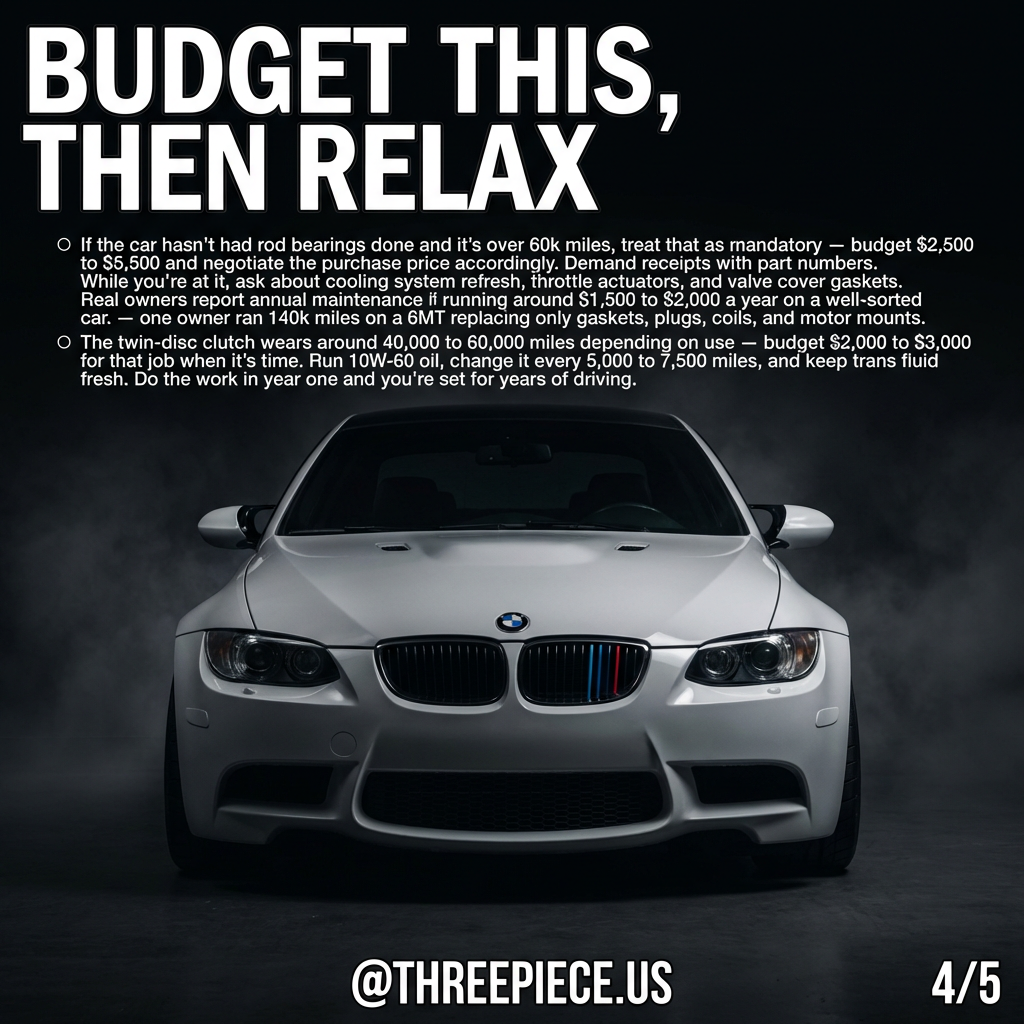
Total year-one budget on top of purchase: $5,000–$8,000 for a comprehensive refresh. After that, real owners report annual maintenance running $1,500–$2,000 on a well-sorted car. Run 10W-60 oil, change it every 5,000–7,500 miles, and keep transmission fluid fresh. This is not a cheap car to own, but the costs are completely predictable — and that's the entire advantage of buying a platform this mature.
Tuning and Exhaust — The Mature Path
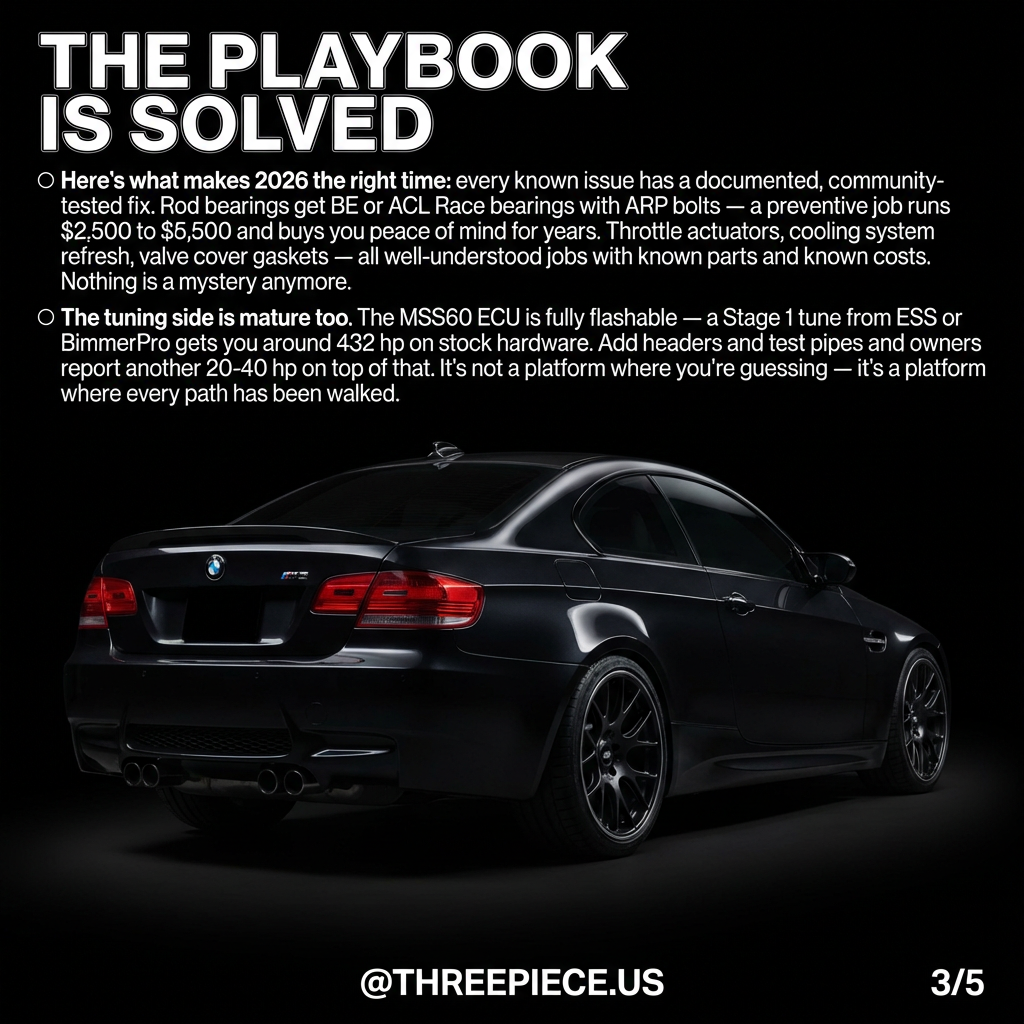
The S65's MSS60 ECU is fully flashable, and the tuning ecosystem is completely mature. A Stage 1 tune from ESS or BimmerPro gets you approximately 432 horsepower on stock hardware — that's a meaningful bump with zero reliability trade-off. Add headers and test pipes and owners consistently report another 20–40 horsepower on top of that, plus the exhaust note transforms from restrained to visceral.
If you're going the exhaust route on a serious build, the Akrapovic Evolution Line for the E92/E93 M3 at $7,819.76 is the benchmark titanium system — full catted, massive weight savings, and a sound that's become iconic in S65 build threads. It's not cheap, but it's the endgame exhaust for this platform. The tuning side is not a platform where you're guessing — every combination of headers, tune, and exhaust has been dyno'd and documented by the community.
For broader context on how naturally aspirated V8 tuning compares to forced induction platforms, our breakdown of where Ford's Coyote 5.0 wins and fails is worth reading. The S65 doesn't make big power numbers with bolt-ons the way a turbo car does, but the character of the power delivery is the entire point.
Wheels and Fitment for the E92 M3
The E92 M3 runs a 5x120 bolt pattern with a 72.56mm hub bore. Factory Competition Package cars came on 19x8.5 ET29 front / 19x9.5 ET28 rear with 245/35R19 and 265/35R19 tires. That staggered setup is the baseline, and the aftermarket has explored every variation from there.
The most popular community-proven fitments for a street/track car:
- 18x9 +22 front / 18x10 +25 rear — ideal for track use, lighter unsprung weight, better tire selection in 18"
- 19x9 +22 front / 19x10.5 +25 rear — fills the fenders aggressively, great for street builds
Browse 18" wheels in 5x120 or 19" wheels in 5x120 to see what's available. If you're running a staggered setup, our guide on cast vs forged wheels is essential reading — on a car with the E92's curb weight (3,704 lbs), the unsprung weight savings from forged wheels are genuinely felt. The Work Emotion series and Work Meister line are both proven on this platform.
For a deeper dive into why multi-piece wheels make sense on a build like this, read our 3-piece wheels explained breakdown. And if you're building a set, valve stems and center caps are the finishing details that matter. Our vehicle gallery has real-world examples of builds on proper fitment.
Pair your wheels with the right rubber — 245/35R19 tires up front and 265/35R19 tires out back match the factory stagger. For 18" track setups, search 265/35R18 tires for the rear.
Stop Waiting — Go Buy One
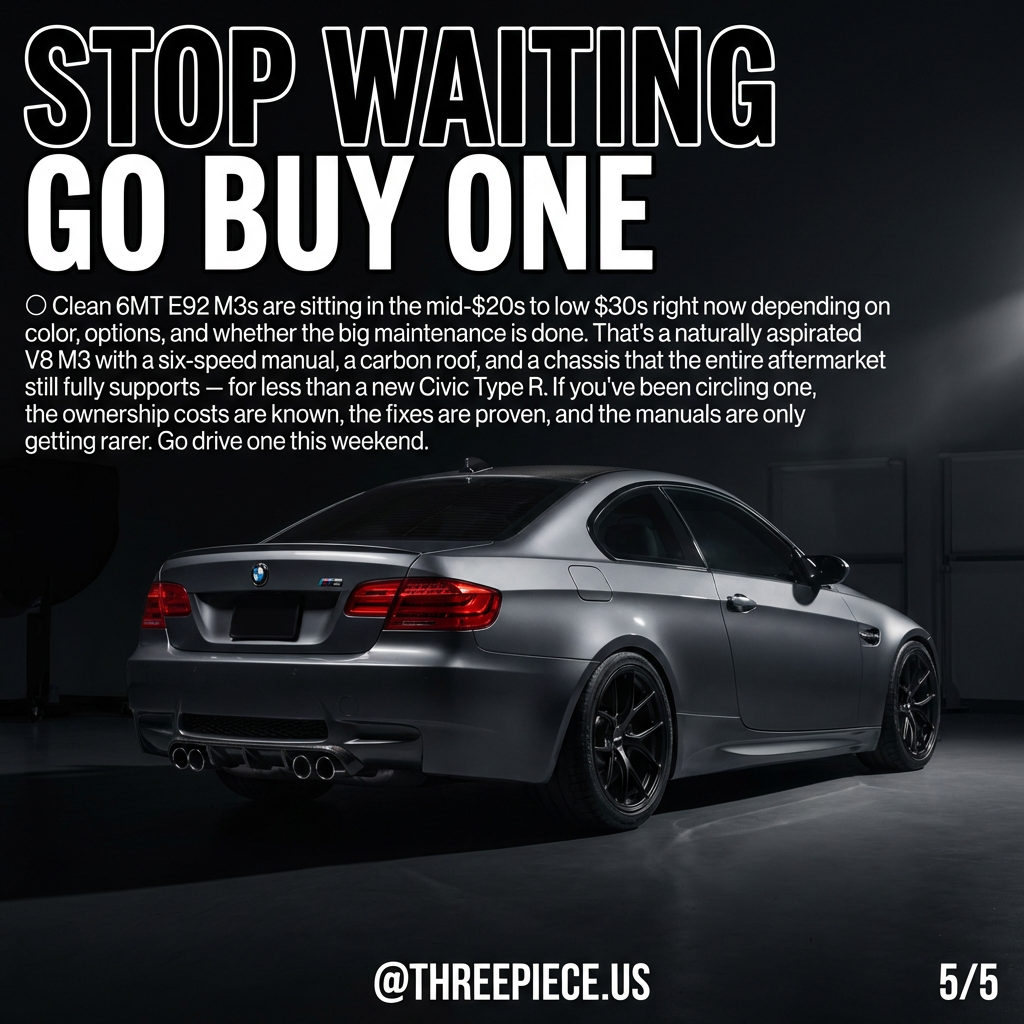
The E92 M3 6MT is a naturally aspirated V8 with a six-speed manual, a carbon roof, and a chassis that the entire aftermarket still fully supports — for less than a loaded Civic Type R. The ownership costs are known. The fixes are proven. The manuals are only getting rarer. Every quarter that passes, clean 6MT coupes get harder to find, and the ones with documented maintenance histories command stronger premiums.
If you've been circling one for years, 2026 is the year the math still works. Budget $5,000–$8,000 on top of the purchase price for a comprehensive refresh, follow the maintenance playbook, and you'll have a car that rewards you for years. Once you've got the mechanicals sorted, pair it with the right build — check our E92 M3 Competition 6MT build guide for the complete S65 mod order from intake to suspension. Then go drive one this weekend.