Half the wheels marketed as "forged" aren't actually forged. Brands throw around terms like "rotary forged," "flow forged," and "spin forged" as if they're interchangeable — they're not. If you're spending serious money on forged wheels, you need to understand exactly what that word means, what it doesn't, and how to tell the difference before you hand over your credit card. This is the only breakdown you need.
Quick links
- What "forged" actually means
- Why grain structure matters for performance
- How forged wheels fail vs cast wheels
- The marketing traps you need to avoid
- One-piece vs multi-piece forged wheels
- When forged wheels are actually worth it
What "Forged" Actually Means
A true forged wheel starts as a solid billet of 6061-T6 aluminum. That billet gets heated and compressed under a forging press — often 8,000 to 12,000+ tons of force — which reshapes the metal at a molecular level. The extreme pressure compresses the aluminum's internal grain structure, eliminating the tiny voids and air pockets that naturally occur in cast metal. After forging, the blank goes through extensive CNC machining — turning, milling, drilling — to carve out the final spoke design, center bore, and lip profile.
Compare that to a cast wheel, which is made by pouring molten aluminum into a mold and letting it cool. Casting is cheaper and faster, but it produces a coarser grain structure with inherent porosity. That's not an opinion — it's basic metallurgy. The difference in internal material quality is why forged wheels cost what they cost, and why the knockoff terminology exists in the first place. If you're curious about how different wheel construction tiers stack up in practice, our breakdown of Volk Racing's history from workshop to Le Mans shows what happens when a manufacturer commits fully to forged construction at the highest level.
Why Grain Structure Matters for Performance
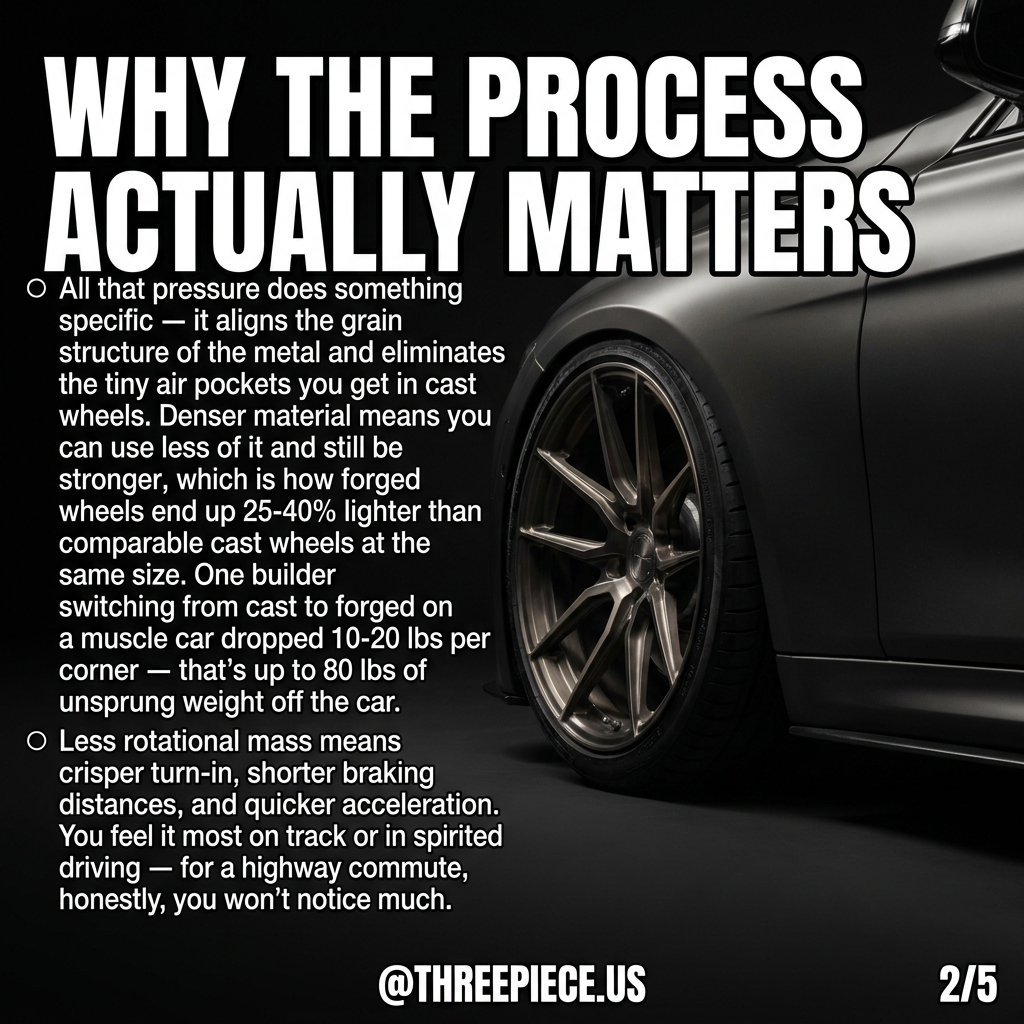
All that pressure does something specific — it aligns the aluminum's grain structure and eliminates the micro-voids you get in casting. Denser, more uniform material means you can use less of it while maintaining higher strength. That's how forged wheels end up 25–40% lighter than comparable cast wheels at the same diameter and width. Real-world builders switching from cast to forged on muscle cars and track builds regularly report dropping 10–20 lbs per corner — that's up to 80 lbs of unsprung weight removed from the car.
Unsprung weight is everything the suspension has to manage: wheels, tires, brake components, hubs. Reducing it sharpens turn-in response, shortens braking distances, and improves acceleration. You feel the difference most on track or during spirited driving. For a highway commute, honestly, you won't notice much. But if you're building a car for performance — whether it's an E46 M3 track build or a 370Z with a real mod order — forged wheels are one of the single most impactful upgrades you can bolt on. The weight savings compound with every other modification: lighter wheels mean your coilovers work more effectively, your brakes last longer, and your tires wear more evenly.
How Forged Wheels Fail vs Cast Wheels
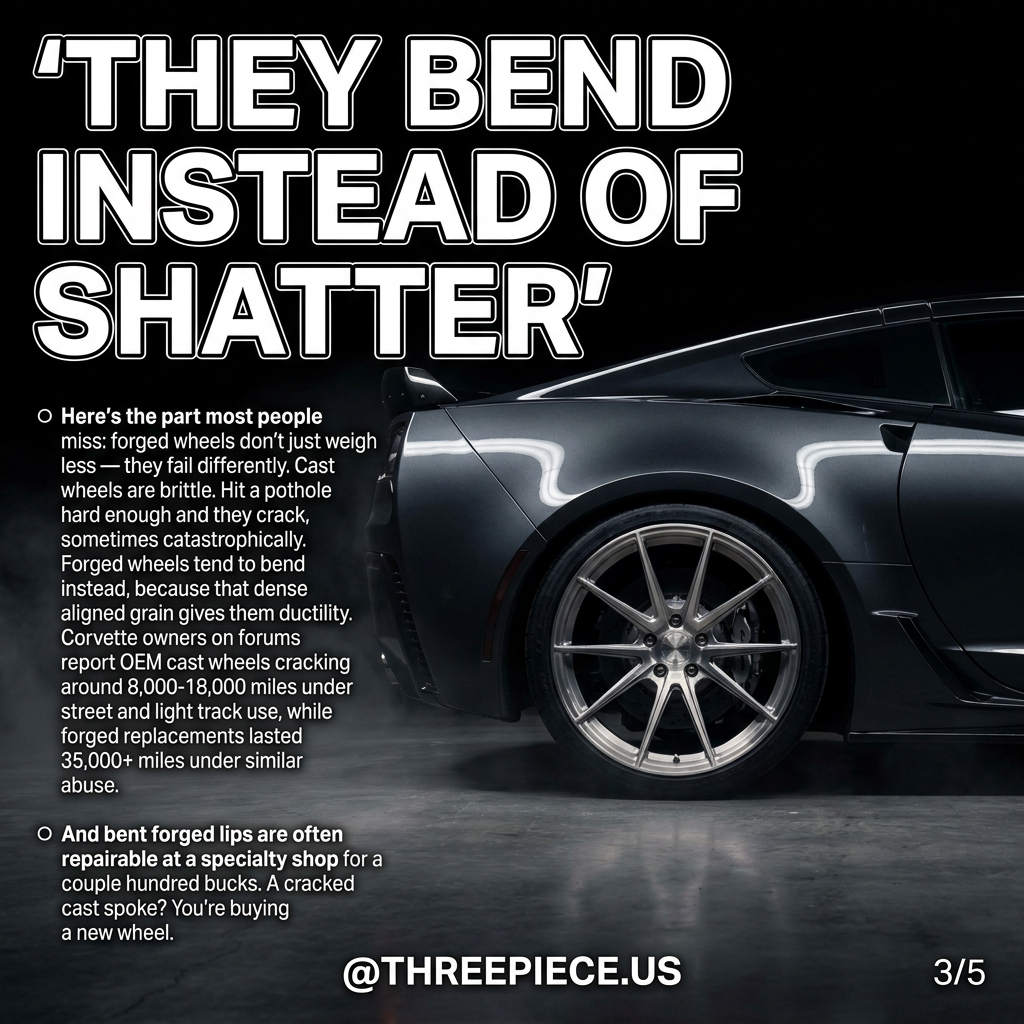
Here's the part most people miss: forged wheels don't just weigh less — they fail differently. Cast wheels are brittle. Hit a pothole hard enough and they crack, sometimes catastrophically, sending chunks of aluminum into your fender liner. Forged wheels tend to bend instead of shatter because that dense, aligned grain gives the metal ductility. Corvette owners on forums report OEM cast wheels cracking around 8,000–18,000 miles under street and light track use, while forged replacements lasted 35,000+ miles under similar abuse — documented across multiple C6 and C7 builds. If you're running a Corvette, our C6 Corvette wheel fitment guide covers the exact sizing to avoid clearance issues.
The repairability factor is massive. A bent forged lip can often be straightened at a specialty shop for a couple hundred dollars — especially on a 3-piece wheel where the lip is a separate component that can be replaced entirely. A cracked cast spoke? You're buying a new wheel. For 3-piece owners, replacement Work wheel halves, BBS lips and barrels, and SSR replacement parts mean you can rebuild a damaged wheel instead of scrapping it. That's a structural advantage of multi-piece forged construction that monoblock cast wheels simply can't match.
The Marketing Traps You Need to Avoid
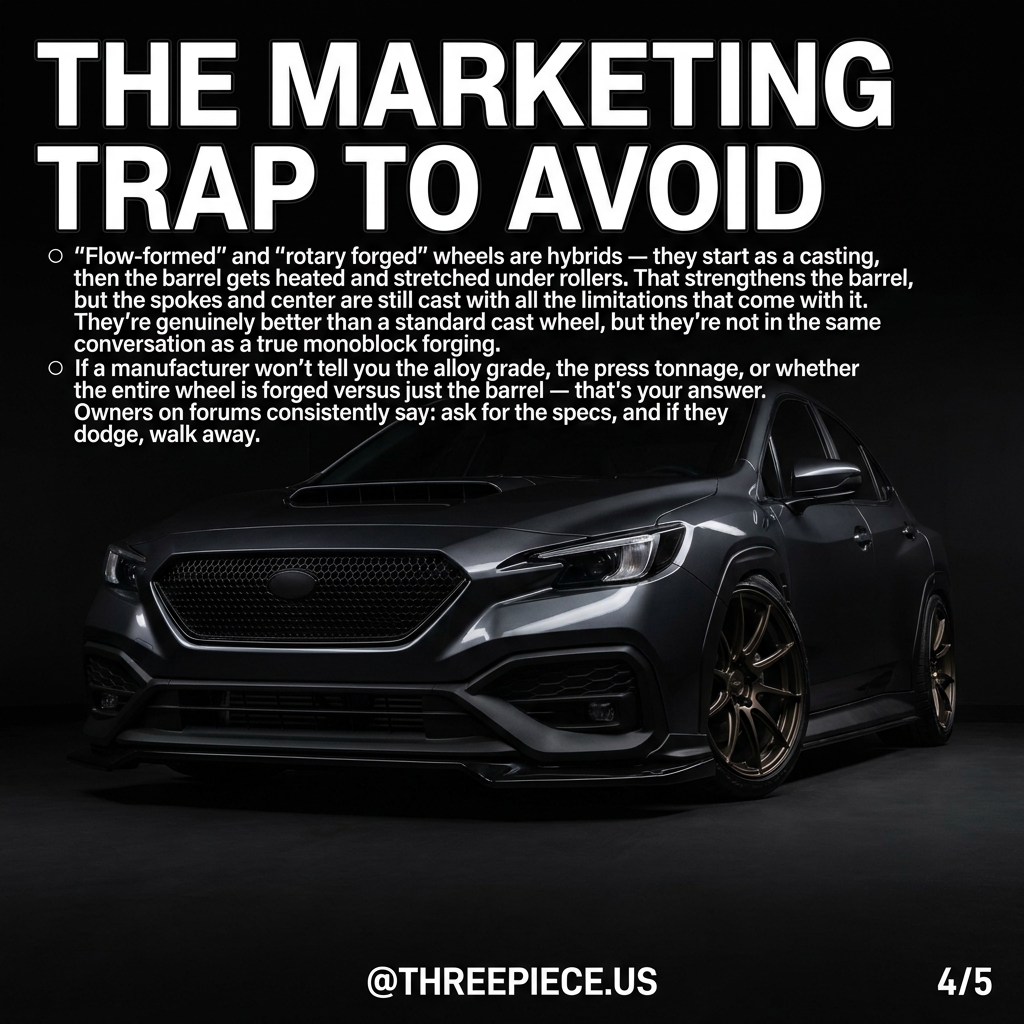
"Flow-formed" and "rotary forged" wheels are hybrids — they start as a casting, then the barrel section gets heated and stretched under rollers. That spinning process strengthens and thins the barrel, improving its grain structure compared to a standard cast barrel. But here's what the marketing doesn't tell you: the spokes and center hub are still cast with all the porosity and brittleness that comes with it. The weakest part of the wheel — the spoke — gets zero benefit from the flow-forming process.
Flow-formed wheels are genuinely better than standard cast wheels. They're a solid middle ground for budget-conscious builds. But they are not in the same conversation as a true monoblock or multi-piece forging where the entire wheel — center, spokes, and barrel — has been forged under massive pressure. One Forgestar owner on the Corvette forums discovered their "fully forged" wheels were actually rotary forged — lighter than cast OEM, sure, but nowhere near the strength or weight of a true forging.
The red flags are consistent: if a manufacturer won't tell you the alloy grade (look for 6061-T6 minimum), the press tonnage, or whether the entire wheel is forged versus just the barrel — that's your answer. Owners on forums consistently say the same thing: ask for the specs, and if they dodge the question, walk away. Certifications matter too — look for JWL and VIA stamps on Japanese wheels, or TÜV certification on European ones. Brands like Work Wheels and Weds Kranze publish their specs openly because they have nothing to hide.
One-Piece vs Multi-Piece Forged Wheels
Forged wheels come in two main configurations: monoblock (one-piece) and multi-piece (2-piece or 3-piece). A monoblock forged wheel is machined from a single forged billet — no seams, no bolts, no separate components. It's the lightest and stiffest option because there's no hardware weight and no potential for air leaks at seams. OEM performance wheels from Porsche, Ferrari, and BMW M division are typically monoblock forgings.
A 3-piece forged wheel separates the center disc, inner barrel, and outer lip into individual forged components that are assembled with hardware. This construction allows for infinite customization — you can specify exact widths, offsets, lip depths, and finishes that a monoblock can't offer. It also means individual components can be refinished or replaced without scrapping the entire wheel. That's why the 3-piece format dominates the high-end aftermarket scene, from Work VS series to Work Meister to Work Equip lineups.
The assembly hardware itself matters more than most people realize. Proper assembly bolts — like the M7x32 Socket Cap Assembly Bolt in Chrome at $10 or the M8x32 Socket Cap Assembly Bolt in Satin Black at $10 — are torqued to spec and sealed to prevent air loss. Cheap knockoff hardware is one of the fastest ways to ruin a legitimate 3-piece wheel. If you're building or rebuilding a set, M7 Assembly Nuts at $3.80 and M8 Assembly Nuts at $3.80 are the correct replacement parts — don't substitute generic hardware.
When Forged Wheels Are Actually Worth It
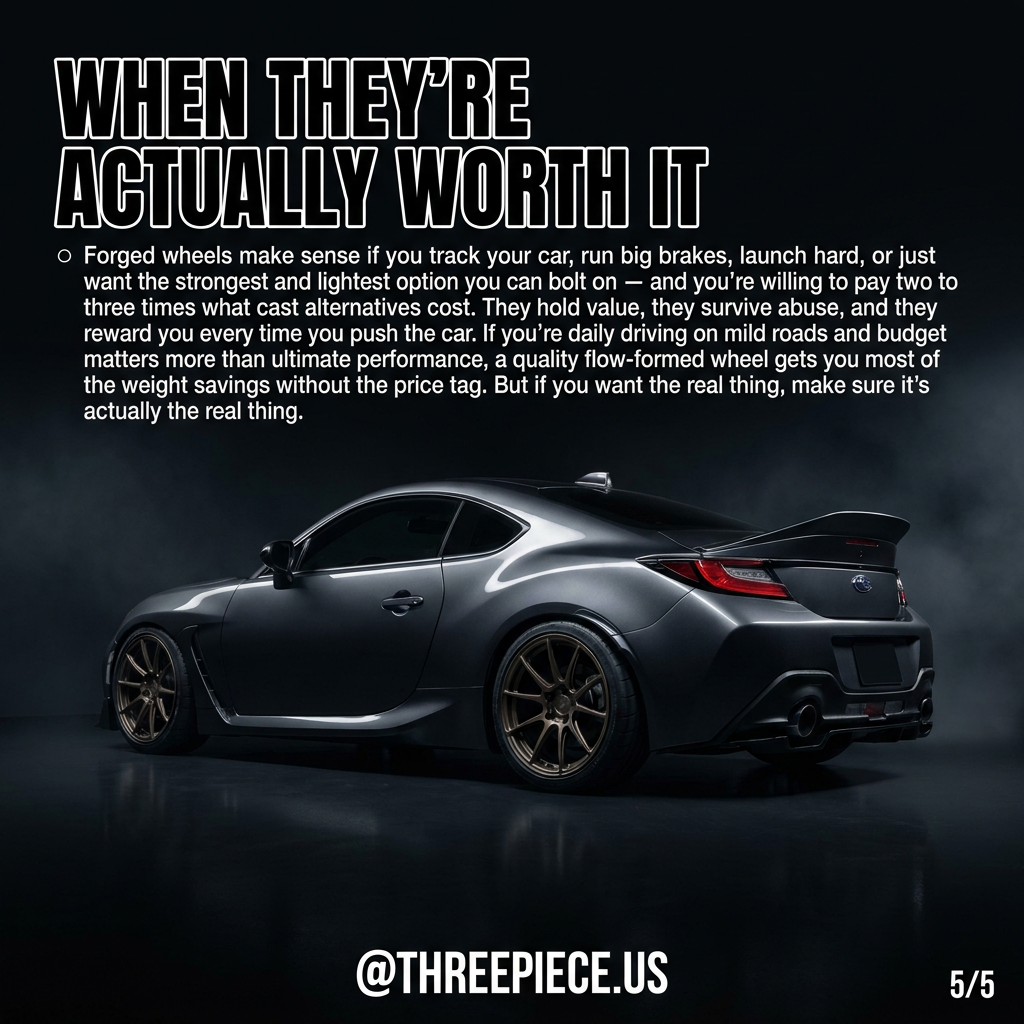
Forged wheels make sense if you track your car, run big brakes that need spoke clearance, launch hard, or simply want the strongest and lightest option you can bolt on — and you're willing to pay two to three times what cast alternatives cost. A quality set of forged 18" wheels might run $3,000–$6,000+ depending on brand and construction, versus $800–$1,500 for comparable cast options. That premium buys you measurable weight savings, dramatically better failure characteristics, superior resale value, and a wheel that rewards you every time you push the car.
If you're daily driving on mild roads and budget matters more than ultimate performance, a quality flow-formed wheel gets you most of the barrel weight savings without the price tag. But if you want the real thing, make sure it's actually the real thing. Browse the full wheel catalog at ThreePiece.us to see what genuine forged construction looks like across brands like Work Emotion and Heritage Wheel. Check our vehicle gallery for real builds running real forged setups. And if you're already running a 3-piece set that needs love, our refinishing services can bring them back to factory condition.
Finish the details right — a Work VS Reproduction Center Cap at $50 or Work Rezax Reproduction Center Cap at $50 completes the look on a freshly built set. Pair them with 90 Degree Valve Stems at $3.80 for proper fitment behind deep-dish lips. The small hardware is what separates a finished build from one that looks like it's still in progress.