

Hub-Centric vs Lug-Centric Wheels: What Actually Centers Your Wheel
Hub-centric vs lug-centric mounting is one of the most misunderstood concepts in aftermarket wheel fitment — and it's the reason you're chasing a vibration that no amount of rebalancing will ever fix. Your lug nuts aren't centering your wheels. They never were. They clamp. That's it. If you're running aftermarket wheels without understanding how your wheel is actually located on the hub, you're putting stress on hardware that wasn't designed for it and wondering why the steering shakes at 70 mph.

Quick links
- What hub-centric actually means
- The lug-centric problem
- Where the weight actually goes
- Hub-centric rings: the $20 fix
- How to install aftermarket wheels correctly
- Always run hub-centric
What hub-centric actually means
On a hub-centric setup, the wheel's center bore — the big round hole in the middle — is machined to match the vehicle's hub diameter exactly. When you slide the wheel onto the hub, it drops over the raised hub "boss" and is perfectly centered before you ever pick up a lug wrench. The hub locates the wheel concentrically. The lug nuts then clamp the wheel flat against the hub face, applying even clamping force. That's their only job.
OEM wheels are almost always hub-centric. The factory knows the exact hub diameter — 56.1mm for most Hondas, 66.6mm for many BMWs, 73.1mm for a lot of GM trucks — and machines the center bore to match. This is why your stock wheels feel perfectly smooth at highway speed even after years of service. The centering is mechanical, not dependent on how carefully someone tightened five lug nuts. If you're shopping for wheels for a specific platform, our fitment guides like the 370Z wheel fitment guide or the F80 M3 fitment guide always list the correct hub bore alongside bolt pattern and offset.
The lug-centric problem
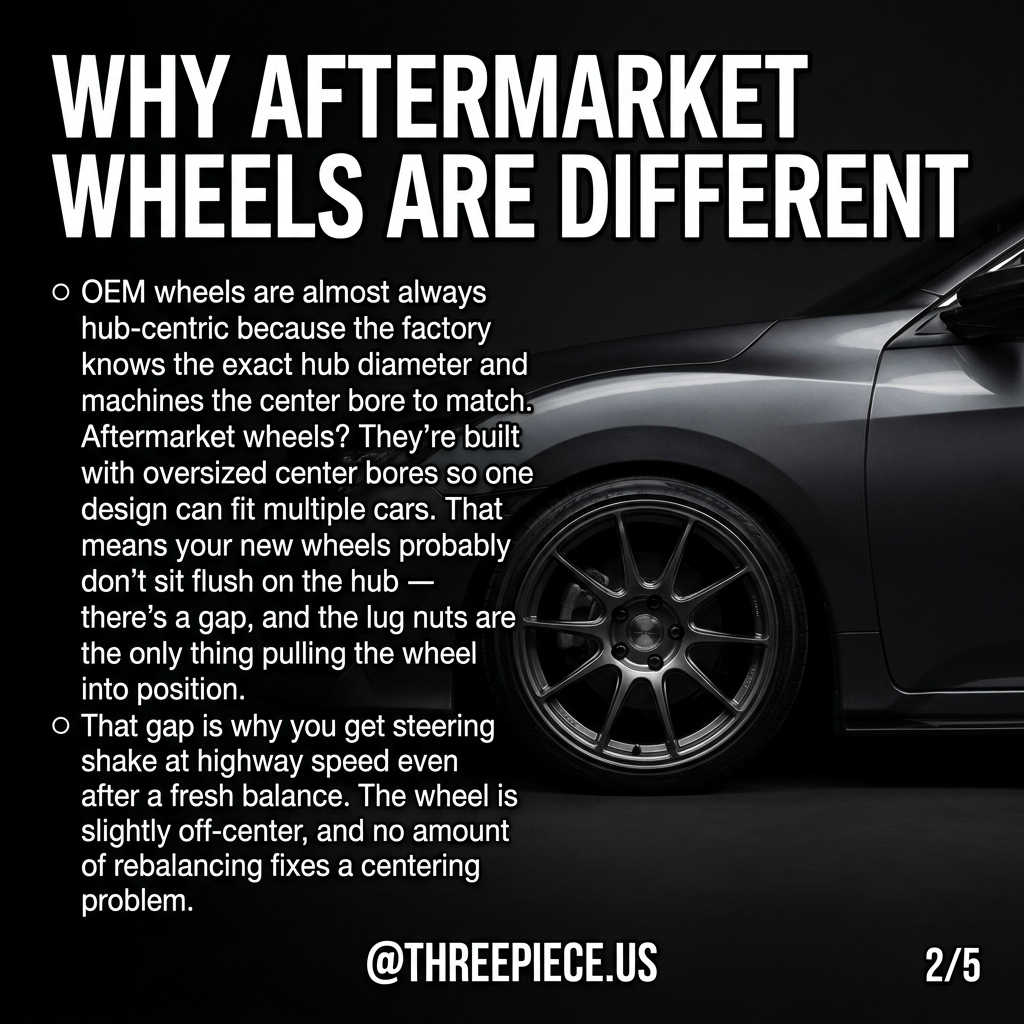
Aftermarket wheels are built to fit multiple vehicles. A wheel designed for 5x114.3 bolt pattern might need to fit an Infiniti Q50 (66.1mm hub), a Nissan 370Z (66.1mm), a Honda Civic Type R (64.1mm), and a Mazda Miata (54.1mm). The only way one center bore works across all of those is to make it bigger than any of them — often 73.1mm or larger. That means there's a gap between the wheel bore and your hub, and the wheel is now "lug-centric."
In a lug-centric setup, the lug nuts are doing double duty: centering the wheel and clamping it. The conical or radius seat on the lug nut pulls the wheel into position as you tighten. If you get it perfectly right — correct torque, star pattern, clean hub face — the wheel can end up centered. But "can" and "will" are different things. A fraction of a millimeter off-center creates an imbalance that no tire shop can spin out, because the problem isn't weight distribution — it's the wheel's rotational axis not aligning with the hub's axis. You'll feel it as a steering vibration between 50-70 mph that appears even after a fresh balance.
This is the phantom vibration that wrecks forum threads. Guys swap tires, rebalance three times, check ball joints, and replace tie rods — when the real issue is a center bore gap that costs almost nothing to fix. If you've ever wondered why your Q50 Red Sport or Civic Type R developed a shake after fitting aftermarket wheels, this is almost certainly why.
Where the weight actually goes
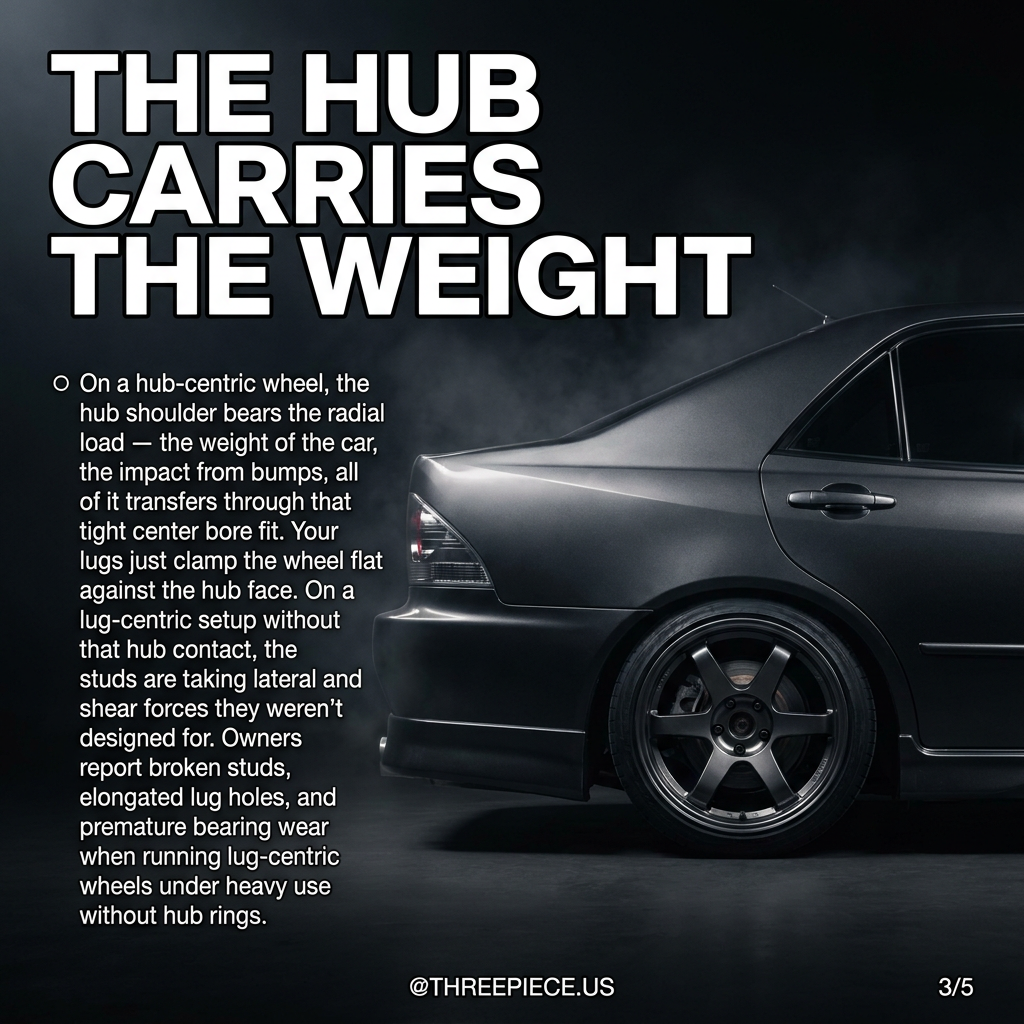
This is the part most explanations skip. On a hub-centric wheel, the hub shoulder bears the radial load — the weight of the car, the impact from every bump, every pothole, every hard corner. That tight center bore fit transfers force directly through the hub face into the bearing and knuckle. Your lugs clamp the wheel against the hub face with axial force. They resist the wheel pulling away from the hub. They do not resist the wheel sliding laterally on the hub — the hub bore fit does that.
On a lug-centric setup without hub contact, the studs and lug seats are taking lateral and shear forces they weren't engineered for. Wheel studs are designed for tension (clamping) and some shear, but not as primary centering devices under dynamic load. Owners on build forums report broken studs, elongated lug holes in the wheel, and premature wheel bearing wear when running lug-centric wheels under heavy use — track days, aggressive driving, heavy vehicles — without hub rings. The studs flex microscopically under load, the wheel shifts slightly, and over thousands of cycles, hardware fatigues.
If you're running forged wheels or expensive 3-piece assemblies, the last thing you want is lug hole elongation from improper mounting. A set of Work Wheels or Weds Kranze wheels deserves proper hub-centric mounting — not just for safety, but to protect the investment.
Hub-centric rings: the $20 fix
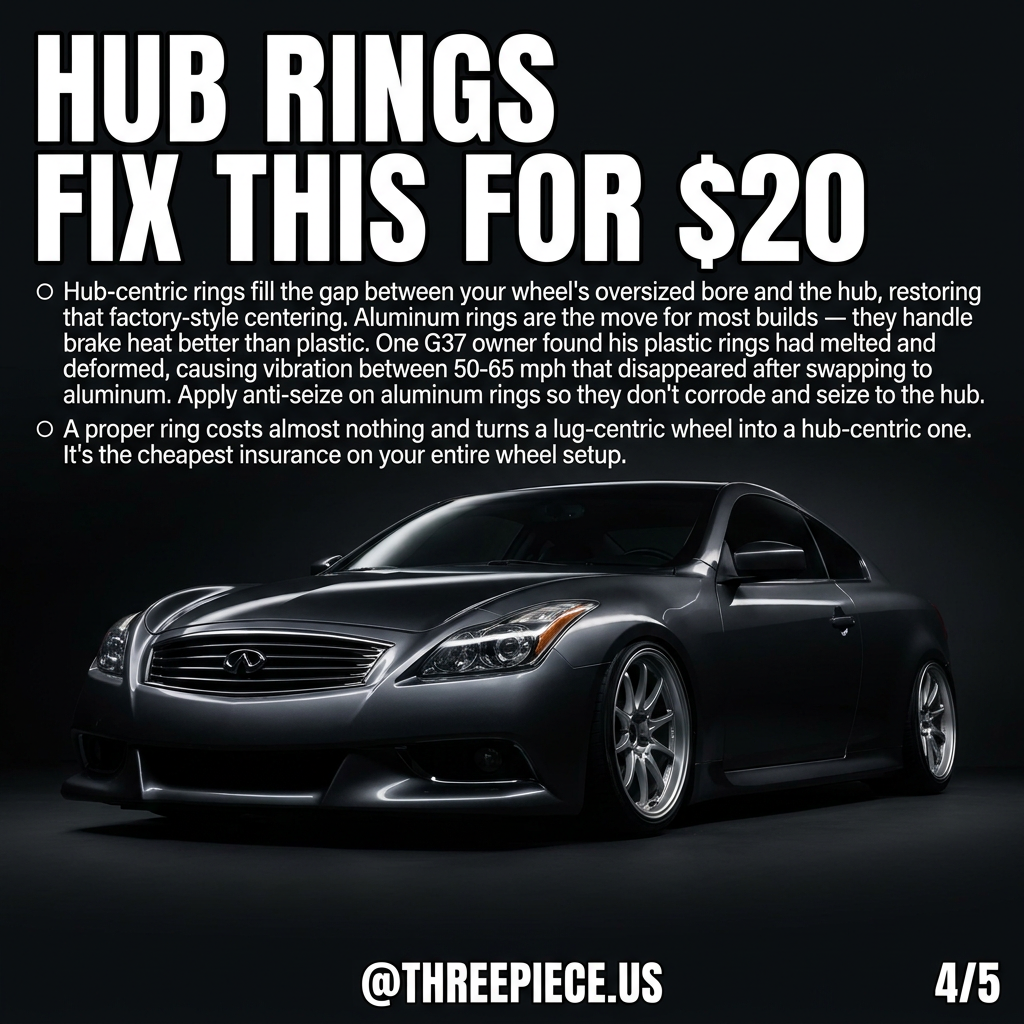
Hub-centric rings (also called spigot rings) are simple spacers that fill the gap between the wheel's oversized center bore and your vehicle's hub. They restore factory-style hub-centric mounting to any aftermarket wheel. A set of four typically costs $15-$30 — browse our hub-centric rings to find the exact size for your setup. You need to know two numbers: your wheel's center bore and your vehicle's hub diameter. The ring's outer diameter matches the wheel bore; the inner diameter matches the hub.
Aluminum vs. plastic: This one isn't even close. Aluminum rings handle brake heat significantly better. One well-documented case from a G37 owner on MyG37 forums showed plastic hub rings that had melted and deformed from brake heat, causing vibration between 50-65 mph that disappeared immediately after swapping to aluminum. Plastic rings are cheaper and corrosion-immune, but they can crack after repeated heat cycles or deform under sustained high temperatures — especially on cars with big brakes or track use.
Aluminum rings are the move for any serious build. The one caveat: apply anti-seize compound on the hub contact surface before installation. Aluminum-to-steel contact creates the conditions for galvanic corrosion, and without anti-seize, the ring can seize to the hub and become a nightmare to remove at tire rotation. A thin coat prevents this entirely.
How to install aftermarket wheels correctly
Whether your wheels are hub-centric out of the box or you're using hub rings, proper installation matters. Here's the process that eliminates 90% of post-install vibration complaints:
1. Clean the hub face. Wire brush off any rust, dirt, or old paint from the hub mating surface. A contaminated hub face prevents the wheel from sitting flat, which introduces run-out even on a hub-centric setup. This is the single most overlooked step.
2. Verify lug seat compatibility. Aftermarket wheels often require different lug nuts than OEM. Most Japanese OEM lugs use a conical (60°) seat, while many European cars use radius (ball) seat bolts. Using the wrong seat type means the lug isn't contacting the wheel properly, which compromises clamping force and centering. Check our lug nut selection to make sure you're running the correct hardware for your wheel's seat type.
3. Install hub-centric rings first. Slide the ring onto the hub, then mount the wheel over it. The wheel should drop over the ring snugly. If you can wobble the wheel side-to-side before tightening, the ring isn't the right size.
4. Torque in stages, star pattern. Hand-tighten all lugs first. Then torque to approximately 50% of final spec in a star pattern. Then final torque to manufacturer spec — typically 80-100 ft-lbs for most passenger cars, but always verify for your vehicle. This staged approach ensures even clamping and prevents the wheel from tilting during tightening.
5. Re-torque after 50-100 miles. Lug nuts can settle after initial driving. A quick re-torque check prevents the slow loosening that causes intermittent vibrations weeks after install.
If you're assembling or rebuilding 3-piece wheels, proper hardware matters just as much at the wheel level. The M7x32 assembly bolts at $10 each or M8x32 assembly bolts at $10 each keep your wheel halves sealed and secure. Pair them with silicone sealant at $10.99 to prevent leaks on reassembly.

Always run hub-centric
This isn't a preference or a "depends on your use case" situation. Hub-centric mounting is how every OEM does it, and it's how you should do it with aftermarket wheels. If your wheel's center bore doesn't match your hub diameter — and on aftermarket wheels, it almost never does — you need hub-centric rings. They cost less than a single tire balance, and they solve the vibration problem that no balance will ever fix.
Grab a set of aluminum hub-centric rings sized for your vehicle, apply anti-seize, torque your lugs properly, and move on. Your studs will thank you, your bearings will thank you, and you'll stop chasing a phantom vibration that was never a balance issue in the first place.
If you're building a wheel setup from scratch — whether it's Work Equip mesh wheels, Work VS series, or a full custom 3-piece build with custom reverse lips starting at $399 — hub-centric mounting is the foundation everything else sits on. Get it right first. Check our vehicle gallery for build inspiration, and browse the full wheel catalog when you're ready to build.