
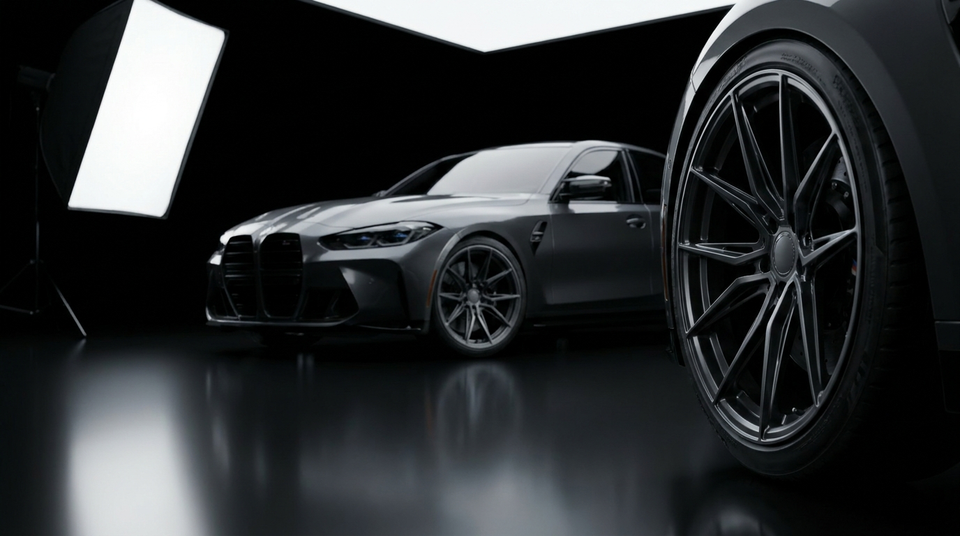
BMW G80 M3 Wheel & Tire Guide: Fitment, Sizing, and the Best Upgrades
The G80 M3's wide-body shell is one of the most fitment-friendly platforms BMW has built in years. Those flared fenders — 80 mm wider up front and 70 mm wider out back than a standard G20 3 Series — exist specifically to accommodate serious rubber. If you're running stock wheels on this car, you're leaving stance and grip on the table.
---
Quick Navigation
- Quick Answer
- Key Takeaways
- Stock Wheel and Tire Specs
- Recommended Aftermarket Sizing
- Top Wheel Picks for the G80 M3
- Tire Recommendations
- Suspension and Its Effect on Fitment
- Staggered vs. Square Fitment
- Bottom Line
Quick Answer
The G80 M3 Competition leaves the factory on 19x9.5 ET22 fronts and 19x10.5 ET18 rears with Michelin Pilot Sport 4S tires. Most owners move to 20-inch fitment for aesthetics without sacrificing handling. The wide fenders give you real flexibility on offset, but getting backspacing right — especially over upgraded brakes — still requires platform-specific knowledge.
---
Key Takeaways
- Stock fitment is staggered: 275/35R19 front, 285/35R19 rear
- The wide-body fenders accommodate 20-inch wheels without aggressive camber correction
- RWD cars benefit from staggered setups; xDrive cars can run square fitment more easily
- Michelin Pilot Sport 4S is the OEM benchmark — still the right tire for most owners
- BBS CI-R and LM, HRE FlowForm FF01/FF15, and Forgeline GA1R are the community's top wheel picks
- Carbon ceramic brake upgrade (6-piston, 410 mm rotors) changes your clearance math — verify before ordering
---
Stock Wheel and Tire Specs
The G80 M3 Competition runs a staggered factory setup:
- Front: 19x9.5 ET22
- Rear: 19x10.5 ET18
- Front tire: 275/35R19
- Rear tire: 285/35R19
- OEM tire: Michelin Pilot Sport 4S
The staggered configuration is tuned for RWD handling balance — more rubber out back supports the rear-biased torque delivery. xDrive Competition cars can run square setups more naturally because the AWD system distributes load across all four corners.
The M3's wider track versus the standard G20 — 80 mm front, 70 mm rear — means the M3 uses its own bumpers, fenders, and body panels. That extra width is what makes aggressive aftermarket fitment achievable without pulling fenders or running extreme negative camber.
---
Recommended Aftermarket Sizing
For a more aggressive stance without compromising handling geometry:
- Front: 19x9.5 or 20x9.5, ET25–35
- Rear: 19x11 or 20x11, ET15–25
Moving to 20-inch diameter is the most common upgrade in the G80 community. The wide fenders absorb the visual mass of a 20-inch wheel well, and the fitment math works without forcing camber adjustments that accelerate tire wear. Going wider on the rear — up to 11 inches — fills the arch properly and supports the wider tire contact patch that the RWD drivetrain rewards.
One critical variable: if your car has the M Carbon Ceramic Package, you're running 6-piston front calipers on 410 mm rotors instead of the standard 4-piston setup on 380 mm rotors. That's a meaningfully larger caliper body. Verify brake clearance against your specific wheel choice before purchasing — a wheel that clears standard iron brakes may not clear the ceramic package calipers.
---
Top Wheel Picks for the G80 M3
The G80 community has converged on a short list of wheels that balance weight, fitment precision, and aesthetics for this platform:
- BBS CI-R and LM:** The classic BMW enthusiast choice. Forged construction, lightweight, available in G80-specific fitment configurations. Price range: $3,500–$6,000 per set depending on size and finish.
- HRE FlowForm FF01 / FF15:** Flow-formed construction hits a strong value-to-quality ratio. Lighter than cast, less expensive than full forged. Approximately $2,000–$3,000 per set.
- Forgeline GA1R:** American-made forged monoblock. Excellent build quality, strong fitment support for the G80 platform. Approximately $3,500–$5,000 per set.
- Vossen HF-Series:** Popular in the G80 community for a more aggressive aesthetic at a mid-range price point. Good quality, wide finish selection.
ThreePiece.us maintains G80-specific fitment data and can cross-reference wheel specs against your exact build — stock suspension versus coilovers, RWD versus xDrive, standard brakes versus the ceramic package. The offset and backspacing tolerances on the G80 are workable, but the variables stack up fast when you're combining a wider rear, a lowered ride height, and an upgraded brake package.
---
Tire Recommendations

Michelin Pilot Sport 4S — the OEM fitment — remains the benchmark for street-driven M3s. It performs at a high level in both wet and dry conditions, and the 275/35R19 rear is approximately $250–$300 per tire. If it's good enough for BMW M GmbH to spec from the factory, it's good enough for a street car.
For track-focused use:
- Michelin Pilot Sport Cup 2 / Cup 2 R:** Dramatically better dry grip than the PS4S. Meaningfully reduced wet weather capability — this is a track tire that tolerates street use, not a street tire that tolerates track use.
- Continental ExtremeContact Sport 02:** Strong value alternative to the PS4S. Approximately $180–$220 per tire in rear sizing. Competitive dry grip, good wet performance.
RWD Competition owners running the car hard should budget for rear tire replacement at 10,000–15,000 miles under aggressive use. At $250–$300 per PS4S rear, that's $500–$600 per rear pair — a real line item in the ownership cost.
---
Suspension and Its Effect on Fitment
The factory adaptive M suspension on Competition models sets a reasonable baseline, but lowering the car changes your fitment clearances and your available offset range.
H&R Sport Springs drop the G80 approximately 20–25 mm while retaining the factory adaptive dampers. At approximately $250–$350, this is the lowest-cost way to tighten up the stance. A 20–25 mm drop narrows your safe offset window slightly at the front — factor this in if you're also moving to a wider front wheel.
KW Suspensions V3 Coilovers (part number 35220098)** are the most commonly recommended full coilover upgrade for the G80. At approximately $2,200–$2,800, they allow precise ride height adjustment, which means you can dial in exactly how much clearance you're working with before finalizing wheel and tire selection. Running coilovers at aggressive drop with a wide, low-offset rear wheel requires careful fitment verification — the combination of reduced arch clearance and increased wheel width is where rubbing problems originate.
Bilstein B16 is a solid alternative at approximately $1,800–$2,200 with similar adjustability.
---
Staggered vs. Square Fitment
The factory staggered setup exists for a reason on RWD cars: a wider rear contact patch supports the rear-biased power delivery and improves rotation balance. Running a square setup on a RWD M3 is possible but works against the car's engineered handling balance.
On xDrive Competition cars, square fitment makes more sense. The AWD system distributes torque across all four wheels, reducing the rear-specific loading that makes staggered setups advantageous on RWD. Square fitment also allows tire rotation, which extends tire life — a practical consideration given PS4S rear pricing.
If you're building a dedicated track setup with a second wheel-and-tire package, a square fitment on 19-inch wheels with Cup 2 R tires is a common approach. The 19-inch diameter keeps sidewall height reasonable for track use, and the square setup simplifies rotation between sessions.
---
Bottom Line
The G80 M3's wide-body platform is purpose-built for serious wheel and tire fitment. The factory 19x9.5/10.5 staggered setup with Michelin Pilot Sport 4S is a strong baseline, but the car's fender clearance supports 20-inch fitment and wider rear sizing without the compromises you'd make on a narrower platform. Get the offset right — especially if you're running the ceramic brake package or coilovers — and this car rewards the investment in proper wheels more visibly than almost anything else in the segment.
Buy the BBS or HRE if budget allows. Run PS4S for the street. Verify your brake clearance before you order. And use a fitment specialist who has G80-specific data, not generic offset calculators.