

Genesis Coupe vs 350Z: Which Budget Coupe to Buy in 2026
The Hyundai Genesis Coupe vs Nissan 350Z debate comes down to one question: do you want the faster car or the better-feeling car? The BK2 3.8 Genesis Coupe makes 348 hp stock and walks a base DE 350Z in a straight line. But owners who've driven both — on forums, on back roads, at track days — keep saying the same thing: the Genesis is quicker, the Z is more fun. That gap tells you everything about this decision, and it's worth unpacking before you hand someone cash for either one.

Quick links
- The Z Feels Alive — Why Driving Experience Matters
- Power and Tuning Ceiling: Genesis Wins on Paper
- Reliability: Both Bite You Differently
- Wheel Fitment for Both Platforms
- Which One Should You Actually Buy?
The Z Feels Alive — Why Driving Experience Matters
The 350Z has a shorter wheelbase, a lighter front end, and more steering feedback than the Genesis Coupe at any price point. Owners describe it as tighter, more willing, more engaged on back roads. The Z corners like a car that wants you to push it — the chassis talks to you through the steering wheel in a way the Genesis simply doesn't replicate.
The Genesis feels more planted at highway speed, which makes it a better grand tourer. But in tight stuff — canyon roads, autocross courses, technical circuits — owners consistently call it floaty compared to the Z. Some of that is the longer wheelbase, some is the softer factory damping, and some is just the way Hyundai tuned the electric power steering. It's not bad. It's just not the same conversation.
That's the core trade: the 350Z is a sports car that happens to have a street registration. The Genesis Coupe is a GT that happens to be rear-wheel drive. If you've read our BK2 Genesis Coupe 3.8 buying guide, you already know the platform's strengths lean toward comfort and straight-line speed rather than raw driver engagement. The 350Z shares its DNA with the Infiniti G35, and that FM platform has been proven at every level of motorsport from grassroots drift events to professional Formula D.

Power and Tuning Ceiling: Genesis Wins on Paper
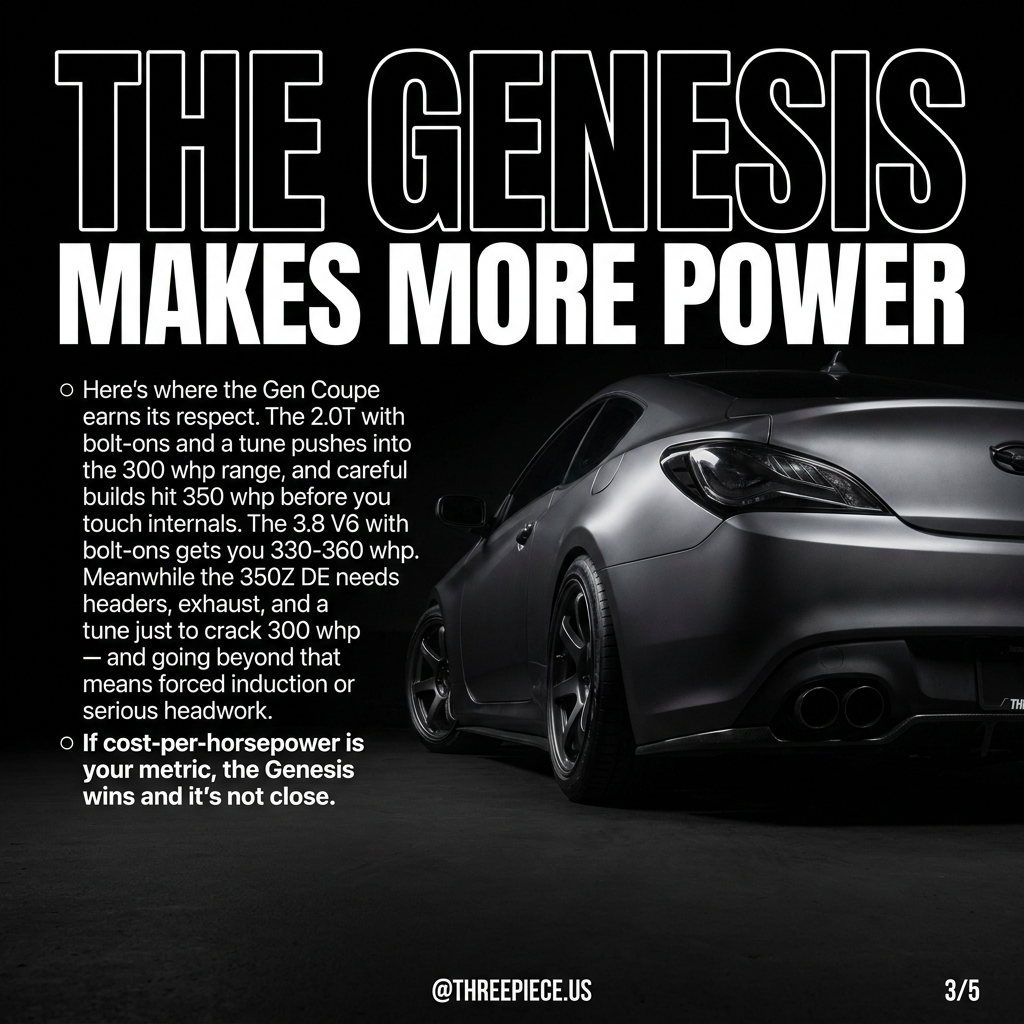
Here's where the Gen Coupe earns its respect. The 2.0T with bolt-ons and a tune pushes into the 270-310 whp range, and careful builds hit 350 whp before you touch internals. The 3.8 V6 with bolt-ons gets you 330-360 whp. Meanwhile the 350Z DE needs headers, exhaust, and a tune just to crack 300 whp — and going beyond that means forced induction or serious headwork.
If cost-per-horsepower is your metric, the Genesis wins and it's not close. The 2.0T especially rewards bolt-on spending because the turbo platform responds to simple upgrades — a quality downpipe, an intake, an intercooler, and a proper dyno tune can transform the car. For the 2.0T specifically, the Injen SS Exhaust with 76mm Y-Pipe for the 2010-2013 Genesis Coupe 2.0T at $1,919 is a serious piece that opens up real flow gains on a tuned car.
The 350Z's naturally aspirated VQ35 is a different animal. You're chasing incremental gains — long-tube headers, high-flow cats, full exhaust, and a tune might net you 30-40 whp over stock. The Invidia High Flow Cat for 2002-2006 350Z at $1,087 is one of the best-documented upgrades for the DE motor, and it pairs well with a full exhaust for meaningful gains. But to hit 400+ whp on the Z, you're looking at a turbo kit or supercharger — and at that point, you're spending more than the car is worth.
One critical note on the Genesis 2.0T: pushing beyond 350 whp without upgrading internals is risky. The stock rods are the weak point, especially under heavy torque low in the rev range. Bad tunes have wrecked more than a few Theta II engines. If you're building one, make sure your air-fuel ratios are dialed in on a proper dyno tune — not a flash from the internet.
Reliability: Both Bite You Differently
Neither of these is a Corolla. Both have documented failure modes that will cost you real money if you ignore them. But the nature of their problems is completely different.
Nissan 350Z Known Issues
- Synchro wear on early manuals (2003-2005): Grinding in 2nd and 3rd gear, especially on downshifts. Well-documented fix, but budget $1,000-1,500 for a rebuild.
- Oil consumption on VQ35DE/HR: Valve cover gasket leaks, PCV issues, sometimes piston ring wear. Owners report topping off oil between changes. An oil catch can like the Mishimoto PCV-Side kit for 2007-2009 350Z at $580 is a smart preventive move — read our guide on why catch cans are worth it.
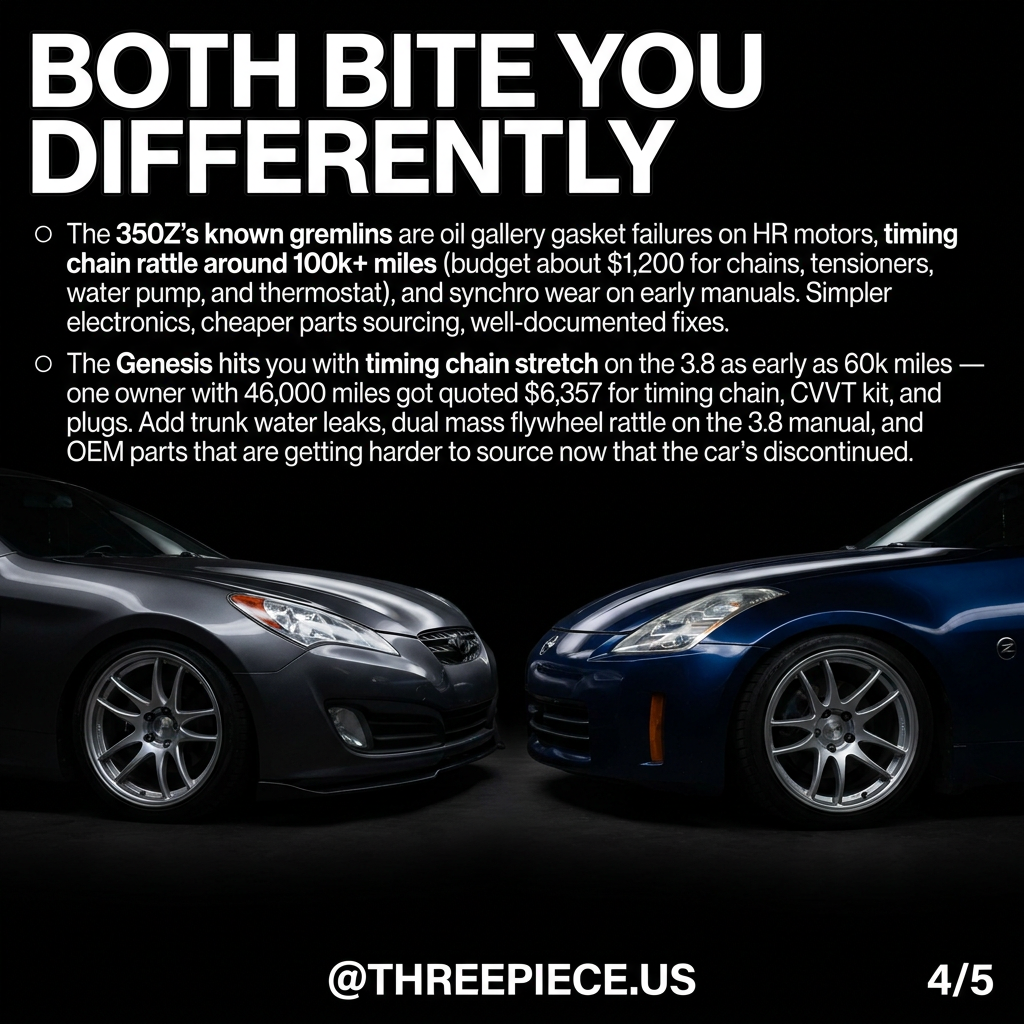
- Timing chain rattle on HR motors around 100k+ miles: Budget about $1,200 for chains, tensioners, water pump, and thermostat. Well-documented, straightforward job for an experienced shop.
- Cooling system age: On a 15-20 year old car, hoses get brittle. The Mishimoto Black Silicone Hose Kit for 2007-2009 350Z at $154 is cheap insurance against a roadside overheat.
Hyundai Genesis Coupe Known Issues
- Timing chain stretch on the 3.8 as early as 60,000 miles: This is the big one. One owner with just 46,000 miles got quoted $6,357 for timing chain, CVVT kit, and plugs. That's not a typo — that's a potential engine-out job on a car worth $12-15K.
- Dual mass flywheel rattle on 3.8 manual: Known since new. Not dangerous, but annoying. Replacements run about $1,000+ in parts alone plus labor.
- Trunk water leaks: Faulty sealing design causes water ingress behind tail lights. Can lead to rust or electrical issues if neglected. DIY fix possible; sealing parts $200-400.
- Manual synchro wear (5th/6th gear): Similar to the Z but in different gears. Rebuilding synchros costs about $1,500+.
- OEM parts sourcing: The Genesis Coupe is discontinued, and parts are getting harder to find. The 350Z's 20+ year aftermarket ecosystem means you can source virtually anything overnight.
The takeaway: the 350Z's problems are cheaper and better documented. The Genesis Coupe's problems are fewer in number but potentially more expensive — that timing chain job alone can wreck your ownership budget. For the Genesis 3.8, keeping the cooling system healthy is critical. The CSF Radiator for the 2010-2012 Genesis 3.8L at $396 is a worthwhile upgrade if you're planning to keep the car long-term or track it.
Wheel Fitment for Both Platforms
Both the 350Z and Genesis Coupe run 5x114.3 bolt patterns, which opens up one of the largest aftermarket wheel selections in the sport-compact world. That shared bolt pattern means you're shopping the same catalog — it's offset and width that separate the two.
For the 350Z, the sweet spot is a staggered setup: 18x9.5 +15 to +22 front, 18x10.5 +15 to +22 rear for an aggressive fitment with rolled fenders. A more conservative daily setup runs 18x9 +25 front, 18x10 +25 rear. Browse Vision American-Muscle 142 Legend 5x114.3 18x9.5+0 Gunmetal Machined Lip to see what's available. The 350Z also responds well to Eibach 15mm Pro-Spacers at $182 if you want to push factory wheels closer to flush without buying a new set. Our 370Z fitment guide shares enough DNA with the Z33 to be useful reference for rear fender clearance.
For the Genesis Coupe, 19x9.5 +22 front, 19x10.5 +22 rear is the popular aggressive setup on coilovers. If you're staying at 18 inches, 18x9.5 +22 square works well on both axles. Search Vision American-Muscle 142 Legend 5x114.3 18x9.5+0 Gunmetal Machined Lip for the Genesis platform.
Both cars look exceptional on 3-piece wheels — the deep lip options available through Work Wheels and Weds Kranze let you dial in exact offsets for perfect fitment. If you're running 3-piece wheels and need to rebuild or refinish them, Work replacement lips start at $399 and Work wheel halves are always in stock. For a deep dive on how forged multi-piece construction actually differs from cast, read our breakdown of what forged wheels actually are.
If you're lowering either car — and you should be — the Genesis Coupe has a direct-fit option: the F2 Function & Form Type 1 Coilovers for the 2009-2010 Genesis Coupe. Pair coilovers with proper rear camber arms to avoid chewing through tires. For inspiration on how both platforms look fully built, check the ThreePiece vehicle gallery.

Which One Should You Actually Buy?
This isn't a "both are great, pick whichever you like" situation. These cars attract completely different drivers, and buying the wrong one means you'll be selling it within a year.
Buy the 350Z if: You want the car that makes you grin on a canyon road. You want something mechanical, direct, and rewarding when driven hard. You want a platform with 20+ years of aftermarket support, cheap parts, and a community that has documented every possible failure and fix. Go find a clean 2007-2009 350Z HR with maintenance records — that's the driver's car. Budget for the BLOX Racing Thermal Shield at $111 for heat management under the hood, and you're already ahead of most Z owners.
Buy the Genesis Coupe if: You want more power per dollar, back seats, modern comforts, and a real tuning ceiling — especially on the 2.0T. The Genesis is genuinely the smarter buy for someone who wants a daily-drivable coupe that can make serious power with bolt-ons and a tune. Just budget for timing chain work early and don't skip it. If you're going the braking upgrade route, PosiQuiet 07-08 Nissan 350Z Front Ceramic Brake Pads - 105.08880 at $230 paired with PosiQuiet 07-08 Nissan 350Z Front Ceramic Brake Pads - 105.08880 at $143 are a proven combo for non-Brembo cars — and read up on why semi-metallic pads aren't always the answer.
Both of these are under-$15K coupes that punch way above their weight class. The 350Z gives you a purer driving experience with a proven platform. The Genesis Coupe gives you more car for the money with a higher power ceiling. Neither choice is wrong — but they're not interchangeable. Know what you want before you buy, and you'll keep it for years instead of months.