

Air-Fuel Ratio Explained: How AFR Works and Why It Matters
Understanding air-fuel ratio (AFR) is the single most important thing separating people who actually tune cars from people who bolt on parts and hope for the best. Whether you're datalogging a naturally aspirated Honda or chasing boost targets on a turbocharged build, AFR dictates whether your engine makes reliable power or ends up with a hole in a piston. Here's a complete breakdown of how it works, what the numbers mean, and where most enthusiasts get it wrong.

Quick links
- 14.7:1 Is Just the Starting Point
- Your Engine Runs Two Modes
- Narrowband vs. Wideband: The Sensor Makes or Breaks It
- Where Most People Get Wrecked
- Match Your Hardware to Your Targets
- How Intake Mods Affect AFR
- Final Takeaway: Know Your Numbers
14.7:1 Is Just the Starting Point
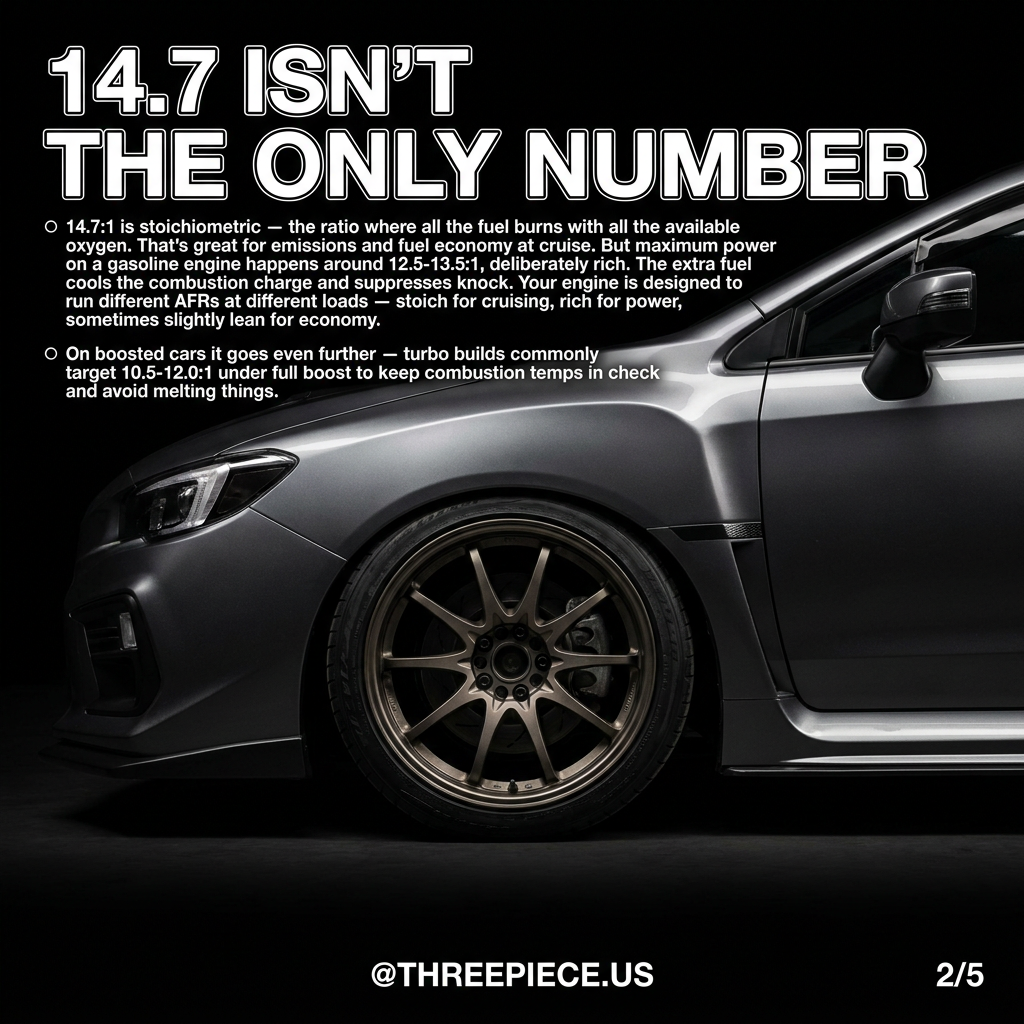
Everyone knows 14.7:1 — the stoichiometric ratio for gasoline where all available fuel burns with all available oxygen. It's the number your ECU targets during light-load cruising in closed-loop operation, and it's what the catalytic converter needs to efficiently scrub HC, CO, and NOx from the exhaust. But stoichiometric is not a power number. It's an efficiency and emissions number.
Maximum power on a naturally aspirated gasoline engine happens around 12.5–13.5:1 — deliberately rich. The extra fuel absorbs heat from the combustion charge, lowers peak cylinder temperatures, and suppresses knock. On a turbocharged build, targets go even richer: 10.5–12.0:1 under full boost is standard practice to keep exhaust gas temperatures in check and prevent component failure. Meanwhile, some engines run slightly lean — around 15–16:1 — during light-load cruise for maximum fuel economy. AFR isn't one number. It's a map that changes with every load point and RPM cell.
If you're interested in how ECU tuning interacts with these targets, our breakdown of whether an ECU tune is actually worth it covers the real-world dyno gains and what's happening behind the scenes in the fuel and ignition tables.
Your Engine Runs Two Modes
Your ECU constantly switches between two fundamental operating strategies, and understanding them is the key to understanding AFR.
Closed-loop is the default mode during cruise, idle, and part-throttle driving. The ECU reads the oxygen sensor in the exhaust, compares the actual AFR to its target (usually stoich), and adjusts injector pulse width in real time. This is the feedback loop — the ECU commands fuel, reads the result, and corrects. Fuel trims (short-term and long-term) are the ECU's running tally of how far off the base fuel map is from reality.
Open-loop kicks in under wide-open throttle (WOT) or heavy load. The ECU stops listening to the O2 sensor and instead relies entirely on its pre-programmed fuel map to deliver a richer mixture for power and safety. This is where your tune actually matters — and where sensor accuracy becomes non-negotiable, because the ECU is flying without real-time feedback.
The transition between these modes is where many tuning issues hide. If your ECU enters open-loop too early or too late, or if the enrichment targets in the open-loop map are wrong, you'll either leave power on the table or run dangerously lean. This is also why supercharger and forced-induction kits almost always require a retune — the stock open-loop map has no idea how to fuel for boost it wasn't designed to see.
Narrowband vs. Wideband: The Sensor Makes or Breaks It
The oxygen sensor is the engine's only direct measurement of combustion quality, and the type of sensor you're running determines whether you actually know what's happening inside your cylinders.
A factory narrowband O2 sensor outputs roughly 0–1V and switches sharply around stoichiometric. Above ~14.7:1 it reads low voltage (lean); below ~14.7:1 it reads high voltage (rich). That's it. It's essentially a binary switch — "richer than stoich" or "leaner than stoich." Below about 14:1, the signal saturates and just reads "full rich" with zero resolution. You cannot see whether you're at 12.5:1 or 10.5:1. For closed-loop cruise operation, this is fine. For tuning under load, it's useless.
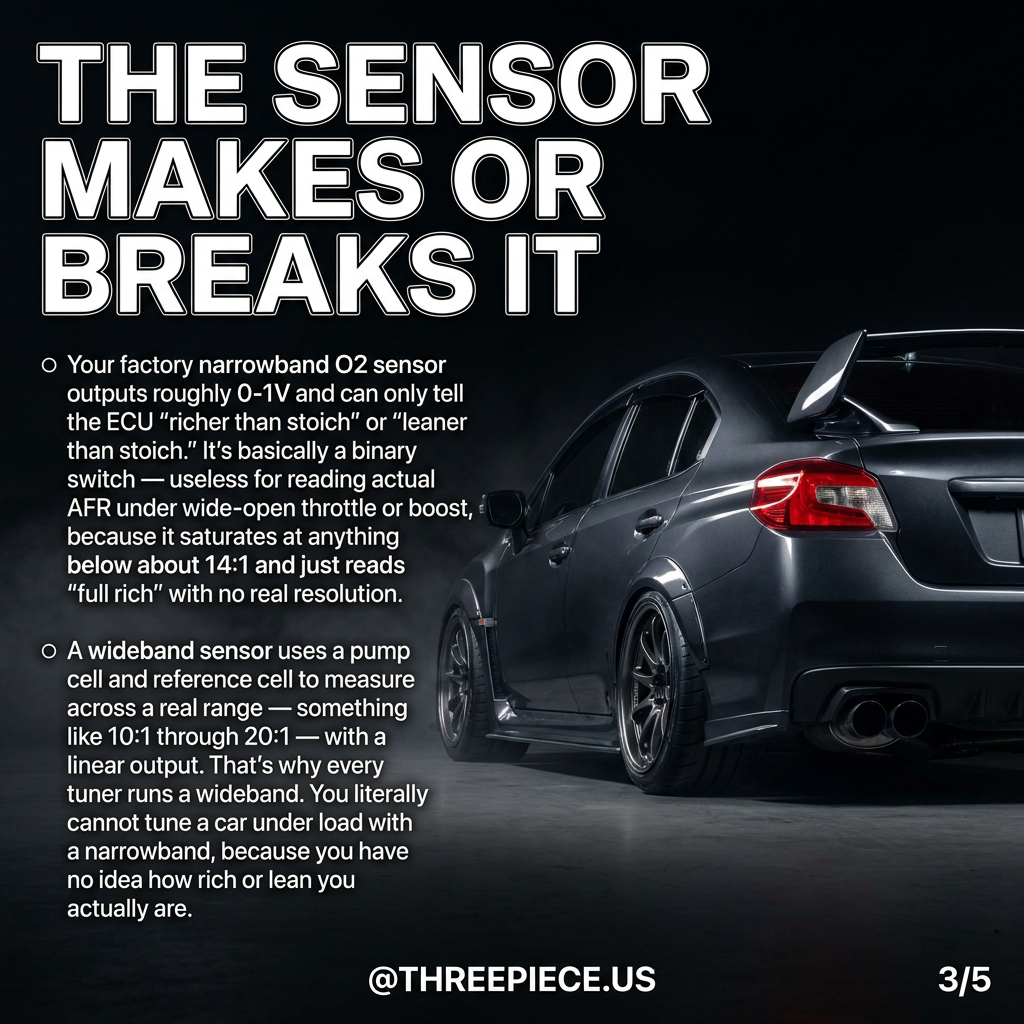
A wideband (UEGO) sensor uses a fundamentally different design: a pump cell and a Nernst reference cell. The controller drives current through the pump cell to maintain a target voltage across the reference cell. The amount of current required to maintain equilibrium directly correlates to the oxygen concentration in the exhaust — and therefore the AFR. The output is linear across a wide range, typically 10:1 through 20:1, with a 0–5V signal. This is why every serious tuner, every dyno, and every standalone ECU setup runs a wideband. You literally cannot tune a car under load without one.
OEM "air-fuel ratio sensors" on newer cars are technically widebands, but forum debates persist about whether they match the accuracy of standalone units like AEM or Innovate controllers. The OEM units often output a narrower voltage range and rely on proprietary ECU algorithms. For datalogging during a tune, a dedicated wideband gauge is still the standard.
Wideband sensors also degrade. Contamination from silicone sealants, leaded fuel residue, or excessive exhaust gas temperatures can ruin the sensing element. Owners on boosted builds report sensor accuracy dropping after 1–2 years of hard use. Mounting location matters — too close to the turbo or exhaust manifold and sustained EGTs above 900°C will cook the sensor. Free-air calibration is routine maintenance, not optional.
Where Most People Get Wrecked
The most common real-world AFR failure isn't a bad tune file — it's the fuel system running out of capacity. Your ECU can command 11.5:1 all day, but if your injectors are at 100% duty cycle or your fuel pump can't maintain rail pressure under boost, the engine goes lean regardless of what the map says. Forum owners on boosted Subarus and Evos have logged AFR spiking to 18:1 at WOT because the pump dropped pressure at high RPM. That's how pistons get holes melted through them.

The second most common mistake is unmetered air. A vacuum leak, cracked intake boot, or loose coupling after the MAF sensor lets air enter the engine without the ECU knowing about it. The ECU calculates fuel delivery based on measured airflow — if air bypasses the MAF, the mixture goes lean with no corresponding fuel correction. Symptoms show up as stumble, hesitation under load, and lean misfire codes. On a turbocharged car with silicone couplers and aftermarket piping, this is especially common. If you've ever wondered why a car feels off after an intake or intercooler piping install, unmetered air is usually the answer.
This is also why the cold air intake debate is more nuanced than most people think. A poorly sealed aftermarket intake can introduce unmetered air and wreck your AFR without throwing an obvious code. If you're going to run one, the fitment and sealing quality matter more than the filter element itself.
For boosted BMW builds specifically, charge pipe integrity is critical. A burst charge pipe under boost is an instant unmetered-air event that can send AFR dangerously lean in milliseconds. The AEM BMW 228i Turbo Intercooler Charge Pipe Kit at $416 is the kind of upgrade that prevents exactly this scenario — replacing the factory plastic pipes with aluminum before they fail under pressure.
Match Your Hardware to Your Targets
Before you touch a tune file, you need to verify that your fuel delivery hardware can actually support the AFR targets your map is calling for. This means three things:
Injectors: Calculate your required injector flow rate based on target horsepower, BSFC (brake-specific fuel consumption), and number of cylinders. Running injectors above 80% duty cycle at peak demand is asking for trouble — you lose spray pattern quality and response time. If your injectors are maxed, no amount of tuning will fix a lean condition at high load.
Fuel pump: The pump needs to maintain target rail pressure at maximum flow demand. A stock pump on a car making 50% more power than factory is a ticking time bomb. Many builds use a staged fuel system — stock pump for cruise, secondary pump activated under boost or high load.
Fuel pressure regulator: On return-style fuel systems, the regulator maintains consistent rail pressure relative to manifold pressure. A failing regulator can cause fuel pressure to drop under boost, creating a lean condition that looks identical to a pump failure in the datalog.
And critically — log everything with a wideband. Not a narrowband. Not the stock O2 sensor output. A dedicated wideband controller feeding real AFR data into your datalog. If you're building a turbocharged car, this is not optional equipment. It's the difference between a car that makes power reliably and one that ends up on a flatbed.
If you're in the build-planning phase and considering forced induction, our guide on supercharger kit costs and real gains breaks down the full picture of what supporting mods you'll need — fuel system included.
How Intake Mods Affect AFR
Every intake modification changes the volume, velocity, or temperature of air entering the engine — and all three directly affect AFR. A cold air intake that lowers intake air temperature increases air density, which means more oxygen mass per intake stroke. If the ECU's MAF calibration doesn't account for the new airflow characteristics, the mixture shifts. On most modern cars with MAF-based fueling, swapping to a larger-diameter intake pipe or a less restrictive filter changes the airflow profile the MAF sees, and the ECU adjusts fuel trims accordingly — sometimes well, sometimes poorly.
For H22A-swapped Civics — a platform that's still heavily built in the Honda community — the AEM Cold Air Intake for 96-00 Civic with H22A at $366 is designed specifically for that swap and maintains proper MAF scaling. On the RX-8, which is notoriously sensitive to intake airflow because of the rotary engine's unique breathing characteristics, the AEM RX-8 Cold Air Intake starting at $387 is one of the few aftermarket options that doesn't wreck the factory AFR calibration. If you're building an RX-8, our RX-8 wheel fitment guide covers the other side of the build.
For turbocharged platforms, the Veloster N has become a serious tuner car, and the Injen Veloster N Evolution Intake at $440 pairs well with the platform's responsive 2.0L turbo. Pair it with the Injen Veloster N Stainless Axle-Back Exhaust at $1,105 for a full intake-to-exhaust breathing upgrade — but retune afterward, because the changed exhaust backpressure will shift your AFR targets.
The Acura TL and TL-S are another platform where intake quality matters. The AEM 04-07 Acura TL/TL-S Cold Air Intake at $435 is a proper bolt-on that maintains the MAF housing diameter. If you're looking at the newer TLX Type S platform, check out our writeup on why the TLX Type S is underrated.
Final Takeaway: Know Your Numbers
AFR isn't a single number — it's a strategy that changes with every operating condition. Cruise at 14.7:1 in closed-loop. Target 12.5–13.5:1 at WOT on a naturally aspirated car. Go richer — 10.5–12.0:1 — under boost. But none of those targets mean anything if your fuel system can't deliver, your sensors can't measure, or your intake is leaking unmetered air past the MAF.
Before you tune, verify your injector duty cycle, fuel pump capacity, and pressure regulator function. Log with a wideband, not a narrowband. And if you're modifying the intake or exhaust path, understand that you're changing the variables the ECU uses to calculate fuel delivery — which means the tune needs to follow.
Building a car that actually performs means getting the fundamentals right before the flashy stuff. If you're in the middle of a build and ready to finish the exterior to match the engine work, browse the full wheel catalog or check out the vehicle gallery for build inspiration. And if you're running 3-piece wheels that need freshening up after track duty, our wheel refinishing services bring them back to spec.