Posted by THREEPIECE.US on May 10th 2026
Supercharger Kits: Real Cost, Real Gains, Honest Verdict
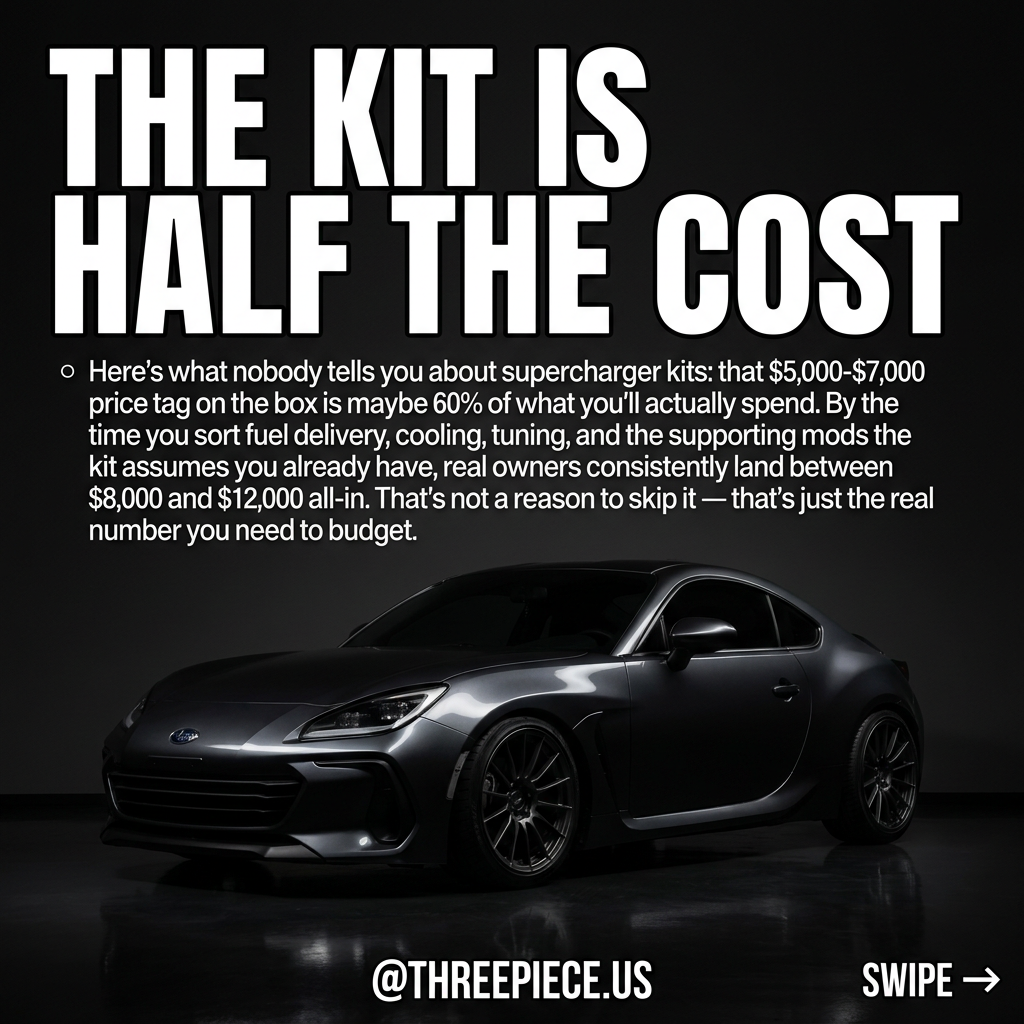
Supercharger kits are the most misunderstood performance mod in the game. That $5,000–$7,000 price tag on the box? It's roughly 60% of what you'll actually spend once you sort fuel delivery, cooling, tuning, and the supporting mods the kit assumes you already have. Real owners consistently land between $8,000 and $12,000 all-in — and the ones who budget only for the blower are the same ones parting out their builds on Facebook Marketplace six months later. Here's what the marketing won't tell you, what the forums will, and how to decide if a supercharger kit is actually worth it for your build.
Quick links
- The Real Cost Nobody Advertises
- Marketing Numbers vs. Dyno Numbers
- Supporting Mods That Separate Reliable Builds From Grenades
- Long-Term Maintenance and Failure Points
- Your Clutch and Drivetrain Are Next
- The Honest Verdict: Worth It With One Condition
The Real Cost Nobody Advertises
Every supercharger kit manufacturer has a headline price. Vortech quotes around $6,200. VMP Performance's 2024+ Mustang 5.0L Gen6 3.0L Stage 2 kit runs $10,041 — and that's before you touch supporting hardware. What the box doesn't include is what actually makes the kit work: upgraded injectors, a higher-flow fuel pump, a proper dyno tune (not the generic base map that ships in the box), spark plugs gapped for boost, and cooling that can handle repeated pulls without heat-soaking the intake charge.
Across Mustang forums, GR86 groups, and even Tacoma threads, the pattern is the same. Owners who thought they were spending $5K ended up at $8K–$12K once they did it right. That's not a reason to skip the mod — it's the real number you need in your budget before you order anything. If you've been considering an ECU tune as a first step, that's smart — but understand that a tune on a supercharged car is a completely different calibration challenge than a tune on a naturally aspirated one.
Marketing Numbers vs. Dyno Numbers
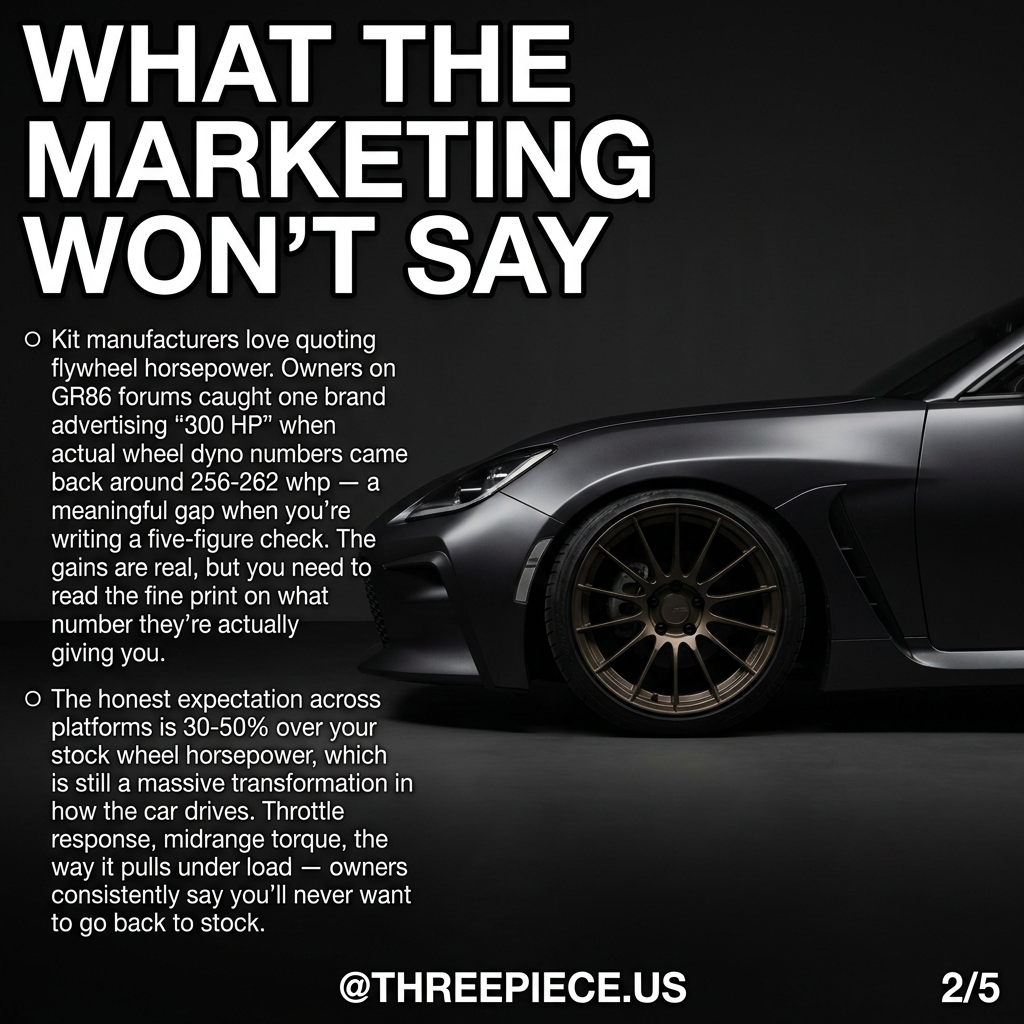
Kit manufacturers love quoting flywheel horsepower. Owners on GR86 forums caught one brand advertising "300 HP" when actual wheel dyno numbers came back around 256–262 whp — a meaningful gap when you're writing a five-figure check. A Mustang 4.6L 3-valve owner reported pushing around 430 whp / ~450 ft-lbs with a supercharger kit plus intake at roughly 7.5 psi of boost, no built bottom end. Those are real numbers from a real dyno sheet, not marketing copy.
The honest expectation across platforms is 30–50% over your stock wheel horsepower. On a GR86 making ~200 whp stock, that's 260–300 whp. On a Coyote Mustang making ~400 whp stock, that's 520–600 whp depending on boost and supporting mods. Both are massive transformations in how the car drives — throttle response, midrange torque, the way it pulls under load. Owners consistently say you'll never want to go back to stock. But you need to read the fine print on which number the manufacturer is actually giving you. If you're coming from the naturally aspirated side and wondering how bolt-ons compare, our cold air intake reality check puts those gains in perspective — spoiler, they're not even in the same universe as forced induction.
Supporting Mods That Separate Reliable Builds From Grenades
The supercharger itself is the easy part. What separates a reliable build from a teardown photo is everything around it. Here's the non-negotiable list that comes up in every long-running build thread:
- Fuel system upgrades — larger injectors, higher-flow fuel pump, and sometimes a return-style fuel system. Running lean on a base map is the number-one way builds end up wrecked.
- ECU tuning on a dyno — not the generic flash tune that ships with the kit. A conservative tune on quality fuel with proper fueling keeps stock bottom ends alive for 30,000+ miles. A Tacoma owner ran a Magnuson kit to 200,000 miles on premium fuel with no major issues. The difference is always in the calibration, not the blower.
- Cooling — larger radiator, upgraded intercooler (or adding one if the kit doesn't include it), and sometimes an oil cooler. Heat soak under repeated pulls is a constant complaint on forums.
- Spark plugs — colder heat range, gapped for boost. This is a $40 mod people skip and then wonder why they're getting knock.
For the Mustang crowd, components like the VMP Performance 5.0L TVS 3.1" 6-Rib Pulley at $157 and the VMP 2018+ Roush TVS 2.8" 6-Rib Pulley at $158 are the kind of precision parts that let you dial in boost levels properly. The VMP Low-Vacuum By-Pass Valve for Eaton superchargers at $218 is another commonly overlooked piece — especially if you're running aftermarket cams, the stock bypass valve can't keep up and you'll get surge and odd idle behavior. And if you're running a Shelby GT500 or Coyote platform, the VMP Boost-Lok Supercharger Gasket Seal at $88 prevents the boost leaks that quietly rob you of power and make your tune inconsistent.
Long-Term Maintenance and Failure Points
Beyond the build cost, you're signing up for maintenance most bolt-on guys aren't used to. Supercharger oil changes, belt and coupler inspections, and eventually bearing or rebuild work are all part of ownership. SC rebuild kits run $700+ DIY. If a pulley or nose cone fails, one Hellcat owner paid $4,700 for parts and labor on that single repair — and that's a platform where the supercharger is factory equipment, not aftermarket.
The recurring failure modes from forums are predictable: supercharger bearing failure (especially after changing the pulley for higher boost), belt slipping under high-load pulls, bypass valve failure causing surge or power loss, and heat soak degrading performance on back-to-back runs. Hellcat owners who swapped to smaller pulleys for more boost without upgrading the clutch mechanism on the pulley itself saw failures as early as 2,000–25,000 miles. The ones who kept quality components and maintained the system properly? Rock solid past 30,000 miles with no blow-ups. If you want to see how Hellcat owners approach the wheel and tire side of these builds, our Hellcat wheel setup guide covers what actually fits.

Your Clutch and Drivetrain Are Next
Here's the part nobody budgets for until it's too late: once you're making supercharged power, your transmission, clutch, axles, and differential are seeing forces they were never designed for. One owner put it plainly — once you're in supercharged territory, have backup transportation money set aside. The clutch is usually the first thing to slip on a manual car, and stock axles and differentials become the next weak link on higher-boost setups.
This is where planning the full build matters. If you're running a manual transmission, budget for a clutch upgrade from the start. For Honda B-series builds, the Comp1 Honda B-Series Twin Disc Flywheel at $417 handles the torque that a supercharged B-series produces. Civic owners running the 1.5L turbo platform can look at the Clutch Masters FX400 Sprung Clutch Kit at $590. Focus ST owners — the Clutch Masters Aluminum Flywheel at $531 is a common pairing with forced induction builds on that platform, and our Focus ST Mk3 build guide covers the full mod order. If you're weighing whether to go single-mass or dual-mass on the flywheel side, our flywheel comparison breakdown has the full analysis.
For the 240SX crowd running boosted KA or SR setups, a Chase Bays S13/S14 Clutch Line at $95 replaces the factory rubber line that gets soft under heat and gives you inconsistent pedal feel — a small upgrade that makes a big difference when you're putting down real power. IS300 owners can grab the Chase Bays IS300 Clutch Line at the same $95 price point.
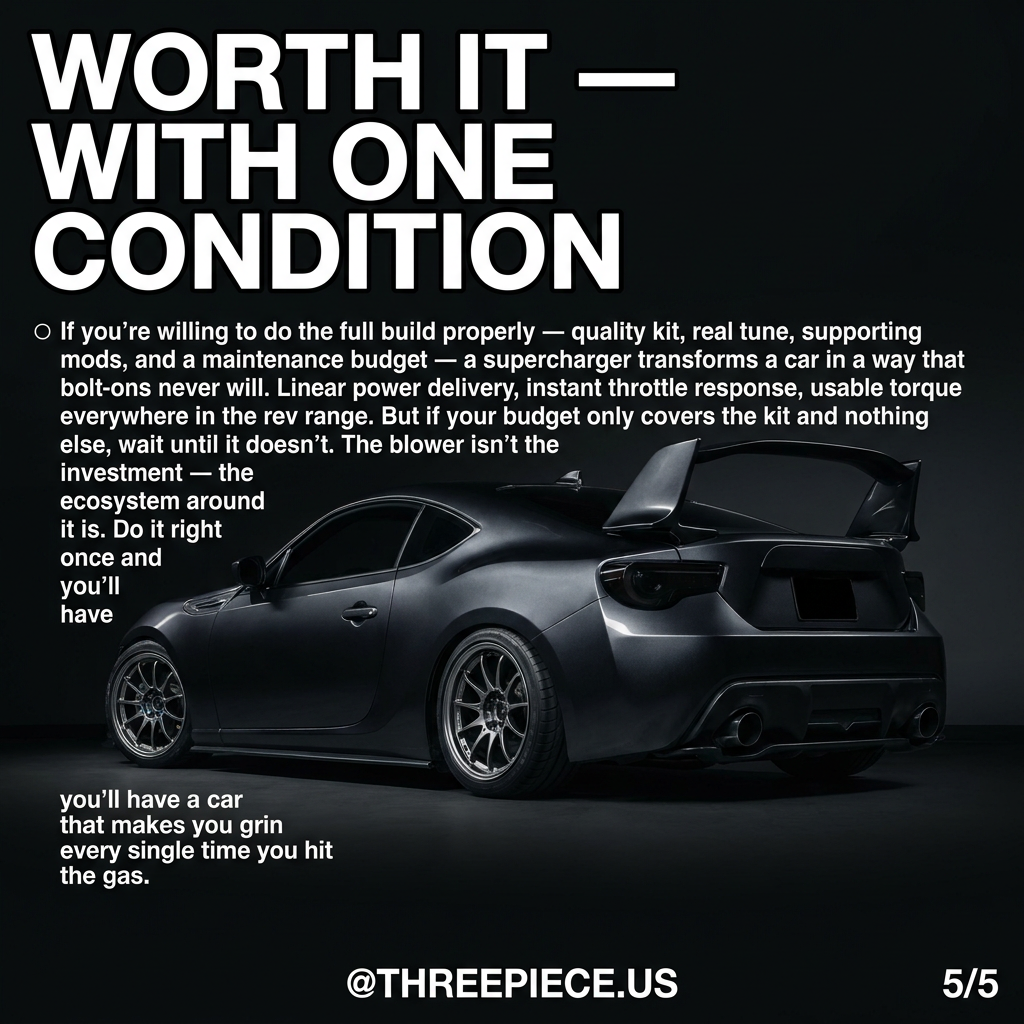
The Honest Verdict: Worth It With One Condition
If you're willing to do the full build properly — quality kit, real dyno tune, supporting mods, and a maintenance budget — a supercharger transforms a car in a way that bolt-ons never will. Linear power delivery, instant throttle response, usable torque everywhere in the rev range. The owners running reliable supercharged setups for 30,000+ miles didn't cheap out on the stuff you can't see on Instagram. They budgeted $8,000–$12,000 from day one, not $5,000 with a prayer.
But if your budget only covers the kit and nothing else, wait until it doesn't. The blower isn't the investment — the ecosystem around it is. Do it right once and you'll have a car that makes you grin every single time you step on the gas.
Once the power is sorted, the next step is putting it to the ground properly. Browse our full wheel catalog for lightweight options that complement a forced induction build, check the vehicle gallery for build inspiration, and explore our suspension lineup to make sure your chassis can handle the power you're making. If you're building a Supra, our MK5 Supra fitment guide has you covered. For the 370Z crowd, the Z34 build guide lays out the full mod order. And if you're weighing whether forged wheels are worth the investment on a boosted car — they absolutely are, because unsprung weight matters even more when you're putting down 400+ whp.