
Infiniti G Series History: Every Generation Ranked
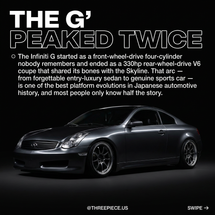
The Infiniti G series has one of the strangest platform evolutions in Japanese automotive history. It started as a front-wheel-drive four-cylinder sedan nobody remembers and ended as a 330hp rear-wheel-drive V6 coupe that shared its bones with the Skyline. That arc — from forgettable entry-luxury to genuine sports car — is a story most people only know half of. Here's every generation ranked, with the ownership data, common failures, and buying advice that actually matters.
Quick links
- The FWD Years Nobody Mentions
- The V35 Platform Shift That Changed Everything
- Two Golden Eras, One Nameplate
- Where Each Generation Stumbles
- G35 and G37 Wheel Fitment Basics
- Which Infiniti G Should You Buy Now
The FWD Years Nobody Mentions
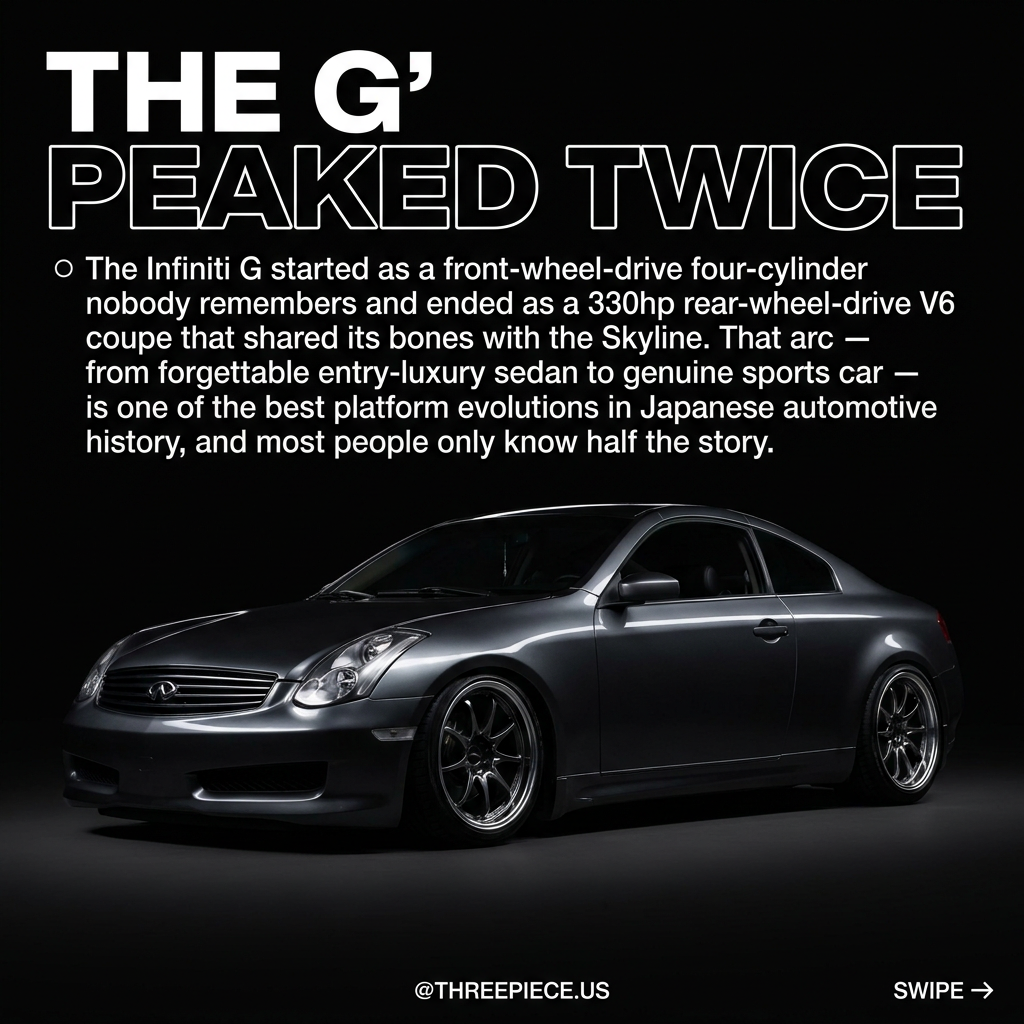
The first two generations of the Infiniti G were the P10 (1990–1996) and P11 (1999–2002) G20s — small sedans built on the Nissan Primera platform with an SR20DE making around 140hp through the front wheels. Infiniti literally marketed them as "Born in Japan. Educated in Europe. Now Available in America." They were simple, reliable, and completely outgunned by the BMW 3 Series in every measurable way.
The SR20 tuner crowd kept P10s alive — the same engine that powered the Sentra SE-R had a deep aftermarket — but as an Infiniti product, the G20 barely registered. The P11 refresh brought minor interior upgrades and a slight power bump to roughly 145hp, but the mod scene remained thin. If you're comparing this era to the early Lexus IS generations, the IS had more identity from day one. The G20 was a parts-bin exercise that Infiniti would rather you forget.
The V35 Platform Shift That Changed Everything
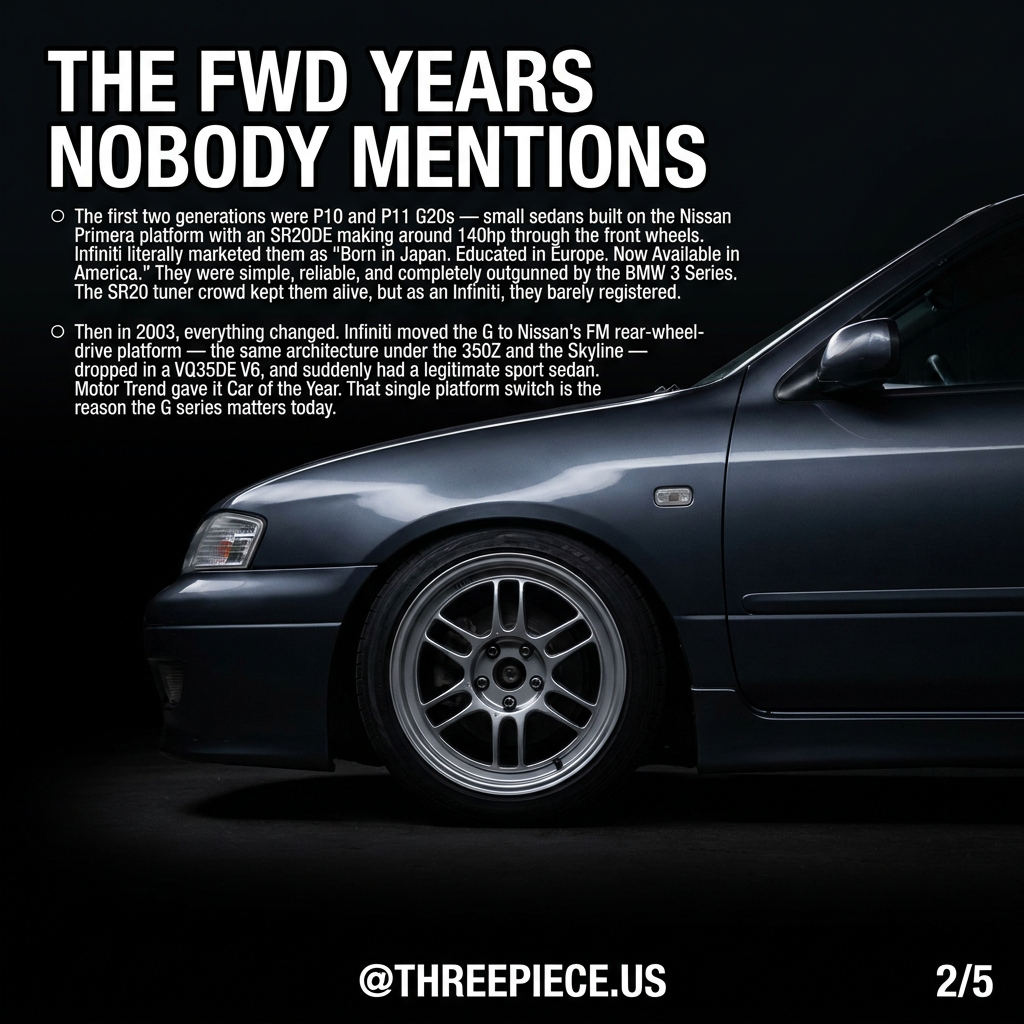
In 2003, Infiniti moved the G to Nissan's FM rear-wheel-drive platform — the same architecture under the 350Z and the JDM Skyline — dropped in a VQ35DE V6, and suddenly had a legitimate sport sedan. Motor Trend gave it Car of the Year. That single platform switch is the reason the Infiniti G series matters today.
The base V35 sedan made around 260hp and 260 lb-ft through a 5-speed automatic or 6-speed manual. The coupe, especially in later "Rev-Up" form, pushed 298–300hp with a higher redline and better top-end breathing. The shared parts bin with the 350Z meant immediate aftermarket depth — intakes, exhaust, headers, ECU tuning via UpRev or EcuTek — and built long-block VQ35s on track cars were seeing 350–400hp naturally aspirated. If you're familiar with the 370Z platform, you already understand the DNA. The G35 was the sedan version of that formula.
This generation also introduced the G35x with all-wheel drive for the sedan, targeting 3 Series xDrive buyers in snow states. It worked — the G35x became a volume seller, even if enthusiasts largely ignored it in favor of the RWD coupe with the 6MT.
Two Golden Eras, One Nameplate
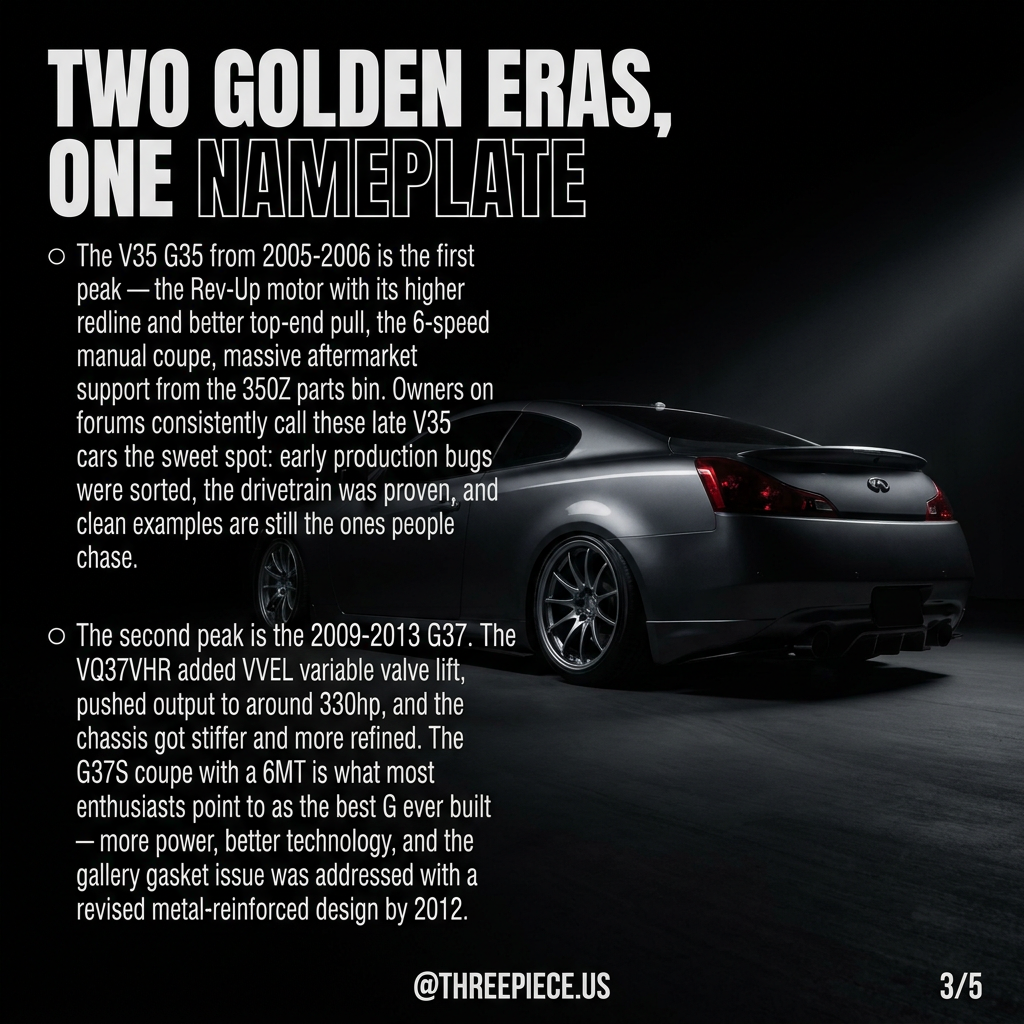
The V35 G35 from 2005–2006 is the first peak. The Rev-Up motor with its higher redline and better top-end pull, the 6-speed manual coupe, and massive aftermarket support from the 350Z parts bin made these the cars forum owners consistently call the sweet spot. Early production bugs were sorted by this point, the drivetrain was proven, and clean examples are still the ones people chase on the used market.
The second peak is the 2009–2013 G37. The VQ37VHR added VVEL variable valve lift, pushed displacement to 3.7 liters, and output climbed to around 330hp with 270 lb-ft at an 11.0:1 compression ratio. The chassis got stiffer and more refined. The G37S coupe with a 6MT is what most enthusiasts point to as the best G ever built — more power, better technology, and the oil gallery gasket issue that plagued the earlier VQ35HR was addressed with a revised metal-reinforced design by 2012.
Between the V35 and V36, the transitional 2007–2008 models ran the VQ35HR — a heavily reworked version of the DE with 306hp, 268 lb-ft, and a 7,500 rpm redline. It's a strong motor, but it sits in an awkward spot: more refined than the DE but lacking the displacement and VVEL tech of the VQ37VHR that arrived a year later. The HR also introduced the oil gallery gasket issue that became the most-discussed reliability concern in the entire G lineage. If you want deeper context on how the HR and VHR engines compare, the AFR fundamentals help explain why the VHR's variable valve lift made such a difference in real-world driveability.
Where Each Generation Stumbles
Every G generation has documented weak points. These come from forum threads, build logs, and owner complaint data — not press releases.
2003–2004 V35 (VQ35DE early): First-year growing pains hit hard. Oil consumption and high blow-by show up around 60,000–80,000 miles due to worn piston ring sealing. Alternator brushes tend to fail around 80k. Front wheel bearings develop a howl under load. Transmission control module failures and electrical gremlins are common enough that forum buy guides universally warn against early VIN ranges. Owners recommend running 5W-40 full synthetic and budgeting for alternator replacement. Bearing work runs roughly $700 with labor.
2005–2006 V35 (VQ35DE late / auto trans): The TCC solenoid in the automatic transmission can fail as early as 30,000 miles, causing slippage and hard shifts. A PCM firmware bug compounds the issue — the fix involves a TSB reflash plus solenoid replacement. Manual cars dodge this entirely, which is one more reason the 6MT is the enthusiast's choice. An oil catch can is a worthwhile addition on any VQ35DE to manage blow-by and keep the intake tract clean.
2007–2008 V36 (VQ35HR): The oil gallery gasket at the rear cam is the big one. It leaks oil into the cam sensor housing, triggering P0011/P0021 codes and ragged idle. This typically surfaces around 70,000 miles. Repair runs $2,000–$3,000 and usually involves replacing the gasket, cam phasers, and cleaning the affected area. EVAP system codes add to the diagnostic cost. On manual cars, the clutch slave cylinder tends to go around 60–80k miles — budget accordingly.
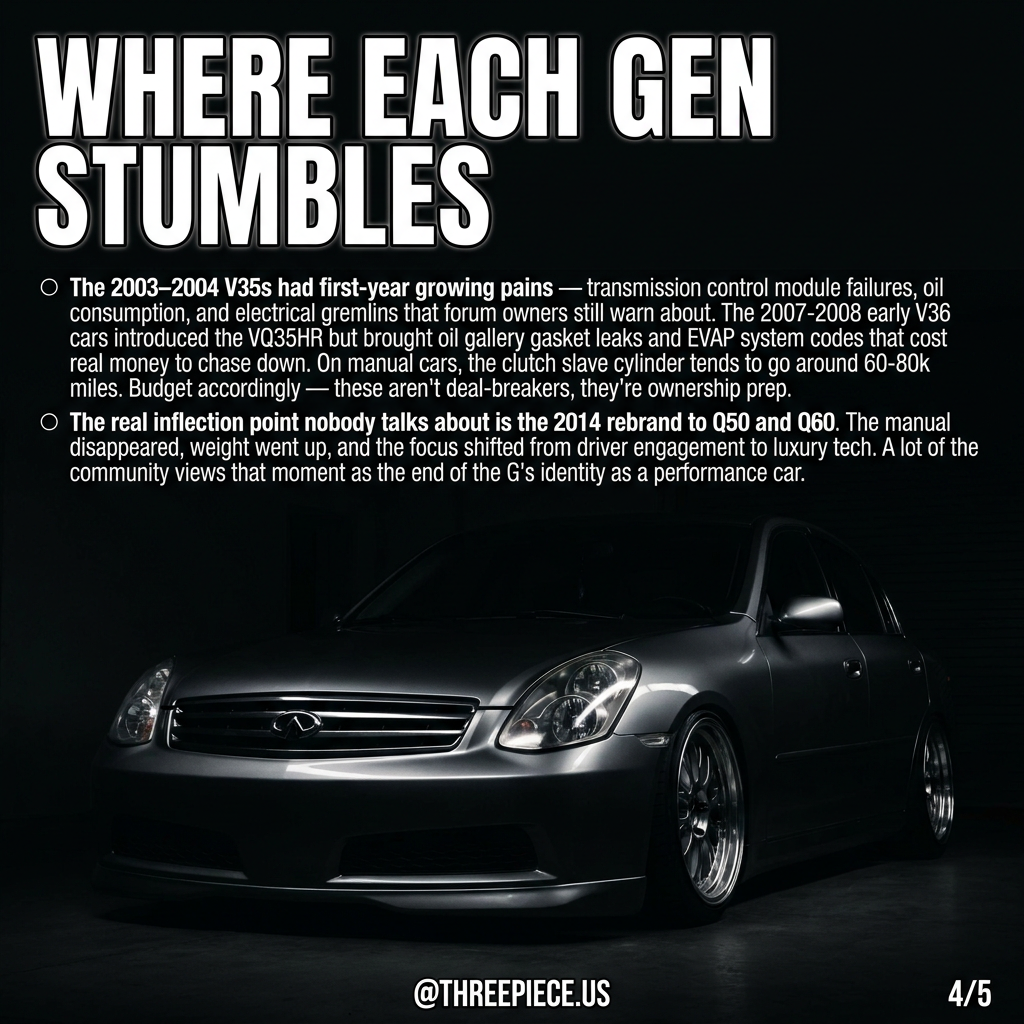
Across all generations: Electrical trim wear, window switch failures, actuator issues, and dash cracks show up between 50,000 and 120,000 miles. None of these ruin the car mechanically, but they erode resale value and daily satisfaction. Structural braces and subframe bushings are common DIY upgrades. The rear camber arms guide is essential reading if you're lowering any G — the rear subframe geometry on the FM platform is tight and unforgiving without correction.
G35 and G37 Wheel Fitment Basics
Both the V35 and V36 run a 5x114.3 bolt pattern with a 66.1mm hub bore. This is the same pattern as the 350Z, 370Z, and countless other Nissan/Infiniti platforms, which means wheel options are enormous. If you're already familiar with the 370Z fitment guide, the G37 coupe shares very similar fender geometry.
On the G35 sedan, 18x8.5 +30 to +38 is the safe zone for a flush, daily-friendly setup. The coupe can handle 19x9.5 +22 to +30 in the rear with appropriate tire sizing. Browse Vision American-Muscle 142 Legend 5x114.3 18x9.5+0 Gunmetal Machined Lip or step up to Vision American-Muscle 142 Legend 5x114.3 18x9.5+0 Gunmetal Machined Lip for the coupe. The G37 sedan and coupe follow similar sizing, with the G37S sport brakes requiring a minimum 18-inch diameter for caliper clearance.
For a proper three-piece setup on either platform, the Work VS series and Work Meister are among the most popular choices in the G community. If you're running existing 3-piece wheels that need refreshing, Work replacement lips in reverse mount start at $399, and Work step-lip barrels are the same price — letting you change dish depth or repair curb damage without replacing the entire wheel. Pair them with 245/40R18 tires up front and 275/35R19 out back for a staggered coupe setup.
If you're considering forged wheels for a G build, they make sense here — the FM platform responds well to unsprung weight reduction, and the improvement in turn-in on a car this heavy is immediately noticeable. Don't forget hubcentric rings to ensure proper centering on the 66.1mm hub, and finish the look with Work VS reproduction center caps at $50 each. Check the ThreePiece vehicle gallery for real-world G35 and G37 builds with proper fitment.
Which Infiniti G Should You Buy Now
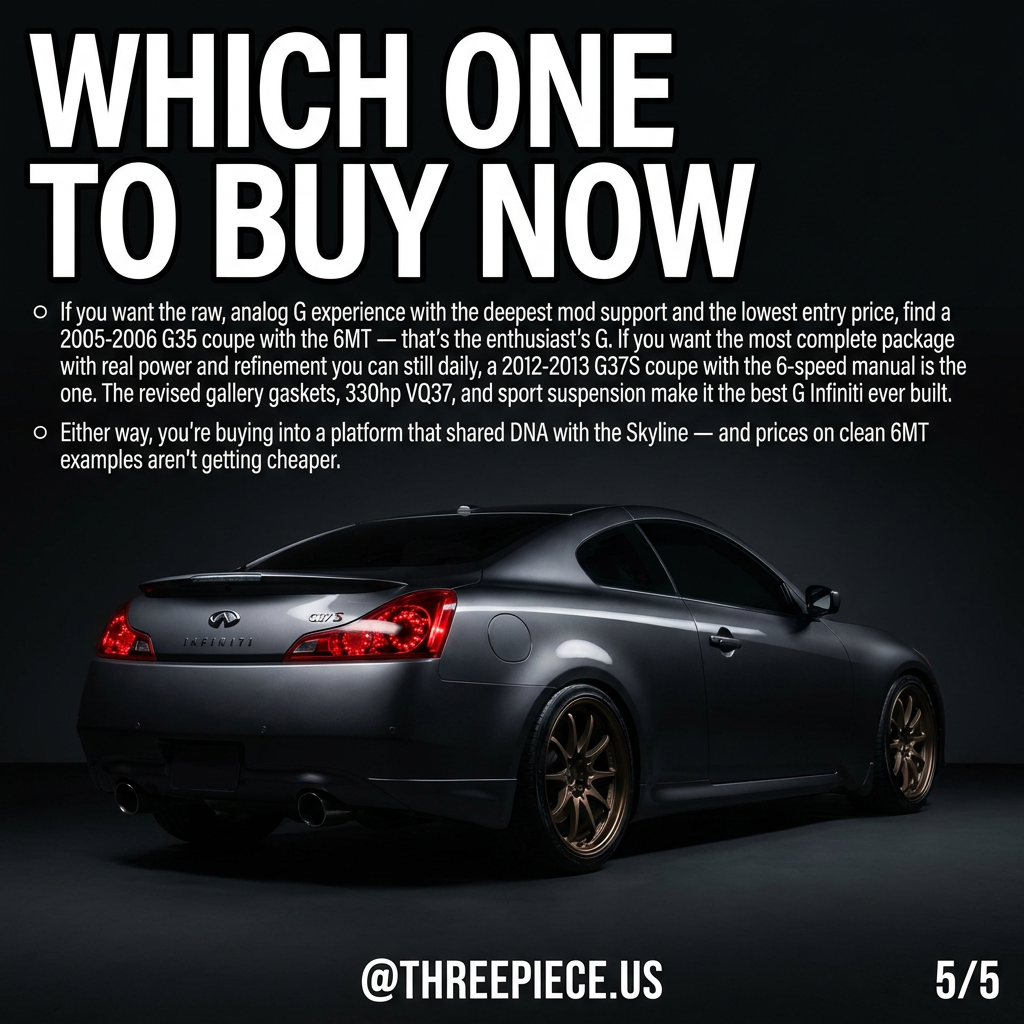
If you want the raw, analog G experience with the deepest mod support and the lowest entry price, find a 2005–2006 G35 coupe with the 6MT. That's the enthusiast's G. The Rev-Up motor, proven drivetrain, and 350Z-shared aftermarket make it the most moddable version. Prices on clean 6-speed examples have been climbing steadily — this is not a car that's getting cheaper.
If you want the most complete package with real power and refinement you can still daily, a 2012–2013 G37S coupe with the 6-speed manual is the one. The revised gallery gaskets, 330hp VQ37VHR, and sport suspension make it the best G Infiniti ever built. It's the closest thing to a modern Skyline coupe you can buy without importing one.
The real inflection point nobody talks about is the 2014 rebrand to Q50 and Q60. The manual disappeared, weight went up, and the focus shifted from driver engagement to luxury tech. A lot of the community views that moment as the end of the G's identity as a performance car. If you're curious about how the Q50 turned out on the other side of that transition, the Q50 Red Sport wheel guide covers fitment for the newer platform.
For context on how the G stacks up against its direct competitors in this price range, the Genesis Coupe 3.8 BK2 is the other V6 RWD coupe everyone cross-shops, and the CT4-V Blackwing vs M3 comparison shows where the sport sedan segment went after the G left. The Infiniti G didn't just compete in this space — it helped define it. And for builds at any level, ThreePiece.us carries the wheels, parts, and suspension to finish the job right.