
Lexus IS History: Every Generation Ranked by Owners
The Lexus IS exists because Toyota handed a luxury sedan project to the chief engineer behind the AE86 — and told him to make BMW nervous. That single decision shaped three generations of one of the most underrated sport sedans ever built. Some nailed the formula, some lost the plot, and one of them came with a 5.0-liter V8 making 416 horsepower that still doesn't get the attention it deserves. Here's how every generation of the Lexus IS stacks up, what forums actually say about owning each one, and which one you should buy depending on whether you want to build or just drive.

Quick links
- The AE86 Engineer Who Started It All
- First Gen XE10: The Enthusiast's IS
- Second Gen XE20: The IS-F Saved This Generation
- Third Gen XE30: The Smart Daily Driver
- Lexus IS Wheel Fitment Across Generations
- Final Ranking: Which Lexus IS to Buy
The AE86 Engineer Who Started It All
Nobuaki Katayama — the chief engineer behind the AE86 Corolla — was the man Lexus chose to develop their BMW 3 Series competitor in the mid-1990s. His entire reputation was built on chassis dynamics and driver engagement, not luxury appointments or NVH refinement. That's a deliberate choice that tells you exactly what Toyota wanted the IS to be: a driver's car wearing a Lexus badge. Every generation since has been measured against that original intent, and it's the reason the IS community argues so passionately about which gen actually delivered on the promise. If you've followed the Honda NSX generational ranking we published, you know how these debates play out — the original almost always wins on purity.
First Gen XE10: The Enthusiast's IS
The XE10 launched in Japan as the Toyota Altezza in 1998 and arrived stateside as the Lexus IS300 with a naturally aspirated 2JZ-GE inline-six making approximately 215 horsepower. Lighter, simpler, and completely analog — manual transmissions were available, the car was rear-wheel drive only, and the steering feel was direct in a way that no subsequent generation replicated. The SportCross wagon variant added even more cult appeal.
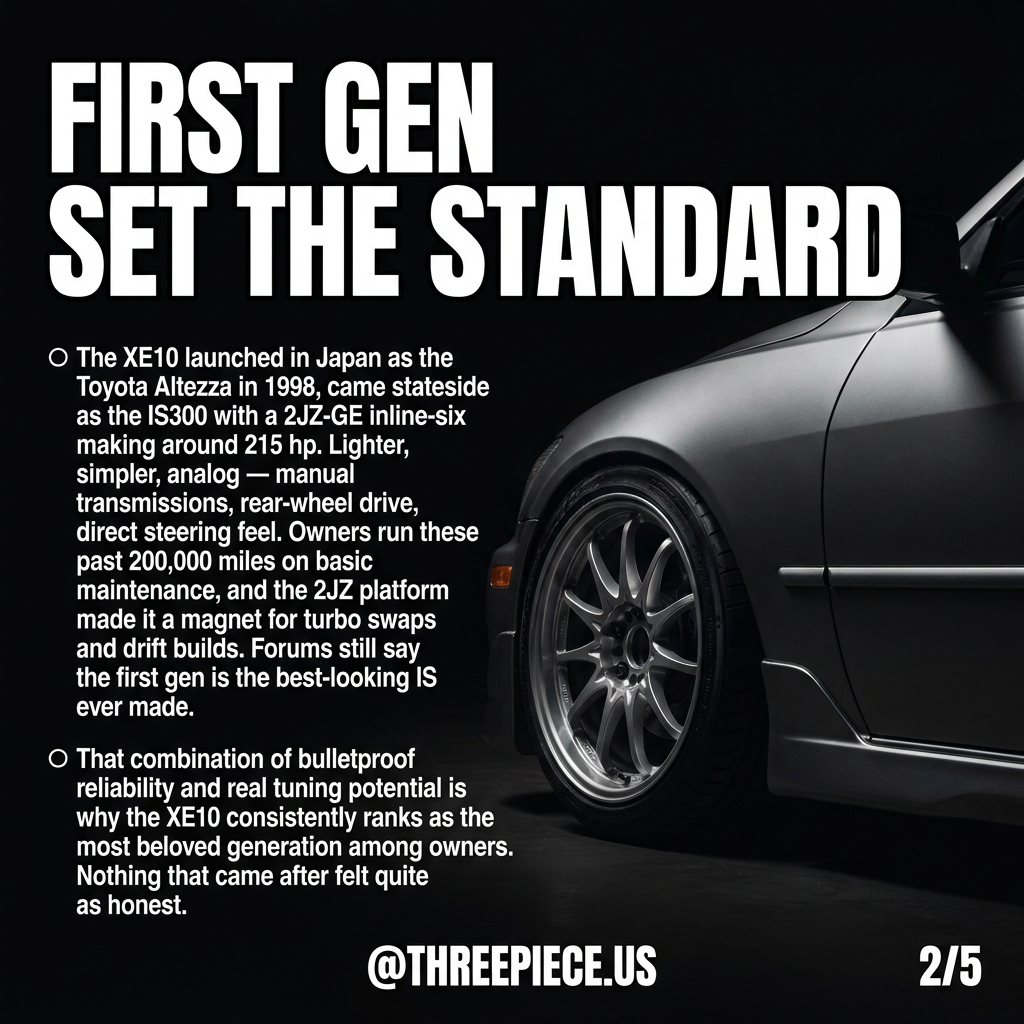
What makes the XE10 special in 2025 is the convergence of two things: bulletproof reliability and real tuning headroom. Owners routinely run these past 200,000 miles on basic maintenance — valve cover gaskets, radiator replacement around 90k miles, and timing chain tensioner checks on high-mileage cars are the main items. Compare that to the second gen's laundry list and it's not even close. The 2JZ platform is a magnet for turbo swaps; 2JZ-GTE conversions pushing 350–500 horsepower are well-documented on ClubLexus and My.IS forums, though they require serious fueling, cooling, and drivetrain upgrades. If you're considering a turbo build, understanding how air-fuel ratios work is essential before you tune. For manual IS300 builds, the Chase Bays 99-05 Lexus IS300 Clutch Line at $95 is a common upgrade that replaces the factory rubber line with a braided stainless unit for better pedal feel under hard use.
The 2JZ-GE IS300 shares DNA with the Toyota Aristo S140, another 2JZ-powered sedan that's climbing in value. Forum consensus is clear: the first gen is the best-looking IS ever made, and prices are already creeping on clean examples. If you're building one, it deserves proper wheels — not rep garbage.
Second Gen XE20: The IS-F Saved This Generation
The XE20 arrived for the 2006 model year with a wider body, more weight, and a switch from inline-six to V6 power across the range. The IS 250 made do with a 2.5-liter V6, the IS 350 stepped up to a 3.5-liter V6 producing around 306 horsepower, and in 2008 Lexus dropped the hammer with the IS-F — a 5.0-liter V8 with a forged crank making 416 horsepower, hitting 0-60 in roughly 4.6 seconds. The IS-F is the most visceral IS ever built, a genuine future collectible, and the only reason this generation doesn't rank last across the board.
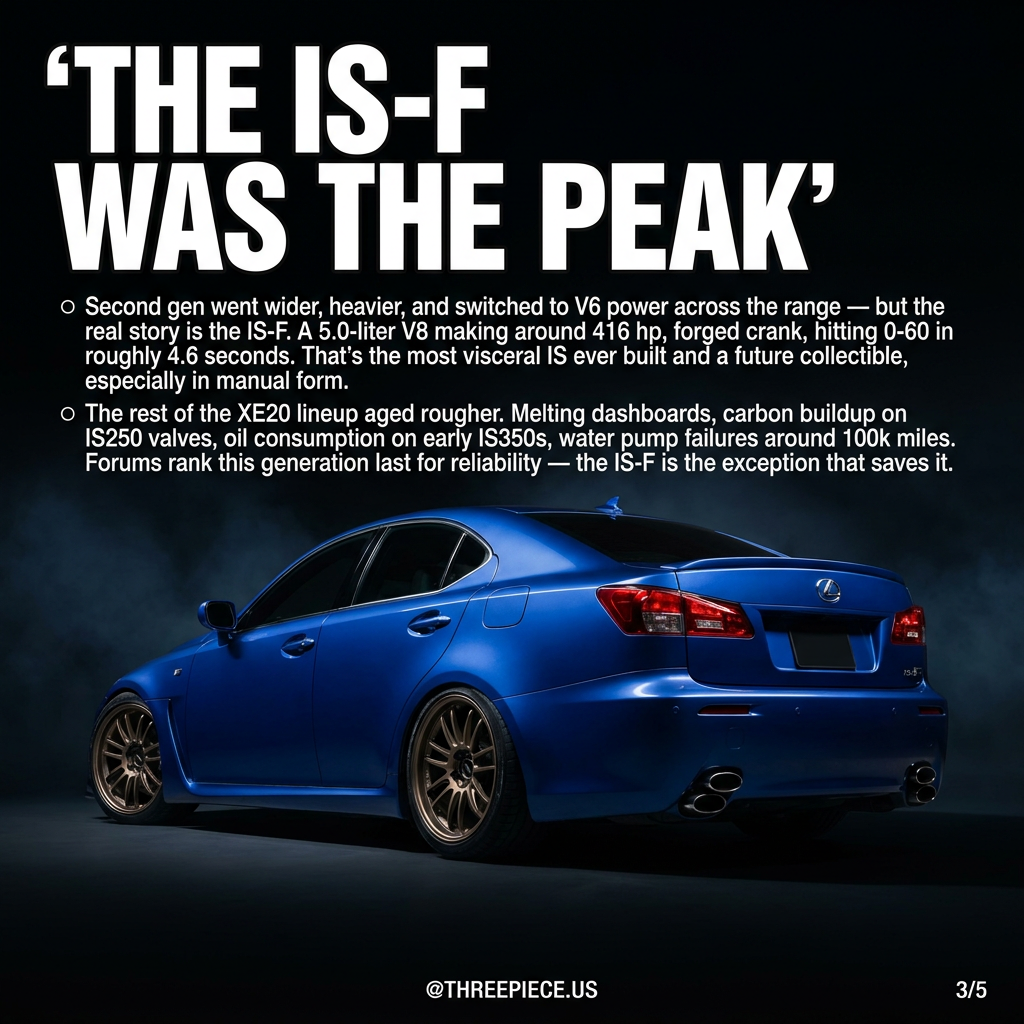
The rest of the XE20 lineup aged rough. The melting dashboard problem — particularly on 2006–2008 models in hot climates — is infamous, with replacement costs hitting $2,000+ if Lexus didn't cover it under their extended warranty. Early IS 350 automatics had harsh shifts, TCM faults, and limp-mode triggers. The IS 250 developed a reputation for carbon buildup on intake valves and oil consumption from leaking VVT-i cam-gear bolts. Water pump failures around 50,000–70,000 miles are well-documented. Front lower control arm bushings crack between 50k and 100k miles — many owners swap in IS-F spec arms or aftermarket units for better durability. An oil catch can is a smart preventive mod on the IS 250 to reduce carbon buildup on those direct-injection valves.
If you own a second-gen IS 250, upgrading the worn-out factory shocks makes a dramatic difference. The KYB Gas-a-Just Front Right Strut for 2006-10 IS250 at $199 and the matching KYB Gas-a-Just Front Left Strut at $199 are direct-fit replacements that restore handling without the harshness of cheap coilovers. For IS-F owners chasing more, supercharger kits are the established path to 500+ horsepower on the 2UR-GSE V8. If you're wondering whether an ECU tune is worth it, the IS-F responds well to flash tunes even before forced induction.
Third Gen XE30: The Smart Daily Driver
The XE30 debuted for the 2014 model year with Lexus's aggressive spindle grille, sharper body lines, and a broader powertrain lineup. In the U.S., the range included the IS 200t with a 2.0-liter turbo inline-four making 241 horsepower, the IS 300 with a 3.5-liter V6 around 260 horsepower, and the IS 350 pushing 306+ horsepower in F-Sport RWD trim — which finally got a factory limited-slip differential as standard equipment after the 2017 facelift.
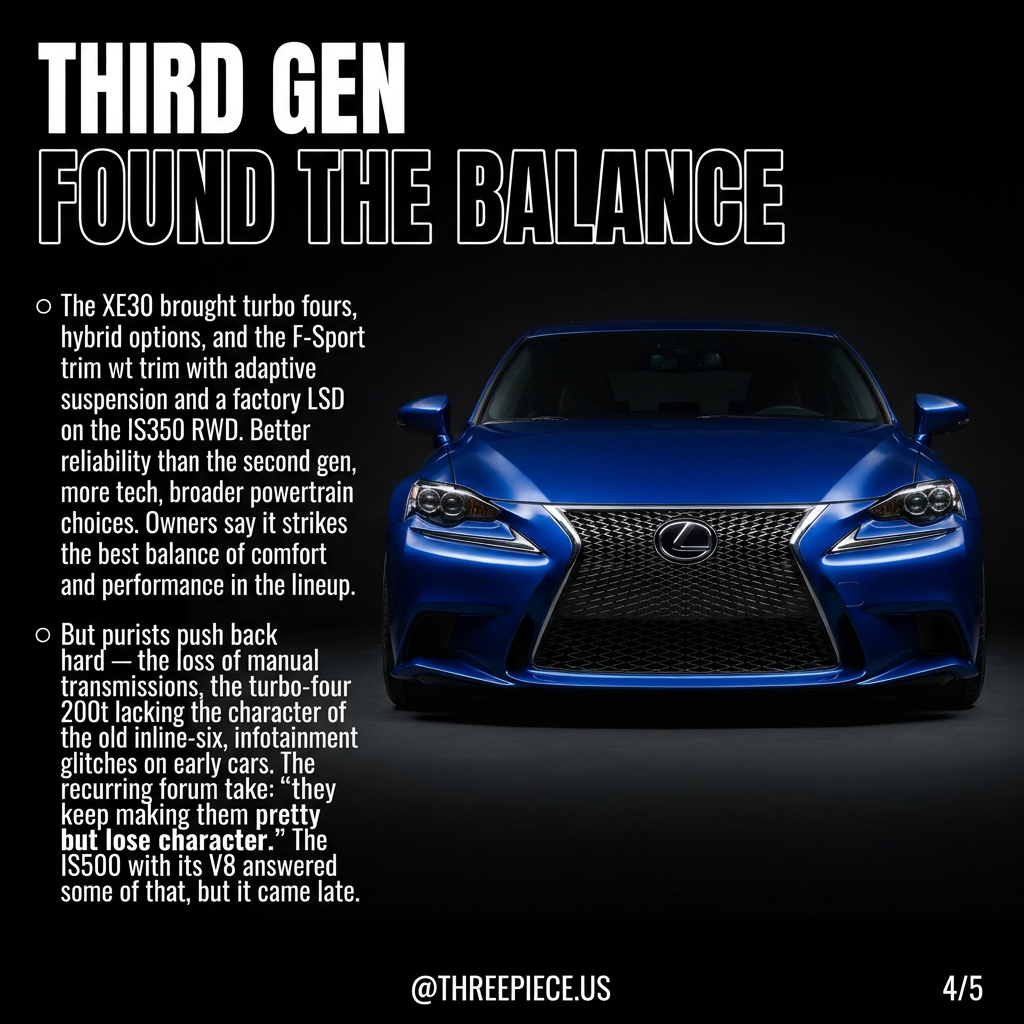
Reliability improved substantially over the XE20. No melting dashboards, fewer seal-related oil issues, and the 3.5-liter V6 in the IS 350 is a proven unit by this point. Owners say the XE30 strikes the best balance of comfort and performance in the IS lineup. But purists push back hard: no manual transmission option, the turbo-four IS 200t lacks the character of the old inline-six, and early cars had infotainment glitches that frustrated owners. The recurring forum take is that Lexus keeps making them prettier while losing character. The IS 500 with its naturally aspirated V8 answered some of that criticism, but it arrived late in the generation's life.
For third-gen IS 350 owners looking to wake up the exhaust note, the MagnaFlow Cat-Back System for 2014-18 IS350 3.5L at $1,350 is a bolt-on upgrade that adds real presence without drone. It's one of the most popular exhaust choices on IS forums for a reason. If you're running a 2006-08 IS 250 AWD and need emissions compliance, the MagnaFlow Direct Fit Catalytic Converter for 06-08 IS250 AWD at $909 is a direct OEM replacement. Understanding coilover spring rates matters here too — the XE30 responds well to a moderate drop on quality coilovers, and the F-Sport's adaptive dampers mean you need to be deliberate about what you replace them with.
Lexus IS Wheel Fitment Across Generations
Wheel fitment varies significantly across IS generations, and getting it wrong means rubbing, poor handling, or a stance that looks like an afterthought. Here's what the community has settled on as the sweet spots:
XE10 IS300: The factory bolt pattern is 5x114.3. The go-to size is 18x8.5 +35 to +38 front and rear for a square setup, or 18x9.5 +22 to +28 in the rear for a staggered look. Browse 18-inch wheels in 5x114.3 for options that fit. Pair them with 225/40R18 tires up front and 255/35R18 tires out back on a staggered setup.
XE20 IS250/IS350/IS-F: Also 5x114.3 with a 60.1mm hub bore. The IS-F came with staggered 19x8 front / 19x9 rear from the factory. For the IS 350, 18x8.5 +35 square is clean and functional, while 19x8.5 +35 front / 19x9.5 +25 rear is the aggressive staggered look. If you're exploring forged wheels for an IS-F build, the weight savings over cast wheels is meaningful on a car that already weighs 3,800 pounds. Check out 19-inch wheels in 5x114.3 for the right sizing.
XE30 IS350 F-Sport: Same 5x114.3 bolt pattern. Factory F-Sport wheels are staggered 18x8 front / 18x8.5 rear. The community favorite is stepping up to 19x8.5 +35 front / 19x9.5 +25 rear for a flush, aggressive look without fender modification. The Work Emotion series is a popular choice on IS builds — lightweight, available in the right offsets, and they look right on the XE30's aggressive body lines. For a more classic JDM aesthetic, the Work VS series is hard to beat. Finish any 3-piece build with proper assembly hardware — cheap bolts have no place on a quality wheel. Visit our vehicle gallery for real-world IS builds with proper fitment.
Final Ranking: Which Lexus IS to Buy
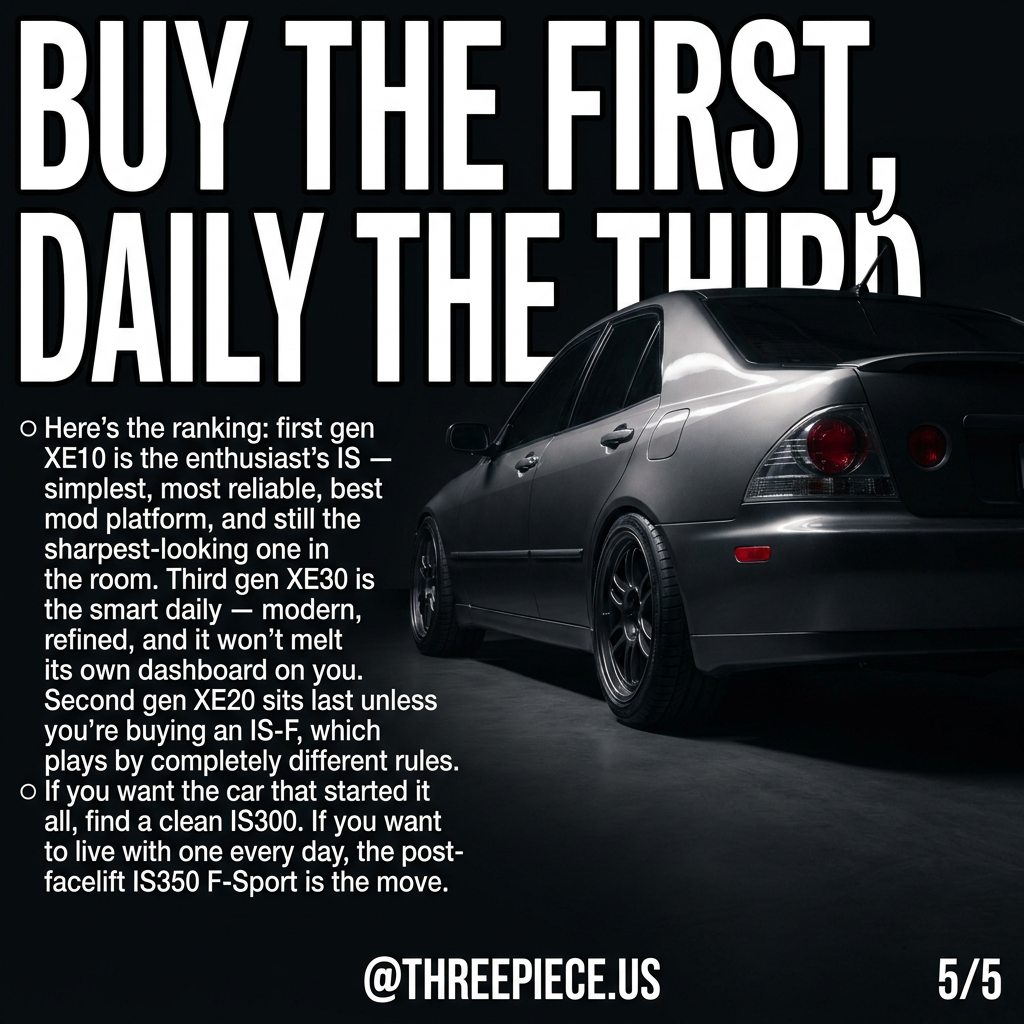
Here's the ranking, and it's not controversial if you've spent time on IS forums:
1st Place — XE10 (1998–2005): The enthusiast's IS. Simplest, most reliable, best mod platform, sharpest-looking. The 2JZ-GE is a proven engine with massive tuning headroom, the chassis is honest, and clean examples are only getting harder to find. If you want the car that started it all, find a manual IS300 before prices get out of reach. This generation shares the same ethos as the cars in our MK5 Supra analysis — Toyota's inline-six heritage at its finest.
2nd Place — XE30 (2013–Present): The smart daily. Modern, refined, and it won't melt its own dashboard on you. The post-facelift IS 350 F-Sport with the factory LSD is the sweet spot — comfortable enough for commuting, sharp enough for weekend canyon runs, and reliable enough that you're not budgeting for surprise repairs. At current used prices under $25,000 for clean examples, it's one of the best sport sedan values on the market. It competes directly with cars like the Acura TLX Type S for the title of most underrated luxury sport sedan.
3rd Place — XE20 (2005–2013): Last place unless you're buying an IS-F, which plays by completely different rules. The IS-F's 416-horsepower V8 is a future collectible and one of the most underappreciated performance sedans of its era — similar to how the AMG E-Class had standout V8 models that elevated otherwise flawed generations. But the standard IS 250 and IS 350 from this era carry too many known issues to recommend without a thorough pre-purchase inspection and a realistic maintenance budget.
Whichever generation you choose, the Lexus IS deserves wheels that match its intent. Browse the full wheel catalog at ThreePiece.us or explore Work Wheels — the brand that's been on more IS builds than any other in the JDM scene. If you're refreshing a set of 3-piece wheels, we carry Work replacement lips starting at $399 and Work replacement barrels at $399 to bring tired wheels back to life.