

The Mercedes AMG E-Class has spanned four distinct generations of V8 performance sedans — from the supercharged M113K in the W211 to the twin-turbo M177 in the W213 — and the enthusiast community has been arguing about which one got it right ever since. This isn't a press-fleet comparison or a spec-sheet exercise. This is how actual owners, builders, and long-term wrenchers rank the AMG E-Class lineup, and why the answer keeps surprising newcomers who assume the newest car is the best one.

Quick links
- The W211 Started the Argument
- The W212 Facelift Changed Everything
- The W213 Is Faster, Not Better
- Real Failure Modes and What They Cost
- AMG E-Class Wheel Fitment Across Generations
- The Final Ranking and Where to Start
The W211 Started the Argument
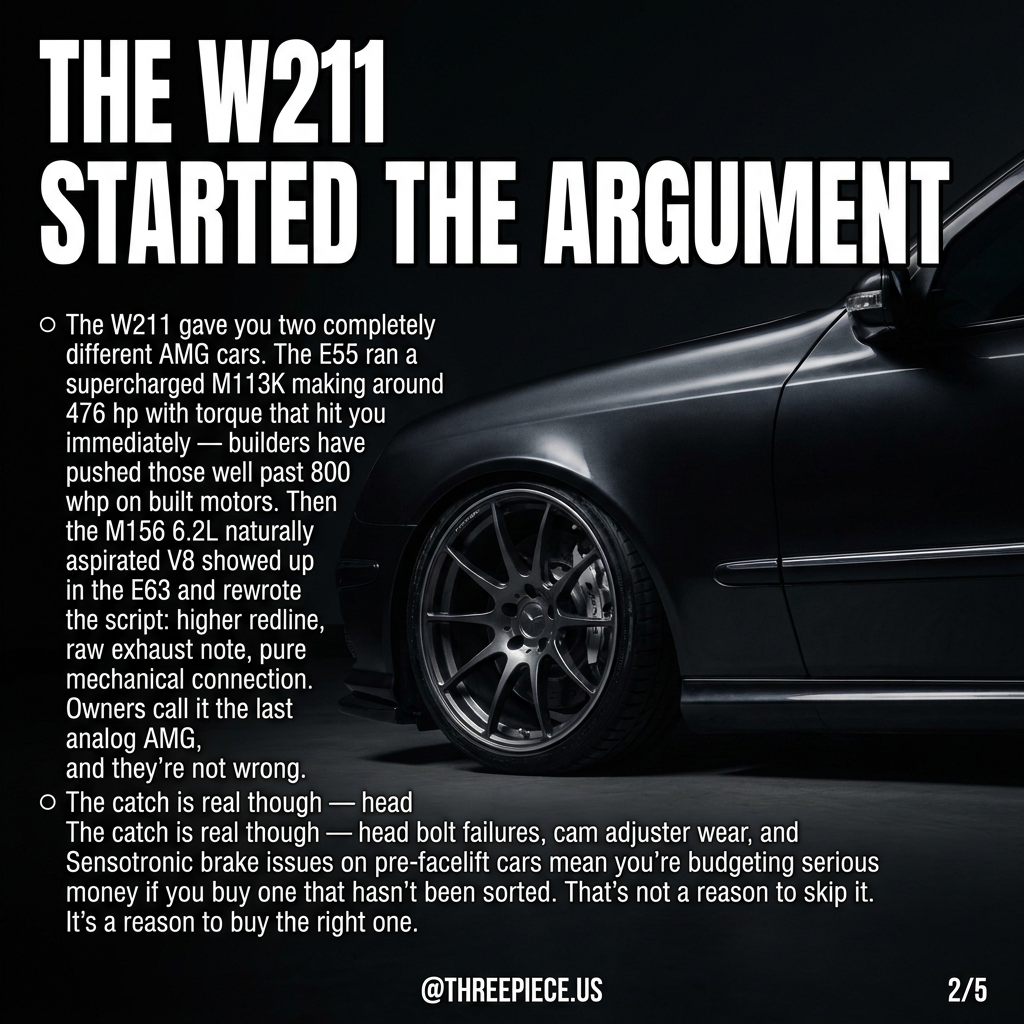
The W211 gave you two completely different AMG sedans under the same body, and that's why the debates around it never end. The E55 AMG ran a supercharged M113K 5.4L V8 making roughly 476 hp with torque that stacked immediately off idle — builders on forums like MBWorld have documented pushing those well past 800 whp on built internals with larger supercharger pulleys and supporting mods. The M113K is one of the most proven forced-induction platforms Mercedes ever produced, and the tuning ceiling is absurd for a car you can find under $20K.
Then the M156 6.2L naturally aspirated V8 showed up in the E63 and rewrote the entire script. Higher redline, a raw exhaust note that nothing in the current lineup can replicate, and a mechanical connection that owners consistently describe as the last analog AMG. If you've read our W204 C63 AMG buying guide, you already know the M156's reputation — the E63 shares the same engine and the same ownership realities. Head bolt failures on pre-2011 engines (serial numbers before approximately 060658), cam adjuster wear that starts ticking around 80,000–110,000 miles, and Sensotronic Brake Control issues on pre-facelift W211 cars mean you're budgeting serious money if you buy one that hasn't been sorted.
That's not a reason to skip it. It's a reason to buy the right one.
The W212 Facelift Changed Everything
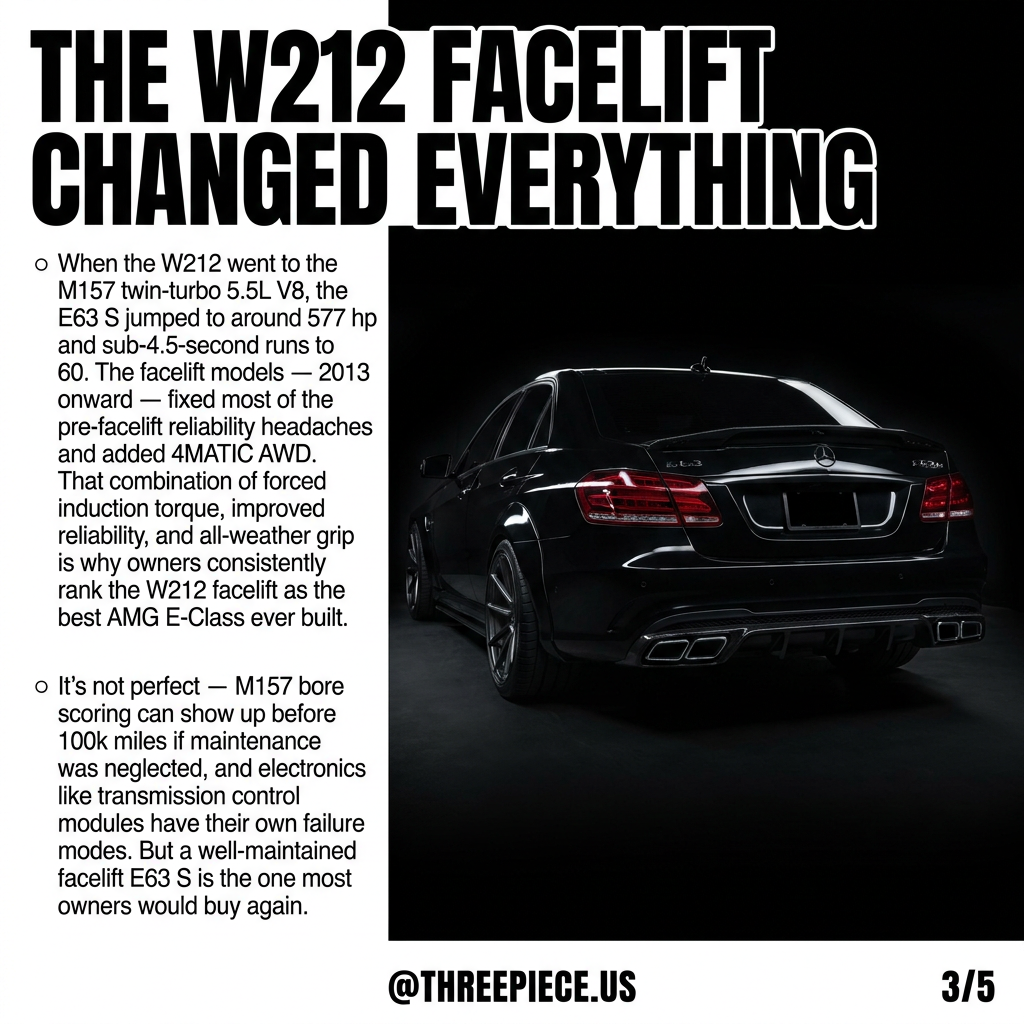
When the W212 moved to the M157 twin-turbo 5.5L V8, the E63 jumped to around 525 hp in standard trim. The Performance Package pushed that to ~557 hp, and the E63 S 4MATIC topped out at roughly 577 hp and 590 lb-ft of torque — enough for consistent sub-4-second 0–60 runs in real-world conditions, not just manufacturer claims. If you want the detailed mod order for this platform, we already wrote the W212 E63 AMG build guide covering exactly how to extract more from the M157 without wrecking reliability.
The facelift models — 2013 onward — fixed the majority of the pre-facelift reliability headaches. Earlier W212 E63s shared some of the M156's growing pains during the transition, and pre-facelift M157 cars had their own set of issues with turbo oil lines and early software calibration. The facelift cleaned that up, added 4MATIC AWD as an option, and refined the interior without stripping out the analog character. That combination of forced-induction torque, improved long-term reliability, and all-weather grip is why owners consistently rank the W212 facelift as the best AMG E-Class ever built.
It's not perfect. M157 bore scoring can show up before 100,000 miles if oil changes were stretched or the wrong spec was used. Transmission control module failures have their own thread on every Mercedes forum. But a well-maintained facelift E63 S is the one most owners would buy again — and the one that holds value the strongest in the used market right now. An ECU tune on the M157 is one of the best bang-for-buck modifications in the entire German performance sedan segment, with documented gains of 80–120 hp from a flash alone.
The W213 Is Faster, Not Better
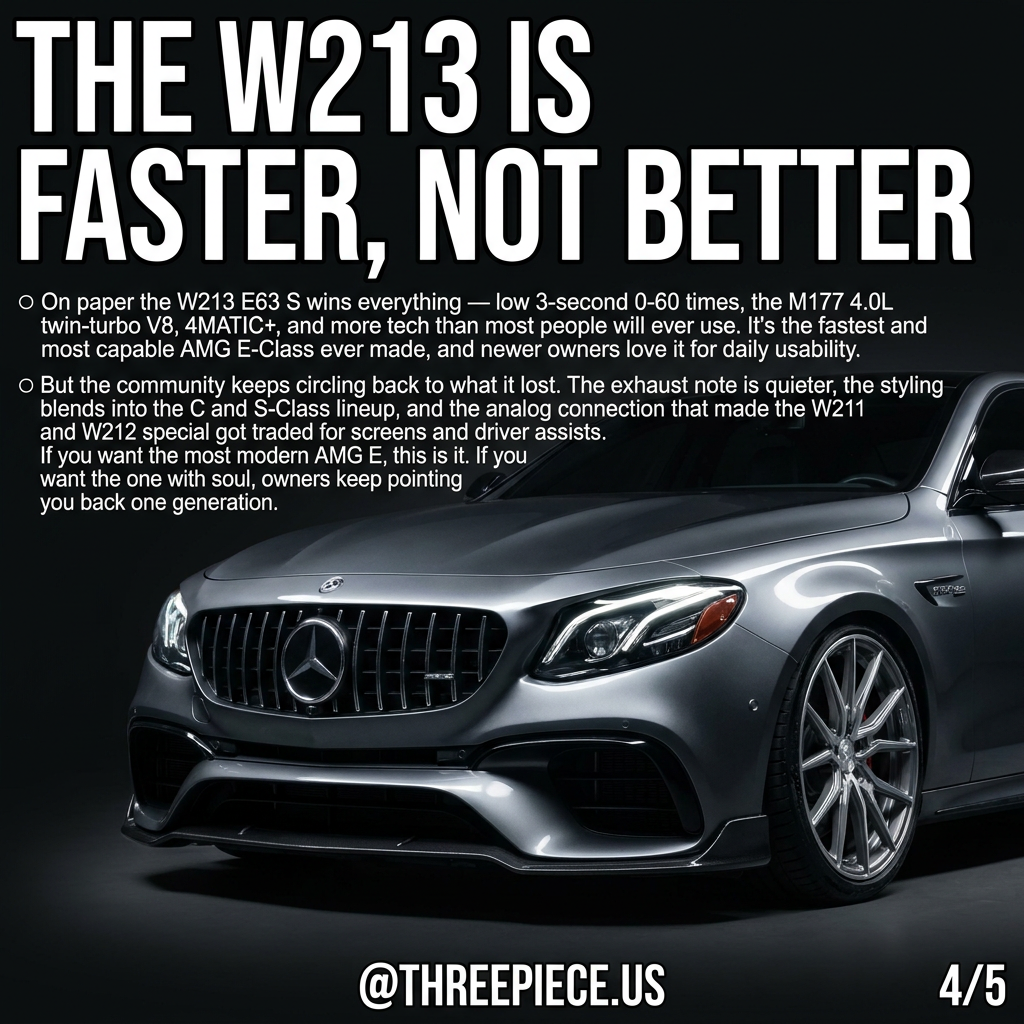
On paper, the W213 E63 S wins everything. Low 3-second 0–60 times. The M177 4.0L twin-turbo V8 making 603 hp. Standard 4MATIC+ with a drift mode that actually works. More technology, more driver assists, and more daily usability than any AMG E-Class before it. Newer owners love it as a daily driver, and for pure capability, it's the best AMG sedan Mercedes has ever shipped.
But the community keeps circling back to what it lost. The exhaust note is quieter — even with the sport exhaust, it doesn't have the M156's unfiltered scream or the M157's supercar-adjacent rumble. The styling blends into the C-Class and S-Class lineup in a way that the W212's aggressive facelift never did. And the analog connection that made the W211 and W212 special got traded for screens, haptic buttons, and layers of driver-assist software that you're constantly toggling off.
If you want the most modern AMG E, the W213 is it. If you want the one with soul, owners keep pointing you back one generation. That said, the W213 is the strongest tuning platform of the bunch — the M177 responds extremely well to ECU calibration, and downpipe-plus-tune builds are consistently putting down 700+ whp on stock turbos. The car isn't lacking in character when you build it — it just doesn't hand it to you stock the way the older cars did.
Real Failure Modes and What They Cost
Every AMG E-Class generation has a known failure profile. Ignoring these is how you turn a $30K purchase into a $45K regret. Here's what the forums and independent shops consistently flag:
W211 M156 E63: Head bolt failure is the big one. Pre-2011 engines with serial numbers below the updated threshold are at risk, and the fix involves pulling the heads, replacing bolts with updated ARP studs, and re-torquing — expect $4,000–$8,000+ depending on labor rates and whether additional damage occurred. Cam adjuster and lifter wear starts showing as cold-start ticking around 80K–110K miles and can degrade cam lobes if ignored. Budget $5,000–$10,000 for a full cam adjuster service. The Sensotronic Brake Control system on pre-facelift W211s is its own category of headache — SBC pump replacements run several thousand dollars, and some owners have converted to conventional systems entirely. Our C63 M156 buying guide covers these failure modes in depth since the engine is shared.
W212 M157 E63: Bore scoring is the primary concern, usually linked to poor oil maintenance or extended intervals. If caught early, it's manageable. If not, you're looking at a short block. Turbo oil feed line leaks are common on higher-mileage cars. Transmission valve body issues show up as harsh shifts or delayed engagement. Pre-facelift W212s (2010–2012) have more documented problems than facelift cars (2013–2016), which is a major reason the facelift commands a price premium.
W213 M177 E63: Fewer catastrophic failure modes so far, but the car is newer and the sample size of high-mileage examples is smaller. Early reports flag turbo wastegate rattle, oil consumption on hard-driven cars, and the usual German electronics gremlins with COMAND and driver-assist systems. Long-term reliability data is still being written.
AMG E-Class Wheel Fitment Across Generations
If you're building any of these cars, wheels are where the look comes together — and the AMG E-Class platform is surprisingly flexible across generations. All W211, W212, and W213 AMG models run a 5x112 bolt pattern, which means the aftermarket options are enormous. The differences are in hub bore, brake caliper clearance, and fender geometry.
For the W211 E55/E63, the sweet spot is 19x8.5 +35 front / 19x9.5 +35 rear in a staggered setup. The W211's fenders are generous and the car sits well on 19s without aggressive rolling. Pair with 245/35R19 fronts and 275/30R19 rears for a proper fitment. If you're unfamiliar with staggered setups, our forged wheels breakdown explains why multi-piece construction matters on heavy sedans like these.
The W212 E63 came stock on 19x9 +33 front / 19x10 +40 rear on the S model — one of the most aggressive OEM fitments Mercedes has ever offered. Most owners stay at 19" to clear the massive AMG brakes, though some 20" setups work with the right offset. Browse 19" wheels in 5x112 to see what fits. The Work Wheels lineup is particularly popular on the W212 platform — the Work VS series gives you a classic mesh look that complements the W212's aggressive fender lines, and the Work Meister series offers the deep-lip 3-piece aesthetic that transforms the car. Check our vehicle gallery for build inspiration across platforms.
The W213 E63 runs similar sizing to the W212 but with slightly different hub bore (66.6mm) and more aggressive caliper clearance requirements on the front. 20x9 and 20x10 setups work well if you're willing to run spacers or confirm caliper clearance with your wheel manufacturer. Finish any of these builds with proper 90-degree valve stems at $3.80 each — they make a real difference on deep-dish and multi-piece wheels where straight stems won't clear the brake caliper.

The Final Ranking and Where to Start
Here's how the AMG E-Class generations stack up based on actual owner sentiment, long-term reliability data, and build potential:
1. W212 Facelift E63 S (2013–2016) — Peak power, improved reliability over every prior generation, the last raw-but-refined AMG sedan before everything went digital. The M157 twin-turbo V8 is a proven platform with massive tuning headroom, and 4MATIC models are usable year-round. This is the one most owners would buy again.
2. W211 E55 / E63 (2003–2009) — Two different cars, both worth owning. The E55's supercharged M113K is the tuner's choice with an 800+ whp ceiling on built motors. The E63's naturally aspirated M156 is the purist's choice — the last AMG V8 without forced induction. Both require informed buying and maintenance budgets. If you want to understand the M156's quirks before committing, read the W204 C63 ownership guide — same engine, same lessons.
3. W213 E63 S (2016–2023) — The fastest and most capable AMG E-Class ever made, and the best daily driver of the group. It loses points for muted character and a clinical driving experience that prioritizes speed over feel. Still an incredible car — just not the one that makes you look back after you park it.
4. W210 E55 (1998–2002) — A classic and the one that started it all, but it's sentimental at this point, not competitive. The ~354 hp M113 is reliable and simple, but it doesn't have the performance ceiling or the community support that the later cars do.
If you're buying one AMG E-Class to keep, find a sorted 2014–2016 W212 E63 S 4MATIC with documented maintenance and don't look back. Then start planning the build — our W212 E63 build guide has the full mod order. Finish the wheels with M7 assembly hardware or M8x32 chrome assembly bolts at $10 each if you're running 3-piece wheels, and browse the full wheel catalog to find the right set for your platform.