W212 E63 AMG Build Guide: M157 Mod Order That Works
The W212 E63 AMG is one of the most overlooked big-power platforms in the Mercedes lineup right now. While the C63 market gets bid up by hype buyers, the W212 sits quietly with the same hand-built AMG engine, a longer wheelbase, more presence, and dramatically more tuning headroom — often for less money. The 2012–2016 cars with the M157 5.5L twin-turbo V8 make 550–577 hp from the factory, and documented builds are pulling another 120+ whp with nothing more than a flash tune and bolt-ons. This is the build guide that lays out the correct mod order, the parts that actually matter, and the wheel and suspension specs that finish the car properly.
Quick links
- Start With the Right Car
- Why the M157 Has So Much Headroom
- The Power Path: Mod Order That Works
- Failure Modes and Preventive Maintenance
- Wheels and Suspension Done Right
- Build Yours This Week
Start With the Right Car
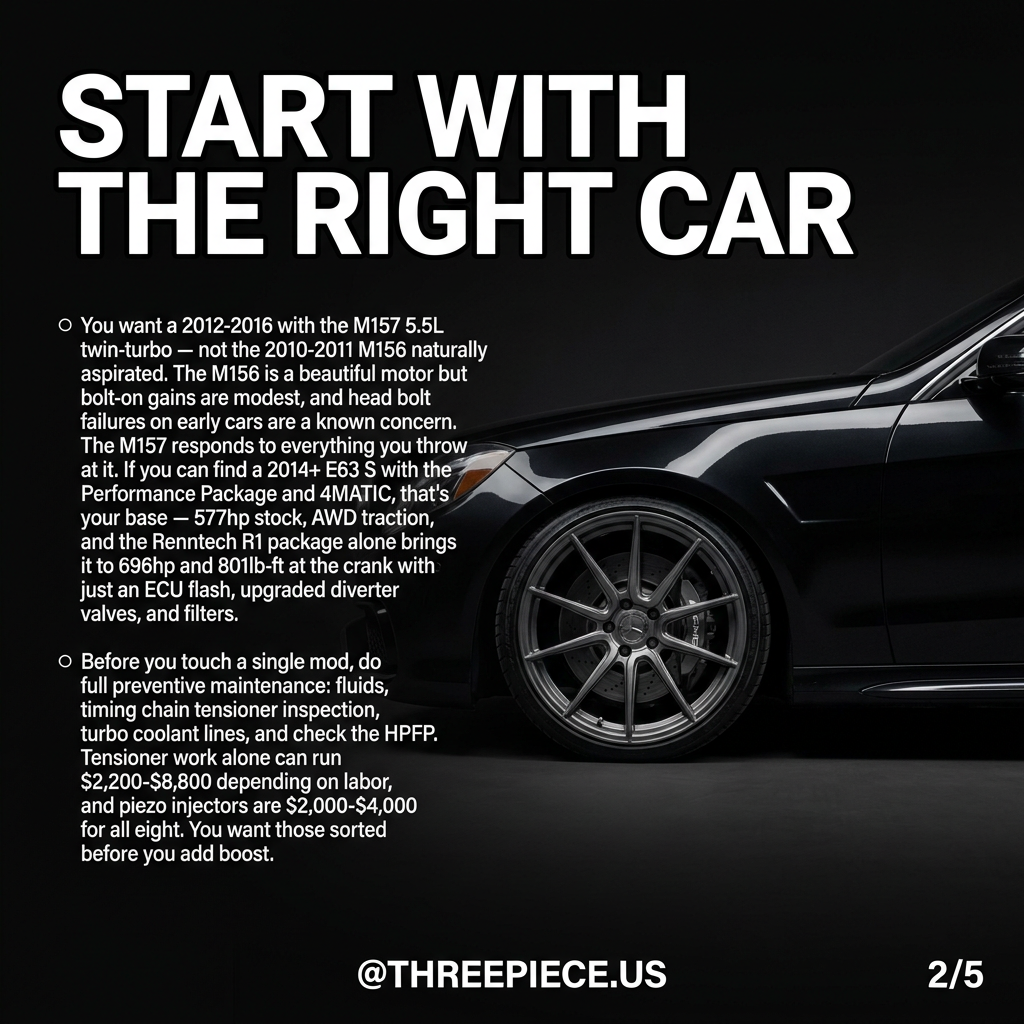
This matters more than any mod you'll bolt on. You want a 2012–2016 W212 E63 with the M157 5.5L twin-turbo — not the 2010–2011 car with the M156 naturally aspirated 6.2L. The M156 is a beautiful engine and shares its architecture with the W204 C63 AMG, but bolt-on gains are modest on a naturally aspirated motor, and early M156 cars have documented head bolt failure concerns. Most of those failures surfaced years ago, but it's still a risk factor when you're shopping.
The M157 responds to everything you throw at it. If you can find a 2014+ E63 S with the Performance Package and 4MATIC, that's your ideal base — 577 hp stock, AWD traction, and the Renntech R1 package alone brings it to 696 hp and 801 lb-ft at the crank with just an ECU flash, upgraded diverter valves, and filters. Pre-facelift 2012–2013 M157 cars are still excellent — they make 550 hp stock and follow the exact same tuning path — but the facelift S-model gives you more to start with and better residual value.
Why the M157 Has So Much Headroom
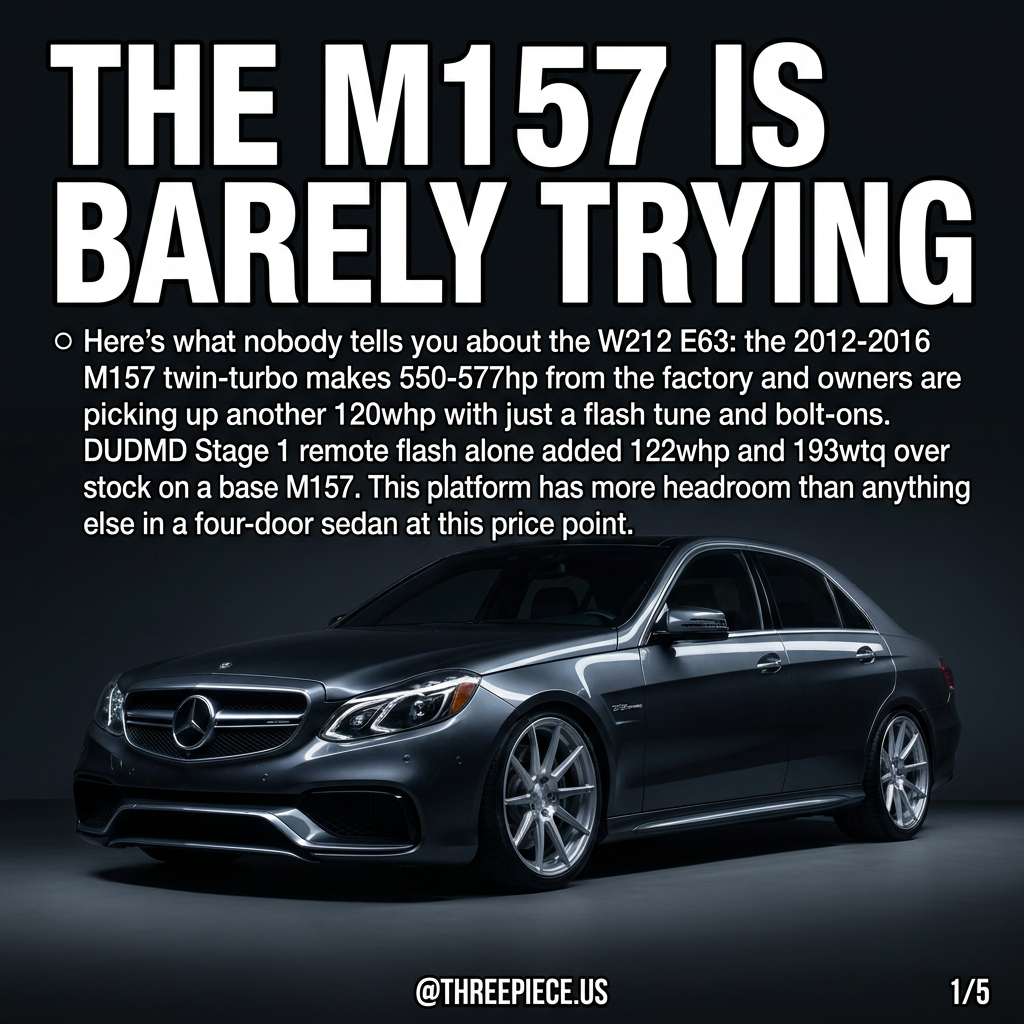
The M157 is a hand-built, twin-turbocharged 5,461cc V8 that Mercedes intentionally detuned from the factory for reliability and emissions. Stock turbo pressure, fuel delivery, and ignition timing all leave significant margin on the table. A DUDMD Stage 1 remote flash alone — no hardware changes — added 122 whp and 193 wtq over stock on a base M157. That's the kind of gain that requires forced induction upgrades on most other platforms. Here, it's a laptop and 30 minutes. If you're curious how ECU tuning stacks up across platforms, our breakdown of whether an ECU tune is worth it with real dyno numbers covers the data.
Even at the Renntech R2 package level — upgraded turbos with supporting mods — the M157 puts down 716 crank hp and 826 lb-ft on the 2012–2013 cars. AMS Alpha 9 builds push into the ~800 hp range with upgraded turbos, fuel system, heat exchanger, and ECU calibration. Stock internals (rods, pistons) appear to hold reliably up to roughly 700 hp at the crank. Beyond that, you're into forged internals. But the point is: the first 150–200 hp over stock costs you a tune and bolt-ons. That's absurd value in a four-door sedan.
The Power Path: Mod Order That Works
Order matters here. Do this wrong and you waste money on parts that don't compound properly. Here's the sequence the community has validated across hundreds of builds:
Step 1: Intake and diverter valves. AMS Performance carbon intake system or equivalent high-flow intake, plus upgraded diverter valves. These wake up spool response and let the turbos breathe. Some owners add a quality intake system as the very first mod — on the M157, it's one of the few platforms where intake gains are immediate and measurable because you're feeding twin turbos.
Step 2: Downpipes. Weistec 3-inch downpipes are the community standard. Paired with a quality exhaust (Renntech sport mufflers are popular), owners report up to 210 hp and 262 lb-ft gains at the crank before any ECU work. The stock downpipes are extremely restrictive — this is the single biggest hardware bottleneck on the M157.
Step 3: ECU flash tune. This is where the real magic happens. Stack a Stage 1 ECU calibration on top of intake and downpipes and you're making serious power on stock turbos and stock internals. DUDMD, Renntech, Weistec, and AMS all offer proven calibrations. For context on how Stage 1 vs Stage 2 tunes compare across platforms, the M157 responds better than most.
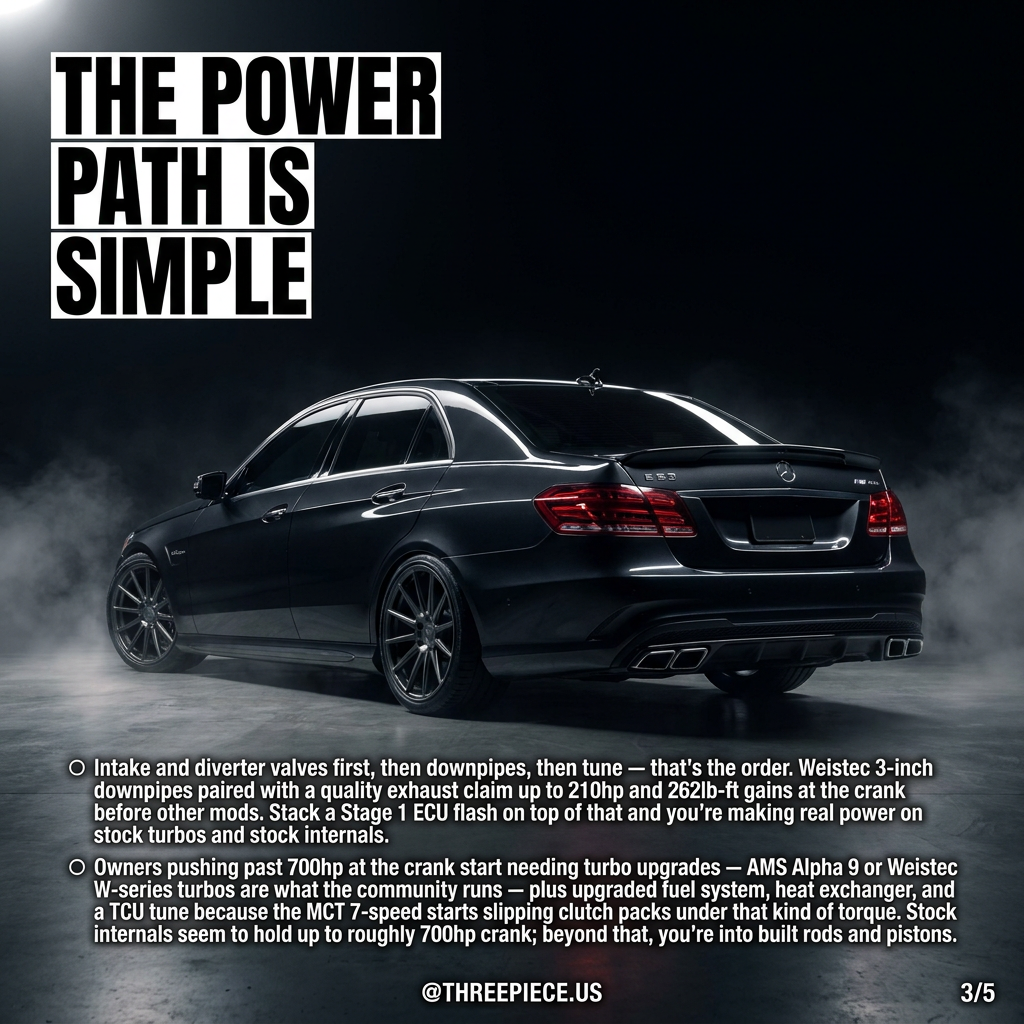
Step 4 (700+ hp): Turbo upgrade. Owners pushing past 700 hp at the crank move to upgraded turbochargers — AMS Alpha 9 or Weistec W-series turbos are what the community runs. At this level you also need an upgraded fuel system, upgraded heat exchanger, and a TCU tune because the AMG SPEEDSHIFT MCT 7-speed starts slipping clutch packs under that kind of torque. The Wesitec TCU upgrade and EDOK TCU tune are both documented solutions. Some builds at this level also upgrade the torque converter or clutch packs entirely.
Failure Modes and Preventive Maintenance
Before you touch a single mod, do full preventive maintenance. This is not optional — it's the difference between a reliable 700 hp sedan and an expensive paperweight.
Timing chain tensioner: Inspect and replace if needed. Labor alone runs $2,200–$8,800 depending on the shop. This is the single most important pre-mod inspection on the M157.
Piezo injectors: Budget $2,000–$4,000 for all eight if they need replacement. These are high-precision components and they degrade over time, especially on higher-mileage cars.
Turbo coolant lines: Check for leaks and replace proactively. A coolant leak near the turbos can cascade into much more expensive problems.
HPFP (high-pressure fuel pump): Verify function before adding boost. A failing HPFP under increased fuel demand is a recipe for lean conditions. If you've dealt with HPFP concerns on other German turbo platforms, the N54 335i's well-documented HPFP issues offer a cautionary tale.
Front control arm bushings: These wear out around 60–80k miles and faster with stiffer suspension. Symptoms include vibrations at 60–80 mph and idle incline. Forum members report getting these replaced under warranty when caught early. The Energy Suspension polyurethane control arm bushings at $74.56 are a popular upgrade path for longer bushing life on lowered cars.
Front differential: Some long-term owners report front diff bearing failures or leaks on AWD cars. Not usually catastrophic, but monitor for noise or fluid loss.
Wheels and Suspension Done Right
The W212 E63 runs rear air suspension from the factory with steel springs up front. This hybrid setup is actually decent stock, but it limits your options when lowering. Most owners go one of two routes: coilovers up front with the rear air retained, or a full coilover conversion. BC Racing BR series (part J-23-BR) fits the 2014–2015 E63 AWD. If you're weighing whether coilovers make sense for your use case, our guide on whether coilovers are worth it on daily drivers covers the tradeoffs. For spring rate selection on a 4,200+ lb sedan, read our coilover spring rate guide — you'll want stiffer rates than most people assume for a car this heavy.
Target a drop of 1.5–2 inches up front and 1.5 inches in the rear for a clean stance without scraping on full compression. Budget for front control arm bushings in your suspension build — they wear faster with stiffer springs.
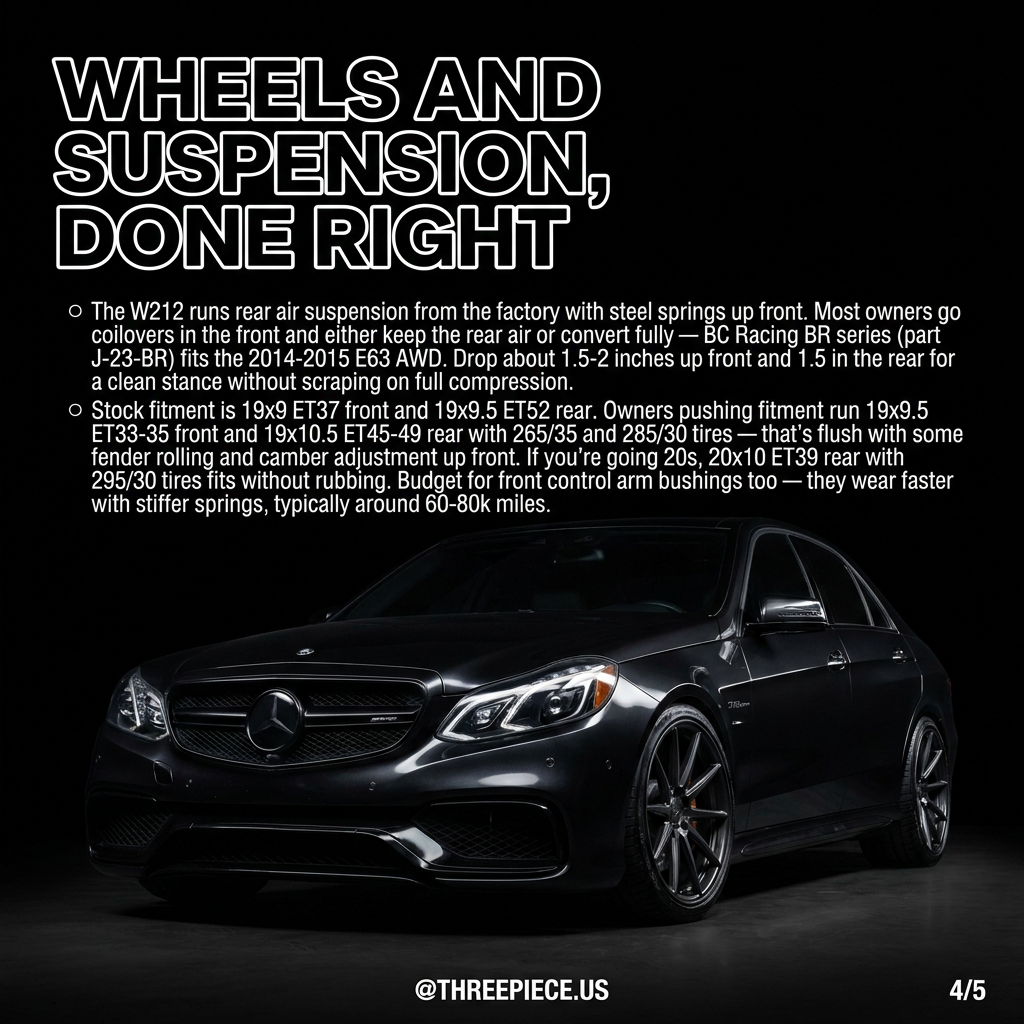
Stock fitment is 19x9 ET37 front / 19x9.5 ET52 rear on a 5x112 bolt pattern with a 66.6mm center bore. That rear offset is very conservative — Mercedes tucks the wheels in for comfort and clearance. Owners pushing fitment run 19x9.5 ET33–35 front / 19x10.5 ET45–49 rear with 265/35R19 and 285/30R19 tires — that's flush with some fender rolling and camber adjustment up front.
If you're going 20s — which is where the W212 really transforms visually — 20x9.5 front / 20x10.5 rear is the proven staggered setup. A 20x10 ET39 rear with 295/30R20 tires fits without rubbing. Browse 20-inch wheels in 5x112 to see what's currently available. For the front, 20x9.5 in 5x112 is your search. Pair them with 265/30R20 front tires and 295/30R20 rear tires for the aggressive staggered look.
For wheel style, the W212's aggressive fender lines pair exceptionally well with deep-concave multi-piece designs. The Work VS series and Work Meister series both offer the kind of concavity that transforms the E63 from "nice sedan" into something that stops people in parking lots. A set of Work VS center caps at $50 each finishes the look properly. If you're running any 3-piece wheel, make sure you have the right assembly hardware — M7x32 chrome assembly bolts at $10 each or M8x32 chrome assembly bolts depending on your wheel spec. Don't forget 90-degree valve stems at $3.80 — deep-dish lips make standard valve stems nearly impossible to air up. Check our vehicle gallery for real-world fitment examples on similar platforms.
Build Yours This Week
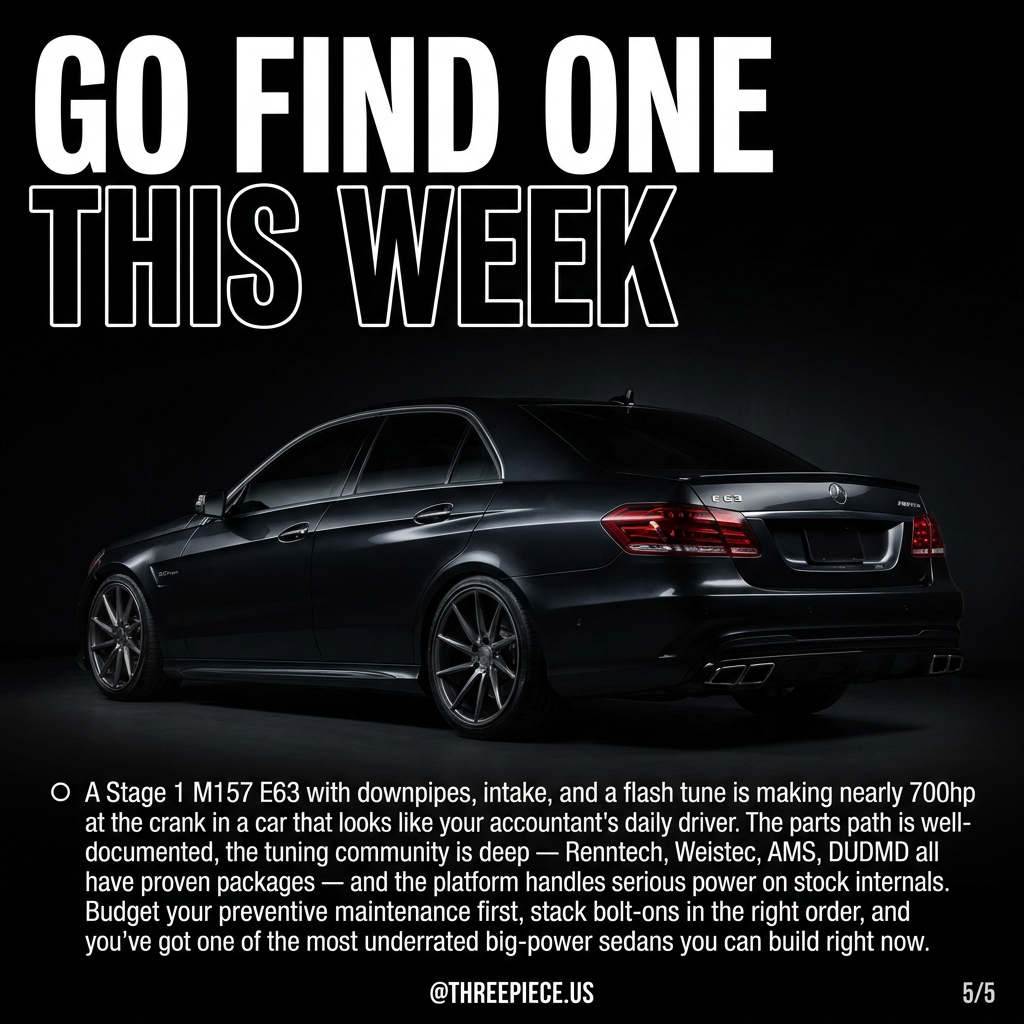
A Stage 1 M157 E63 with downpipes, intake, and a flash tune is making nearly 700 hp at the crank in a car that looks like your accountant's daily driver. The parts path is well-documented, the tuning community is deep — Renntech, Weistec, AMS, DUDMD all have proven packages — and the platform handles serious power on stock internals up to that threshold. Budget your preventive maintenance first, stack bolt-ons in the correct order, and finish it with a proper staggered wheel setup that actually fits.
The W212 is sitting in a value window right now. C63 prices climbed. M5 prices climbed. The E63 hasn't caught up yet. If you're building one, start with the right wheels and suspension to match the power — because a 700 hp sedan on stock wheels is a waste of a platform this good.