
Honda NSX History: Every Generation Ranked by Owners
The Honda NSX rewrote the supercar rulebook in 1990 and spent the next three decades proving that analog engineering ages better than anything with a hybrid battery pack. From the original NA1 with its all-aluminum monocoque to the NC1 Type S making 600 hp through twin turbos and three electric motors, every generation of the NSX represents a fundamentally different philosophy about what a mid-engine car should be. Here's the full history, the real owner data, and our definitive ranking — backed by forum threads, build logs, and long-term ownership patterns that tell you more than any press release ever will.
Quick links
- The NA1: Senna-Tuned and Built to Embarrass Ferrari
- The NA2: Why the 3.2L 6-Speed Is the Definitive NSX
- The NC1: 507 HP That Divided the Community
- 2022 Type S: The 600 HP Redemption Arc
- Common Failures and What They Actually Cost
- NSX Wheel Fitment and Upgrade Path
- The Final Rankings — No Debate
The NA1: Senna-Tuned and Built to Embarrass Ferrari
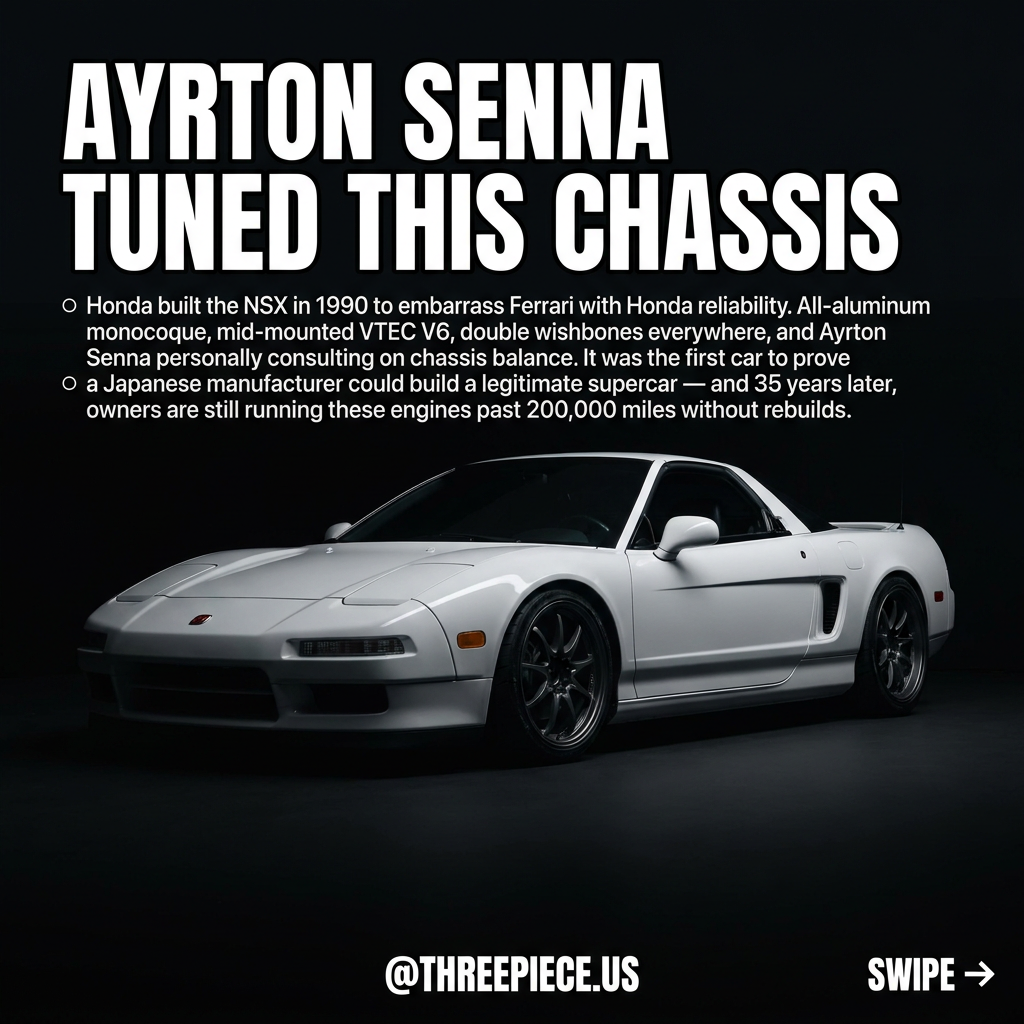
Honda didn't just build a sports car in 1990 — they built the first all-aluminum monocoque production car, stuffed a mid-mounted 3.0L C30A DOHC VTEC V6 behind the seats, and then let Ayrton Senna drive the prototype around Suzuka until he told them exactly what needed fixing. The result was ~270 hp, ~210 lb-ft, double wishbone suspension at all four corners, and a chassis balance so precise that it famously forced Ferrari to rethink their entire quality control process. If you've read our breakdown of the Porsche Cayman's generational evolution, the NSX story follows a similar arc — a mid-engine car that was underestimated at launch and now commands serious collector money.
The early NA1 came with a 5-speed manual that had notoriously long gearing — second gear alone tops out around 81 mph at redline. A 4-speed F-Matic automatic was available later, but nobody building an NSX today wants that. The NSX-T targa variant arrived around 1995, adding roughly 100 lbs (~45 kg) of structural bracing to compensate for the roof cut. It softened the front springs and stiffened the rears to manage the mid-engine oversteer tendencies introduced by the rigidity loss. The NSX-T is the most common variant you'll find, and it's the reason coupe-only NA1s command a premium.
Then there's the NSX-R (1992–1994, JDM only): stripped to roughly 1,230 kg versus the stock car's ~1,350 kg, no sound deadening, optional A/C and stereo, blueprinted engine pushing closer to 280 bhp, Recaro buckets, titanium shift knob. These are the holy grail cars now — if you can find one outside Japan, expect to pay accordingly. The NSX-R proved that Honda understood weight reduction the way Porsche understood turbocharging: as a fundamental engineering discipline, not a marketing checkbox. If you appreciate that philosophy, our piece on the Acura RSX Type-S as a future classic covers the same Honda DNA in a more accessible package.
The NA2: Why the 3.2L 6-Speed Is the Definitive NSX
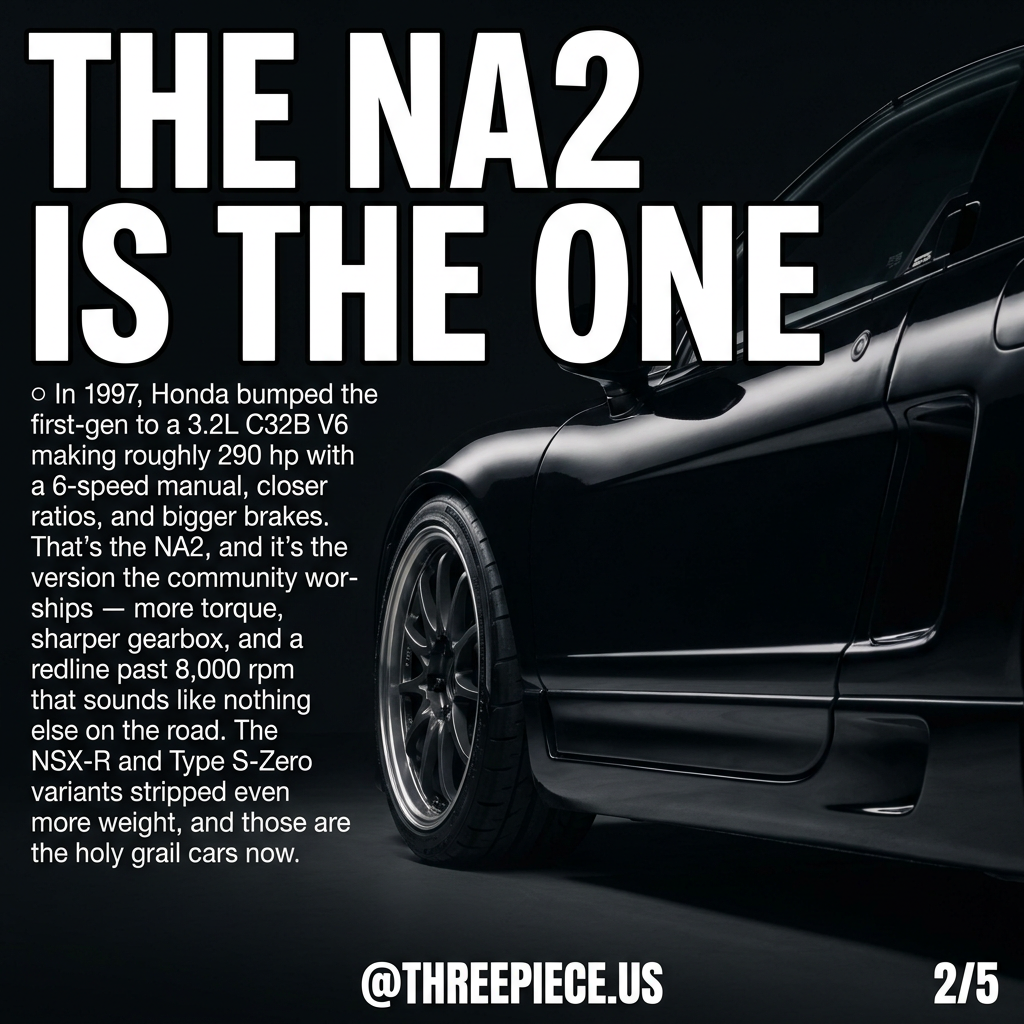
In 1997, Honda upgraded the first-gen NSX to the NA2 specification, and this is the version the community worships. The engine grew to a 3.2L C32B V6 making roughly 290–295 hp and ~224 lb-ft of torque, with a redline pushing past 8,100–8,200 rpm. The transmission switched to a 6-speed manual worldwide with closer ratios and dual-cone synchros on third and fourth gears — addressing the biggest complaint about the original 5-speed's gaping ratio spread. Second gear was shortened significantly, making the car feel dramatically more responsive in the real-world driving range where you actually use it.
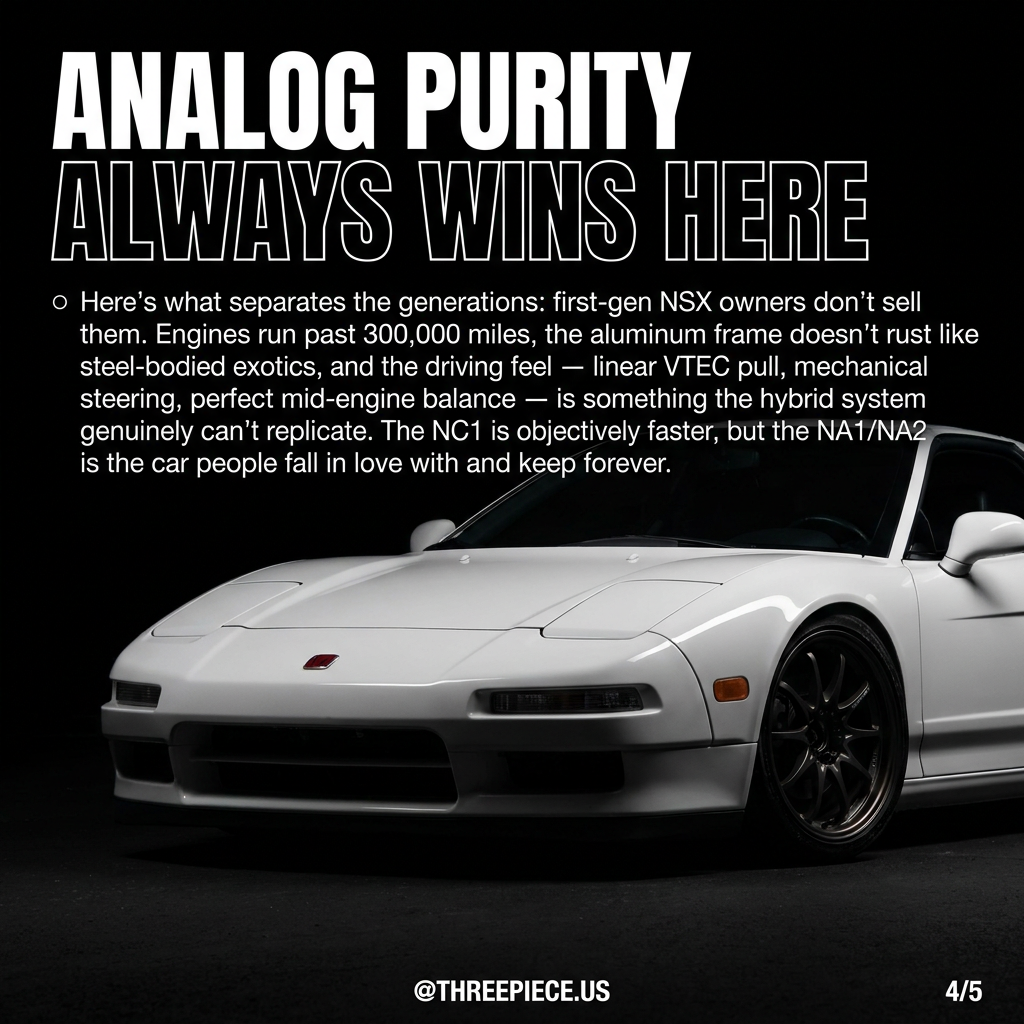
Brakes got a serious upgrade too: front rotors jumped from 305 mm to 330 mm, improving both straight-line stopping and repeated high-speed braking. The NA2 also spawned the Type S and Type S-Zero variants in Japan — further weight reduction, stiffer suspension tuning, and the kind of factory obsessiveness that makes these cars appreciate rather than depreciate. The driving experience is what separates the NA2 from everything else in its price range: linear VTEC pull that builds with absolute precision, mechanical steering with real feedback, and a mid-engine balance that makes you better as a driver rather than hiding your mistakes behind electronics. Similar to how the best sub-$30K sports cars punch above their weight through driver engagement, the NA2 NSX delivers an experience that no amount of horsepower can substitute.
Modding the NA1/NA2 is common and fruitful. JDM short gears with a 4.23 rear ring and pinion, Type R transmission gearing swaps, lighter wheels, exhaust, and intake work are the go-to upgrades. Stock dyno pulls often show numbers higher than Honda's published figures. The platform rewards thoughtful modification — it doesn't need forced induction to be fast, it needs less weight and better gearing. That's the purist approach, and it's why first-gen NSX owners almost never sell.
The NC1: 507 HP That Divided the Community
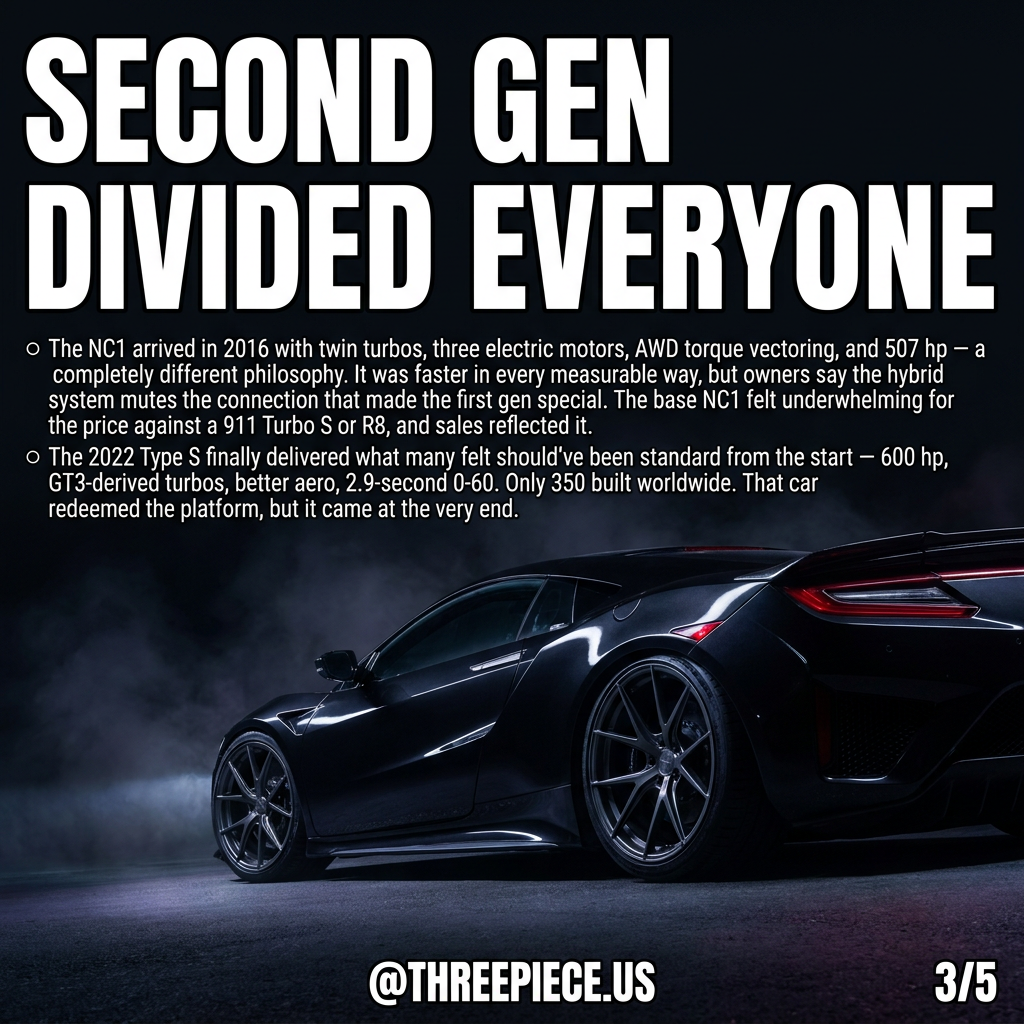
The second-generation NSX arrived in 2016 as the NC1, and it was a completely different animal. A twin-turbocharged 3.5L V6 paired with three electric motors — one sandwiched between the engine and a 9-speed DCT, two driving the front wheels independently for torque-vectoring AWD. Combined output: ~507 hp. Built at Honda's Performance Manufacturing Center in Marysville, Ohio, not hand-assembled in Japan. The car was faster in every measurable metric, but the enthusiast community was split from day one.
The base NC1 felt underwhelming relative to its $157K+ MSRP. Against a Porsche 911 Turbo S or Audi R8, the NSX didn't have the badge cachet, the dealer experience, or — critically — the visceral driving feel to justify the price. Reddit threads and owner forums consistently note that the hybrid system mutes the connection. Oil changes run north of $400, transmission and clutch fluid maintenance is frequent, and the bespoke hybrid components make independent shop work difficult. Sales volume reflected the disconnect — Honda never moved enough units to justify the platform's development cost, and the NC1 was discontinued after just six model years.
That said, the NC1 is criminally undervalued right now. Depreciation has been steep, and the technology underneath is genuinely impressive. If you're the kind of buyer who cares about lap times and tech over analog feel, the base NC1 is a lot of car for what the market is asking. It's a similar dynamic to what we covered in the Boxster vs. Cayman comparison — the "lesser" car is often the smarter financial play.
2022 Type S: The 600 HP Redemption Arc
The 2022 NSX Type S is what many owners felt the NC1 should have been from the start. Honda fitted GT3 Evo turbos with roughly 5.6% more boost, 25% higher-flow fuel injectors, and 15% larger intercoolers. Combined output jumped to ~600 hp. Aerodynamics were reworked with a new front nose and a carbon rear diffuser derived directly from the GT3 race car. The front and rear track were widened, and semi-slick Pirelli P-Zero tires delivered roughly 6% more lateral grip. The result: 0–60 in ~2.9 seconds, quarter-mile in roughly 11.0 seconds, and a claimed 4-second improvement over the original NSX at Suzuka.
Only 350 units were built worldwide. That scarcity, combined with the fact that it's the fastest NSX Honda ever produced, means the Type S will almost certainly hold value as a limited-run sendoff — similar to how the last-year special editions from Porsche and BMW become instant collectibles. The Type S redeemed the NC1 platform, but it came at the very end of the production run, which tells you everything about how long it took Honda to get the formula right on the second generation.
Common Failures and What They Actually Cost
The first-gen NSX is remarkably reliable for a mid-engine exotic, but there's one well-documented failure you need to know about. The 1991–1992 5-speed transmissions in serial range J4A4-1003542 to J4A4-1005978 have an incorrectly machined aluminum groove in the case. The snap ring holding the countershaft bearing can break, causing shifter play, grinding between first and second, and eventual transmission failure. Documented failures typically occur between 40,000–80,000 miles, though some lucky owners have gone past 120,000 miles without issue. A full dealer transmission replacement runs ~$7,000–$7,500; an NSX specialist rebuild with new upper case, snap ring, and bearings costs roughly ~$2,500. Preventive repair before failure is about ~$700 in parts plus roughly 10 hours of labor.
Beyond the snap-ring issue, first-gen ownership is straightforward: timing belt service every ~90,000 miles or 6 years, trunk and hatch gas struts wear out, stereo amps and speakers fail, and mirror/tail light parts are getting rare and expensive. None of these are bank-breakers individually, but cumulative neglect is the real threat on these cars. If you're considering any high-mileage Japanese sports car, our oil catch can guide covers a mod that helps protect aging VTEC engines, and our cold air intake reality check will save you from wasting money on mods that don't help the C30A/C32B platform.
The NC1 is a different story. Hybrid system complexity means independent shop work is limited, oil changes exceed $400, and DCT clutch/fluid maintenance adds up fast. Parts are bespoke and expensive. If you're buying an NC1, budget for dealer-level maintenance or find a specialist early.
NSX Wheel Fitment and Upgrade Path
The first-gen NSX runs a 5x114.3 bolt pattern — the same as most Honda/Acura platforms, which opens up a massive aftermarket selection. The factory stagger was 15x6.5 front / 16x8 rear on early NA1s, moving to 16x7 front / 17x9 rear on later NA2 models. Most builds today run 17x8 front / 18x9.5 rear for the ideal balance of sidewall protection, brake clearance, and aggressive stance without rubbing. If you're exploring that sizing, browse 17x8 wheels in 5x114.3 for fronts and 18x9.5 wheels in 5x114.3 for rears.
Lightweight wheels are the single best modification you can make to a first-gen NSX. Reducing unsprung mass on a car that already weighs under 3,000 lbs transforms turn-in response and braking feel. The Work Emotion series is a popular choice for NSX builds — lightweight, strong, and available in the right sizes. For a more period-correct JDM look, the Work Meister line or Work Equip series fits the era perfectly. If you want to understand why forged wheels matter on a car this light, the weight savings per corner are proportionally larger than on any 4,000-lb sedan.
For tire pairing, 215/45R17 fronts and 255/40R18 rears is the community-proven sweet spot on a staggered 17/18 setup. If you're running a square setup for track duty, the math changes — check our guide on Civic Type R fitment for a reference point on 5x114.3 Honda platform sizing principles. Finish the build with proper Work center caps and 90-degree valve stems at $3.80 each — critical on deep-dish rear wheels where straight stems won't clear.
The NC1 runs a 5x120 bolt pattern with factory 19-inch front / 20-inch rear sizing. Aftermarket options are more limited due to the hybrid system's weight distribution requirements and massive Brembo brake calipers, but 19-inch 5x120 wheels are a good starting point for front replacements. Check our vehicle gallery for real-world NSX builds with proper fitment.
The Final Rankings — No Debate
Here's how the NSX generations and variants stack up, based on owner retention rates, community consensus, and long-term value trajectory:
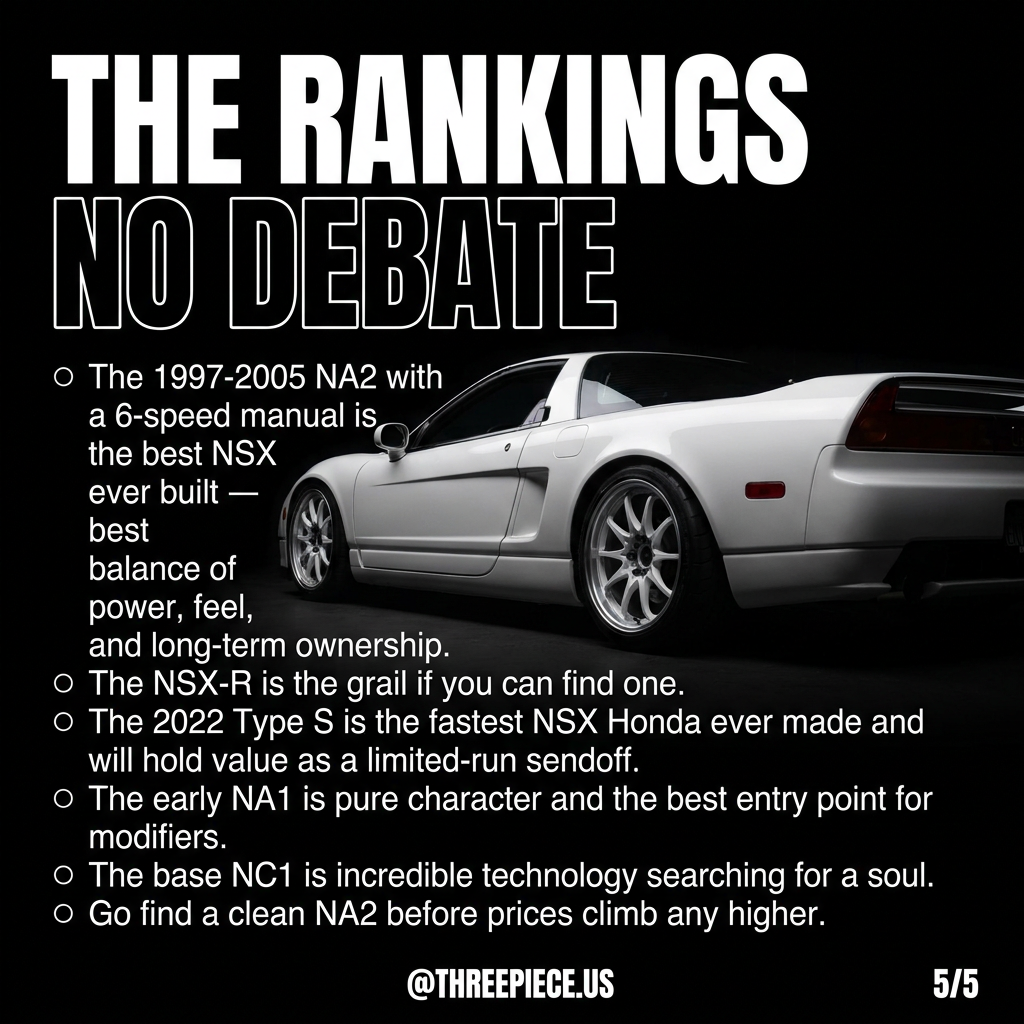
- 1997–2005 NA2 (6-speed manual) — The best NSX ever built. Best balance of power, feel, gearing, and long-term ownership. The C32B's extra torque and the 6-speed's closer ratios fix every weakness of the original. Engines run past 200,000–300,000 miles without rebuilds, the aluminum frame doesn't rust like steel-bodied exotics, and the driving feel is something no hybrid system can replicate. If you can only own one NSX, this is it.
- NSX-R (1992–1994 / 2002 JDM) — The grail. Factory blueprinted engine, ~120 kg lighter than stock, and a driving experience that borders on religious. Finding one outside Japan at a price that makes sense is the challenge.
- 2022 Type S — The fastest NSX Honda ever made. 600 hp, 2.9-second 0–60, only 350 built. This will hold value as a limited-run sendoff piece, and it finally delivered the performance the NC1 platform always promised.
- 1990–1996 NA1 (manual) — Pure character. The original Senna-tuned chassis, the screaming C30A, and the best entry point for modifiers who want to build something personal. The long gearing is a quirk, not a flaw, once you install a JDM short-gear final drive.
- Base NC1 (2016–2021) — Incredible technology searching for a soul. Objectively fast, criminally undervalued on the used market, and a smart buy if you care about performance per dollar over analog purity. But it's not the car people fall in love with and refuse to sell.
The market is figuring this out. Clean NA1s and NA2s aren't getting cheaper. If you've been waiting to find one, the window is closing. Start with the right wheels — browse our full wheel catalog or explore the Work VS series for a wheel that matches the NSX's JDM heritage. And if you're building any Honda platform right now, the FG2/FA5 Civic Si buying guide and TLX Type S deep dive cover the broader Honda/Acura ecosystem worth knowing.