
Posted by THREEPIECE.US on May 13th 2026
Porsche Boxster vs Cayman: Why the Boxster Is the Smarter Buy
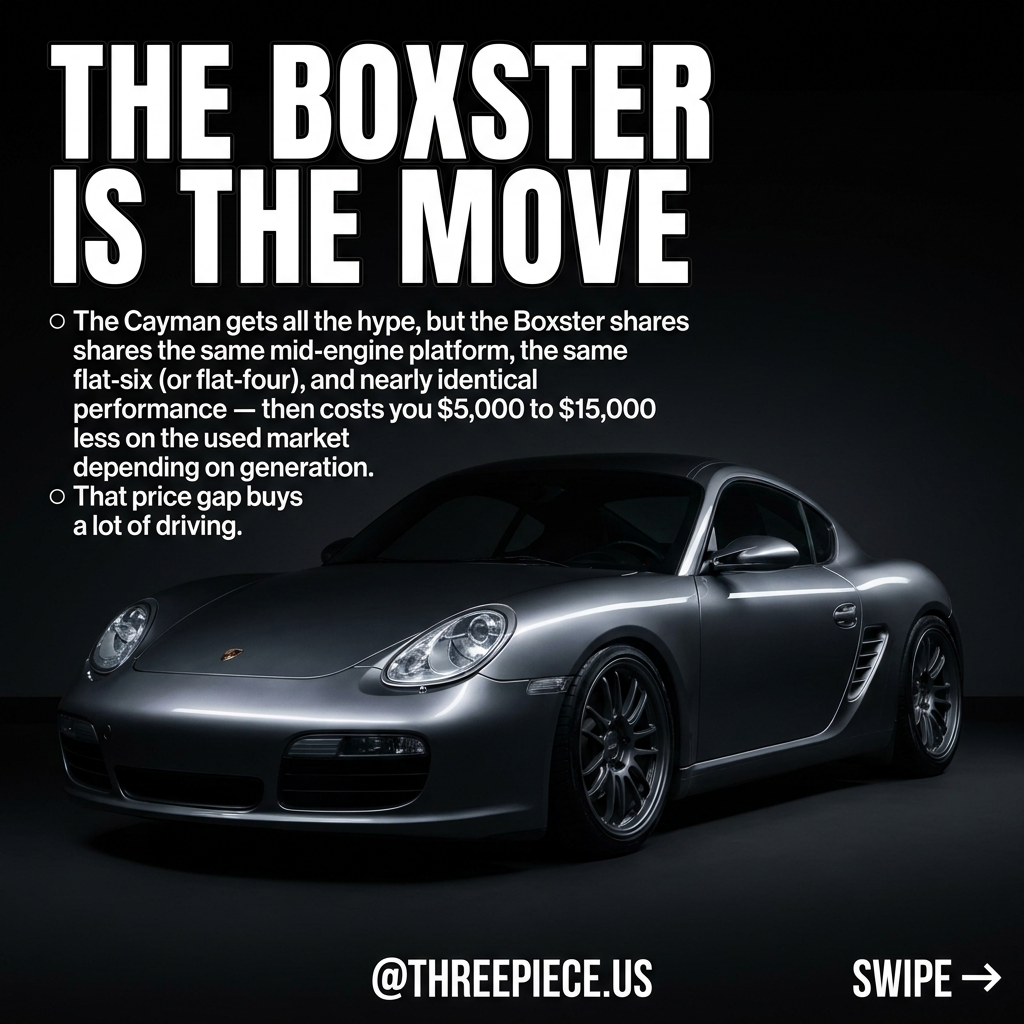
The Porsche Boxster shares the same mid-engine platform, the same flat-six (or flat-four), and nearly identical performance numbers as the Cayman — then costs you $5,000 to $15,000 less on the used market depending on generation. The Cayman gets all the forum hype and the "serious driver" reputation, but the math doesn't support the premium. If you're shopping for a mid-engine Porsche and you haven't seriously considered the Boxster, you're leaving money on the table — money that goes straight into the mods that actually matter.
Quick links
- Same Car, Roof Off
- The Price Gap Is Real
- Budget for the Top
- Wheel Fitment for the Boxster
- Which Boxster to Buy
- Stop Paying the Coupe Tax
Same Car, Roof Off
Here's what most buyers miss: in the 981 generation, the Boxster S and Cayman S weigh almost the same — around 2,976 lbs. The performance gap is roughly 10 hp. On the 718/982 platform, both the Boxster S and Cayman S use the same 2.5-litre turbo flat-four, and the Cayman S edges out the Boxster S in 0–60 by about two tenths of a second — 3.9 vs 4.1 seconds — mostly attributable to the fixed roof's marginal rigidity advantage. That's it. That's the entire performance delta you're paying five figures more for.
Owners who've driven both back-to-back consistently say the Boxster feels more alive. More sensory feedback, more connection to the road, more of the visceral mid-engine experience that made you want a Porsche in the first place. The convertible top isn't a compromise — it's the point. You hear the flat-six (or the turbo four's intake bark) directly behind your head, unfiltered. If you've ever wondered how our Cayman generation rankings stack up, the Boxster equivalents follow the same hierarchy — because they're the same cars underneath.

The Price Gap Is Real
Used 987 Boxsters show up in the $5,000–$8,000 range where comparable 987 Caymans sell for noticeably more. On 981s, you're looking at roughly $42k for a Boxster versus $55k for a Cayman. That's $10–15k in your pocket for the same drivetrain, same chassis, same mid-engine balance — just with a convertible top instead of a fixed roof.
The Cayman holds resale better in percentage terms, but you paid more to get in. If your goal is lowest cost per year of ownership, the Boxster wins the math every time. And that $10–15k gap? That's a full set of forged wheels, a quality coilover setup from our suspension catalog, and tires with change left over. It's the difference between a stock Cayman and a properly built Boxster that handles better, looks better, and cost you less total.
If you're curious whether forged wheels are worth the spend on a car like this, we broke down the real math in our guide to forged wheels — on a lightweight mid-engine car, the unsprung weight savings are more tangible than on almost any other platform.

Budget for the Top
Honesty time: the convertible mechanism is extra maintenance the Cayman doesn't have. On 986 and 987 Boxsters, plastic ball joints in the roof's support arms get brittle and crack, causing misalignment or the top jamming mid-cycle. Nylon gears inside the top's transmission units wear out — symptoms include the motor spinning but the top not moving, or stopping halfway. Shop repairs for the top gearing run $1,000–$1,500. A full soft-top replacement on a late-model car can hit $4,000–$6,000.
The electrical side is where things get sneaky. Bad microswitches, corroded wiring harnesses, and blocked drains can send water into the CVM (convertible vehicle module) under the passenger seat. On 981 Boxsters, owners have traced roof control failures directly to water intrusion from clogged drain tubes. Inspect the top operation before you buy. Check for drain blockages. Budget a couple hundred a year for seal upkeep. Do that and you're golden — it's not a dealbreaker, it's just ownership prep.
The IMS bearing concern is the other elephant in the room, but it's largely a pre-2005 problem. The M96 engines in early 986/987 cars suffered IMS bearing failures between 30,000–80,000 miles in poorly maintained examples. Post-2005 base 2.7L models received improved bearings that dropped failure risk to under 1%. If you're buying a post-2005 car with documented IMS upgrade history, you're in good shape. For context on how engine reliability concerns affect buying decisions, our N54 problems guide covers a similar risk-vs-reward calculus.

Wheel Fitment for the Boxster
The Boxster and Cayman share the same bolt pattern — 5x130 — across every generation, which gives you access to the entire Porsche wheel ecosystem. On the 987, the factory stagger is typically 18x8 front / 18x9.5 rear on S models. The 981 bumps to 19x8 front / 19x9.5 rear on optioned cars. These are conservative fitments from the factory, and most owners running aftermarket wheels push slightly wider.
For 987 Boxsters, 18x8.5 +50 front / 18x10 +45 rear is the sweet spot for aggressive but streetable fitment. Browse 18-inch wheels in 5x130 to see what's available. On 981s, stepping up to 19-inch wheels in 5x130 fills the arches properly and gives you room for bigger brake packages. Pair those rears with 265/35R19 tires for serious grip without rubbing.
Three-piece wheels are a natural fit for the Boxster platform because the staggered setup demands precise width and offset control. The Work Meister series is a classic pairing — deep lips in the rear, flush fronts — and the modularity means you can spec exact offsets for your particular car. If you're running a 718 Boxster, our 718 Cayman wheel guide covers the same bolt pattern and similar sizing, so it's directly applicable. For a staggered setup primer, read our E92 M3 fitment guide — different car, but the principles of staggered width, offset, and tire stretch translate directly.
Don't forget the details that finish a build. 90-degree valve stems at $3.80 each are mandatory on deep-dish rears where straight stems won't clear brake calipers. And if you're running Work wheels, the Work VS Reproduction Center Cap at $50 or the Work Rezax Reproduction Center Cap at $50 finishes the look properly.
Which Boxster to Buy
The 987.2 Boxster (2009–2012) is the sweet spot for most buyers. It runs the improved DFI (Direct Fuel Injection) flat-six with no IMS bearing concern whatsoever. The base 2.9L makes 255 hp, the S bumps to 310 hp from a 3.4L. Both sound incredible with the top down. Prices for clean 987.2 Boxster S examples sit in the $25,000–$35,000 range — significantly less than equivalent Cayman S cars.
If you're on a tighter budget, the 987.1 Boxster (2005–2008) with the 2.7L base engine and documented IMS bearing service is the value play. These show up under $15k regularly. The S models with the 3.2L/3.4L carry slightly more bore-scoring risk, so service history matters more there.
For the 981 generation (2013–2016), both the Boxster and Boxster S are mechanically excellent. The 981 Boxster S with its 315 hp 3.4L flat-six, six-speed manual, and Sport Chrono package is one of the best driver's cars ever made at any price. These trade in the $40,000–$50,000 range — still meaningfully less than a 981 Cayman S or GTS.
The 718 (982) generation moved to turbocharged flat-fours on base and S models. The GTS 4.0 brought back the naturally aspirated flat-six with ~395 hp. If you want the flat-six sound with the top down, the 718 Boxster GTS 4.0 is the pinnacle — but 987.2 and 981 cars give you that same experience for dramatically less money. If you want to understand how the 718 Cayman stacks up generation by generation, our Porsche Cayman history article covers every variant.

Stop Paying the Coupe Tax
If you live somewhere with six-plus months of good weather and you actually want to feel the car — the wind, the exhaust note bouncing off concrete walls, the whole visceral mid-engine experience — the Boxster delivers what the Cayman physically cannot. The performance difference is negligible. The price difference is not.
Post-2005 models with improved IMS bearings, documented service, and a healthy top are the sweet spot. Buy one, put the savings into a set of proper Work Wheels or Work Emotion series wheels, add quality M7 assembly hardware, and you'll have a better-looking, better-handling car than the guy who spent $15k more on a Cayman and left it stock. Check out our vehicle gallery for build inspiration, and stop paying the coupe tax for a roof you don't need. Go drive one with the top down and try to talk yourself out of it.