
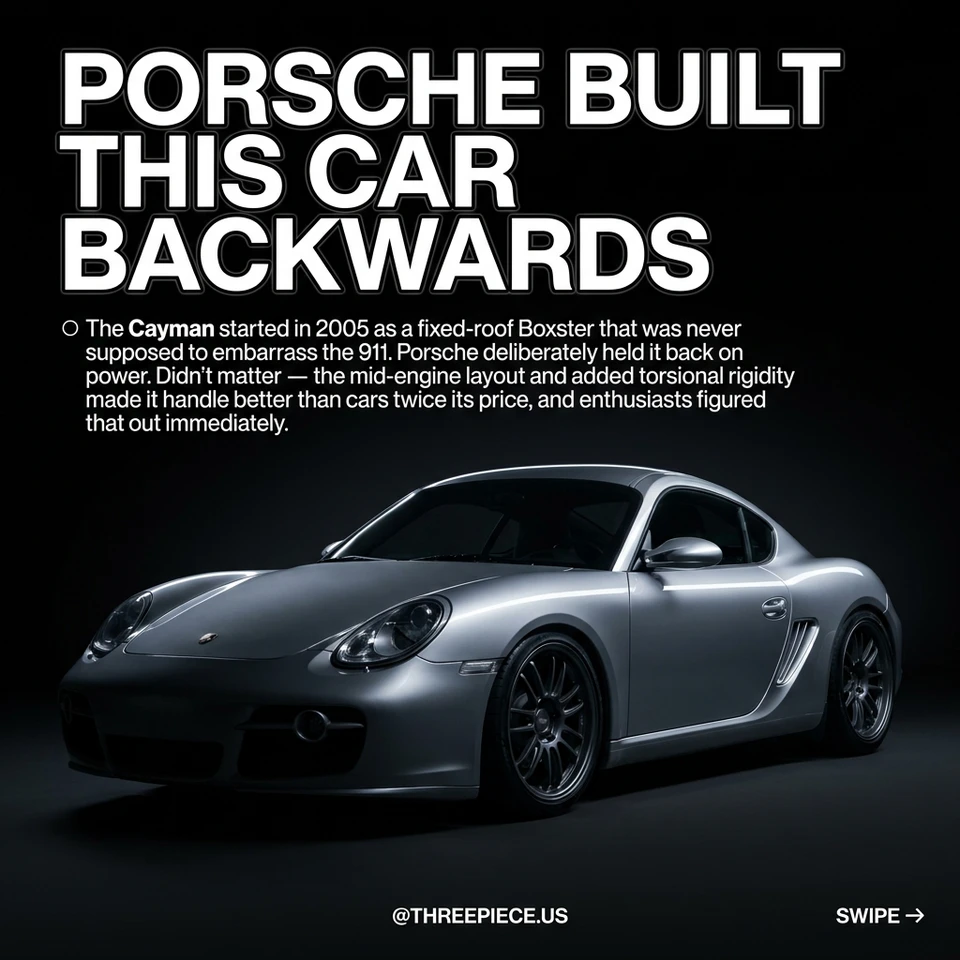
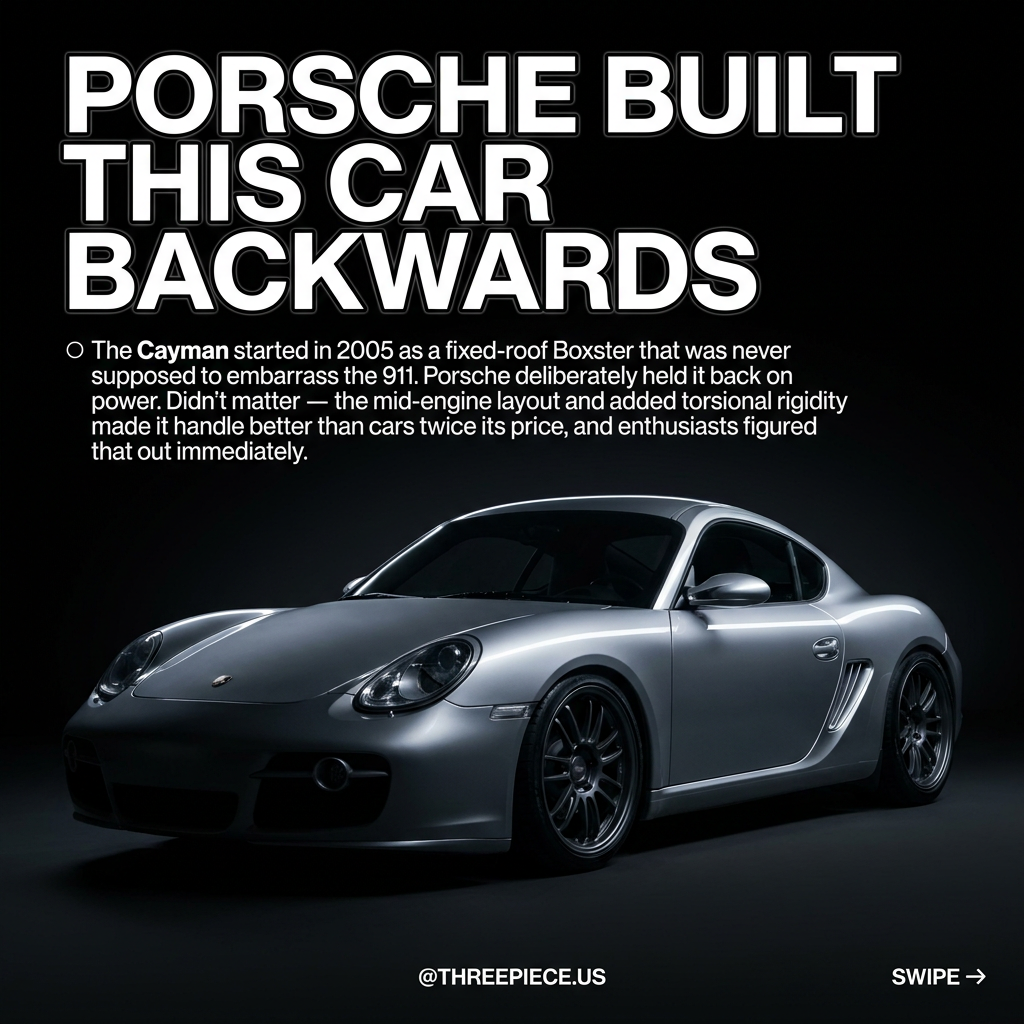
The Porsche Cayman was never supposed to be this good — and Stuttgart knew it. From the moment the fixed-roof Boxster variant debuted in 2005, Porsche deliberately held it back on power to protect the 911's hierarchy. But a mid-engine layout, exceptional torsional rigidity, and a chassis that punched well above its price point meant enthusiasts figured out the truth immediately. Here's the full Porsche Cayman history — every generation broken down, ranked, and evaluated by what actually matters to the people who drive them.
Quick links
- 987 Cayman (2005–2012): Where It All Started
- 981 Cayman (2012–2016): Peak Naturally Aspirated
- 718 Cayman / 982 (2016–2025): The Flat-Four Controversy
- The Actual Ranking — And Why It Matters
- Cayman Wheel Fitment and Sizing Notes
- Which Cayman Should You Buy?
987 Cayman (2005–2012): Where It All Started
The first-generation Cayman split into two distinct eras, and understanding the difference between them is the single most important thing if you're shopping for one. The 987.1 (2005–2008) gave you hydraulic steering, a cable throttle, and a flat-six that felt completely mechanical. The Cayman S made roughly 295 hp from a 3.4L M97.20, hitting 0–60 in about 5.2–5.4 seconds — respectable, but the real story was the chassis. That mid-engine balance made it handle better than cars costing twice as much.
The problem? The M96/M97 engines in pre-2007 cars carried two notorious failure points: IMS bearing failures that could destroy the entire engine (replacements running $8,000–$12,000 with install) and bore scoring on the cylinder walls that led to oil burning and progressive performance loss. AOS (air-oil separator) failures and rear main seal leaks round out the list of common headaches. Buying a 987.1 without a pre-purchase inspection from a Porsche-specialist shop is a gamble you don't want to take.
The 987.2 (2009–2012) changed everything. Porsche redesigned the engine case, effectively eliminating the IMS bearing concern, added direct injection, bumped the S to around 320 hp, and introduced the PDK gearbox as an option — all while keeping the hydraulic steering that made the 987 feel alive. Owners on forums routinely report 987.2s running past 180,000 miles with no major engine work. The crown jewel of this generation is the 2012 Cayman R: 330 hp, aluminum doors, no AC or radio from the factory, roughly 121 lbs lighter than the S. Still analog, still raw, and increasingly collectible. If you're considering whether forged wheels are worth the investment for a build like this, the answer on a car this pure is always yes.
981 Cayman (2012–2016): Peak Naturally Aspirated
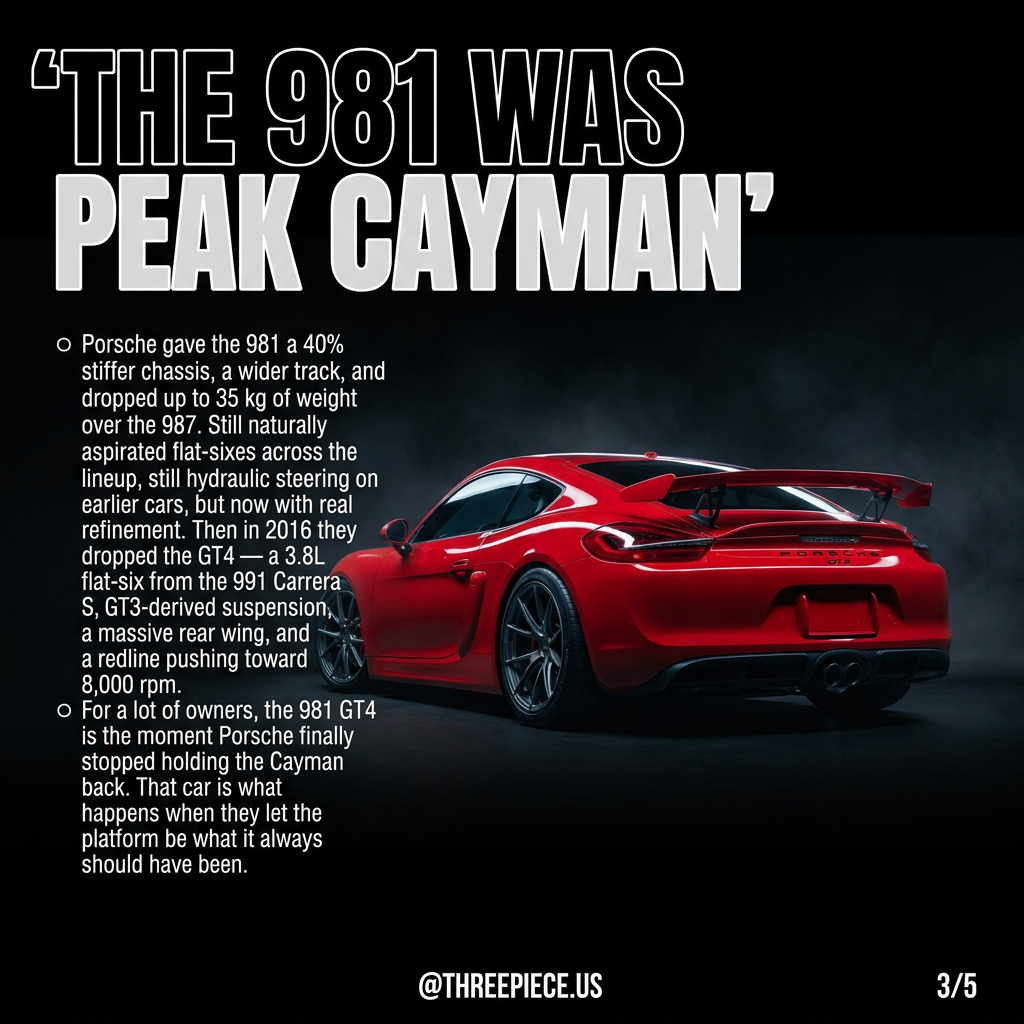
The 981 is where Porsche finally let the Cayman breathe — and it might be the best mid-engine sports car you can buy under $80,000. The chassis received a 40% increase in torsional rigidity over the 987, a wider track, and shed up to 35 kg of weight. The base model ran a 2.7L flat-six, the S got the 3.4L, and the GTS pushed output even further. All naturally aspirated, all flat-six, all connected to a chassis that could exploit every horsepower.
Then in 2015, Porsche dropped the GT4. A 3.8L flat-six borrowed from the 991 Carrera S, GT3-derived suspension, a massive fixed rear wing, and a redline pushing toward 8,000 rpm. Factory rating was 385 hp, but owner dyno pulls and builds with lightweight flywheels and exhaust work regularly show 420+ crank hp. The 981 GT4 is the moment Porsche stopped pretending the Cayman wasn't capable of embarrassing the 911 in the right hands. If you're curious about how similar mid-engine platforms compare, our piece on the $30K sports car that outperforms $100K supercars covers that territory.
The trade-off with the 981 is the switch to electric power steering on most models. It's less communicative than the hydraulic rack in the 987, and some owners notice the difference immediately. PDK clutch packs can also wear under heavy track use, so if you're buying a 981 with a documented track history, budget for transmission cooling upgrades or a clutch pack refresh. That said, for the vast majority of canyon and weekend-track use, the 981 is the sweet spot of the entire Cayman lineage. Understanding how to pick the right coilover spring rate matters here — the 981's chassis rewards proper suspension tuning more than almost any car in this price range.
718 Cayman / 982 (2016–2025): The Flat-Four Controversy
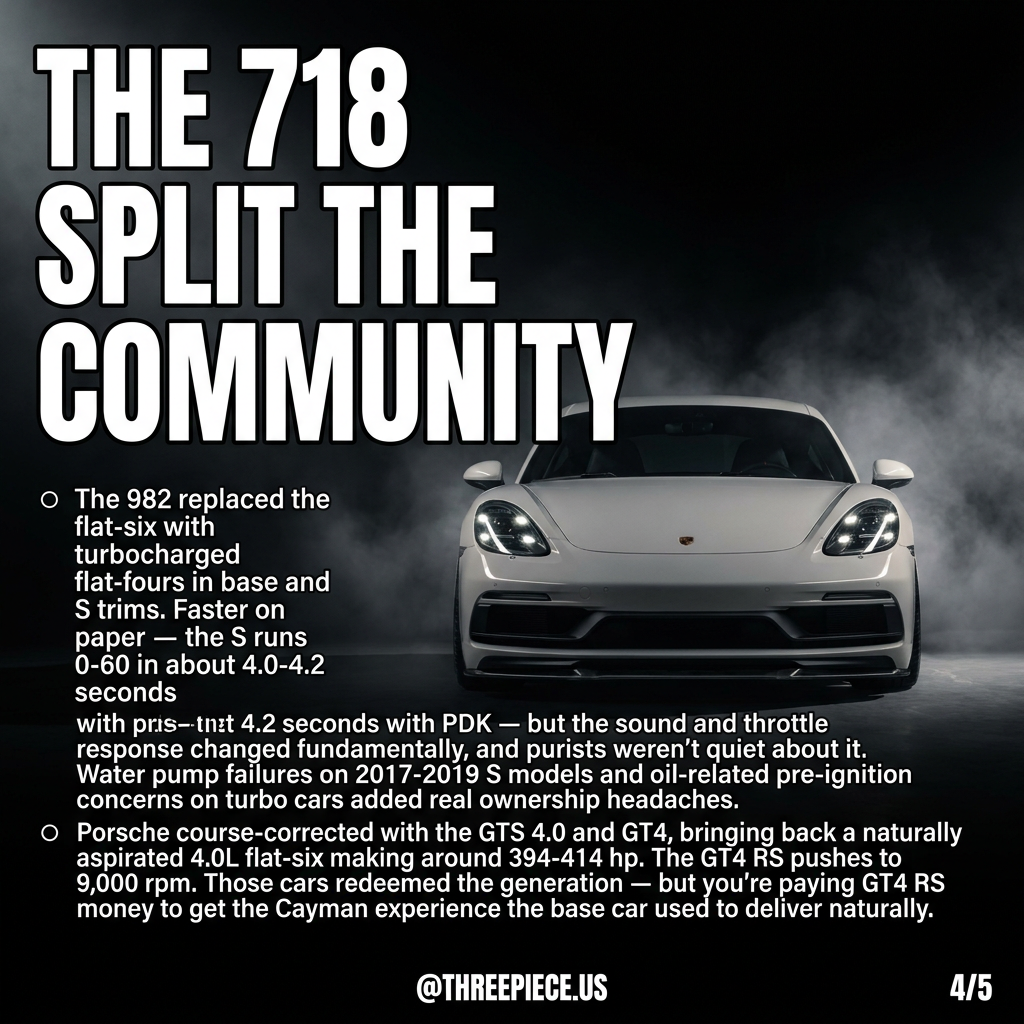
The 982 generation is where Porsche split the Cayman community in half. Base and S models replaced the beloved flat-six with turbocharged flat-fours — a 2.0L in the base and a 2.5L with VTG turbo in the S. On paper, the 718 S is faster than any previous base-or-S Cayman: 0–60 in about 4.0–4.2 seconds with PDK. But the sound changed fundamentally, the throttle response lost the instantaneous snap of a naturally aspirated engine, and purists were not quiet about it.
Real ownership headaches compounded the issue. Water pump failures on 2017–2019 S models caused coolant leaks that could contaminate the vacuum system, fouling valves and triggering erratic temperature warnings. Oil-related pre-ignition concerns on the turbo engines pushed many owners to shorter oil change intervals — every 5,000–6,000 miles instead of the factory-recommended 10,000. These aren't exotic-car problems, but they're frustrating on a car that costs this much. If you're weighing whether an ECU tune is worth it on a turbo-four 718, the answer is complicated — the gains are real, but you're adding stress to an engine that already has documented reliability concerns.
Porsche course-corrected with the GTS 4.0 and GT4, bringing back a naturally aspirated 4.0L flat-six making 394–414 hp. The GT4 RS pushes to a 9,000 rpm redline and is genuinely one of the most spectacular driver's cars ever built. But you're paying GT4 RS money — well into six figures — to get the Cayman experience that the base car used to deliver naturally for half the price. The flat-four 718 is the most capable Cayman on paper and the least loved by the people who actually own them.
The Actual Ranking — And Why It Matters
Here's how the Cayman generations stack up when you account for driving experience, reliability, value, and what owners actually say after years of ownership:
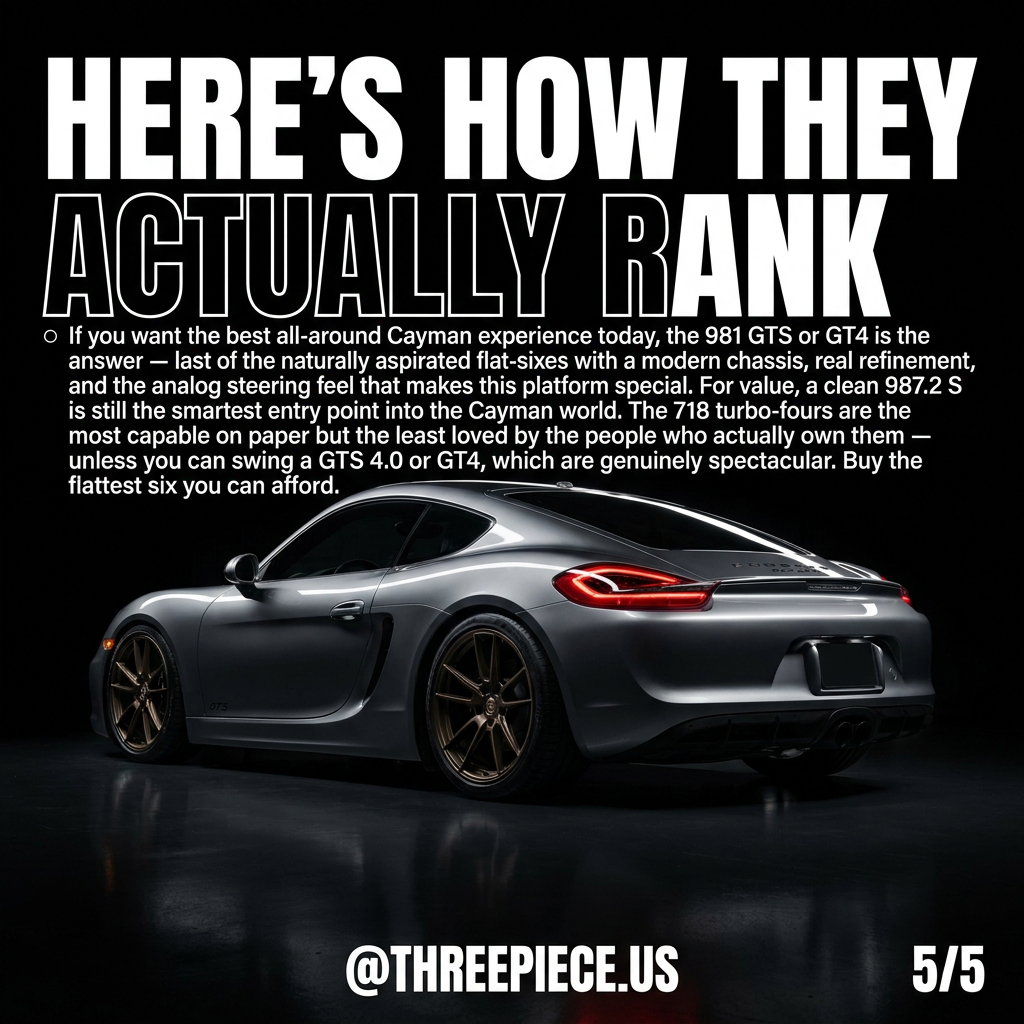
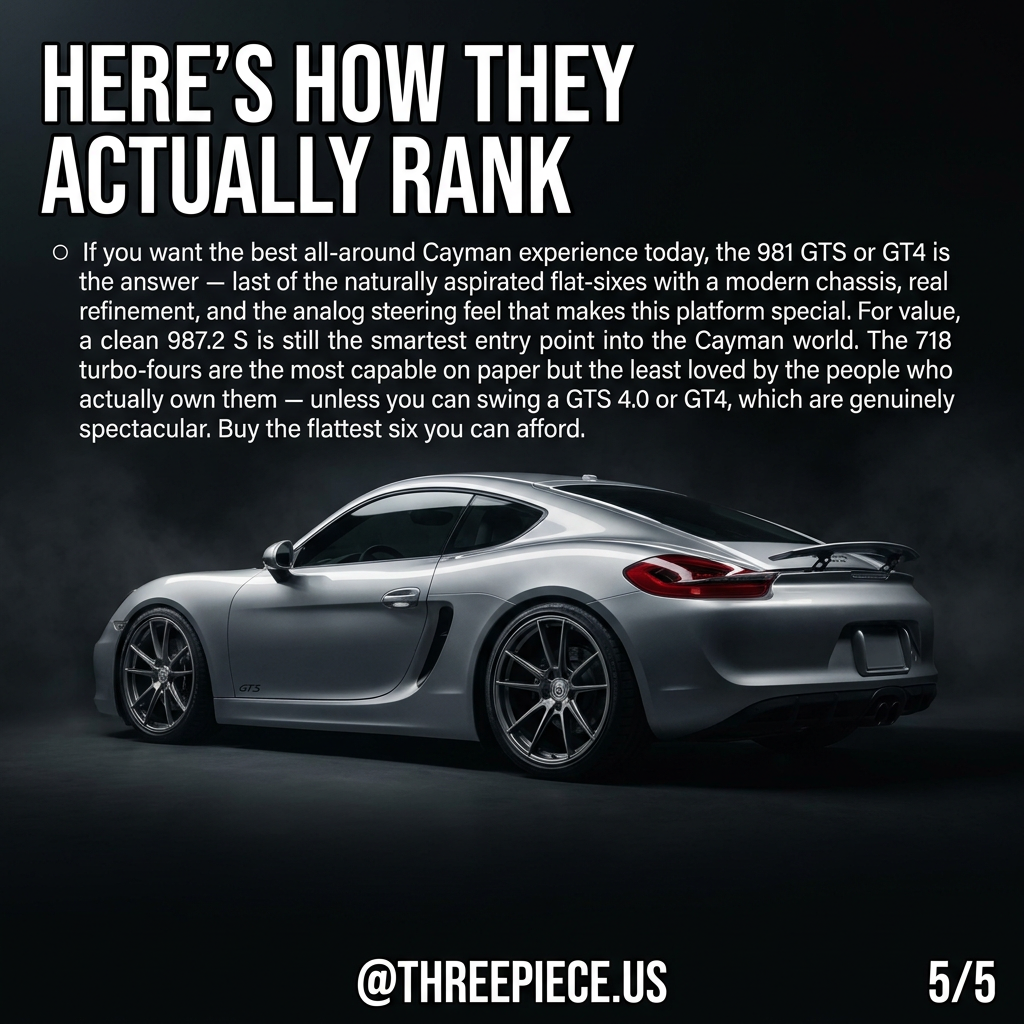
- 981 GTS / GT4 — The best all-around Cayman. Last of the naturally aspirated flat-sixes paired with a modern, rigid chassis. Analog steering feel, real refinement, and the GT4 finally let the platform be what it always should have been. Prices are climbing, but they're still attainable relative to what you get.
- 987.2 S / Cayman R — The smartest entry point into the Cayman world. The 987.2 fixed the engine reliability concerns of the earlier cars, kept the hydraulic steering, and delivers a driving experience that's rawer and more connected than anything newer. A clean 987.2 S with a manual is a future classic.
- 718 GTS 4.0 / GT4 / GT4 RS — Spectacular cars that redeemed the 982 generation, but the price of admission puts them in a different conversation entirely. The GT4 RS is a masterpiece. The issue is that you're paying $100K+ for the experience the 981 GT4 delivered at $60K–$70K.
- 987.1 S — The most characterful Cayman, but the IMS and bore scoring risks make it a car you buy with your eyes wide open. If you find one that's been properly maintained with an IMS retrofit, it's magic. If not, it's a ticking time bomb.
- 718 base / S (turbo-four) — Objectively fast, subjectively compromised. The flat-four sound and turbo lag fundamentally change what a Cayman feels like. Great daily drivers, mediocre enthusiast cars. Prices are soft for a reason.
The throughline is simple: buy the flattest six you can afford. The naturally aspirated flat-six is what makes a Cayman a Cayman. Every version that has it — from the 987.2 S to the GT4 RS — delivers something that the turbo-four cars simply don't replicate. Our breakdown of the MK5 Supra as a sports car value covers a similar dynamic — the engine character defines the ownership experience more than any spec sheet.
Cayman Wheel Fitment and Sizing Notes
Getting wheel fitment right on a Cayman matters more than on most cars because the mid-engine weight distribution and relatively narrow body mean even small sizing mistakes show up in handling balance and fender clearance. If you're building a 718, we wrote an entire dedicated guide: the perfect wheels for your Porsche 718 Cayman.
Across all Cayman generations, the bolt pattern is 5x130. Common OEM sizing runs 18x8 front / 18x9.5 rear on S models, with GT4 variants pushing to 20x8.5 front / 20x11 rear. Aftermarket builds on 987 and 981 platforms tend to land on 18x8.5 +50 front / 18x10 +40 rear or 19x8.5 / 19x10 staggered setups depending on fender work. Browse 19-inch wheels in 5x130 or 18-inch wheels in 5x130 to see what's currently available.
For tire sizing, a popular street setup on 18s is 235/40R18 front and 265/40R18 rear. On 19s, 235/35R19 front and 275/35R19 rear is the go-to. Search 235/35R19 tires and 275/35R19 tires for current options. If you're running a staggered setup for the first time, our guide to staggered wheel fitment fundamentals covers the principles that apply across platforms.
Three-piece wheels suit the Cayman particularly well because the staggered widths and specific offsets required by the mid-engine layout are easier to achieve with split construction. The Work VS series and Work Meister line are both popular choices on Cayman builds — check our vehicle gallery for real-world examples. Finish the look with proper 90-degree valve stems at $3.80 each — critical on deep-dish rear lips where standard stems won't clear.
Which Cayman Should You Buy?
If you want the best Cayman experience available today, a 981 GTS or GT4 with a manual transmission is the answer. It's the last generation with a naturally aspirated flat-six, a modern chassis, and enough refinement to daily without suffering. For pure value, a clean 987.2 S with documented maintenance history is still the smartest way into the Cayman world — and the car people will wish they bought a decade from now.
The 718 turbo-fours are faster on paper and cheaper on the used market, but the ownership experience doesn't match. If you can swing a GTS 4.0 or GT4, those cars are genuinely spectacular — but the entry price has climbed past where most of the Cayman's original value proposition lived. Whatever generation you land on, the Cayman rewards proper wheel and tire selection more than almost any sports car in its class. Start with our 718 Cayman wheel guide, explore our full wheel catalog, and build the Cayman the way Porsche should have from the start.