

Posted by THREEPIECE.US on May 9th 2026
Toyota Aristo S140 Buying Guide: 2JZ-GTE Sedan in 2026
The Toyota Aristo S140 is the car that proves the JDM market still has blind spots. A full-size luxury sedan with the same 2JZ-GTE twin-turbo inline-six that turned the MKIV Supra into an internet religion — same block, same head, same deep aftermarket — wrapped in a four-door body that nobody at a car meet expects to make 400whp. The 25-year import window is wide open for every 1991–1997 model year, and prices haven't caught up to what this platform actually is. Here's everything you need to know before you buy one.

Quick links
- What the Aristo Actually Is
- Supra Parts, Sedan Prices
- The Sleeper Math: BPU to Big Power
- Known Failure Points: What Breaks
- The A340E Problem
- Wheel Fitment for the S140
- Pre-Buy Inspection Checklist
- Go Find a V300
What the Aristo Actually Is
Toyota built the S140 Aristo from 1991 to 1997 as their answer to the BMW 5 Series and the Lexus GS300 (which was its USDM twin with the naturally aspirated 2JZ-GE). But the JDM-only V300 trim got the good stuff: the 2JZ-GTE twin-turbo making approximately 280 horsepower under Japan's gentleman's agreement — a figure everyone knows was sandbagged from the factory. The lesser-known 1UZ-FE V8 with i-Four AWD made around 250 horsepower and is a unicorn in its own right, though the GTE is the one you want for build potential.
This is not a rebadged Lexus with a turbo kit. The V300 Aristo came from the factory with the same engine that powered the Supra RZ. The entire Supra aftermarket — turbos, fuel systems, standalone ECUs, exhaust manifolds — bolts directly onto this car. You're not building from scratch. You're borrowing from the most supported inline-six platform ever made. If you've been following the trajectory of undervalued performance cars that outperform their price tags, the Aristo belongs on that list.

Supra Parts, Sedan Prices
The cost-to-power ratio on the Aristo embarrasses half the JDM market right now. A clean MKIV Supra twin-turbo is a $70,000–$120,000+ car in 2026. A V300 Aristo with the same engine, similar mileage, and decent service records can still be imported for a fraction of that. The powertrain is identical. The aftermarket is identical. The only thing that changed is the body — and that four-door body is exactly why prices haven't caught up.
Bolt-on builds with a boost controller, downpipes, intercooler, and exhaust are hitting 400–440whp on stock internals and the stock ECU. That's Supra TT territory with a back seat and climate control. Owners running the TOM's ECU with supporting mods report around 350bhp as a reliable daily setup. Push to 17 psi on the stock ceramic-wheel turbos with a basic BPU build — restrictor ring delete, Walbro 255 pump, fuel cut defender, upgraded exhaust — and you're in that 400whp range without touching internals. If you want to understand how ECU tuning translates to real dyno numbers, the 2JZ-GTE is one of the most well-documented examples in existence.

The Sleeper Math: BPU to Big Power
The BPU (Basic Performance Upgrades) path on the 2JZ-GTE is proven across thousands of Supra builds, and every piece of it applies directly to the Aristo. The stock bottom end — cast crank, forged rods, cast pistons — handles ~500whp reliably with proper fuel and tuning. Past that, single-turbo conversions with standalone engine management (Link G4X, Haltech) open up 550–650whp on forged internals. The platform scales the same way the Supra does because it literally is the same platform.
The key advantage here is that nobody's paying Supra tax on parts acquisition. The engine is the same, the transmission bolt pattern is the same, and the wiring is close enough that most harness adapters are off-the-shelf. The Aristo's heavier curb weight (roughly 3,500 lbs) means you're not building a drag car — you're building a luxury GT that happens to make absurd power. That's a different kind of appeal, and it's one that ages well.
Known Failure Points: What Breaks
Every S140 Aristo is now 28–34 years old. Age-related wear is not a maybe — it's a certainty. Here's what real owners report failing, when it happens, and what it costs.
Oil consumption and burning: After approximately 125,000 miles (200,000 km), piston ring wear and oil control ring degradation lead to elevated oil consumption on both the 2JZ-GE and 2JZ-GTE. Valve stem seals harden with age. Owners report a quart every few thousand miles and blue smoke at startup. This isn't catastrophic, but it tells you the engine's been around the block.
Oil leaks — everywhere: Rear cam seals, front crank seal, valve cover gaskets, and blanking plugs are all age victims. The cam gear pickup piece on pre-VVT-i engines (all MK1 Aristos) can separate from the timing belt gear, causing timing and trigger issues. Many owners replace this with a one-piece billet crank gear as preventive maintenance. These leaks are messy and expensive due to labor access.
Timing belt and tensioner: The pre-VVT-i 2JZ uses a standard timing belt with a tensioner bracket that wears. If the tensioner fails, the belt can jump — symptoms include a low rev ceiling, misfires, and limp behavior. Service interval is every 90,000–100,000 km. If there's no documentation, budget for a full timing service before you drive it hard.
Sensors and electrical gremlins: MAP/MAF sensors fail or drift out of calibration, causing misfires, uneven idle, and shuddering at stoplights. The igniter unit — which triggers spark on the 2JZ — suffers heat-related failures: the engine cranks but won't start, or stalls when hot. These are not expensive parts, but diagnosing them on a 30-year-old car with no scan data can eat hours.
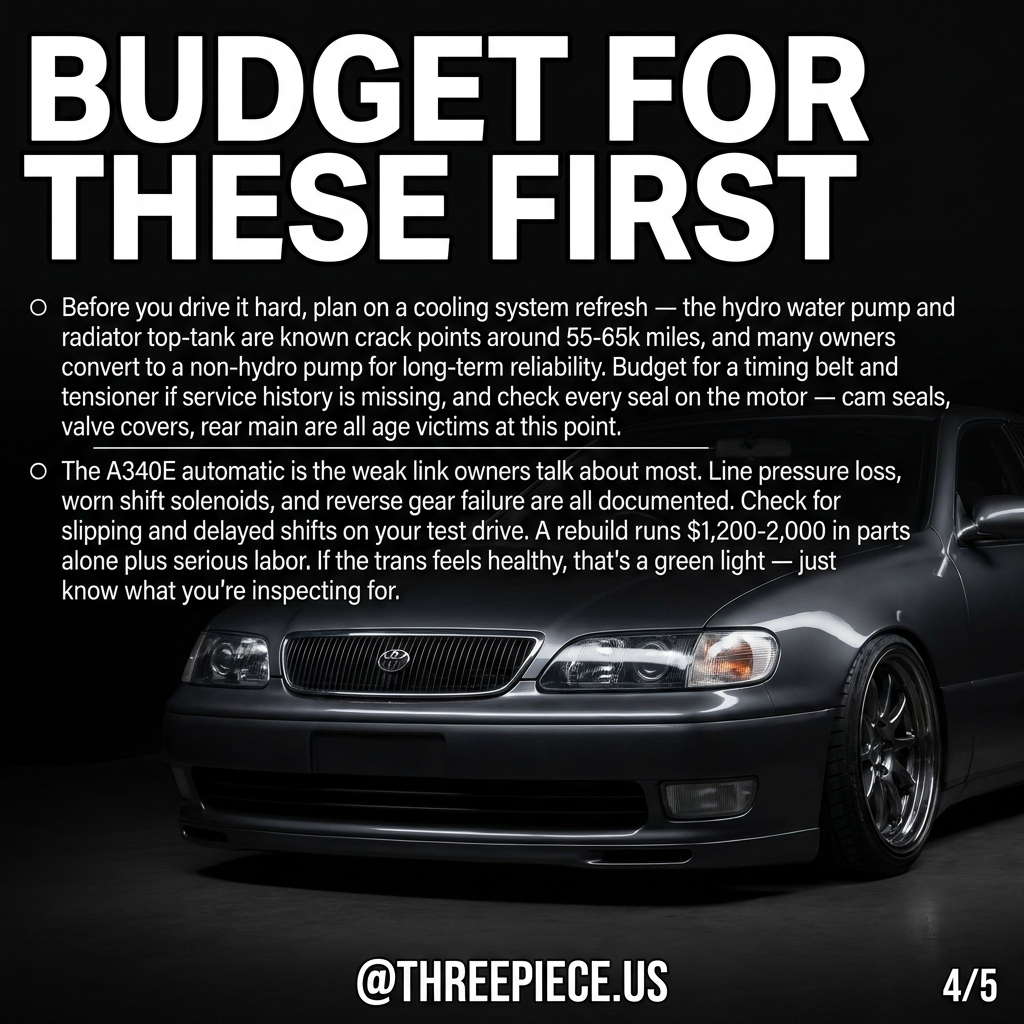
The cooling system deserves its own line item. The hydro water pump and radiator top-tank are known crack points around 55,000–65,000 miles, and many owners convert to a non-hydro pump for long-term reliability. A Chase Bays Radiator Cap Type A at $48 is a small but smart upgrade during any cooling system refresh. If you're sourcing a full radiator replacement, make sure you're matching the dual cooling loop setup the A340E transmission relies on — single-pass replacements will cook the ATF.
The A340E Problem
The A340E automatic is the weak link that owners talk about most, and it's the single biggest variable in any Aristo purchase. This is the same transmission Toyota used across a wide range of applications, and it was never designed for the power levels most GTE owners eventually target.
Loss of line pressure: One of the most documented failure modes. The transmission engages fine when cold, but after a short drive it loses line pressure and stops going into gear until the car is restarted. This points to worn shaft seals and degraded fluid circuits inside the valve body.
Shift solenoid wear: Symptoms include slipping at highway speeds, harsh 1-2 shifts, and the engine revving without the car accelerating. Low fluid, worn solenoids, or a worn valve body are the usual culprits. This gets worse with heat.
ATF overheating: The factory setup uses dual cooling loops — one for the trans cooler and one through the engine coolant radiator. If the radiator has been swapped with a single-circuit unit, ATF temps climb past 230°F, which leads to clutch pack failure and valve body warping. Always verify the cooling circuit is intact.
Reverse gear failure: The steel clutch pack for reverse wears out. Delayed engagement or complete inability to engage reverse is a rebuild-or-replace situation. A full A340E rebuild runs $1,200–$2,000 in parts alone plus serious labor. Many owners eventually swap to an R154 manual — the conversion is well-documented and uses off-the-shelf adapter kits. If you're considering that route, read our breakdown of dual-mass vs single-mass flywheels before you spec the clutch setup.
If the trans feels healthy on your test drive — no slipping, no delayed shifts, no harsh engagement — that's a genuine green light. Just know what you're inspecting for.
Wheel Fitment for the S140
The S140 Aristo runs a 5x114.3 bolt pattern with a hub bore of 60.1mm. Factory wheels were 16x7 on most trims. The aftermarket sweet spot for this chassis is 18x8.5 +35 to +40 front and 18x9.5 +35 to +38 rear if you're running a staggered setup — which suits the sedan proportions perfectly. For a deep dive on stagger, check our guide to avoiding the most common fitment mistakes.
Browse 18-inch wheels in 5x114.3 to see what's currently available. The Aristo's VIP roots make it a natural fit for Japanese 3-piece wheels — Work VS series, Weds Kranze, and Work Meister are all era-correct choices that look right on this body. If you're going Work, finish the look with a Work VS Reproduction Center Cap at $50 for a clean presentation. For tire sizing, 245/40R18 front and 275/35R18 rear is the proven combo for staggered 18s on this platform.
If you're rebuilding or refinishing a set of period-correct 3-piece wheels, we stock Work replacement halves and assembly hardware — including M7x32 chrome assembly bolts at $10 each for a factory-fresh lip rebuild. Check out our vehicle gallery for build inspiration across similar JDM sedans.

Pre-Buy Inspection Checklist
Based on what real owners say, here's what to verify before you hand over money for any S140 Aristo:
- Oil leaks: Check front cam seals, rear cam seals, valve covers, front and rear crank seals, and VVT gear caps (if applicable on late-production cars). Moderate seepage is acceptable on a 30-year-old engine. Heavy leaks mean big labor bills.
- ATF condition and shifting: Request proof of fluid changes. Check for a dedicated trans cooler. Test for slipping, delayed shifts, and harsh engagement during your test drive — especially in reverse. If the trans is healthy, that's a major green light.
- Timing belt service history: Belt should be changed every 90,000–100,000 km. If there's no record, or it's been more than 5–10 years since the last service, budget for a full timing belt and tensioner replacement before you drive it hard.
- Sensors and ignition: Test the MAF/MAP sensors. Check for misfires at idle, both cold and hot. The igniter module is a known heat-failure item — if the car cranks but won't start when hot, that's your culprit.
- Cooling system: Inspect the water pump (hydro vs non-hydro conversion), radiator top-tank for cracks, and verify the dual cooling loop for the transmission is intact.
- Turbo health (GTE only): Listen for shaft play and wastegate rattle. The stock ceramic-wheel turbos are fragile at high mileage. Budget for a turbo rebuild or single-turbo conversion if they're on their way out.
If you're coming from another JDM platform and want to compare the ownership experience, our Lexus IS 350 buying guide covers a similar Toyota luxury formula with a different powertrain. And if you're cross-shopping the Aristo against other turbocharged JDM sedans, our Evo X value breakdown is worth reading.
Go Find a V300
If you want a 2JZ-GTE car that hasn't been priced into the stratosphere like every clean Supra, the Aristo is the move. Find a V300 with service records, a healthy transmission, and no major oil leaks — then enjoy the fact that you're sitting on the same powertrain the internet worships, in a car most people won't even recognize.
Prices aren't staying here forever. The 25-year import window is fully open, the Supra aftermarket plugs straight in, and the platform scales from a comfortable 350bhp daily to a 650whp monster on the same foundation. The only question is whether you buy one before the algorithm discovers them.
Start by browsing wheels and suspension for the build, and explore our full wheel parts catalog for everything from valve stems to center caps when you're ready to finish the details.