
Posted by THREEPIECE.US on Apr 26th 2026
Lexus IS 350 XE20 Buying Guide: 2GR-FSE Under $15K in 2026
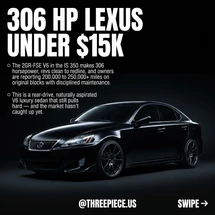
The 2006-2010 Lexus IS 350 (XE20) is one of the most compelling performance sedans you can buy for under $15,000 in 2026. Its 3.5L 2GR-FSE V6 makes 306 horsepower and 277 lb-ft of torque, sends power to the rear wheels, and is documented by owners hitting 200,000 to 250,000+ miles on original internals. It doesn't get the hype of the IS F, and that's exactly why the XE20 IS 350 is still affordable. But that window is closing. Here's everything you need to know before you buy one.

Quick links
- Why the IS 350 Still Makes Sense in 2026
- 2GR-FSE Reliability: What the Mileage Data Actually Shows
- Known Failure Points: What Breaks and What It Costs
- Transmission and Differential: What to Watch For
- Pre-Purchase Checklist: What to Verify Before You Sign
- Wheels and Fitment for the XE20 IS 350
- Final Verdict: Stop Waiting
Why the IS 350 Still Makes Sense in 2026
The IS 350 sits in a category that barely exists anymore: a naturally aspirated, rear-wheel-drive, V6 luxury sport sedan from a manufacturer with genuine reliability DNA. At 306 hp, the 2GR-FSE was the most powerful engine in its class when it launched, and it still pulls harder than most modern turbocharged four-cylinders that cost three times as much. The chassis is balanced, the steering has actual weight, and the interior materials — especially on garage-kept examples — hold up better than anything from BMW or Audi at this price point.
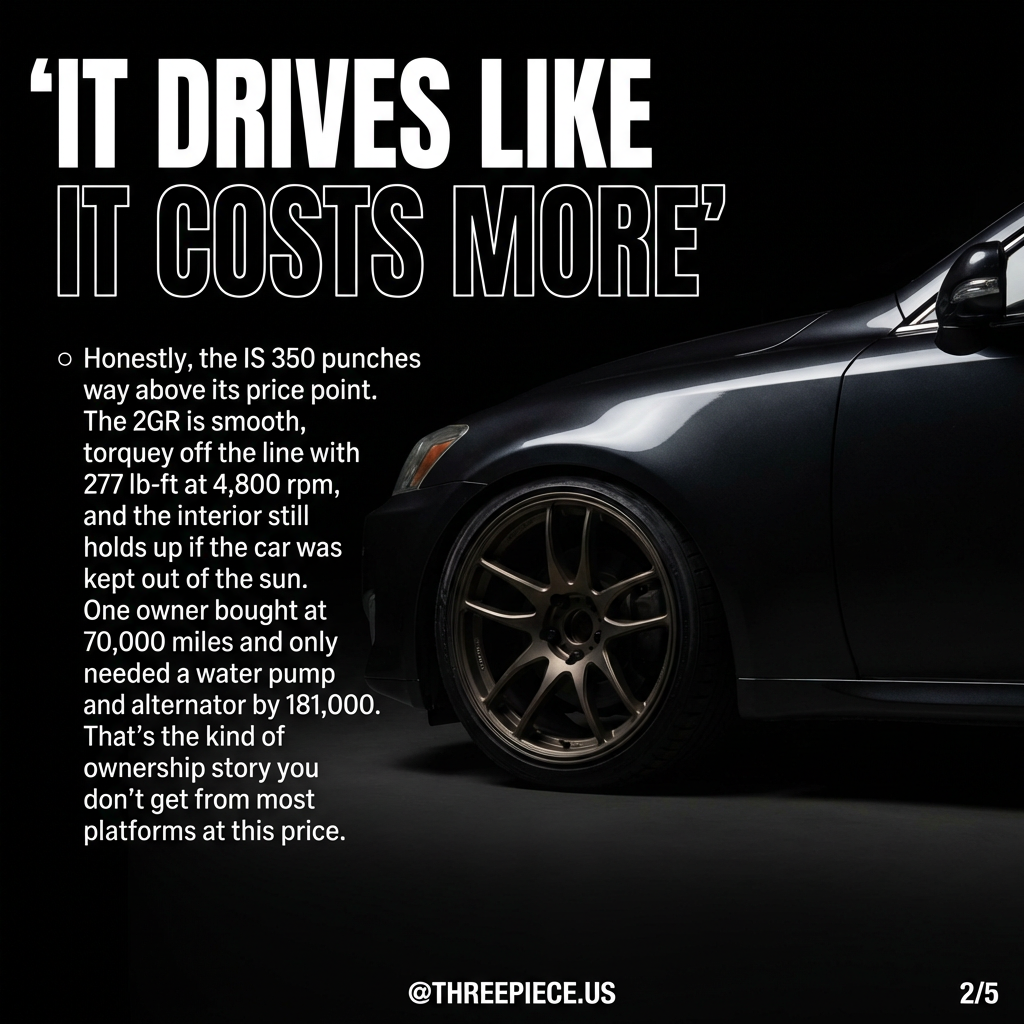
The IS 350 doesn't get the collector-market attention of the Infiniti G37 Sport or the E90 335i, and it doesn't carry the premium of the IS F. That's the opportunity. Depreciation has already done the heavy lifting — clean examples with service history are sitting between $10,000 and $15,000 — but the mechanicals haven't caught up to the price drop. One owner bought at 70,000 miles and only needed a water pump and alternator by 181,000. That's the kind of ownership cost ratio you don't find on most platforms at this price.
2GR-FSE Reliability: What the Mileage Data Actually Shows
The 2GR-FSE is, frankly, one of the best V6 engines Toyota ever built. It uses a dual-injection system (port + direct injection), which helps mitigate the carbon buildup issues that plague many direct-injection-only motors from this era. Owners who run full synthetic oil, change it on time, and avoid chronic short trips are routinely beating 200,000 miles without touching internals. One documented owner hit 282,000 miles still pulling cleanly to redline, burning less than a quart every 4,000 miles.
Compare that to the VQ35DE in the 350Z, which is rightfully celebrated for its longevity — the 2GR matches or exceeds it in most documented ownership cases, and it makes more power doing it. The key differentiator is maintenance discipline. The 2GR rewards owners who stay on top of fluid intervals and punishes neglect harder than most Toyota engines, primarily through oil consumption issues that compound over time.
The automatic transmission — either the AA80E (8-speed) or A760E (6-speed) depending on year — is generally reliable under normal driving. Owners report cold-shift roughness more than outright failure, and a fluid flush at 100,000-150,000 miles typically smooths things out considerably. This isn't a platform where the transmission is the weak link — that distinction belongs to specific engine-side components we'll cover next.

Known Failure Points: What Breaks and What It Costs
No car is perfect, and the IS 350 has a handful of documented weak spots. The good news: most of them are predictable, well-understood, and relatively affordable compared to European alternatives. If you're coming from the world of N55 BMWs or M156 AMGs, these repair costs will feel refreshingly reasonable.
VVT Housing Bolts (Recall 13V395000) — This is the big one. The bolts holding the intake-side VVT gear to the timing chain sprocket can loosen, allowing the VVT housing to separate. This affects 101,000+ vehicles across the 2006-2010 IS 350 production run. If the recall was completed, you're fine. If it wasn't, you're looking at $1,500-$2,500 out of pocket for the VVT assembly and cam gear replacement. This is non-negotiable — confirm the recall status on any car you're considering.
Oil Consumption (100,000-150,000+ miles) — This is the most common complaint on high-mileage 2GR-FSE engines. Worn piston rings or valve stem seals cause blue smoke on cold start and increased oil consumption — some owners report losing 1 quart every 1,000 miles or worse. If it's just valve seals, expect $1,500-$2,500. A full ring job or rebuild can run $4,000-$8,000+. Ask for oil consumption history and check the dipstick cold — if it's a quart low between changes, that's normal aging. If it's bone dry at 3,000 miles, walk.
Water Pump Failure (80,000-120,000 miles) — Coolant weeping from the front of the engine, bearing rumble, or overheating. The pump itself is $200-$400, but labor pushes the total to $700-$1,200. This is a when-not-if maintenance item on any XE20 IS 350 approaching six figures on the odometer.
Cam Gear / Valve Spring Issues (2006-2008) — Early production cars had known issues with cam gear tooth design and valve spring quality. Cold-start clicking, rough idle, and vibration are the symptoms. If you're looking at a 2006-2008 car, look for evidence this was addressed — either through the recall, TSB, or documented independent work. Repair range: $1,500-$3,000+ if it hasn't been done.
Accessory Drive Components (80,000-120,000 miles) — Idler pulleys, belt tensioner, and serpentine belt are wear items. Chirps, squeals, and whining are the telltale signs. Parts are cheap ($50-$200), but labor can climb to $600-$1,200 if multiple components are addressed simultaneously. Do them all at once with the water pump — you're already in there.

Transmission and Differential: What to Watch For
The automatic transmission in the IS 350 is not a weak point, but it's not maintenance-free either. Rough cold shifts — especially from Park to Drive or Reverse — are common on higher-mileage examples and are usually resolved with a fluid flush. Owners who flushed at 150,000-200,000 miles report shifts tightening back up considerably. If the transmission is slipping or jerking when warm, that's a different story — solenoid wear, torque converter issues, or internal clutch pack degradation. Minor solenoid work runs a few hundred dollars. A full rebuild or replacement: $3,000-$7,000.
The rear differential on RWD models can develop a low-pitch whine under acceleration, most noticeable at 35-55 mph. This is typically carrier bearing wear or old fluid. Servicing the diff fluid is cheap insurance. If bearings are gone, expect $1,200-$1,900 for parts and labor. Not catastrophic, but worth listening for on a test drive.
If you're planning to upgrade the suspension on your IS 350, the KYB Gas-a-Just Front Right Strut at $199 and the KYB Gas-a-Just Front Left Strut at $199 are direct-fit replacements for the 2006-2010 platform. These are a significant upgrade over worn OEM dampers and a smart first move before considering whether coilovers are worth it on your daily driver.
Pre-Purchase Checklist: What to Verify Before You Sign
Here's the non-negotiable list for any XE20 IS 350 you're seriously considering:
- Recall 13V395000 completion — Run the VIN through the NHTSA recall lookup. If it wasn't done, either negotiate the price down by $1,500-$2,500 or have it completed before purchase.
- Cold-start rattle — Start the car cold. Listen for VVT or cam gear rattle in the first 5-10 seconds. Especially critical on 2006-2008 models.
- Oil consumption history — Ask the seller directly. Check the dipstick. Look for blue smoke on startup. Pull the oil cap and look for sludge.
- Water pump area — Inspect for coolant weeping, stains, or crystallized coolant around the front of the engine. If it hasn't been replaced and the car is over 80,000 miles, budget $700-$1,200.
- Transmission behavior — Test cold shifts from Park to Drive and Reverse. Drive at highway speed and feel for smooth downshifts. Rough cold shifts are fixable. Warm slipping is not.
- Differential whine — Cruise at 35-55 mph under light acceleration. Listen for a low-pitch hum from the rear.
- Service records — A car with documented oil changes on synthetic at proper intervals is worth significantly more than one without records, regardless of mileage.
Budget $2,000-$3,000 in year-one preventive maintenance on any higher-mileage car. Water pump, accessory drive refresh, transmission fluid flush, differential fluid, and fresh spark plugs. Do it all up front and you're set for years. Our IS 350 XE20 build guide covers the full mod order if you're planning to go beyond maintenance into performance territory.

Wheels and Fitment for the XE20 IS 350
Once the mechanicals are sorted, the IS 350 is one of the best-looking sedans of its era to put proper wheels under. The XE20 runs a 5x114.3 bolt pattern with a 60.1mm hub bore, which opens up an enormous catalog of aftermarket options. Stock wheel sizes range from 17x7.5 to 18x8.5 depending on trim, but the sweet spot for aftermarket fitment is 18x8.5 +35 to +40 square, or a staggered 18x8.5 front / 18x9.5 rear setup for a more aggressive look.
Browse 18" wheels in 5x114.3 to see what's currently available. For tires, a 225/40R18 front and 255/35R18 rear is a proven staggered combination, or 245/40R18 square for balanced daily driving. Search 245/40R18 tires for square setups or 255/35R18 tires for rear staggered options.
The IS 350 photographs exceptionally well on Japanese multi-piece wheels. The Work Emotion series is a natural fit for this platform — clean spokes, available in the right sizes, and the right aesthetic for a Lexus that's meant to look refined, not overdone. If you want something with more presence, the Work Meister line or Work VS series will transform the car entirely. Check the ThreePiece vehicle gallery for real-world fitment examples. For reference on the newer platform, our 2024-2027 Lexus IS 350 fitment guide covers the current generation's specs if you're comparing.
If you're running 3-piece wheels, make sure your hardware is fresh. M7x32 Chrome Assembly Bolts at $10 each or M8x32 Satin Black Assembly Bolts at $10 each keep your lips and barrels secure. And don't overlook the details — 90-degree valve stems at $3.80 are a must for deep-dish setups where straight stems won't clear the brake caliper.
Understanding the difference between cast and forged wheels matters here — on a car this clean, the weight savings and strength of forged construction are worth the investment, especially if you're driving it hard.
Final Verdict: Stop Waiting
A clean 2006-2010 Lexus IS 350 with service history is one of the best performance sedan values in the used market right now. You're getting 306 horsepower, rear-wheel drive, Lexus build quality, and a motor that routinely outlasts the car around it — all for less than a new Camry. The known failure points are predictable, well-documented, and affordable relative to European competitors. Budget $2,000-$3,000 in year-one preventive work on a higher-mileage car and you're looking at a platform that can deliver another 100,000+ miles of reliable, engaging driving.
The IS 350 doesn't carry the internet tax of the IS F, but it shares the same platform DNA and most of the driving character. That pricing gap won't last forever — these cars are being discovered by the same enthusiast audience that already drove up G37 and E90 prices. If you've been circling one, confirm the recall, check the oil, and go buy it. Then come back and put the right wheels under it — browse the full ThreePiece wheel catalog and the Work Wheels collection to find the setup this car deserves.