
Hyundai Genesis Coupe 3.8 Buying Guide: BK2 in 2026
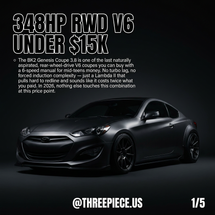
The 2013-2016 Hyundai Genesis Coupe 3.8 is the most underpriced RWD performance platform on the used market right now. A naturally aspirated V6 making 348 horsepower and 295 lb-ft of torque, rear-wheel drive, available 6-speed manual, factory Brembo brakes — all for under $15,000 if you're patient. While everyone fights over clapped 350Zs and BRZs with six-figure mileage, the BK2 Genesis Coupe sits there offering more power, more torque, and a more complete GT experience for less money. Badge bias is literally saving buyers thousands of dollars, and that window won't stay open forever.
Quick links
- Why the power-to-dollar ratio is unmatched
- The driving character nobody talks about
- Bolt-on potential and real dyno numbers
- Known failure points and what to budget for
- Wheel fitment and suspension setup
- Pre-purchase checklist
- Final verdict: buy one before it's too late
Why the Power-to-Dollar Ratio Is Unmatched Under $15K
Let's put the BK2 Genesis Coupe 3.8 in context. In 2026, a clean 370Z with comparable mileage runs $18,000-$22,000. An FR-S/BRZ with 80,000 miles is $16,000+ and makes 200 horsepower. A 2015+ Mustang GT with the Coyote is $22,000-$28,000. The Genesis Coupe 3.8 slots in at $10,000-$15,000 for a clean, documented example with under 80,000 miles — and it makes 348hp from the factory through a Lambda II 3.8L V6 with no forced induction complexity.
The Lambda II is derived from the same family that powers the Genesis sedan and early Kia Stinger GT. It's a DOHC, 24-valve, GDI V6 that revs cleanly to redline and produces a flat, usable torque curve. No turbo lag, no intercooler plumbing to worry about, no wastegate flutter. Just displacement and engineering. If you've been reading our breakdown of the Kia Stinger GT versus Audi S4, you already know this V6 family has real credentials. The difference is the Genesis Coupe weighs less, sits lower, and sends power to the rear wheels only.
The Driving Character Nobody Talks About
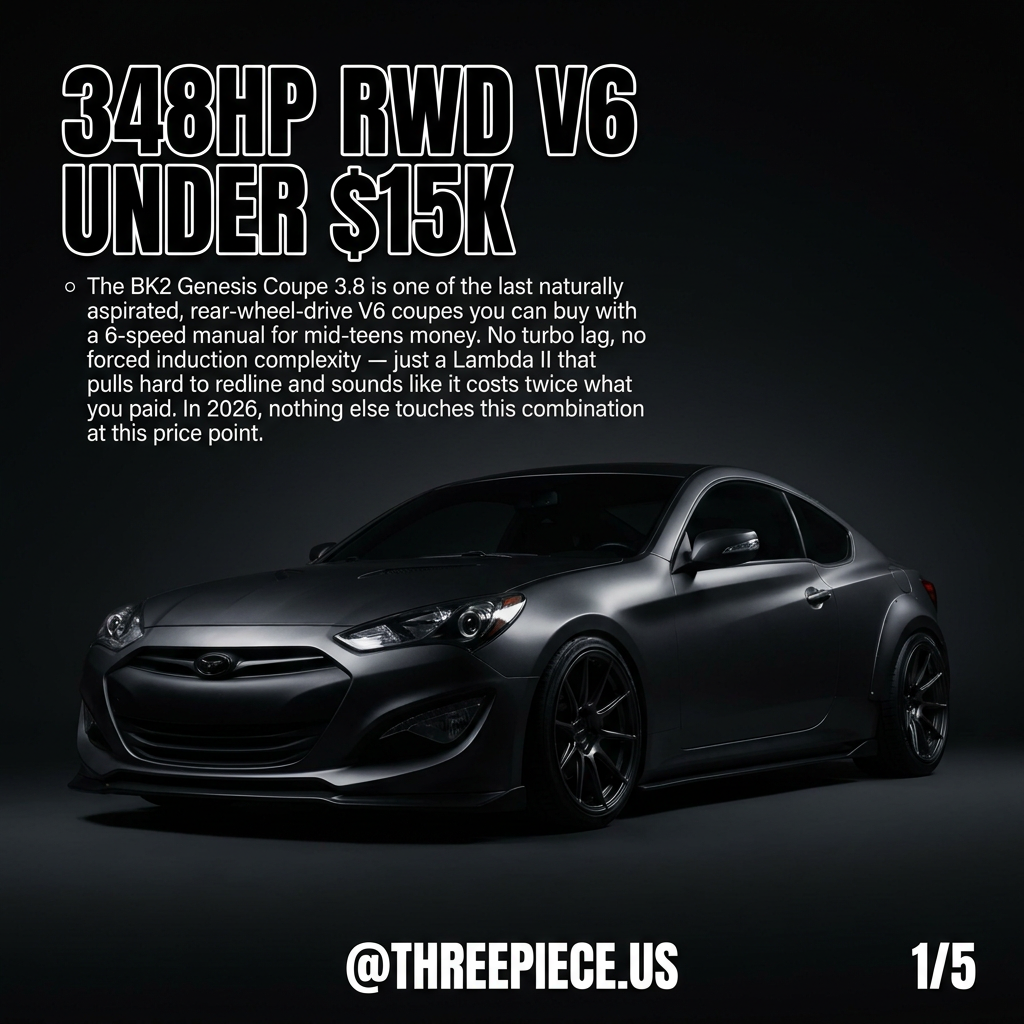
Owners on GenCoupe forums repeat the same observation: the 3.8 has a fat, usable mid-range that makes it feel like more car than the spec sheet suggests. It's not trying to be a lightweight momentum car like the BRZ. It's a proper GT coupe with real mid-range punch and a linear power delivery that rewards you for wringing it out. The 295 lb-ft of torque peaks at 5,300 RPM but the usable band starts well below 3,000 — meaning you're never waiting for the power to arrive in daily driving or spirited canyon runs.
The chassis is more capable than its reputation suggests. The BK2 got revised suspension geometry, stiffer rear subframe bushings, and better steering calibration compared to the 2010-2012 BK1. The R-Spec trim came with a Torsen limited-slip differential, Brembo front brakes, and 19-inch wheels from the factory. Even the base 3.8 Grand Touring models feel planted and predictable at the limit — something you can't say about a same-money Mustang V6 or Camaro LT from the same era.
Bolt-On Potential and Real Dyno Numbers
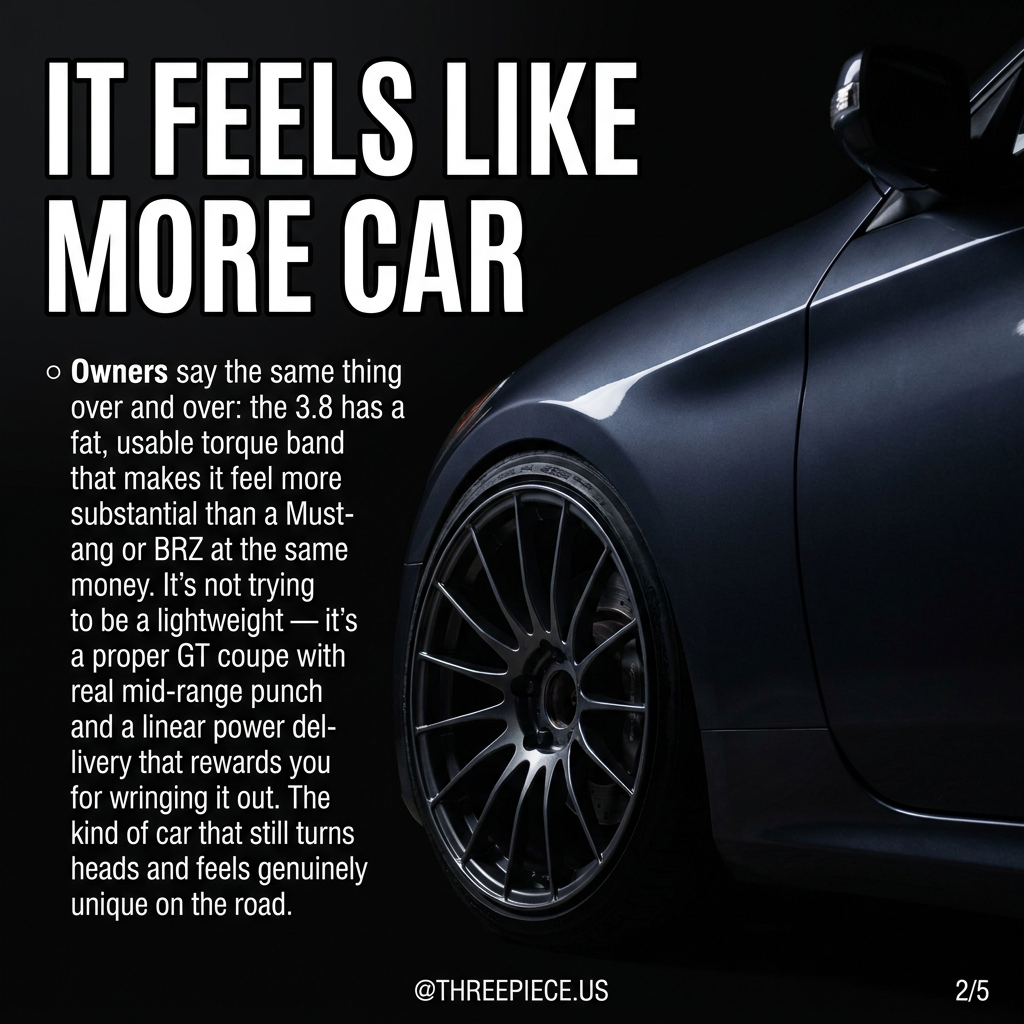
Stock, the 3.8 puts down roughly 290-300 wheel horsepower depending on the dyno. Add an intake, cat-back exhaust, and a custom flash tune through AlphaSpeed or BTRcc and you're looking at 330-340 whp naturally aspirated — these are real dyno numbers from documented owner builds on GenCoupe.com. The 8-speed automatic cars can get a TCU tune to sharpen shift points and eliminate the lazy 4-5 upshift logic that Hyundai issued a TSB for on 2013 models.
If you want to go further, full bolt-on builds with ported intake manifolds and long-tube headers have pushed toward 350 whp without forced induction. That's serious naturally aspirated power from a platform that cost you $12,000. For context, read our piece on whether ECU tunes are actually worth it — on the 3.8, the answer is an emphatic yes. And if you're curious about the NA-versus-forced-induction debate, our supercharger kit guide covers the real costs and gains of going boosted on platforms like this.
The aftermarket support is deeper than most people realize. ISR, Megan Racing, and Solo Werks all make platform-specific parts. The 5x114.3 bolt pattern opens up one of the widest wheel catalogs in the enthusiast world, and the community has documented fitment extensively.
Known Failure Points and What to Budget For
The Genesis Coupe 3.8 isn't without its weak points, and you need to know exactly what you're getting into before you buy. Here's what actually breaks, based on owner-reported data from GenCoupe.com and Hyundai forums — not generic reliability ratings.
Timing Chain, CVVT Phasers, and Cold-Start Rattle
This is the big one. The timing chain system — chains, guides, tensioners, and CVVT cam phasers — is the most common failure point on the Lambda II. Owners report a distinct rattling noise at cold start that goes away once the engine warms up. If you hear it, the phasers and tensioners are on borrowed time. One owner was quoted $3,600 at a dealer for a full timing chain, CVVT, tensioner, and oil pump replacement at 102,000 miles. Independent shops can do it for $1,500-$2,000. This is a when-not-if item on high-mileage examples.
Carbon Buildup on GDI Intake Valves
The BK2's Gasoline Direct Injection system doesn't wash fuel over the intake valves, which means carbon accumulates over time. Symptoms include rough idle, misfires, and reduced throttle response, typically appearing between 60,000-90,000 miles. A walnut blast is the standard fix and runs $300-$500 at most shops. An oil catch can installed early in ownership can slow the buildup significantly — it's one of the best preventative mods you can do on any GDI car.
Rod Bearing Concerns
A poll on GenCoupe.com showed that 63% of 3.8L owners never experienced engine failure, while roughly 27% had at least one failure — many of those traced to rod bearing issues around 90,000-100,000 miles. The root cause appears to be insufficient oil pressure and potential debris in oil passages. The fix is strict maintenance: full synthetic oil every 5,000 miles, quality filters, and monitoring oil pressure. Owners who follow this protocol are reporting 200,000+ miles without major issues.
Manual Transmission Synchros and Clutch
Manual cars develop grinding going into 1st or 2nd gear as synchros wear, especially with spirited driving. Clutch replacement is typical at 70,000-90,000 miles if the car has been commuted in heavy traffic. Budget $800-$1,200 for a clutch job at an independent shop.
Cooling System
Water pump failures, thermostat housing leaks, and overheating issues are reported on 2016 models in particular. A CSF Hyundai Genesis 3.8L Radiator at $395.52 is a worthwhile upgrade if you're addressing cooling system concerns proactively — better flow and build quality than the OEM unit.
Wheel Fitment and Suspension Setup
The Genesis Coupe runs a 5x114.3 bolt pattern with a 67.1mm hub bore. The R-Spec came with 19x8 +38 front / 19x8.5 +38 rear from the factory with Brembo front brakes. This is important because the Brembos require a minimum 18-inch wheel diameter for clearance — don't plan on running 17s if your car has the big brake package.
The sweet spot for most builds is a staggered setup: 19x9.5 +22 front and 19x10.5 +22 rear with appropriate tire sizing. Browse 19-inch wheels in 5x114.3 to see what's currently available. If you prefer a more conservative fitment, 18x9.5 +35 square is a proven setup that clears Brembos and works well with 255/40R18 tires. For a deeper dive on running different front and rear widths, read our guide on 370Z wheel fitment — the 5x114.3 bolt pattern and similar fender geometry make it a useful reference.
The Genesis Coupe takes to coilovers extremely well. A quality set lets you dial in the ride height and damping to complement your wheel and tire setup, and the platform responds to rear camber arms for alignment correction after lowering. If you're building a show car, the Work Wheels catalog has multiple designs that suit the Genesis Coupe's aggressive fender lines — the Emotion series in particular pairs well with the BK2's GT proportions. Finish the look with proper hubcentric rings sized to 67.1mm and quality lug nuts — details that matter on a car you're building to keep.
If you're running 3-piece wheels on this platform, understanding forged wheel construction helps you appreciate why the weight savings and customization options are worth it on a car with this much potential.
Pre-Purchase Checklist for a BK2 3.8
Here's exactly what to look for before you hand over money:
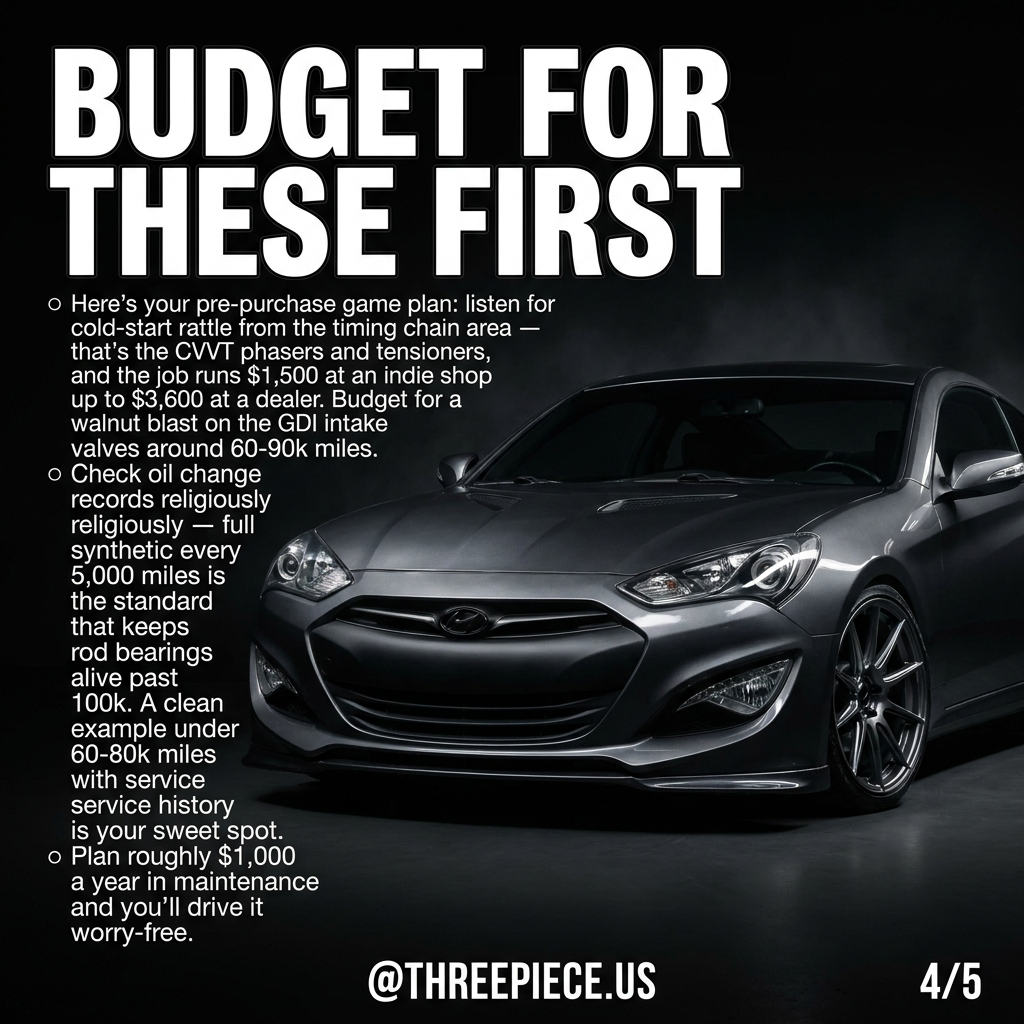
- Cold start the car yourself. Listen for rattle from the timing chain area during the first 10-15 seconds. If it's there, the CVVT phasers and tensioners need attention — budget $1,500-$3,600 depending on the shop.
- Pull the oil cap and check for sludge. The 3.8 needs full synthetic every 5,000 miles to keep rod bearings alive. Dark, thick residue under the cap is a red flag.
- Ask about walnut blasting. If the car has over 60,000 miles and the intake valves haven't been cleaned, budget $300-$500 for a walnut blast in year one.
- Check for oil leaks. Rear main seal, oil pump seal, and oil pressure sensor leaks are common after 100,000 miles. Inspect the bellhousing area and the connector under the intake manifold.
- Test the manual transmission. Shift through every gear cold. Grinding into 1st or 2nd indicates worn synchros.
- Verify the differential recall. 2010-2016 manual transmission cars had a recall for rear differential and suspension crossmember bolts. Confirm it's been addressed.
- Target under 60,000-80,000 miles with documented service history. Plan roughly $1,000 per year in maintenance and you'll drive it worry-free.
Braking is another area to inspect carefully. If the pads are worn, the Hawk HPS Street Front Brake Pads at $205.67 are a direct upgrade for non-Brembo cars, offering better bite and fade resistance than OEM. Pair them with Hawk HPS Street Rear Brake Pads at $142.61 for a complete refresh. If you're tracking the car or doing aggressive canyon runs, step up to the Hawk HP+ Autocross Front Pads at $229.94 — they're designed for repeated hard stops without significant fade.
Stop Waiting — Buy One Before Clean Examples Disappear
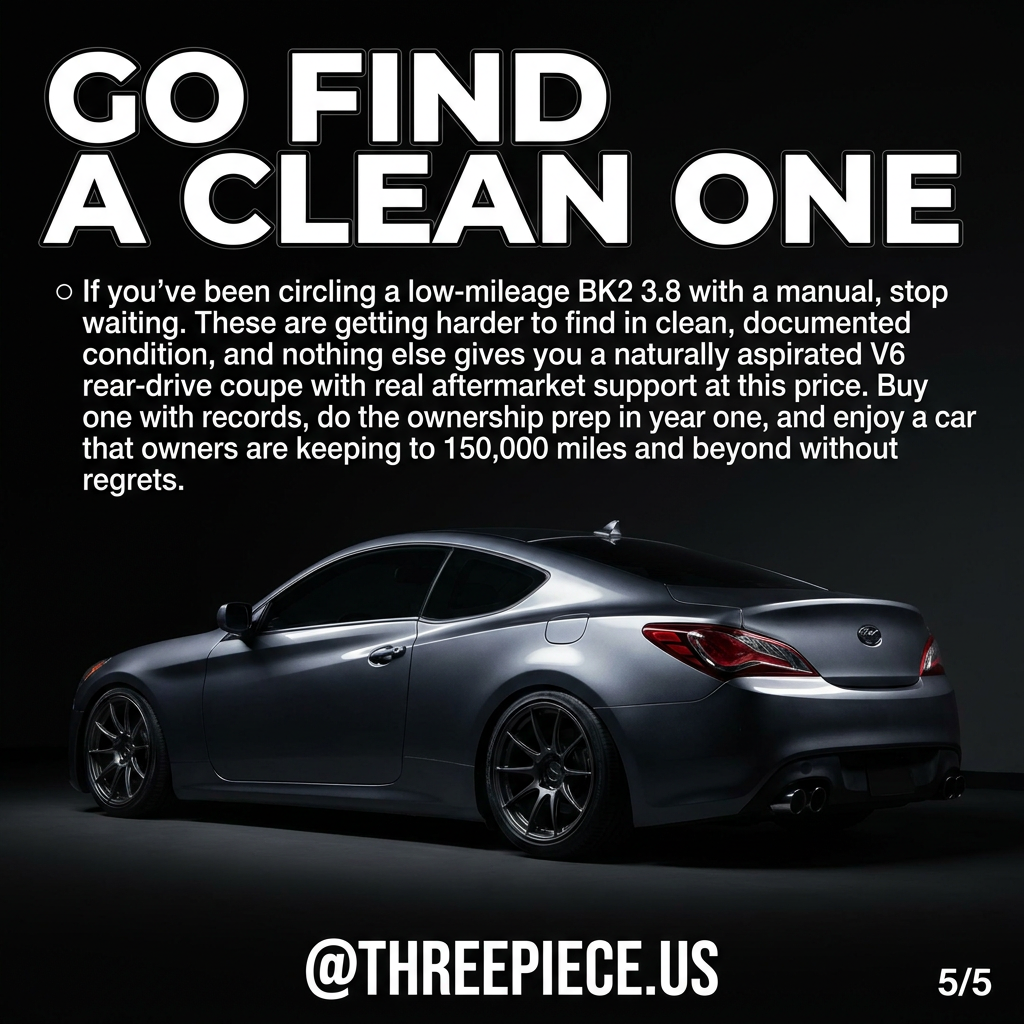
The 2013-2016 Hyundai Genesis Coupe 3.8 is a 348hp, naturally aspirated, rear-wheel-drive V6 coupe with a 6-speed manual option, factory Brembo brakes, and real aftermarket support — all for under $15,000. Nothing else in this price range touches that combination. The Hyundai badge is the only reason these aren't priced like 370Zs, and that gap is closing as more enthusiasts figure out what this platform actually is.
If you've been circling a low-mileage BK2 3.8 with a manual and documented service history, stop waiting. These are getting harder to find in clean condition. Owners are keeping them to 150,000 miles and beyond without regrets. Buy one, do the ownership prep in year one, and enjoy a car that embarrasses everything else at the money. Browse the ThreePiece vehicle gallery for build inspiration, and explore our full wheel catalog when you're ready to make it yours.