
Posted by THREEPIECE.US on May 28th 2026
CT4-V Blackwing vs BMW M3: Which Sedan Should You Buy?
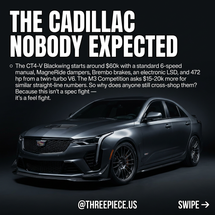
The CT4-V Blackwing vs BMW M3 debate keeps surfacing in every enthusiast group chat, and for good reason — both cars make roughly the same power, both offer a manual transmission, and both sit in the same price neighborhood. But they're engineered for completely different people. One rewards you on every back road with a chassis that refuses to be upset. The other gives you a deeper mod ecosystem, a more charismatic engine, and a badge that holds value. Here's the honest breakdown from real ownership data, forum threads, and documented builds.
Quick links
- Specs that actually matter
- Two completely different personalities
- Where the money really goes
- Mod potential isn't even close
- Wheels and fitment for both platforms
- Who should buy which
Specs That Actually Matter
The CT4-V Blackwing runs a 3.6L twin-turbo V6 (LF4) making 472 hp and 445 lb-ft of torque. It comes standard with a 6-speed Tremec manual, MagneRide adaptive dampers, Brembo brakes, an electronic limited-slip differential, and Performance Traction Management — all starting around $60,000–$65,000. That's a staggering amount of hardware for the money.
The G80 BMW M3 base makes 473 hp and 406 lb-ft from the S58 twin-turbo inline-six with a 6-speed manual in rear-drive form. The M3 Competition bumps output to 503 hp and 479 lb-ft but drops the manual for an 8-speed automatic and adds xDrive AWD as an option. Pricing starts around $70,000 for the base and climbs past $80,000 with Competition and xDrive trims. That's a $15,000–$20,000 premium over the Blackwing for similar or marginally better straight-line performance.
On paper, the Cadillac wins on value. But this comparison was never about spec sheets — it's about what each car does when you're actually driving it. If you're coming from a different performance sedan, our breakdown of V8 sedan matchups gives you a sense of how these head-to-head comparisons usually shake out.
Two Completely Different Personalities
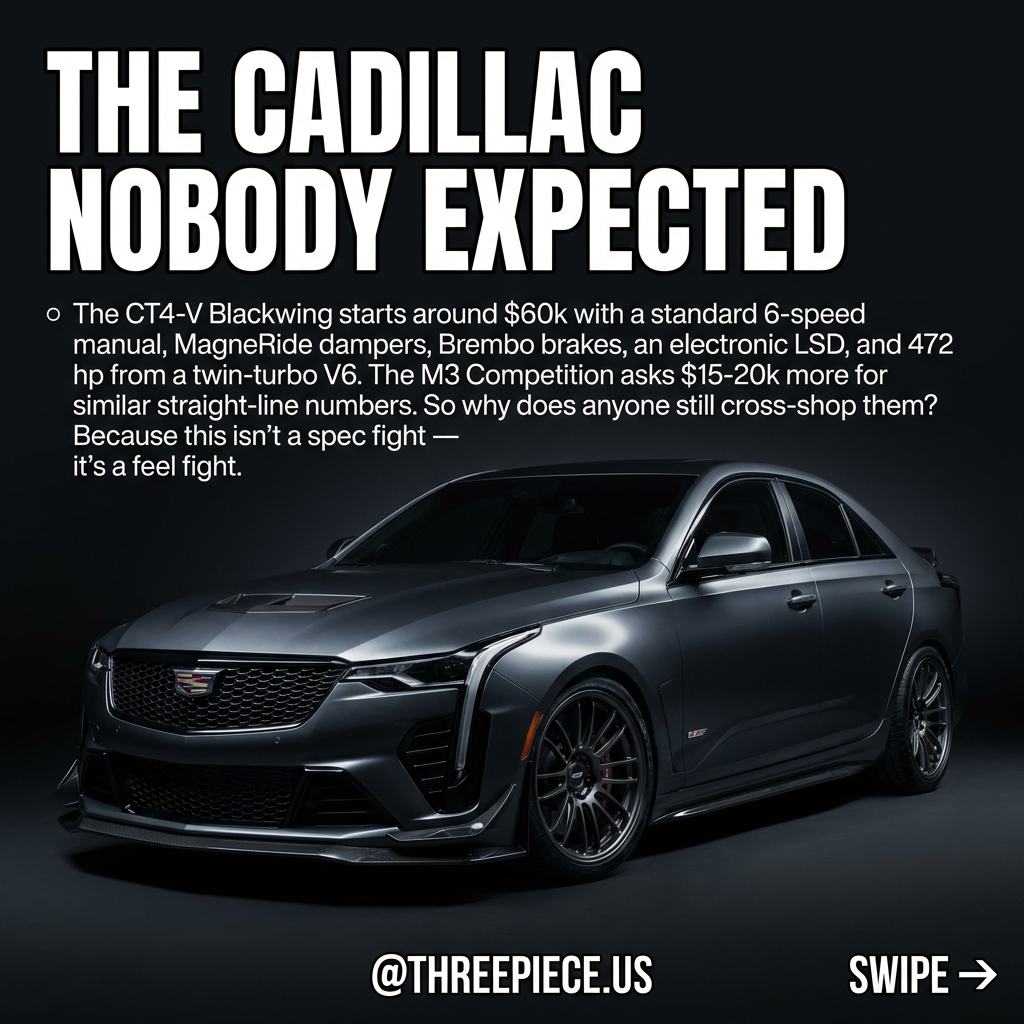
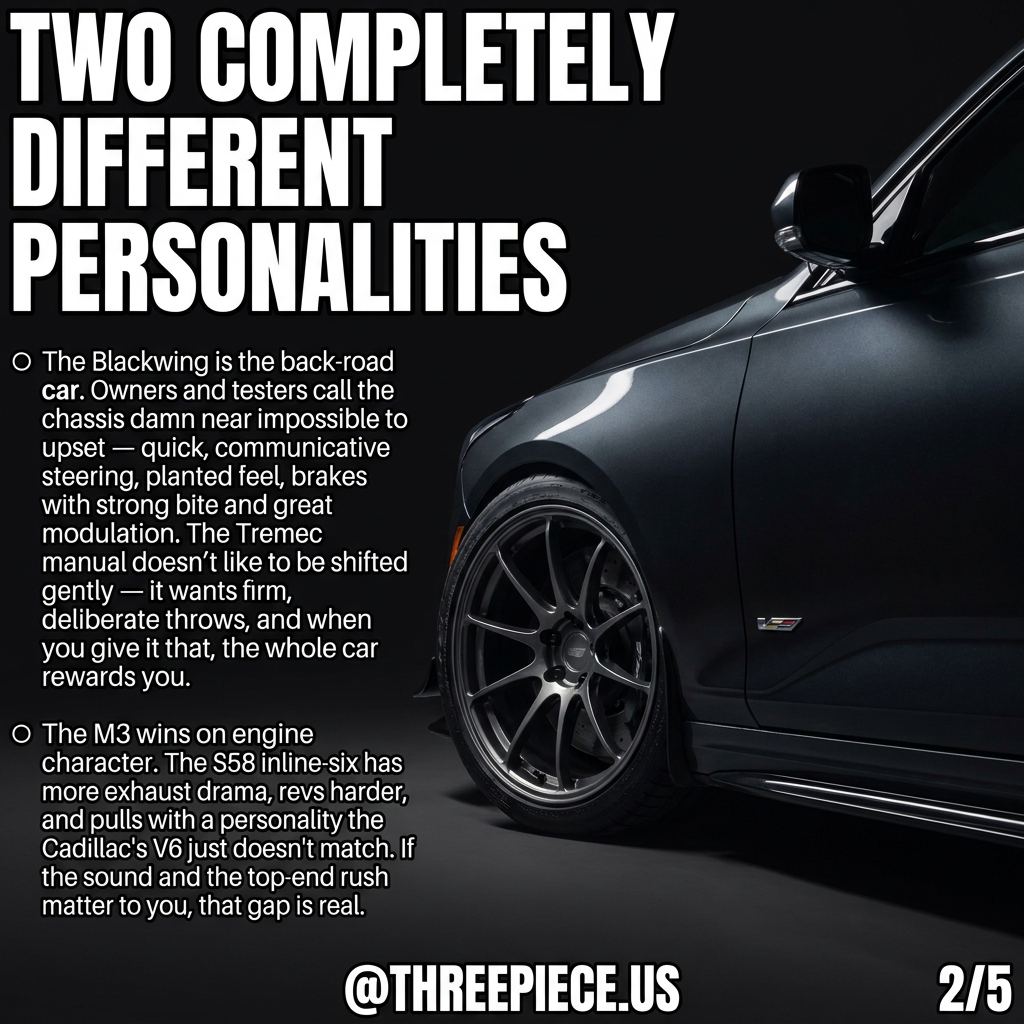
The Blackwing is the back-road car. MotorTrend's long-term testing described the chassis as "damn near impossible to upset" — quick, communicative steering, a planted rear end, and brakes with strong bite and outstanding modulation. The Tremec 6-speed doesn't like gentle shifts. Owners on CadillacForums and Reddit consistently say it wants firm, deliberate throws, especially when cold. Once you learn to match its energy, the entire drivetrain feels mechanical and connected in a way that modern cars rarely achieve.
The M3 wins on engine character, and it's not subtle. The S58 inline-six has more exhaust drama, revs harder, and pulls with a personality the Cadillac's V6 simply doesn't match. The Blackwing's LF4 redlines at ~6,500 rpm with a relatively flat exhaust note. It makes massive torque, but it doesn't scream. If the high-rpm rush and audible feedback matter to you — and for a lot of enthusiasts, they do — that gap is real and it doesn't close with a tune.
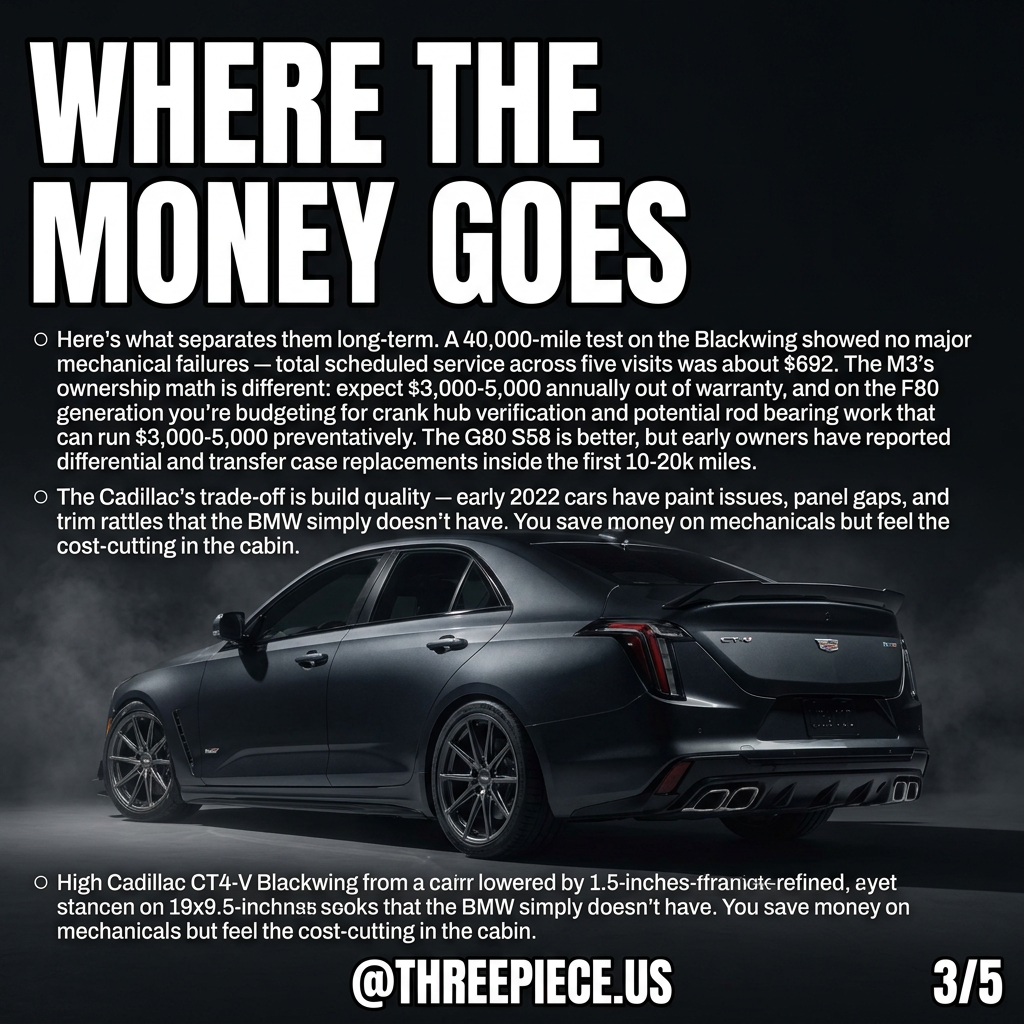
The M3 also brings a more refined interior. Better soundproofing, higher-quality materials, and more driver-assistance tech. The Blackwing's cabin uses softer plastics in places, and early 2022 cars have documented paint issues, panel gaps, and trim rattles. You feel the cost-cutting. The BMW doesn't have that problem. If you're interested in how the older M3 platform compares, our Porsche 987 Cayman vs E46 M3 comparison covers the analog driving experience in a different price bracket.
Where the Money Really Goes
This is where the Blackwing pulls away from the M3 in a way that doesn't show up on a spec sheet. A documented 40,000-mile long-term test on the CT4-V Blackwing showed no major mechanical failures — total scheduled service across five dealer visits came to approximately $692. That's absurdly cheap for a 472 hp performance sedan.
The M3's ownership math is different. Out of warranty, expect $3,000–$5,000 annually for maintenance — spark plugs, coils, cooling components, and brake consumables add up fast. On the older F80 generation, crank hub verification and preventative rod bearing work can run $3,000–$5,000, and ignoring it risks catastrophic engine failure. The G80's S58 is mechanically better, but early owners have reported differential and transfer case replacements inside the first 10,000–20,000 miles. For a deeper look at F80-era issues and maintenance, check out our F80 M3 fitment guide — it covers the platform in detail.
The Blackwing isn't free from wear items, though. Owners report front rotor replacements at ~$1,100 each for OEM Brembo units. The 10-speed automatic has documented issues with early leaks, cold-shift whining, and odd behavior at higher mileage — dealer software updates have addressed many cases, but it's worth noting if you're buying used. The manual's clutch wears faster if you shift gently; owners who drive it firmly report significantly better longevity. Replacements run $2,000+ depending on the shop.
BMW resale is stronger. The M3 badge carries weight in the used market that Cadillac simply can't match right now. If you plan to sell in 3 years, the M3 will hold more of its value. If you plan to keep the car, the Blackwing's lower running costs compound over time.
Mod Potential Isn't Even Close
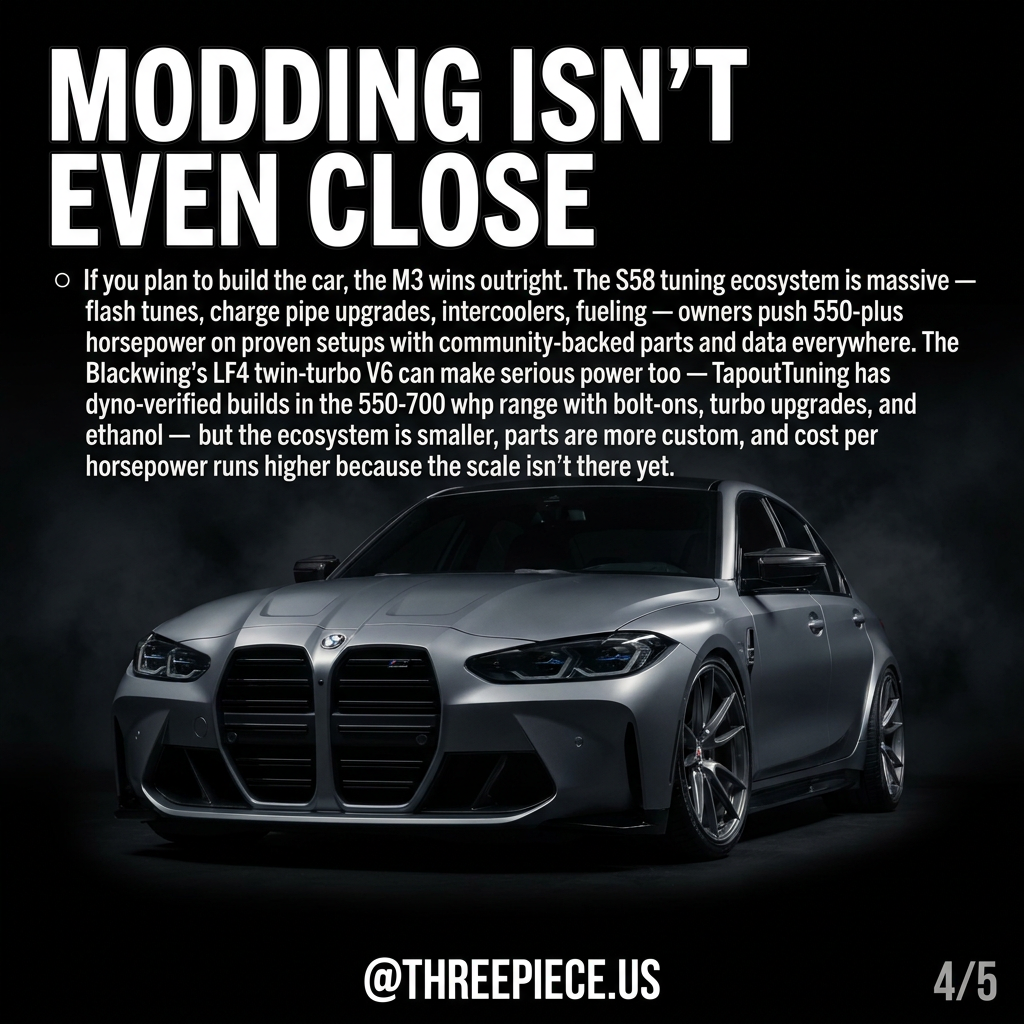
If you're buying a car to build, the M3 wins outright. The S58 tuning ecosystem is massive — flash tunes, charge pipe upgrades, intercoolers, fueling modifications — owners push 550+ horsepower on proven setups with community-backed parts and dyno data everywhere. The Akrapovic G80 M3/M4 Downpipe with Catalytic Converter at $4,347 is one of the most popular first hardware mods — it unlocks meaningful power gains when paired with a flash tune and sounds incredible. For the exhaust side, the Akrapovic G80 OPF/GPF Fitting Kit at $533 is the companion piece most builders grab alongside the downpipe.
The Blackwing's LF4 twin-turbo V6 can make serious power too. TapoutTuning has dyno-verified builds in the 550–700 whp range with bolt-ons, turbo upgrades, and ethanol. But the ecosystem is smaller, parts are more custom, and cost per horsepower runs higher because the scale isn't there yet. Fewer tuners, fewer off-the-shelf solutions, and fewer community data points mean you're paying a premium to be an early adopter.
Suspension is another area where the M3 has deeper support. The aFe Control Sway Bar Set for F80/F82 M3/M4 at $743 is a proven upgrade for track-oriented builds on the previous generation. For E92 M3 owners looking at exhaust, the Akrapovic E92 M3 Evolution Line titanium exhaust at $7,819 is the gold standard. The Cadillac side has MagneRide, which is excellent stock but limits aftermarket coilover options compared to the BMW's conventional setup. If you want to understand how rear camber arms work on lowered cars, that applies to both platforms once you start adjusting ride height.
Wheels and Fitment for Both Platforms
Both the CT4-V Blackwing and G80 M3 run staggered setups from the factory, but the sizing differs. The Blackwing sits on 18x9 front / 18x9.5 rear with 255/35R18 and 275/35R18 tires. The G80 M3 runs 18x9.5 front / 18x10 rear stock, with Competition models stepping up to 19x9.5 front / 19x10 rear.
The Blackwing uses a 5x114.3 bolt pattern, which opens up the entire JDM wheel catalog — Work Wheels, SSR, Enkei, Advan, and everything in between. Browse 18-inch wheels in 5x114.3 to see what fits. The M3 runs 5x112, which is Euro-standard and compatible with most German aftermarket options. Search 19-inch wheels in 5x112 for G80 Competition fitments.
If you're running 3-piece wheels on either platform, proper hardware matters. M7x32 chrome assembly bolts at $10 each or M8x32 satin black assembly bolts at $10 each are the standard fasteners for most 3-piece builds. Don't forget 90-degree valve stems at $3.80 — they're essential for deep-lip wheels where straight stems won't clear. For a full breakdown of what makes forged wheels different, we covered the engineering in detail.
The G80 M3 has extensive fitment documentation across forums and build threads. Our BMW M2 wheel fitment guide covers the closely related F87 platform if you're cross-referencing offsets. For E92 M3 owners, the E92 M3 fitment guide breaks down the common sizing mistakes. Check the ThreePiece vehicle gallery for real-world examples of both platforms on aftermarket wheels.
Who Should Buy Which
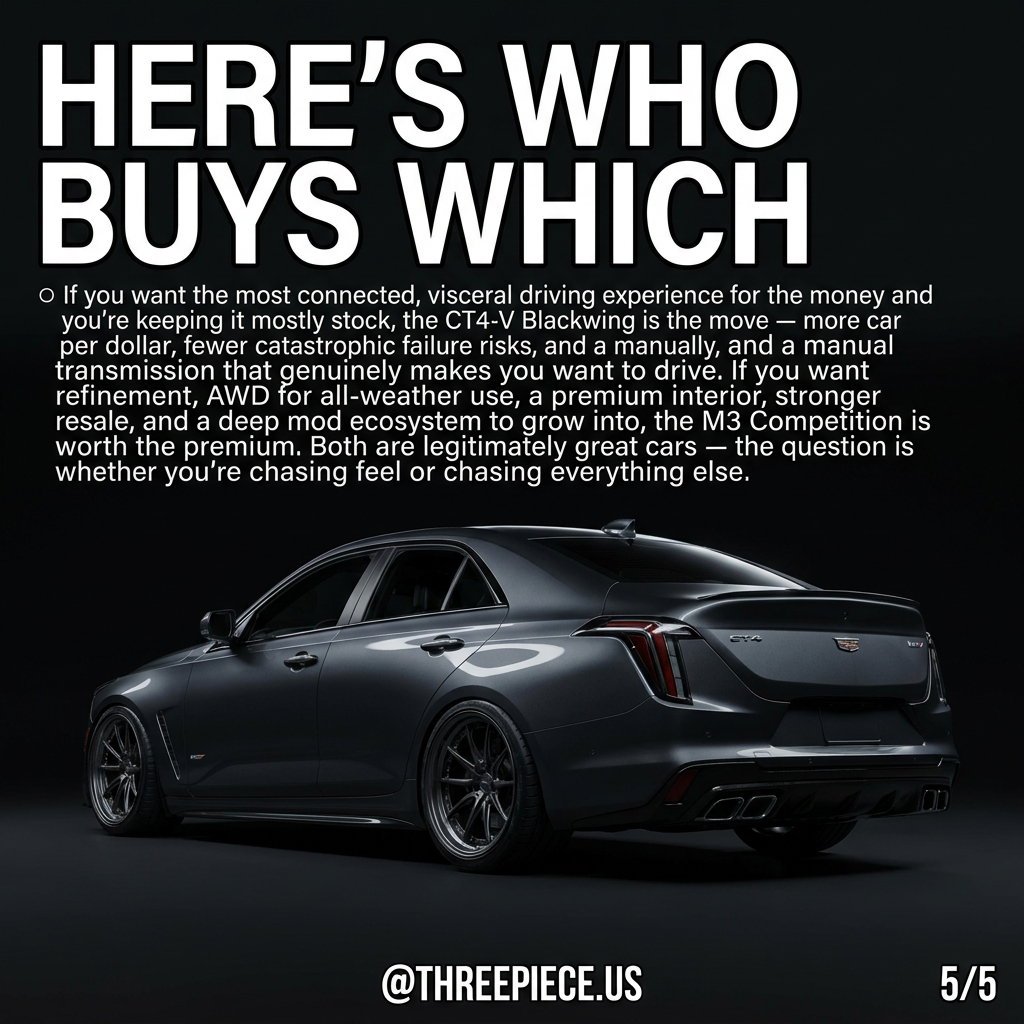
If you want the most connected, visceral driving experience for the money and you're keeping it mostly stock, the CT4-V Blackwing is the move. More car per dollar, fewer catastrophic failure risks, a manual transmission that genuinely makes you want to drive, and long-term ownership costs that make the BMW look expensive. The chassis is special. The value proposition is undeniable.
If you want refinement, AWD for all-weather use, a premium interior, stronger resale, and a deep mod ecosystem to grow into, the M3 Competition is worth the premium. The S58 platform has years of tuning development behind it, parts availability is massive, and the badge holds its value in ways Cadillac hasn't earned yet.
Both are legitimately great cars. The question is whether you're chasing feel or chasing everything else. If you're building either platform and need wheels, wheel parts, or suspension, ThreePiece.us has you covered. And if you want more head-to-head comparisons with real ownership data, read our breakdown of the Kia Stinger GT vs Audi S4 — same energy, different segment.