
Porsche 987 Cayman vs E46 M3: Which One Should You Buy?
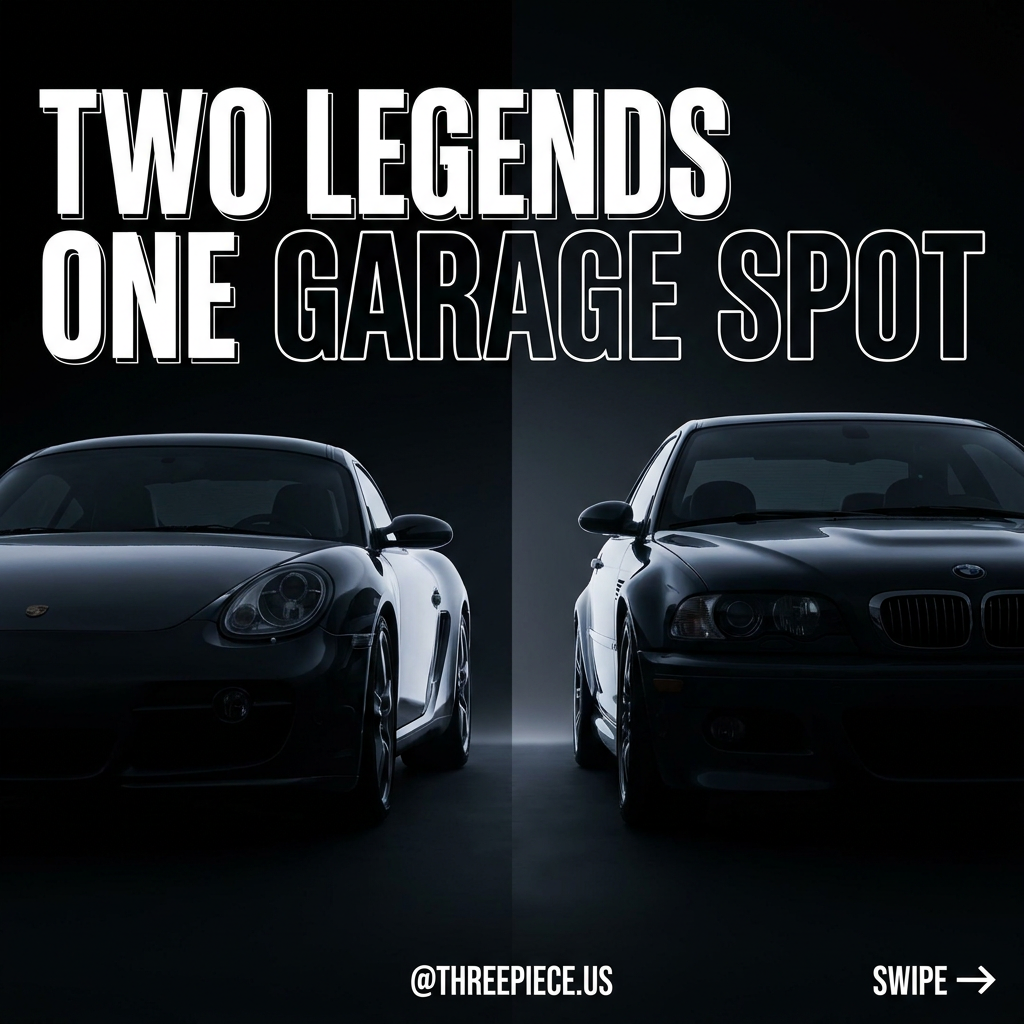
The Porsche 987 Cayman vs BMW E46 M3 debate has been running for almost two decades, and the forums still can't agree. That's because both cars are genuinely excellent — and genuinely flawed — in completely different ways. The Cayman gives you mid-engine precision and lower catastrophic risk. The M3 gives you an 8,000-rpm inline-six that sounds like nothing else on the road. Both are appreciating. Both will wreck your budget if you buy the wrong example. Here's how they actually compare for someone ready to write a check.
Quick links
- The Cayman's Mid-Engine Advantage
- The M3's Emotional Argument
- Failure Modes That Actually Matter
- Real Ownership Costs Compared
- Wheel Fitment for Both Platforms
- The Verdict: Who Buys Which
The Cayman's Mid-Engine Advantage
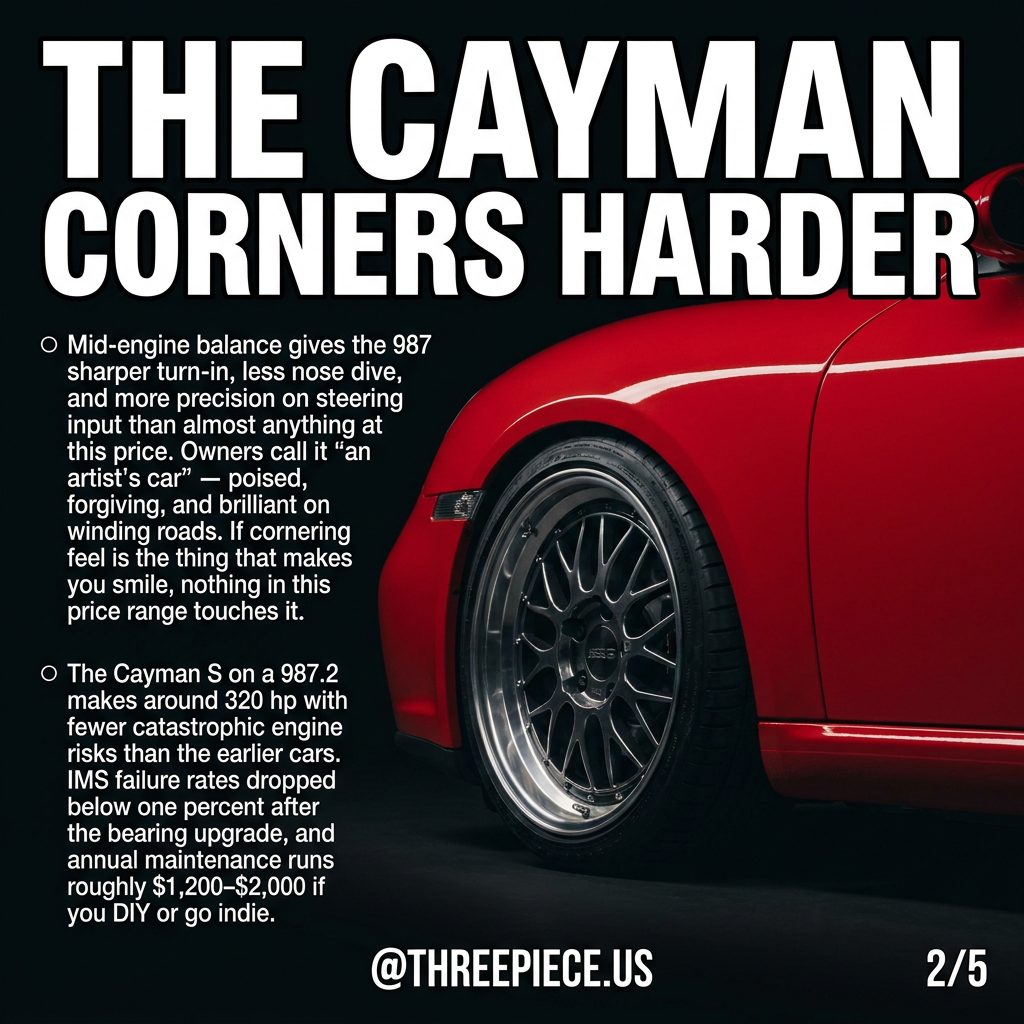
The 987 Cayman S on the 987.2 platform makes roughly 320 hp and 273 lb-ft of torque from a 3.4L flat-six, sitting right behind the driver. That mid-engine layout gives it a mechanical advantage no front-engine car can replicate: sharper turn-in, almost zero nose dive under braking, and a balance point that rewards precision rather than brute force. Owners consistently describe it as "an artist's car" — poised, forgiving, and brilliant on winding roads where corner speed matters more than straight-line pull.
The 987.2 specifically is the one to target. Porsche upgraded the IMS bearing after 2006, and failure rates dropped below one percent. Annual maintenance on a well-kept example runs roughly $1,200–$2,000 if you DIY or go indie. That's remarkably manageable for a mid-engine Porsche. If you're curious how the Cayman lineage evolved, our Porsche Cayman history ranked by owners covers every generation in detail. And if you're cross-shopping the open-top variant, read our take on Porsche Boxster vs Cayman — the Boxster might surprise you.
The M3's Emotional Argument
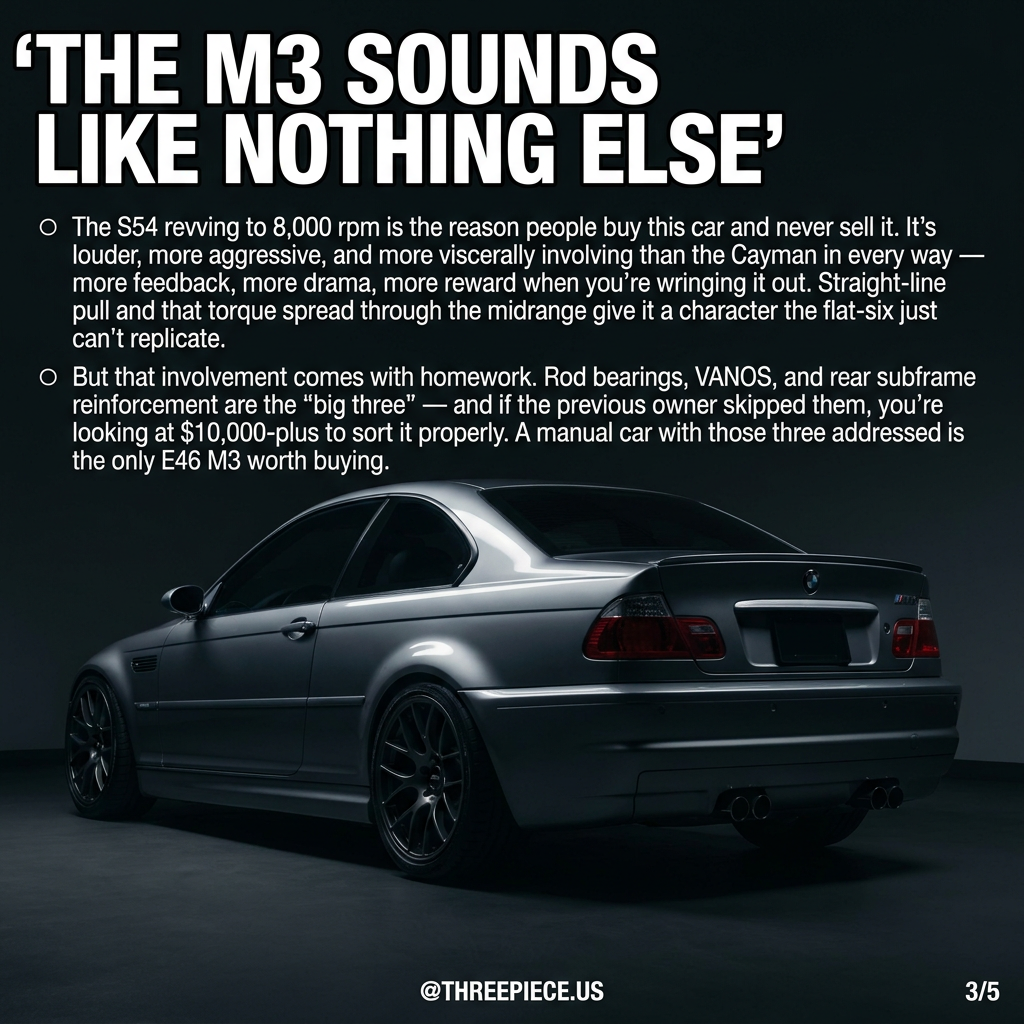
The S54 inline-six revving to 8,000 rpm is the reason people buy the E46 M3 and never sell it. It produces 333 hp and 262 lb-ft of torque through a naturally aspirated powerband that builds like a turbine. It's louder, more aggressive, and more viscerally involving than the Cayman in every measurable way — more steering feedback, more drama, more reward when you're wringing it out. The torque spread through the midrange gives it a character the flat-six simply can't replicate.
But that involvement comes with homework. The E46 M3 weighs roughly 1,470 kg versus the Cayman's 1,350 kg, and its front-engine, rear-drive layout demands more driver input to rotate. That's not a disadvantage — it's a different philosophy. The M3 rewards aggression and commitment where the Cayman rewards finesse. If you eventually move up to the next-generation M3, our F80 M3 wheel fitment guide covers that platform extensively. For the E92 generation, check our E92 M3 wheel fitment breakdown so you don't make a costly sizing mistake.
Failure Modes That Actually Matter
This is where the conversation gets real. Both cars have well-documented weak points, but the nature of those failures is fundamentally different — and that distinction should drive your buying decision.
E46 M3: The "Big Three"
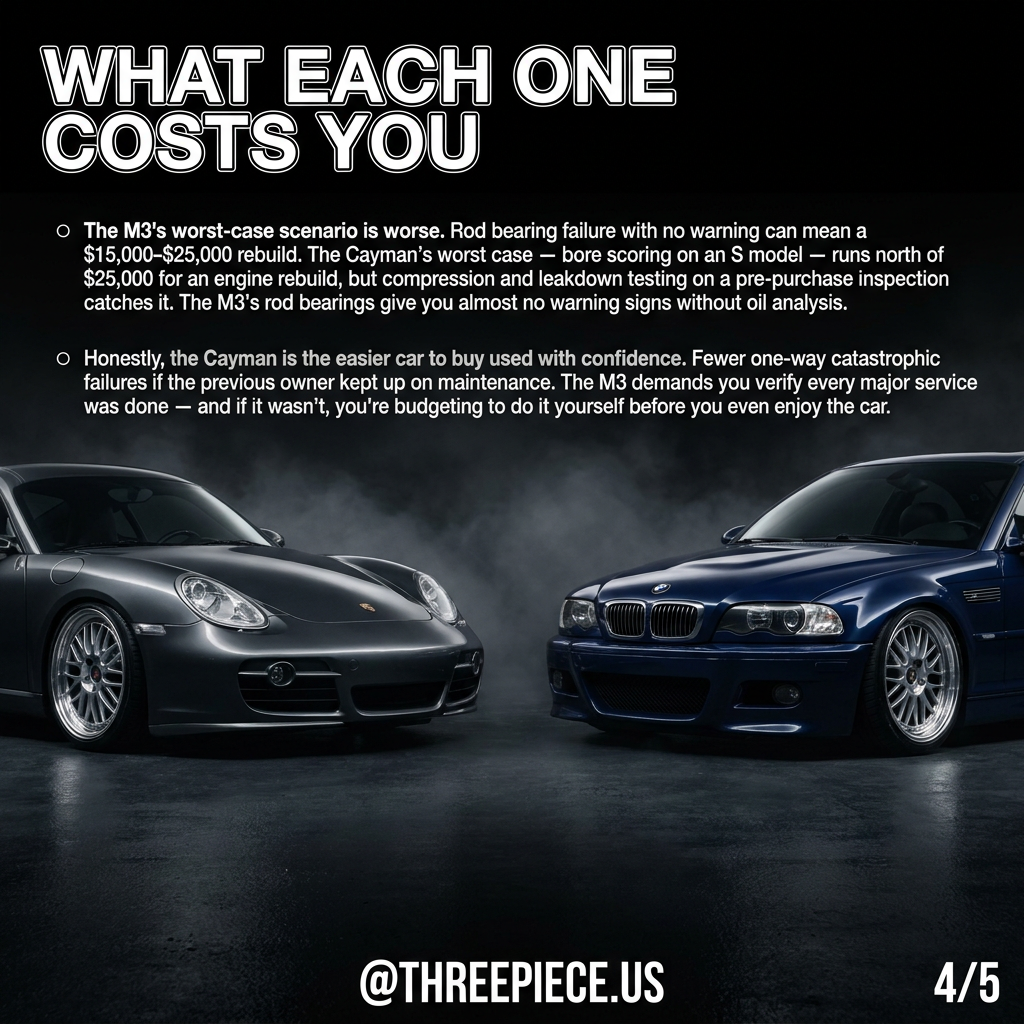
Rod bearings are the single biggest risk. The factory bearings are undersized and wear prematurely, especially with aggressive use or extended oil change intervals. The terrifying part: they give you almost no warning without oil analysis. If they let go, you're looking at a $15,000–$25,000 rebuild. Preventative replacement at 60,000–80,000 miles runs $3,000–$5,000.
VANOS system degradation is next. Failed solenoids, degraded internal seals, and sheared cam gear bolts on the exhaust side cause loss of low-end torque, rough idle, and rattles. A full VANOS overhaul costs $2,000–$3,000. Beisan Systems makes upgraded aftermarket seals that are now considered standard preventative maintenance.
Rear subframe cracking rounds out the trio. The mounting points for the rear subframe can crack or tear out, especially on SMG cars or chassis that have seen track abuse. Repair involves welding, reinforcing plates, and replacing bushings — $2,000–$5,000+ depending on severity. Many buyers factor this into purchase negotiation immediately. If you're lowering an E46, rear camber arms are non-negotiable — the Eibach Pro-Alignment Rear Camber Arm Kit for E46 at $435 is one of the best investments you can make on this chassis.
Beyond the big three, the cooling system is all plastic and ages terribly. Expansion tanks, radiator end tanks, and thermostat housings all crack with age. A full cooling refresh runs $1,500–$2,500. The Mishimoto E46 Silicone Hose Kit at $139 replaces the brittle factory rubber with silicone that actually lasts. And if you're running an SMG, just know that hydraulic pump, accumulator, and actuator failures are expensive — most long-term owners convert to manual or avoid SMG entirely.
987 Cayman: Lower Catastrophic Risk, But Not Zero
Bore scoring on S models with the M97 engine is the big one. Scoring in the Lokasil cylinder liners typically appears between 30,000–80,000 miles, especially with cold-start abuse or aggressive warmup habits. An engine rebuild runs north of $25,000. The critical difference from the M3's rod bearing issue: a compression and leakdown test on a pre-purchase inspection catches it. You can screen for this before you buy.
Rear main seal leaks are common — oil seeping where the engine meets the transmission can contaminate the clutch. Labor is high due to the mid-engine packaging. Ignition coils and spark plugs on the M97 are maintenance items, not catastrophic failures, but accessing front-bank spark plugs on the boxer layout is tedious enough that shops charge accordingly.
Cooling system plastic components also degrade on the 987 — cracked expansion tanks, stone-chipped radiators and A/C condensers — but the failure mode is gradual rather than sudden. Suspension bushings wear and cause clunks and uneven tire wear, prompting many owners to upgrade to polyurethane or monoball components.
Real Ownership Costs Compared
The M3's worst-case scenario is objectively worse, and it's harder to predict. Rod bearing failure with no warning can turn a $30,000 car into a $50,000 project overnight. The Cayman's worst case — bore scoring — is equally expensive to fix, but you can test for it before purchase. That single distinction makes the 987.2 Cayman S the easier car to buy used with confidence.
A manual E46 M3 with the big three already addressed is the only one worth buying. If the previous owner skipped rod bearings, VANOS, and subframe reinforcement, you're budgeting $10,000+ before you even enjoy the car. For the M3 owner planning to upgrade the clutch during that work, the DKM Clutch E46 M3 Sprung Organic MB Kit with Steel Flywheel handles 440 ft-lbs of torque and runs $1,017 — worth doing while the transmission is out.
Annual ownership costs on a well-maintained 987.2 Cayman run roughly $2,500–$4,000/year in the US including insurance. The E46 M3 is comparable in routine maintenance but carries significantly higher variance — one deferred service item can cascade into a five-figure bill. For context on how other performance sedans compare in real ownership costs, our W212 E63 AMG problems breakdown shows what happens when German engineering meets deferred maintenance on an even more complex platform.
Wheel Fitment for Both Platforms
Both cars look exceptional on properly fitted aftermarket wheels, and both have specific sizing constraints you need to respect.
The E46 M3 runs a 5x120 bolt pattern with a 72.6mm hub bore. The factory staggered setup is 18x8 front / 18x9 rear, but most enthusiasts run 18x9 +22 front / 18x10 +25 rear for a more aggressive stance without excessive fender work. Browse 18-inch wheels in 5x120 to see what fits. Pair the fronts with 245/40R18 tires and the rears with 275/35R18 tires for the ideal setup. If you're running aftermarket wheels, make sure you understand hub-centric vs lug-centric fitment — on a car this capable, centering matters.
The 987 Cayman runs a 5x130 bolt pattern with a 71.6mm hub bore. Factory sizing is 18x8 front / 18x9.5 rear on S models. A popular upgrade is 19x8.5 front / 19x10 rear, though you need to be careful with offset — anything more aggressive than +50 front / +45 rear starts rubbing without spacers or camber adjustment. Check out 19-inch wheels in 5x130 for options. For 718 Cayman owners looking at the newer platform, our 718 Cayman wheel guide covers those specifics.
Both platforms look outstanding on 3-piece wheels. The E46 M3 in particular pairs beautifully with Work VS series wheels — the VS-XX in particular has become the definitive look for clean E46 builds. If you're building or rebuilding a set, Work step lips start at $399 and Work reverse barrels are also $399. Finish the build with Black/Gold Work VS center caps at $120 each. To understand why forged multi-piece wheels are worth the investment on cars at this level, read our breakdown of what forged wheels actually are.
The Verdict: Who Buys Which
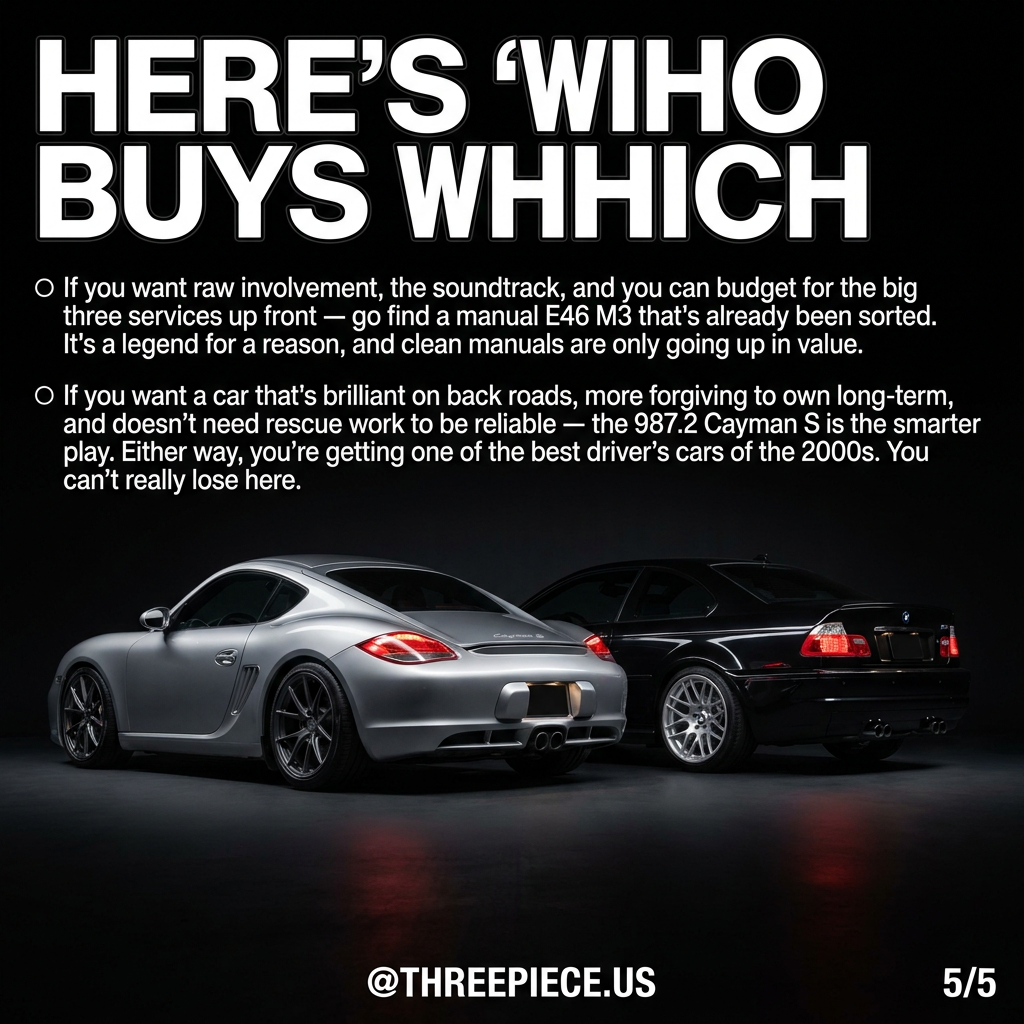
If you want raw involvement, the soundtrack, and you can budget for the big three services up front — go find a manual E46 M3 that's already been sorted. Rod bearings done, VANOS refreshed, subframe reinforced. Clean manuals are only going up in value, and a properly maintained S54 is a top-five engine of all time. The Chase Bays E46 Hydro Handbrake Line Kit at $267 is worth mentioning for anyone building a track or drift-focused E46 — it's a clean solution for dual rear caliper setups.
If you want a car that's brilliant on back roads, more forgiving to own long-term, and doesn't need rescue work to be reliable — the 987.2 Cayman S is the smarter play. Get a pre-purchase inspection with compression and leakdown testing, verify the service history, and enjoy one of the best mid-engine chassis ever made for under $40,000.
Either way, you're getting one of the best driver's cars of the 2000s. You can't really lose here — as long as you buy the right example. Browse our vehicle gallery for build inspiration on both platforms, and explore our full wheel catalog when you're ready to make whichever one you choose look the part.