

Semi-metallic brake pads are the default recommendation at every parts counter in America, and for most enthusiasts, they're the wrong choice. Unless you're tracking your car in triple-digit heat or towing heavy loads down a mountain pass, semi-metallics are actively working against you — destroying your wheel finish, filling the cabin with noise, and chewing through rotors faster than any daily driver should accept. If you've spent real money on your wheel setup, this is the one behind-the-wheel decision that can wreck the entire look.

Quick links
- The brake dust problem is worse than you think
- The noise never goes away
- They're eating your rotors too
- You probably don't even need them
- Run ceramics and move on
The Brake Dust Problem Is Worse Than You Think
Here's the reality: semi-metallic brake pads contain 30–65% metal content — steel, iron, and copper particles that shed as thick, dark, metallic dust every time you touch the brake pedal. That dust doesn't just sit on your wheels. It bakes into the finish, bonds to clearcoat, and becomes nearly impossible to remove without aggressive chemical cleaners or physical scrubbing.
Owners across Civic, Chevy, and Ranger forums all report the same thing — within a month or two, wheels are heavily coated. If you're running polished lips from Work step lips starting at $399, or a set of Weds Kranze reverse lips at $230, that metallic brake dust is oxidizing and pitting the very surface you paid to have perfect. Forum users on E46Fanatics specifically cite semi-metallic dust as the reason they switched pads — not performance, not wear life, but purely because it was destroying the appearance of their wheels.
If you've invested in a proper wheel setup — especially anything with an exposed lip or barrel — you're cleaning every single week just to keep things looking presentable. That's not maintenance. That's a punishment for choosing the wrong pad compound.
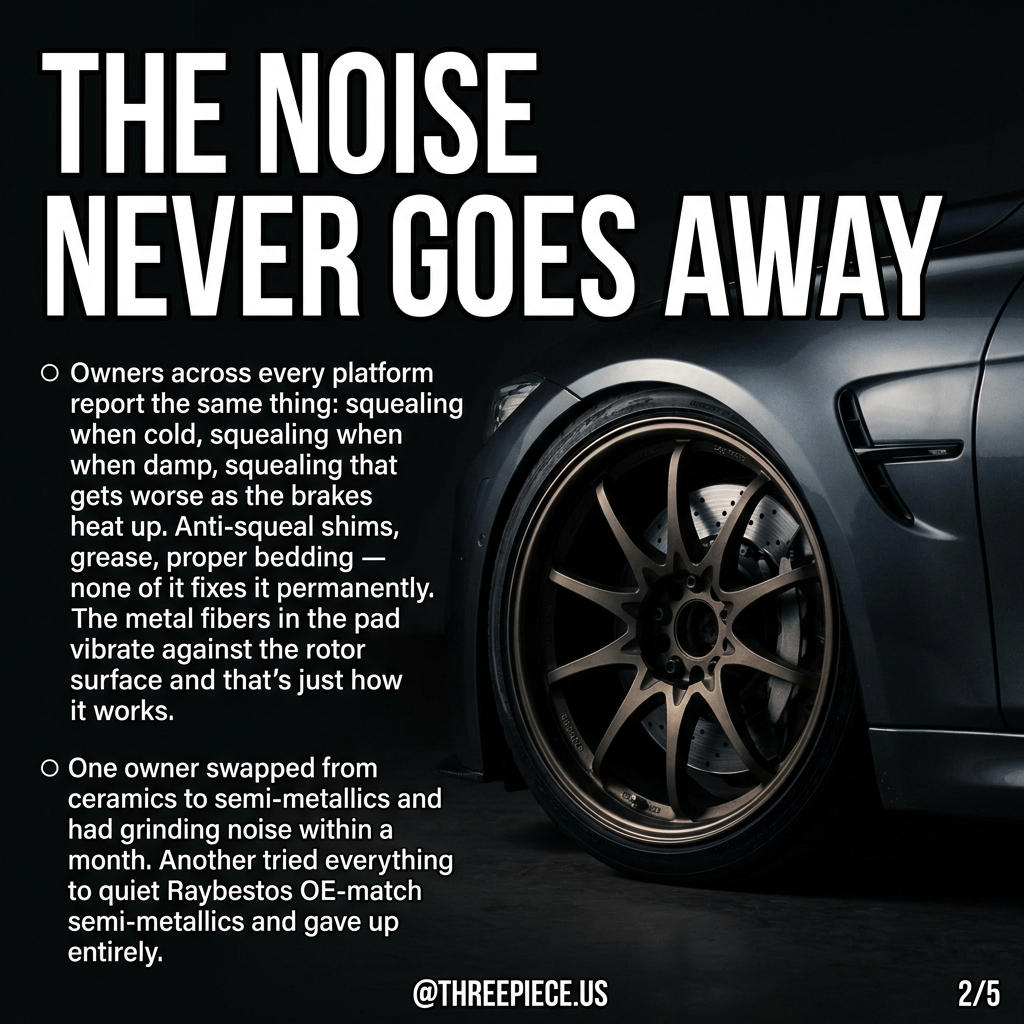
The Noise Never Goes Away
Owners across every platform — BMW, Ford, Subaru, Lexus — report the same persistent complaint: squealing when cold, squealing when damp, and squealing that gets worse as the brakes heat up. Anti-squeal shims, caliper grease, proper bedding procedures — none of it fixes it permanently. The metal fibers in the pad vibrate against the rotor surface at frequencies above 5 kHz, and that's just the physics of the compound.
One owner on TheRangerStation swapped from ceramics to Raybestos OE-match semi-metallics and had grinding noise within a month. He tried everything — hardware lubrication, cleaning components, re-bedding — and eventually gave up entirely and went back to ceramics. Another on BobIsTheOilGuy noted that even "good" semi-metallics will sometimes squeal, and the cheap ones are guaranteed to be loud from day one.
This matters more than most people realize. If you're running a clean build — the kind of car you'd see in the ThreePiece vehicle gallery — persistent brake squeal undermines the entire experience. You didn't build a show-quality car to have it announce itself at every stoplight like a delivery truck. For context on how brake clearance and disc type affect your setup, our breakdown of hub-centric vs lug-centric wheels covers the mechanical side of how wheel-to-hub fitment interacts with your brake components.
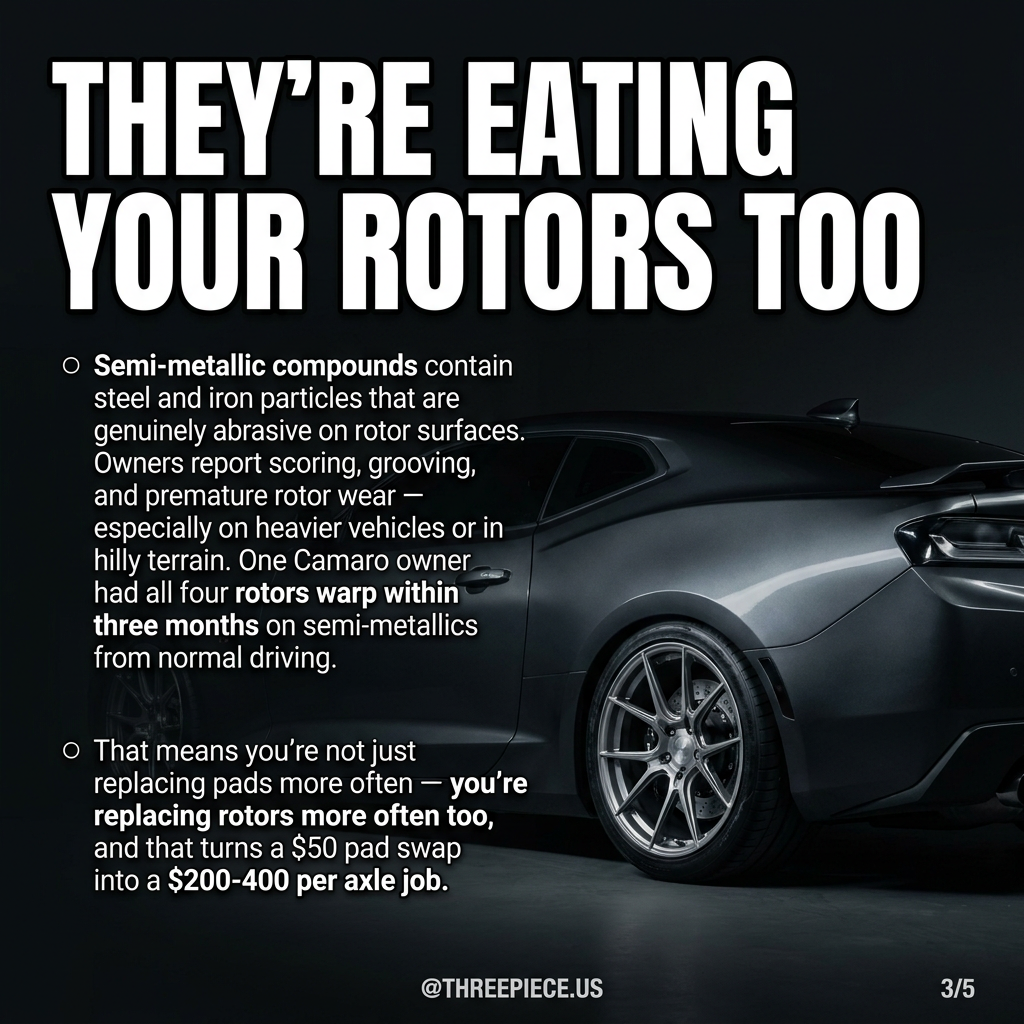
They're Eating Your Rotors Too
Semi-metallic compounds don't just shed dust — they're genuinely abrasive on rotor surfaces. The steel and iron particles embedded in the pad material score, groove, and prematurely wear rotors, especially on heavier vehicles or in hilly terrain. One van owner on Reddit documented front pad replacement every ~25,000 miles and rear pads every ~15,000 miles in hilly conditions. That's shockingly fast for a daily driver, and it means you're not just replacing pads more often — you're replacing rotors more often too.
Wagner's own trouble-tracer documentation notes that metal particles from semi-metallic pads can embed in the rotor, causing noise and rotor damage. ExplorerForum users report rotor surfaces becoming deeply grooved and blackened from metallic dust over time. A Camaro owner had all four rotors warp within three months on semi-metallics from normal driving — turning what should be a $50 pad swap into a $200–400 per axle job.
If you're running a performance platform like a Subaru STI, quality rotors like the EBC BSD Front Rotors for the 05-07 STI at $491 are an investment worth protecting. Pairing expensive rotors with an overly abrasive pad compound is just burning money. For Infiniti G35 owners with Brembo calipers, the EBC BSD Front Rotors for the G35 at $410 are another example — premium hardware that deserves a pad compound that won't wreck it prematurely. And if you're on an Acura platform, the EBC BSD rotors for the CSX Type S at $384 are purpose-built for spirited street driving and shouldn't be paired with semi-metallics.
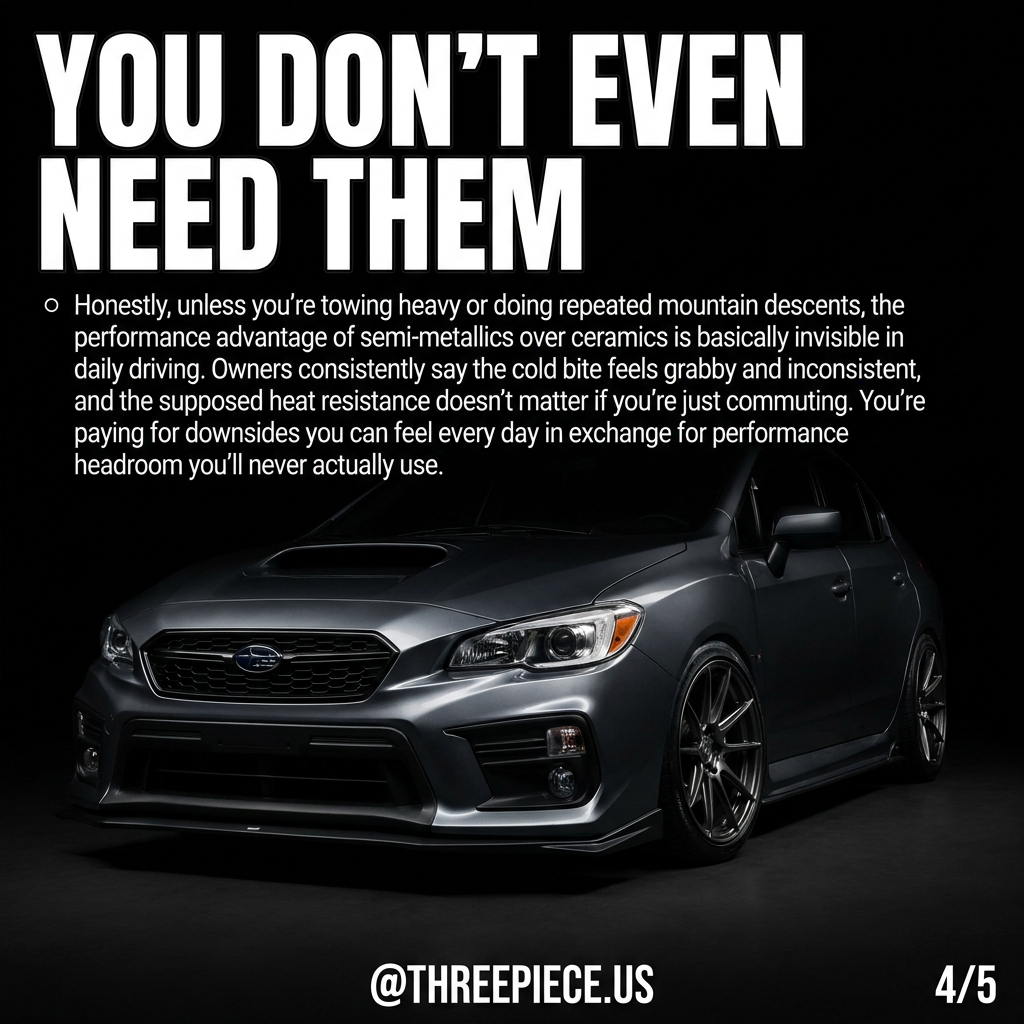
You Probably Don't Even Need Them
The supposed advantage of semi-metallic pads is heat resistance and initial bite. In practice, unless you're doing repeated mountain descents, towing a loaded trailer, or running hot laps at a track day, that performance headroom is completely invisible in daily driving. Owners consistently report that the cold bite on semi-metallics feels grabby and inconsistent — the opposite of what you want in stop-and-go traffic.
Think about it this way: you're paying for downsides you can feel every single day — noise, dust, rotor wear — in exchange for performance you'll never actually use. The thermal limits of a quality ceramic pad are more than adequate for 95% of street driving. If you're building a car for the street and care about how it looks and sounds, the math doesn't work in favor of semi-metallics. Period.
This same logic applies to other parts of your build. Just like choosing the right forged wheel construction for your actual use case matters, choosing the right brake compound for your actual driving style is the difference between a build that works and one that fights you. If you're curious about how brake clearance affects wheel selection on specific platforms, check our 370Z fitment guide or F80 M3 fitment guide for real-world examples of how caliper size dictates your wheel diameter and spoke clearance.
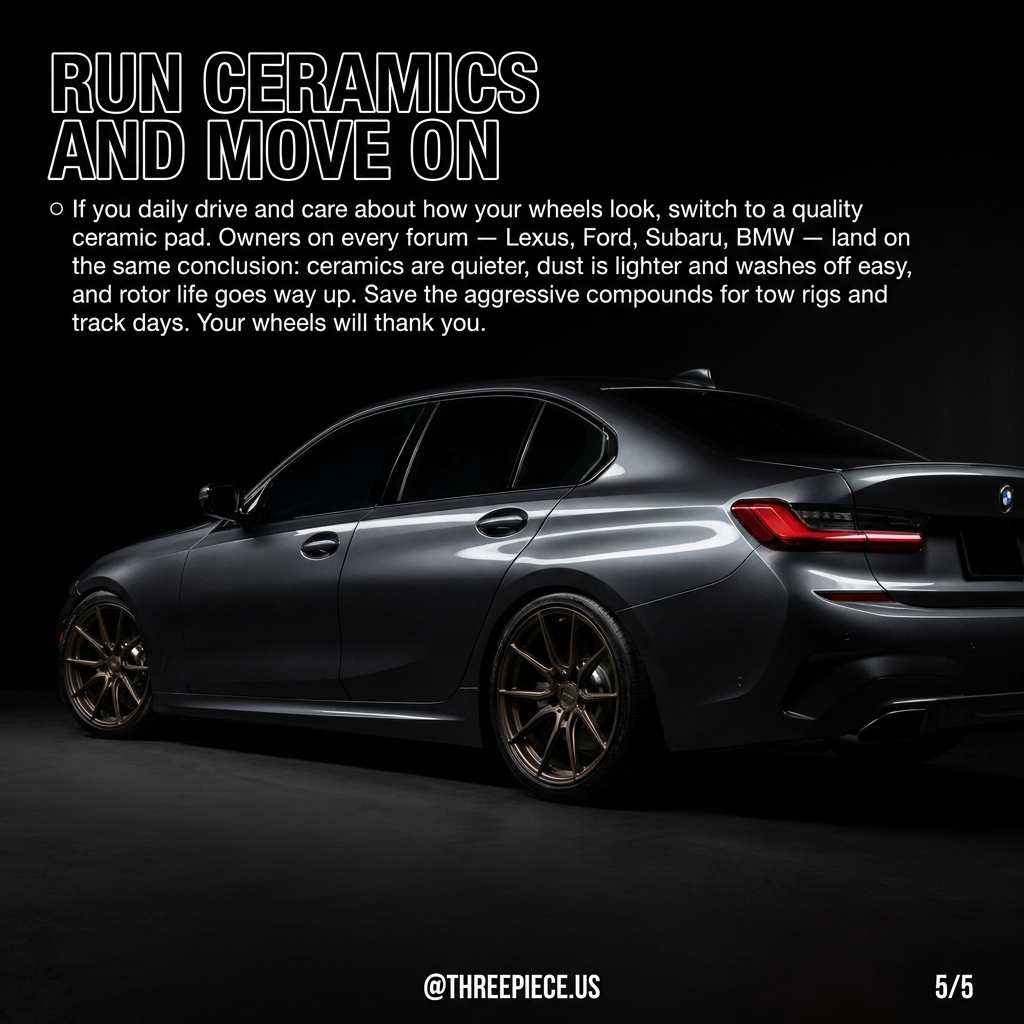
Run Ceramics and Move On
If you daily drive and care about how your wheels look, switch to a quality ceramic pad and don't look back. Owners on every forum — Lexus, Ford, Subaru, BMW — land on the same conclusion: ceramics are quieter, dust is lighter and washes off easily, and rotor life goes way up. The dust from ceramic pads is typically a fine, light-colored powder that doesn't bond to finishes the way metallic particles do.
Save the aggressive compounds for tow rigs and dedicated track cars. For everything else, ceramics handle the job with fewer compromises. Your Work Wheels will thank you. Your Weds Kranze setup will thank you. Even your valve stems will stay cleaner.
If your current semi-metallic pads have already done damage to your wheel lips or barrels, replacement Work wheel halves, SSR replacement parts, and BBS replacement barrels are all available through our wheel parts catalog. Don't let the wrong brake compound be the reason you need to refinish or replace a lip. Make the switch, keep your wheels clean, and focus your budget on the parts that actually matter.