

Mazda RX-8 Buying Guide: Apex Seals, Premix & Compression
The Mazda RX-8 is one of the most misunderstood sports cars on the used market. It sits at $4,000–$8,000 on any given Marketplace scroll, looks like a proper JDM coupe, and revs to 9,000 rpm with a sound nothing else replicates. It also has an engine architecture that will financially ruin you if you don't understand apex seal intervals, premix schedules, and rotary compression testing before you hand over cash. This isn't a scare piece — it's the honest breakdown that every RX-8 forum veteran wishes someone had handed them before their first Renesis rebuild invoice.

Quick links
- Apex seal failure: the Renesis timer
- Premix & oil metering: why the engine starves itself
- Compression testing before you buy
- Series 1 vs Series 2 differences
- What a rebuild actually costs
- Ownership demands: the second-job reality
- RX-8 wheel fitment & build finishing
- Verdict: buy one if you mean it
Apex Seal Failure: The Renesis Timer
The 13B-MSP Renesis uses three apex seals per rotor — leading, trailing, and center — riding directly against chromed rotor housings. There are no reciprocating pistons, no ring lands, and no conventional wear patterns. When those seals lose contact with the housing, compression drops and the engine is finished. The OEM chrome layer on the housings is relatively thin, so once apex seal wear becomes uneven — center section wearing faster than the edges — you get seal face warping, housing scoring, and gas leakage that no tune or additive can fix.
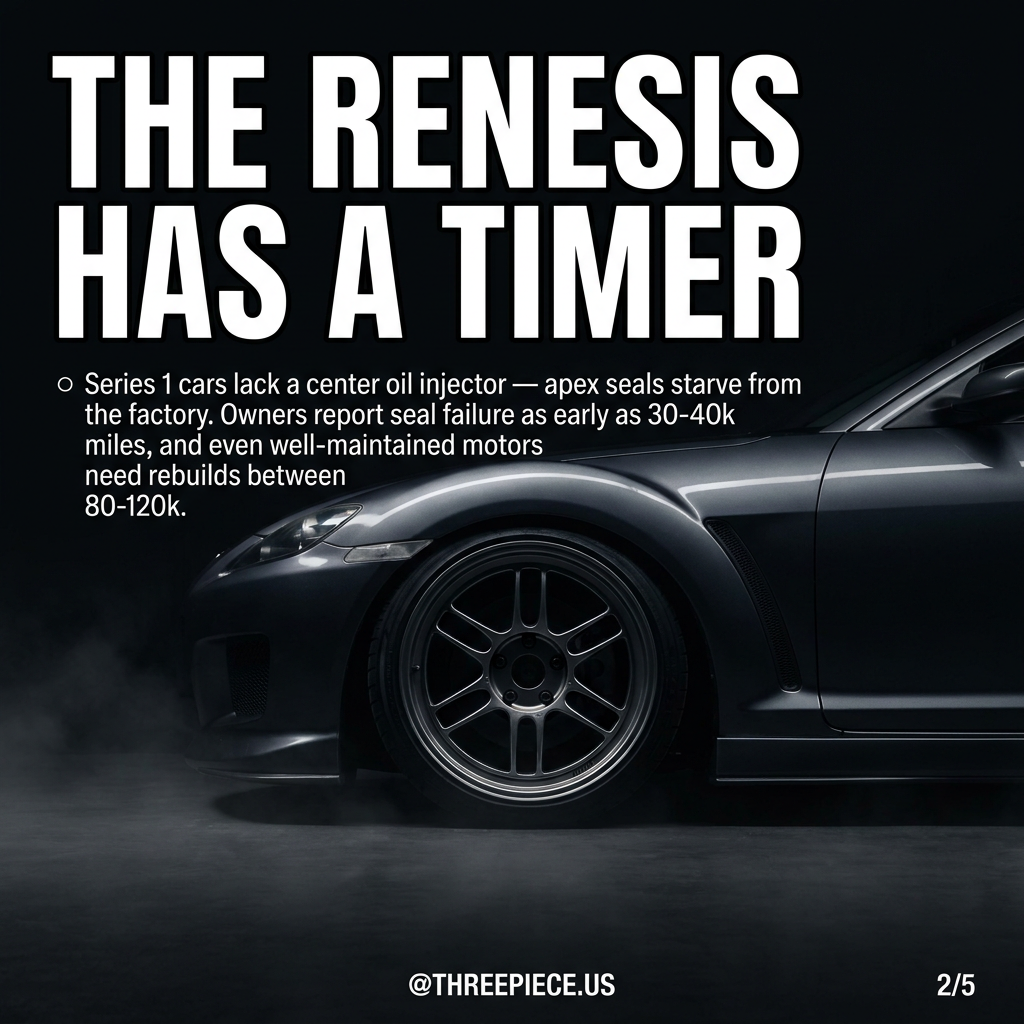
Owners on RX8Club report seal failure as early as 30,000–40,000 miles on Series 1 cars, with one R3 owner documenting complete seal failure at just 34k. Even well-maintained examples typically need a rebuild somewhere between 80,000 and 120,000 miles. Beyond that, longevity is genuinely unpredictable. If you've ever looked at a sub-$20K manual sports car and thought the RX-8 was the obvious bargain, the rebuild timeline is the part of the equation most people ignore.
Premix & Oil Metering: Why the Engine Starves Itself
The Renesis is factory designed to burn oil. An Oil Metering Pump (OMP) injects lubricant directly onto the apex and side seals during operation, and normal consumption runs roughly one quart every 1,500–3,000 miles depending on seal condition and driving style. This isn't a symptom — it's the design intent. The problem is that Series 1 cars lack a center oil injector, which means the middle section of each apex seal gets the least lubrication from the factory. That's exactly where most early failures originate.
Under-lubrication accelerates exponentially with certain driving habits. Cold starts, short trips, and weak ignition all leave unburned fuel in the combustion chamber, which washes oil off the seal faces — a phenomenon called bore wash. Many experienced owners premix additional two-stroke oil into the fuel tank at every fill-up to compensate, essentially treating the Renesis like a two-stroke engine. It helps, but it's a stopgap for a fundamental design limitation, not a cure. If you're comparing ownership demands, the Miata MX-5 mod and maintenance path is a different universe of simplicity.
Compression Testing Before You Buy
This is the single most important step in any RX-8 purchase, and most buyers skip it entirely. A proper rotary compression test requires a Mazda-specific tool — standard piston-style compression testers capture peak pressure but can't detect leakage over time, which is exactly how apex seals fail. You need the engine warm, battery fully charged, and throttle wide open. Healthy readings are 100–120 psi (7.0–8.5 kgf/cm²) per face with no more than 15 psi variance between any two faces.
If you're seeing readings below 90–95 psi, or a spread greater than roughly 1 bar between faces, you're looking at an engine that's either already failing or about to. Some cars show normal compression cold but refuse to hot-start — the engine cranks but won't fire until it cools down. This tracks directly with apex seal wear because hot rotor housings exacerbate seal lifting as the tiny springs behind each seal lose tension. If one face reads zero, that's a shattered apex seal, and expect secondary damage to the rotor face, adjacent housings, and iron housing surfaces. At that point, a simple seal replacement becomes a full engine teardown.
If the seller won't let you compression test, walk. No exceptions. This advice applies to any older Mazda performance purchase — but on a rotary, it's non-negotiable.
Series 1 vs Series 2: Know What You're Buying
Series 1 (2004–mid 2008) cars shipped with thinner apex seals, weaker OMP calibration, and less lubrication safety margin across the board. These are the cars flooding Marketplace at tempting prices, and they're the ones most likely to need a rebuild before 80k miles. The ECU tuning on early cars is also less refined — flooding, misfires, and poor hot-start behavior are all more common, and each of those failure modes accelerates apex seal wear.
Series 2 (2009–2012) brought upgraded OMP mapping, revised ECU calibration, and improved ignition and fueling control. None of this makes the Renesis bulletproof, but it addresses the catastrophic chain reactions — flooding that fouls plugs, misfires that cook catalytic converters, and poor hot-starts that signal compression loss — more effectively. If you're set on an RX-8, the Series 2 is the smarter entry point by a significant margin. The price gap between the two is often only $1,000–$2,000, which is nothing compared to a rebuild bill.
What a Rebuild Actually Costs
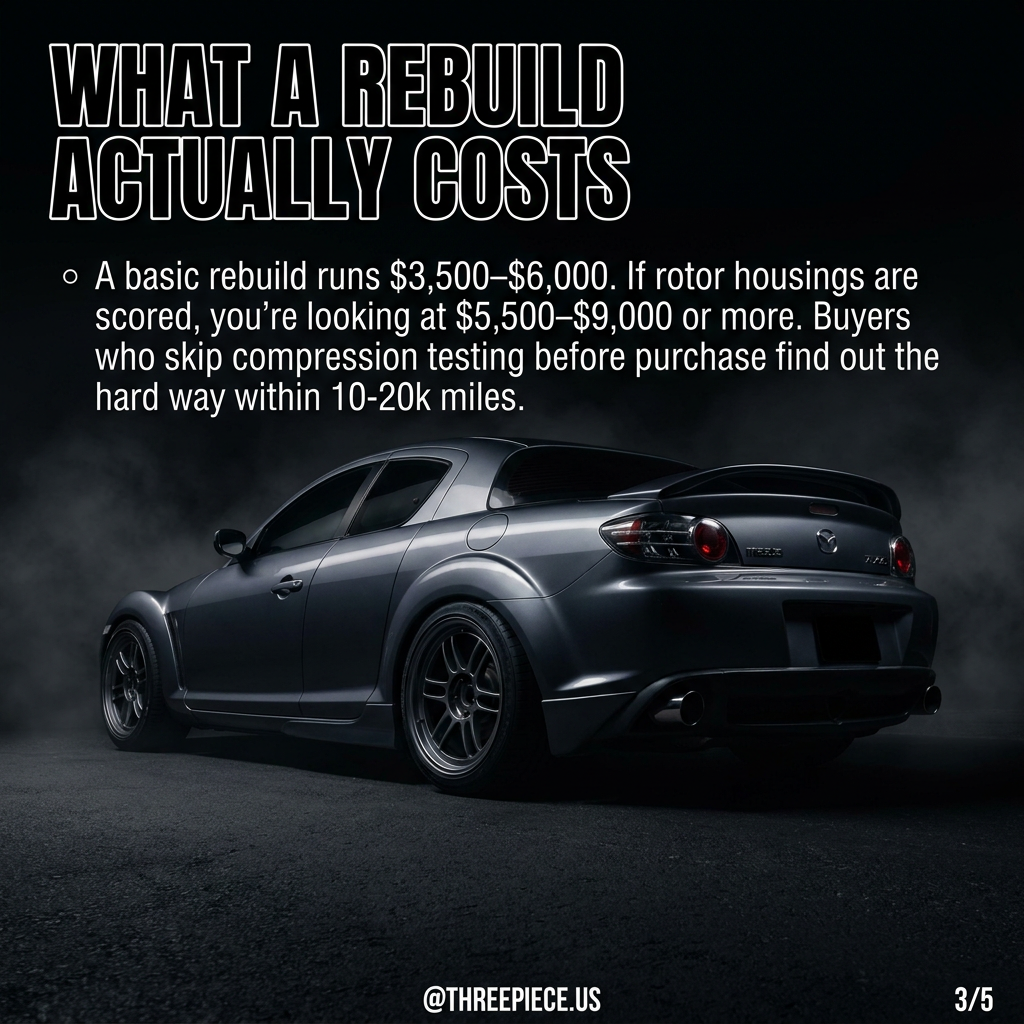
A basic Renesis rebuild — new apex seals, side seals, corner seals, o-rings, and gaskets with the existing housings — runs $3,500–$6,000 in parts and labor if you can find a rotary specialist, and that list is shorter than you think. If the rotor housings are scored from a failed seal dragging across the chrome surface, you're looking at $5,500–$9,000+ because you now need replacement housings, and good used Renesis housings aren't exactly sitting on shelves.
The hidden cost is diagnosis. Misdiagnosis is rampant — forums overflow with stories of owners chasing "apex seal failure" when the real culprit was weak ignition coils, fouled plugs, or a clogged catalytic converter. Coil packs and plugs run $400–$1,200 to replace, and if you catch it early, you prevent the cascade that actually wrecks the seals. But many people delay ignition maintenance, which lets misfires dump unburned fuel into the exhaust, overheat the cat, and simultaneously starve the seals of lubrication. By the time the car won't hot-start, you've already crossed the line from "ignition fix" to "full rebuild." Understanding how exhaust components interact with engine health matters here more than on any piston engine.
Ownership Demands: The Second-Job Reality
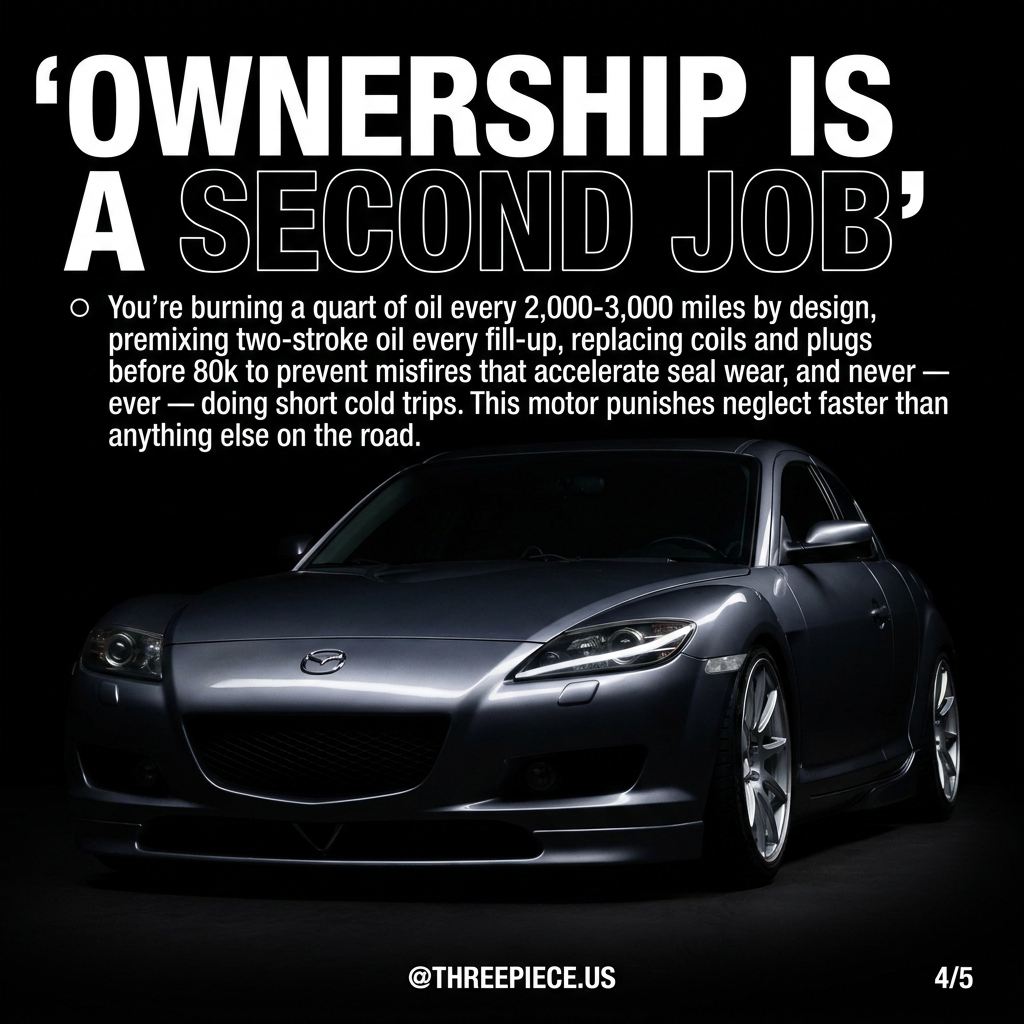
Owning a Renesis-powered RX-8 means accepting a maintenance cadence that would be considered obsessive on any other car. Oil changes every 2,500–3,000 miles with the correct weight. Checking oil level at every fuel stop because the engine is designed to consume it. Replacing spark plugs and ignition coils on a 25,000–40,000 mile schedule — not when they fail, but before they fail, because a single misfire event can start the seal-wear cascade. Premixing two-stroke oil at every fill-up on Series 1 cars. And perhaps most importantly, never doing short cold trips. The Renesis needs to reach full operating temperature regularly, and it needs to be revved. This is an engine that punishes conservative driving.
If that sounds like your kind of commitment, the RX-8 rewards you with one of the best front-midship chassis layouts ever put into a sub-$10K car. The 50/50 weight distribution, the naturally aspirated 9,000 rpm powerband, and the four-door practicality are genuinely unmatched at this price point. The driving experience is why people rebuild these engines two and three times. But if you're coming from something like a Civic Si build or a 350Z/Genesis Coupe and expecting similar ownership costs, you're going to be shocked.
RX-8 Wheel Fitment & Build Finishing
If you've done the homework, passed the compression test, and committed to the maintenance schedule, the RX-8 deserves proper wheels. The platform runs a 5x114.3 bolt pattern with a 67.1mm hub bore, and the sweet spot for most builds is 18x9 +25 to +35 square, or a staggered setup with 18x8.5 front / 18x9.5 rear. The fenders are surprisingly accommodating with minor rolling, and the car's low curb weight means you don't need to oversize tires to find grip.
Browse Volk Racing 21C 5x114.3 18X8.5+35 Dark Gunmetal to see what fits the platform. For a JDM-correct build, the Work Emotion series or Work VS line complement the RX-8's curves without overwhelming the body lines. If you're running a 3-piece setup and need replacement lips or barrels down the road, Work reverse lips start at $399 and Work step barrels are available at the same price. For those running Weds Kranze wheels, replacement Xtune Mazda Rx-8 04-08 LED Tail Lights Black ALT-ON-MRX804-LED-BK - 5081209 start at $230.
Pair 18x9 +30 wheels with 245/40R18 tires for a balanced street/track setup, or go 265/35R18 in the rear if you're running staggered. Understanding how offset affects handling is critical on a car this light — the wrong offset will ruin the RX-8's naturally balanced steering feel. For a deeper dive into sizing fundamentals, our BRZ fitment guide covers the same principles on a similarly lightweight platform. And don't forget the details — finish the build with proper 90-degree valve stems at $3.80 each if you're running deep-dish setups where straight stems won't clear.
Check the ThreePiece vehicle gallery for real-world fitment examples across similar JDM platforms.

Verdict: Buy One If You Mean It
The Mazda RX-8 is not a cheap sports car. It's a cheap chassis attached to an engine that demands either your full attention or your full wallet — usually both. Get a compression test on all six faces before you talk price. Verify readings of 100–120 psi with no more than 15 psi variance. Ask about oil consumption, premix habits, and ignition service history. If the seller can't answer those questions, they didn't maintain the car properly, and you're buying someone else's neglected rebuild timeline.
If you pass all of that and you're ready to carry a premix bottle in your trunk, change oil every 3,000 miles, and actually rev the engine like it was designed to be revved — the RX-8 will reward you with a driving experience that nothing else at this price point can touch. Just walk in with your eyes open. The Renesis doesn't care about your budget. It only cares whether you respected the engineering.
Ready to build yours the right way? Browse wheels and wheel accessories to finish the car it deserves to be.