
Posted by THREEPIECE.US on May 27th 2026
Mazda MX-6 Turbo Buying Guide: The Last Cheap JDM Coupe
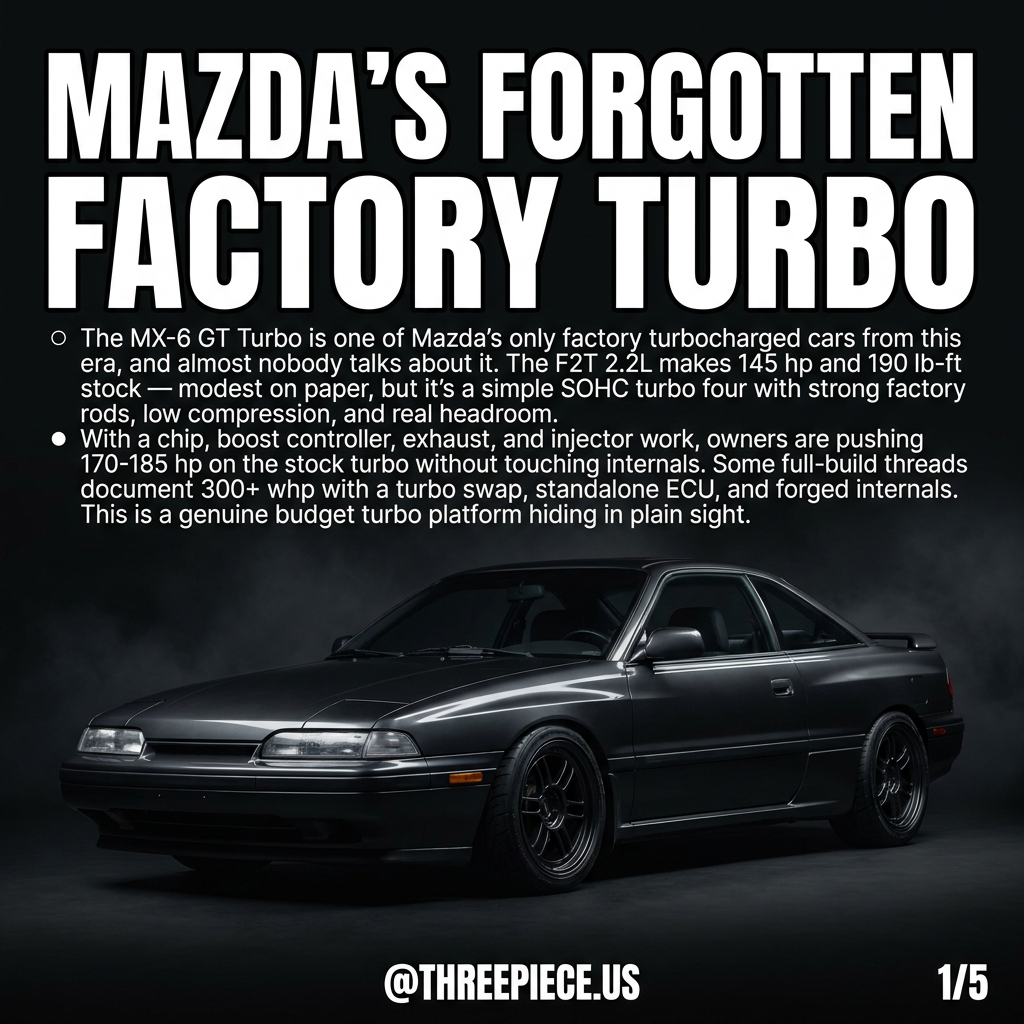
The 1988–1992 Mazda MX-6 GT Turbo is one of the last genuinely undervalued Japanese turbo coupes you can still buy without a bidding war. While MR2 Turbos and 240SXs have been priced into the stratosphere, the MX-6 Turbo has been sitting in the margins — a factory turbocharged coupe with 145 hp and 190 lb-ft from a 2.2L SOHC F2T, real mod headroom, and a chassis that punches way above its weight class. If you've been looking for a budget turbo project that isn't another Miata, this is the one to chase before the market catches on.
Quick links
- The F2T Engine: What Makes It Special
- Driving Experience: Why Owners Keep These
- Real Mod Potential and Power Targets
- What Breaks: Known Failure Points
- Pre-Purchase Checklist
- Wheel Fitment and Sizing
- Final Verdict: Buy One Before You Can't
The F2T Engine: What Makes It Special
The F2T is a 2.2L SOHC turbocharged four-cylinder running an IHI RHB5/VJ11 turbo with factory intercooling and a low 7.8:1 compression ratio. That low compression is the key — it means the bottom end was designed from the factory to handle boost, and the rods are surprisingly strong for an engine of this era. Rod and crank bearing failures are almost unheard of at stock power levels, and even moderately built F2Ts with upgraded pistons and rods have been documented hitting 350–400 whp in long-form build threads on mx6.com.
The simplicity is the other advantage. This is a pre-OBD-II, single-overhead-cam engine with minimal electronic complexity. You're not fighting a CAN bus network or a locked ECU — you're working with an engine that responds to basic turbo fundamentals: more air, more fuel, more spark control. If you understand how air-fuel ratios work in a turbocharged context, you already have the knowledge base to tune one of these.
The F2T also shares its turbo, head, and many drivetrain components with the Ford Probe GT and Mazda 626 Turbo, which means salvage parts are more available than you'd expect for a car this rare. That parts cross-compatibility is a genuine lifeline for anyone building one of these in 2026.

Driving Experience: Why Owners Keep These
On paper, 145 hp doesn't sound like much. But the MX-6 GT Turbo is a lightweight FWD coupe, and that 190 lb-ft of torque arrives low in the rev range. Under boost, this car pulls harder than any late-80s Mazda has a right to. Owners who've refreshed the suspension — new bushings, quality shocks, fresh mounts — consistently report that the GD chassis wakes up in a way that reminds you these cars were genuinely praised by the automotive press when new.
The optional 4-wheel steering models are increasingly rare and genuinely change how the car rotates at speed. If you find one with 4WS intact and functional, that's a car worth paying a premium for. It's a mechanical curiosity that also happens to make the car measurably better in transitions.
This isn't a modern car, and that's the entire point. No traction control, no drive modes, no infotainment fighting for your attention. You get a turbocharged engine, a manual gearbox (if you find the right one), and a chassis that communicates. For anyone who's been priced out of the Miata market or wants something with a roof and a turbo, the MX-6 GT is the answer nobody's talking about.

Real Mod Potential and Power Targets
The tuning path for the F2T is well-documented, even if the community is small. Here's what real owners are getting:
- Stage 1 (stock turbo, bolt-ons): A chip/EPROM tune, boost controller set to ~14 psi, exhaust, and injector work gets you to 170–185 whp without touching internals. This is the sweet spot for a reliable daily.
- Stage 2 (turbo swap, fuel system): Moving to a T3 or T3/T4 hybrid turbo with an upgraded intercooler, larger injectors, and a standalone ECU (Megasquirt MS1 V3.0 is the community standard) opens the door to 220–280 whp.
- Stage 3 (full build): Forged internals (Wiseco pistons at 8.5:1, Pauter rods), head porting, combustion chamber work, standalone ECU, and a properly sized turbo have been documented at 300–400+ whp. This requires serious investment — budget $5,000–$10,000+ in parts alone — but the platform can handle it.
The key detail: the stock ECU with an EPROM chip gets you safely to about 14 psi on the factory IHI turbo. Beyond that, you need standalone engine management. Full write-ups exist for running Megasquirt with the stock wiring harness and distributor, which keeps the swap cost manageable. If you're considering a standalone ECU for the first time, the MX-6 community has some of the most detailed, step-by-step documentation you'll find for any platform this old.
An oil catch can is also a smart addition on any boosted F2T — turbo seal weep and crankcase blowby are real concerns on 30+ year old engines, and catching that oil before it re-enters the intake is cheap insurance.
What Breaks: Known Failure Points
This is the section that matters most. The MX-6 Turbo is a 30+ year old car, and certain failure points are well-documented across forums and owner groups. Know these before you buy.
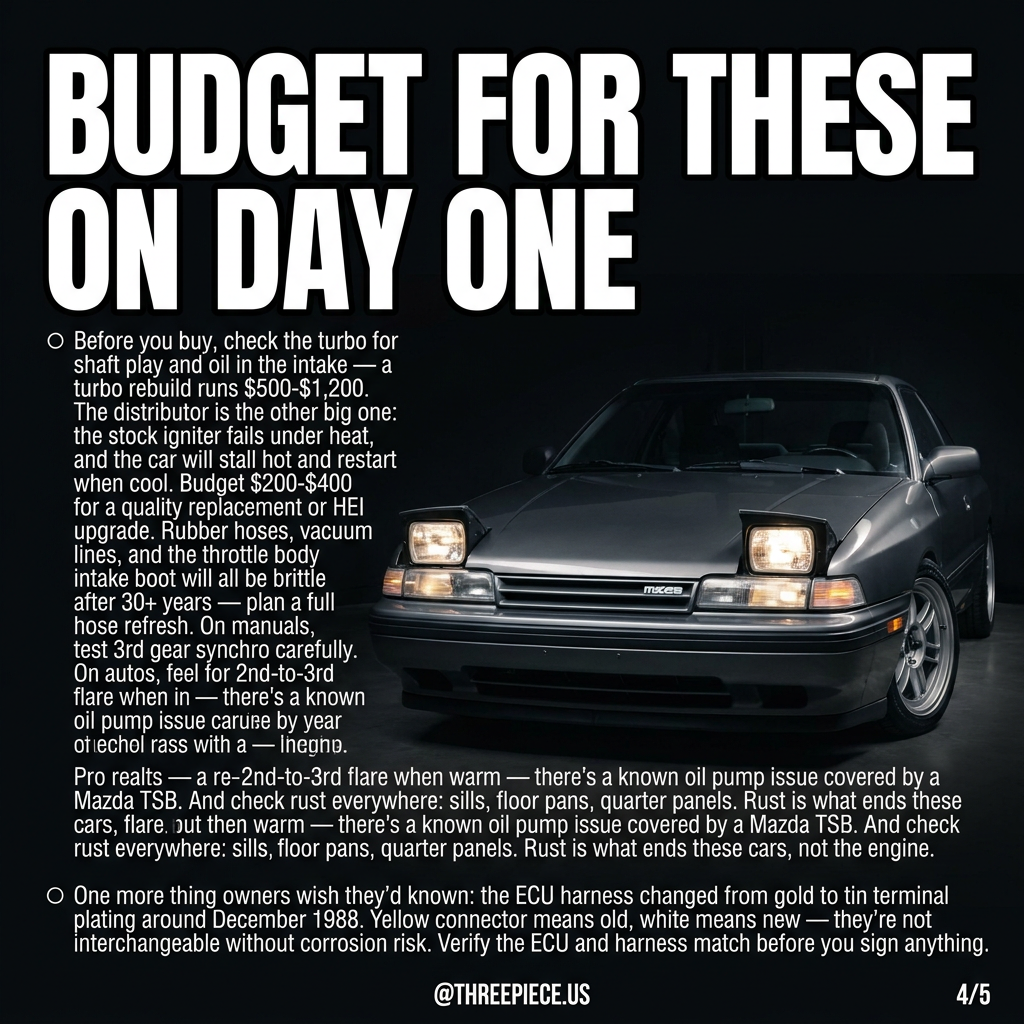
Distributor failure: This is probably the single biggest frustration point on the platform. The electronic igniter and coil inside the stock distributor fail under heat. The classic symptom: the car drives fine, then stalls when hot and won't restart until it cools down. Many experienced owners carry a spare distributor or upgrade to an HEI conversion for long-term reliability. Budget $200–$400 for a quality replacement or upgrade.
Turbo seal failure: The IHI turbo's seals degrade with age, causing oil to blow through the intake manifold. You'll see blue smoke under boost, and in bad cases the car runs like a two-stroke. A turbo rebuild runs $500–$1,200. Check for shaft play and oil residue in the intake piping on any car you're considering.
HLA (Hydraulic Lash Adjuster) collapse: Neglected oil changes are the primary cause. When HLAs lose preload, valve timing gets sloppy and you lose power. Some owners use valve spring spacers to compensate, but the real fix is fresh HLAs and religious oil change intervals going forward.
Automatic transmission (G4A-EL): The turbo models got a reinforced automatic, but it still has a known oil pump design flaw that causes 2nd-to-3rd gear slippage or flare when warm. Mazda issued a TSB (K005/90) for this. Fix requires oil pump replacement — expect $700–$1,200 in labor and parts. Torque converter clutch failure and valve body wear are common beyond 150k miles.
Manual transmission: Less problematic overall, but 3rd gear synchro wear is the recurring issue. Test 3rd gear engagement carefully on any manual car — difficulty selecting 3rd, especially when cold, means the synchro hub is worn. Replacement transmissions from turbo 626s and Probe GTs can be sourced as donors.
Rubber and seals: Every vacuum line, intake boot, intercooler hose, and engine mount on these cars is original rubber that's been baking for three decades. Plan a full hose refresh on day one. Valve cover gasket leaks are nearly universal — oil dripping onto the exhaust manifold creates smoke and smell that can mask other issues during a test drive.
Fuel pump: The stock tank-mounted electric fuel pump wears out, causing low pressure under load, stalling, and no-start conditions. Budget $150–$600 for replacement including the strainer and fuel filter.
Pre-Purchase Checklist
If you're seriously looking at one of these, here's the non-negotiable inspection list:
- Turbo health: Check shaft play by hand, look for oil in the intake piping, and drive the car hard enough to see if it smokes under boost. A fried turbo can contaminate the entire intake tract and intercooler.
- Distributor condition: Ask if it's been replaced or upgraded. If the car has the original distributor, plan to budget for a replacement. Drive the car until it's fully heat-soaked and see if it stalls.
- Transmission behavior: On automatics, drive until warm and feel for 2nd-to-3rd flare. On manuals, test 3rd gear engagement repeatedly from different speeds.
- Rust: Check sills, floor pans, quarter panels, and the undercarriage. Rust is what ends these cars — not the engine. If you're in a northern climate, this is the deal-breaker inspection.
- ECU harness plating: This is the detail most buyers miss. The ECU harness changed from gold to tin terminal plating around December 1988. Yellow connector = old (gold plating), white connector = new (tin plating). They're not interchangeable without corrosion risk. Verify the ECU and harness match before you sign anything.
- Oil history: Ask about oil change intervals. The HLAs and rod bearings suffer most from neglected or dirty oil. If the owner can't tell you what oil they run or when it was last changed, walk away.
Budget $2,000–$3,000 in year-one maintenance for any MX-6 Turbo you buy — turbo health, hoses, distributor, possibly a fuel pump. That's the cost of entry for a 30+ year old turbo car, and it's still cheaper than the purchase price of most comparable platforms.
Wheel Fitment and Sizing
The GD-platform MX-6 runs a 4x114.3 bolt pattern with a factory wheel size of 14x5.5 or 15x6 depending on trim. For a proper upgrade, most owners land on 16x7 or 17x7.5 with offsets in the +38 to +45 range. The fenders are forgiving but not massive — aggressive widths require careful offset selection or minor rolling.
Browse 16-inch wheels in 4x114.3 or step up to 17-inch wheels in 4x114.3 for a more aggressive look without compromising ride quality. The 4x114.3 pattern opens up a huge range of classic Japanese wheel designs — this is a car that looks right on period-correct multi-spoke or mesh wheels.
For tires, a 205/50R16 or 215/45R17 is the go-to fitment. Check 205/50R16 tires or 215/45R17 tires for options that balance grip and sidewall protection on rougher roads.
If you're going the 3-piece route — and on a car this rare, a set of properly built 3-piece wheels is the ultimate move — Work Wheels offer multiple lines that come in 4x114.3. The Work Equip series in particular suits the MX-6's late-80s aesthetic perfectly. A set of Work Meister wheels would give the car a period-correct JDM look that nothing else can replicate.
If you're building or refinishing existing 3-piece wheels for this platform, Work step lips and Work reverse barrels start at $399 and let you dial in the exact width and offset you need. Pair them with proper M7 assembly hardware and you've got a wheel setup that's as unique as the car itself. For a deeper understanding of how 3-piece wheels are constructed, read our breakdown of what forged wheels actually are.
Don't forget hubcentric rings — the MX-6's hub bore is 59.1mm, and most aftermarket wheels will need rings to center properly. Our guide on hub-centric vs. lug-centric wheels explains why this matters more than most people think.

Final Verdict: Buy One Before You Can't
The Japanese turbo coupe tax is coming for everything eventually. MR2 Turbos are already there. 240SXs have been there for years. The MX-6 GT Turbo is running out of time in the affordable window, and clean examples are only getting harder to find. This is a factory turbocharged coupe with real mechanical character, a strong bottom end, documented mod paths to 300+ whp, and a community that's been archiving build knowledge for decades.
Budget a couple thousand in year-one maintenance, find one with a clean body and a manual transmission, and you'll have a car that nobody else at the meet is driving. The parts cross-compatibility with Probe GTs and 626s gives you a salvage network that most rare cars don't have. The tuning knowledge exists — you just have to dig through mx6.com threads to find it.
If you want a rare, character-rich turbo car you can actually wrench on without a laptop and a factory scan tool, this is one of the last honest options left. Stop scrolling past these listings. Check our vehicle gallery for build inspiration, and browse our full wheel catalog when you're ready to give your MX-6 the wheels it deserves.