
Mazda MX-5 Miata History: Every Generation Ranked
The Mazda MX-5 Miata has outsold every other roadster in history, and most people still don't take it seriously. Four generations, 35+ years of production, and Mazda never once gave it more than four cylinders. That's not a limitation — that's a philosophy. While everyone else chased horsepower, Mazda chased balance. Here's how every Miata generation stacks up — from the original NA to the current ND — ranked by what actually matters to the people who drive them.

Quick links
- How Bob Hall's Pitch Became the World's Best-Selling Roadster
- NA Miata (1989–1997): The One That Started Everything
- NB Miata (1998–2005): The Sweet Spot
- NC Miata (2006–2015): The Misunderstood Middle Child
- ND Miata (2016–Present): Subtraction Over Addition
- Final Ranking: Which Miata Should You Actually Buy?
- Wheels and Fitment Across All Four Generations
How Bob Hall's Pitch Became the World's Best-Selling Roadster
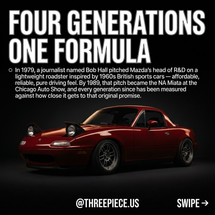
In 1979, automotive journalist Bob Hall pitched Mazda's head of R&D on a concept that seemed almost naive: a lightweight, affordable roadster inspired by 1960s British sports cars — the Lotus Elan, the MGB, the Triumph Spitfire — but with Japanese reliability. That pitch spent a decade in development before debuting as the NA Miata at the 1989 Chicago Auto Show. The development mandate was "Jinba-ittai" — horse and rider as one — and every generation since has been measured against how close it gets to that original promise.
No car teaches you more about driving than a Miata on a good road with the top down. The weight, the feedback, the willingness to rotate — it's the reason every automotive journalist defaults to "just buy a Miata," and it's the reason that advice is still mostly correct. If you want to understand how that same lightweight philosophy applies to other iconic platforms, our breakdown of Honda NSX history ranked by owners hits a similar note.
NA Miata (1989–1997): The One That Started Everything

The original NA weighed around 2,100–2,200 lbs with a 116 hp 1.6L B6-ZE, no power steering in base trims, cable throttle, hydraulic steering, manual everything. Nothing else on the road felt that direct for the money, and honestly, nothing has since. The 1.8L BP-ZE arrived mid-generation in 1994 with approximately 130 hp, and that's the one collectors hunt now.
But rust is the NA's nemesis. Rocker panels, front frame rails, rear wheel arches — they rot from the inside out, especially in salt states. Forum after forum shows owners discovering structural corrosion hidden beneath outer body panels. A clean, rust-free NA is getting genuinely rare, and prices reflect it. Timing belt changes every ~60,000 miles are mandatory, and the crankshaft pulley pins have a documented tendency to loosen and break, causing the belt to jump. The engine is non-interference, so it won't grenade — but it will leave you stranded.
On the dyno, a well-built NA 1.8 with matched headers, tuned intake, COP ignition, and custom exhaust puts down roughly 110 whp versus ~130 at the crank. That's a lot of work for modest gains, which is why many NA builds eventually go forced induction. Pop-up headlights give the NA icon status no other generation can touch — but only if you find one the rust hasn't already wrecked. The NC shares platform bones with the RX-8, but the NA shares nothing with anything. It's pure.
NB Miata (1998–2005): The Sweet Spot

The NB lost the pop-ups to meet safety regulations, and some purists never forgave it. But the NB kept the simplicity, kept the weight close to the NA, and added real power. The NB1 (1999–2000) made ~140 hp from the 1.8L, and the NB2 (2001–2005) got the BP-Z3 with VVT, bumping output to ~146 hp and ~124 lb-ft. Wider track, improved suspension geometry, stiffer anti-roll bars — the NB is what happens when you refine without bloating.
Then there's the Mazdaspeed NB (2004–2005): factory turbo, 178 hp / 166 lb-ft. This was a huge deal. Dyno numbers on stock Mazdaspeed NBs show ~170–180 whp, and the aftermarket turbo path opens up significantly from there. Owners consistently say "NA is the better Miata, NB is the better car," and that's exactly right.
Real failure modes to watch: ignition coil failures (especially cylinder 4) that can cascade into catalytic converter damage, rear main seal leaks, and VVT actuator issues in early NB2s. Rust is still a concern — sill corrosion, wheel arch inner pans, trunk corners — but generally less catastrophic than the NA if the car was maintained. If you're weighing the NB against other affordable sport compacts, our guide to the best Hondas under $8K covers the competition in that price bracket.
NC Miata (2006–2015): The Misunderstood Middle Child

The NC is the least-loved generation, and it earned some of that reputation. Sharing development with the RX-8 platform meant a bigger body, more interior room, more creature comforts — and roughly 220 lbs more curb weight than the NB. The 2.0L LF-DE made ~160 hp in earlier NCs, and the Power Retractable Hard Top (PRHT) introduced in 2007 was the first big deviation from the Miata's simplicity ethos.
Early NC1s had serious issues: rod bearing failures reported between 80,000–130,000 km, excessive oil consumption from the piston/ring design, and AC compressor failures around 40,000–50,000 miles with part costs around $1,200. The PRHT's limit switches and hydraulic mechanisms also develop problems over time. These are not minor complaints.
But here's where the NC gets underrated: the NC2 (2009–2012) and NC3 (2013–2015) fixed the ring design, added Bilstein damper options, improved sound deadening, and addressed most of the early reliability concerns. If you're buying an NC, skip the NC1 entirely and target an NC2 or NC3. They're currently the cheapest way into Miata ownership, and on a set of proper coilovers — like the Tein Flex Z Coilovers for the NCEC at $940 — the chassis comes alive. Pair that with Morimoto XB side markers for the NC/RX-8 and the exterior cleans up significantly. The NC is honestly the sleeper of the lineup — more fun than the reputation suggests.
ND Miata (2016–Present): Subtraction Over Addition
Mazda heard the complaints about the NC's weight and the ND returned to lightweight philosophy — smaller, lighter than the NC, sharper chassis. By the ND2, the 2.0L SkyActiv-G made 181 hp with a 7,500 rpm redline. Many current owners call it the peak Miata for balancing modern comfort with real driver involvement. The ND proved that subtraction is harder than addition, and Mazda nailed it.
But it's not without quirks. Early 2016–2017 cars had 3rd gear synchro failures reported as early as 13,000 miles, infotainment screens that delaminate, and AC lines that crack from vibration. The ND3 has cleaned most of this up, but those early cars need a careful look before you buy. If you're shopping for an ND, the ND2 (2019+) is the sweet spot — the power bump from 155 hp to 181 hp is significant in a car this light.
For ND owners looking to sharpen the chassis further, the Tein Flex Z Coilovers for the NDERC at $892 are one of the most popular options in the community. Braking upgrades matter too — the StopTech slotted sport brake rotor for the 2016–2017 MX-5 at $166 is a direct bolt-on improvement for track days. For a deep dive on ND wheel specs, check our 2024–2026 MX-5 Miata wheel fitment guide.
Final Ranking: Which Miata Should You Actually Buy?

Here's how they actually stack up when you weigh driving feel, reliability, value, and real-world ownership:
- NB2 / Mazdaspeed NB — The purest balance of what makes a Miata a Miata. Reliable VVT motor, simple mechanicals, light weight, and prices that haven't gone completely sideways yet. The Mazdaspeed variant with its factory turbo at 178 hp is the enthusiast's pick. If you want one, buy it now — these are climbing.
- ND2 / ND3 — The move if you want modern reliability and 181 hp in a car that still weighs nothing. The 7,500 rpm redline is intoxicating. Best daily-drivable Miata ever made.
- NA 1.8 — The icon. Pop-up headlights, the rawest driving feel of any generation, and the one every future Miata is measured against. But only if you find one without rust consuming it from the inside. A clean NA is a future classic; a rusty one is a money pit.
- NC2 / NC3 — The sleeper. Grab one for less money than any other generation, drop it on coilovers, and you'll have more fun than the reputation suggests. Just avoid the NC1 and its rod bearing lottery.
This ranking mirrors a similar approach we took with the Lexus IS history ranked by owners and the Porsche Cayman history ranked by owners — real ownership data over magazine hype.
Wheels and Fitment Across All Four Generations
Miatas are among the most wheel-swapped cars on the planet, and fitment varies significantly across generations. The NA and NB share a 4x100 bolt pattern — a classic JDM spec that opens up a massive catalog of vintage and modern wheels. The NC moved to 5x114.3, and the ND runs 5x114.3 as well but with tighter fender clearances due to the smaller body.
For NA and NB builds, 15x8 is the track-day standard, and 15x9 is common for aggressive fitment. Browse 15-inch wheels in 4x100 for options. If you're running 3-piece wheels on an NA or NB, Work step lips starting at $399 and Work reverse barrels at $399 let you build exactly the width and offset you need. The Work Equip series is arguably the most iconic wheel family on the NA Miata — period.
NC and ND owners running 17x8 or 17x9 in 5x114.3 have a broader selection. Check 17x9 wheels in 5x114.3 for current inventory. The Work Emotion lineup fits the ND's sharper design language perfectly. If you're running any 3-piece wheel and need to replace or refresh hardware, the M7x32 chrome assembly bolts at $10 each and 90-degree valve stems at $3.80 are essentials to keep on hand.
For a detailed look at what forged wheels actually bring to a lightweight platform like the Miata, read our explainer on what forged wheels are and why the difference matters. On a car where every pound counts, unsprung weight reduction from forged 3-piece wheels is one of the most noticeable upgrades you can make. Finish the build right — explore the full wheel catalog and the vehicle gallery for real-world fitment inspiration across all four Miata generations.