
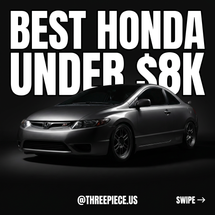
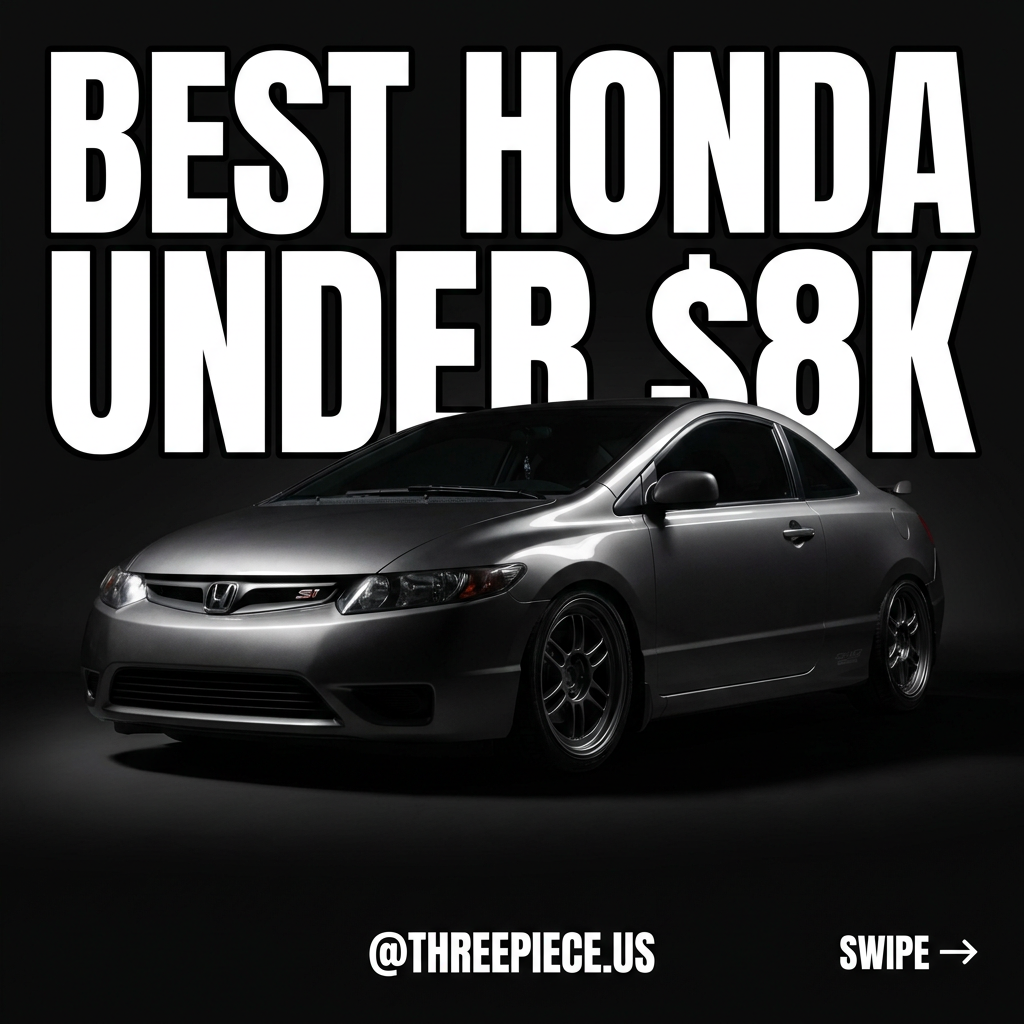
Best Honda Under $8K: 3 Models That Actually Last
Everyone says "buy a Honda" — but nobody tells you which Honda under $8K is actually worth your money. The badge alone doesn't guarantee anything. At this price point, certain generations and engine combos are bulletproof, while others will drain your savings on transmission rebuilds and VTC actuator repairs. Here's the real breakdown of the three best Honda models under $8,000 right now, what to inspect before buying, and how to set one up properly once you own it.
Quick links
- The Top Pick: 2009–2011 Civic with the R18
- The One Nobody Considers: Honda Fit
- If You Need More Car: 8th-Gen Accord 4-Cylinder
- What to Avoid at This Price
- Wheel Fitment for Budget Hondas
- Your Pre-Purchase Checklist
- The Verdict
The Top Pick: 2009–2011 Civic with the R18
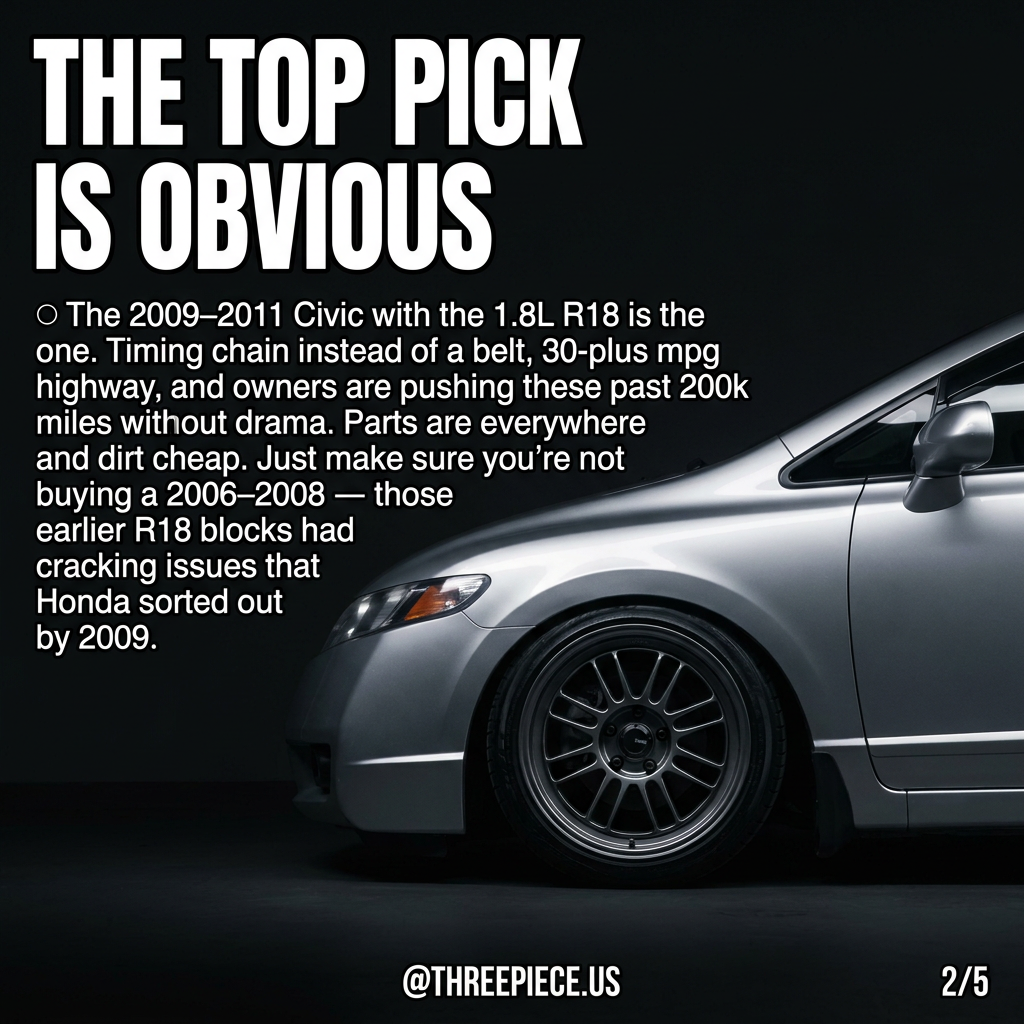
The 2009–2011 Honda Civic with the 1.8L R18 engine is the one. This isn't a hot take — it's backed by hundreds of thousands of documented owner miles. The R18 uses a timing chain instead of a belt, which eliminates one of the most expensive scheduled maintenance items on older Hondas. Fuel economy sits at 30–35+ mpg highway, and owners are routinely pushing these past 200,000 miles without major engine work.
Parts are everywhere and absurdly cheap. Engine mounts tend to wear around 100k–120k miles, causing vibration at idle — budget about $400 for mounts and rear brake pads combined. A/C compressor and condenser leaks show up on higher-mileage examples, so test the system thoroughly during your inspection. Paint and clear coat failure is common on dark-colored 9th-gen Civics, but that's cosmetic, not mechanical.
The critical detail: avoid the 2006–2008 R18 blocks. Those earlier castings had documented cracking issues that Honda resolved by the 2009 model year. Stick with 2009 and later and you're in the clear. If you're considering the sportier Civic Si instead, check out our FG2/FA5 Civic Si buying guide — the K20Z3 Si is a step up in performance but commands a higher price.
The One Nobody Considers: Honda Fit
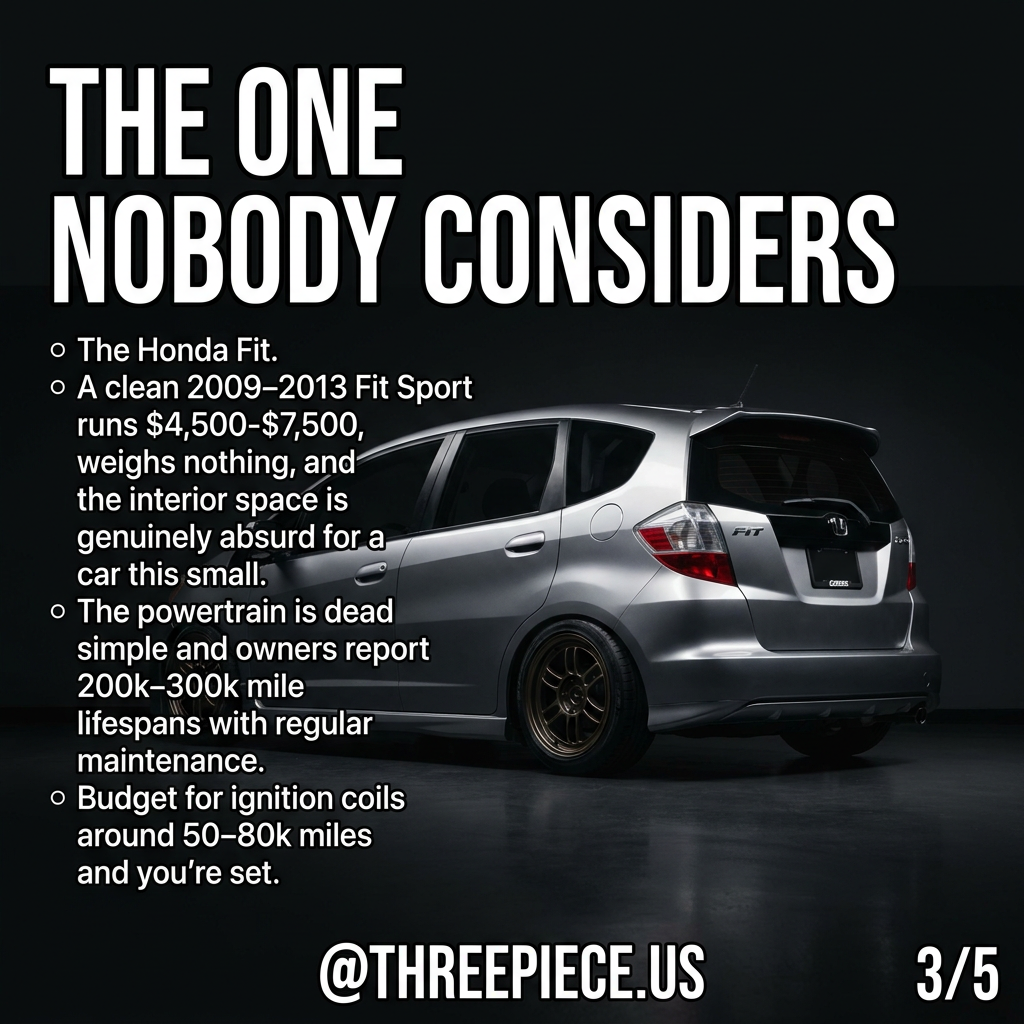
The 2009–2013 Honda Fit Sport is the sleeper pick in this group. Clean examples are running $4,500–$7,500 right now, which leaves serious budget for wheels, tires, and maintenance. The Fit weighs practically nothing, the interior space is genuinely absurd for a car this small thanks to Honda's Magic Seat system, and the powertrain is about as simple as it gets.
Owners consistently report 200,000–300,000 mile lifespans with nothing more than regular oil changes, fluid swaps, and the occasional wear item. The main thing to budget for is ignition coils around 50,000–80,000 miles — they're cheap and easy to replace yourself. The 5-speed manual in the Sport trim is the one to find if you can.
The Fit doesn't get the same forum hype as the Civic or Accord because it's not a "performance" car in the traditional sense. But if you're looking for a city car that's genuinely fun to drive, sips fuel, and has the aftermarket support of a much more expensive platform, this is the move. It's also one of the lightest Hondas you can buy in this era, which matters when you start thinking about lightweight forged wheels and the rotational mass savings they provide.
If You Need More Car: 8th-Gen Accord 4-Cylinder
The 2008–2012 Honda Accord with the 2.4L K24Z3 and 5-speed automatic is the comfort play. This is a proper midsize sedan — spacious, composed on the highway, and powered by an engine that Honda has been refining since the early 2000s. The K24 paired with the conventional 5-speed auto is a proven combination, with owners documenting 250,000+ miles on basic maintenance alone.
The known issues are well-documented and predictable. VTC actuator rattle on cold start is common in the 2009–2011 models — that's the ticking noise you hear for the first few seconds after startup. The fix runs about $300–$500. Alternator failures tend to show up around 80,000–120,000 miles, costing $250–$450 including labor. Combined, you're looking at roughly $650 if neither has been addressed — budget for it upfront.
The critical rule: stay away from the V6. The J35-powered Accord V6 has known transmission issues, more expensive ignition coil failures, and a more complex VCM (Variable Cylinder Management) system that causes oil consumption problems. The 4-cylinder is the one. It's less exciting on paper but infinitely more predictable in ownership. Honda's reputation was built on engines like the K24 — read our Honda NSX history to see how that engineering philosophy scaled up to their halo car.

What to Avoid at This Price
Not every Honda under $8K is a good buy. Here's what to skip:
- Any Accord V6 with an automatic transmission. The torque converter and transmission internals are a known weak point. If you find one with a manual, different conversation — but automatics at this mileage are a gamble.
- Models with CVTs. Later Civics and CR-Vs switched to continuously variable transmissions that don't hold up as well if previous owners skipped fluid changes. Stick with conventional automatics or manuals from the years listed above.
- 2006–2008 Civics with the early R18. Block cracking issues were documented and resolved by 2009. Don't gamble on the earlier castings.
- Fully loaded trims with every option. Sunroof drains clog, navigation screens fail, backup cameras go dark. Every added feature is another potential repair. The LX and EX trims are the sweet spot for long-term ownership.
- Snow-belt cars without documented rust inspection. Clearcoat fade and surface rust are cosmetic, but subframe and rocker panel corrosion is structural. Walk away if you see it.
If you're comparing the Accord against other budget sedans, our Acura TLX Type S breakdown shows where Honda's engineering goes when the budget opens up — and the RSX Type-S buying guide covers another Honda-platform car that's appreciating fast.
Wheel Fitment for Budget Hondas
Once you've secured a clean example, wheels are the single biggest visual upgrade you can make. All three of these Hondas run a 5x114.3 bolt pattern, which is one of the most common patterns in the JDM and sport-compact world. That means access to an enormous selection of aftermarket wheels.
For the Civic and Fit, 17x8 +35 is the go-to fitment — aggressive enough to fill the fender without rubbing on stock suspension. Browse 17x8 wheels in 5x114.3 to see what's available. Pair them with 215/45R17 tires for a balanced setup that doesn't sacrifice ride quality.
For the 8th-gen Accord, step up to 18x8.5 +35. The larger sedan body needs the extra diameter to look right. Check out 18x8.5 options in 5x114.3 and pair with 235/40R18 tires. If you're running the Civic Type R's bolt pattern on a newer platform, we have a dedicated Civic Type R fitment guide that covers aggressive setups in detail.
If you're building a 3-piece setup for any of these platforms, Work step lips starting at $399 and Work reverse barrels at $399 let you spec the exact width and offset you need. Finish the build with proper 90-degree valve stems at $3.80 each — critical for deep-dish setups where straight stems won't clear the disc. And don't forget silicone sealant at $10.99 for reassembly.
Browse our vehicle gallery for real-world Honda builds with proper wheel fitment to get a sense of what works on each platform.
Your Pre-Purchase Checklist
When you're shopping for a Honda under $8K, the standard checks apply — clean title, maintenance records, rust inspection. But these models have specific things to verify:
- Cold-start the engine yourself. On 2009–2011 Accords, listen for VTC actuator rattle in the first 5–10 seconds. If it's there, negotiate accordingly — it's a $300–$500 fix.
- Test the transmission thoroughly. Drive it in city traffic and on the highway. Feel for shift shudder, hesitation between gears, or torque converter slippage. On Civics, the 5-speed auto can develop shift shudder at higher mileage.
- Check the A/C system. Compressor and condenser leaks are common across all three models. Run the A/C on max for at least 10 minutes during your test drive.
- Inspect engine mounts. On the Civic especially, worn passenger-side mounts cause vibration at idle. Easy to check — have someone hold the brake and put it in drive while you watch for excessive engine movement.
- Ask about alternator history on the Accord. If it hasn't been replaced by 120k miles, it's coming due.
- Budget $1,000 for year-one maintenance. Fresh fluids, filters, brake pads, and any deferred maintenance the previous owner skipped. This isn't optional — it's the cost of buying a used car responsibly.
If you want to understand how spring rates affect ride quality on these lighter Honda platforms, read our coilover guide before buying suspension. And for anyone considering performance mods, our cold air intake reality check explains why that's probably not the first mod to make on a naturally aspirated Honda.
The Verdict
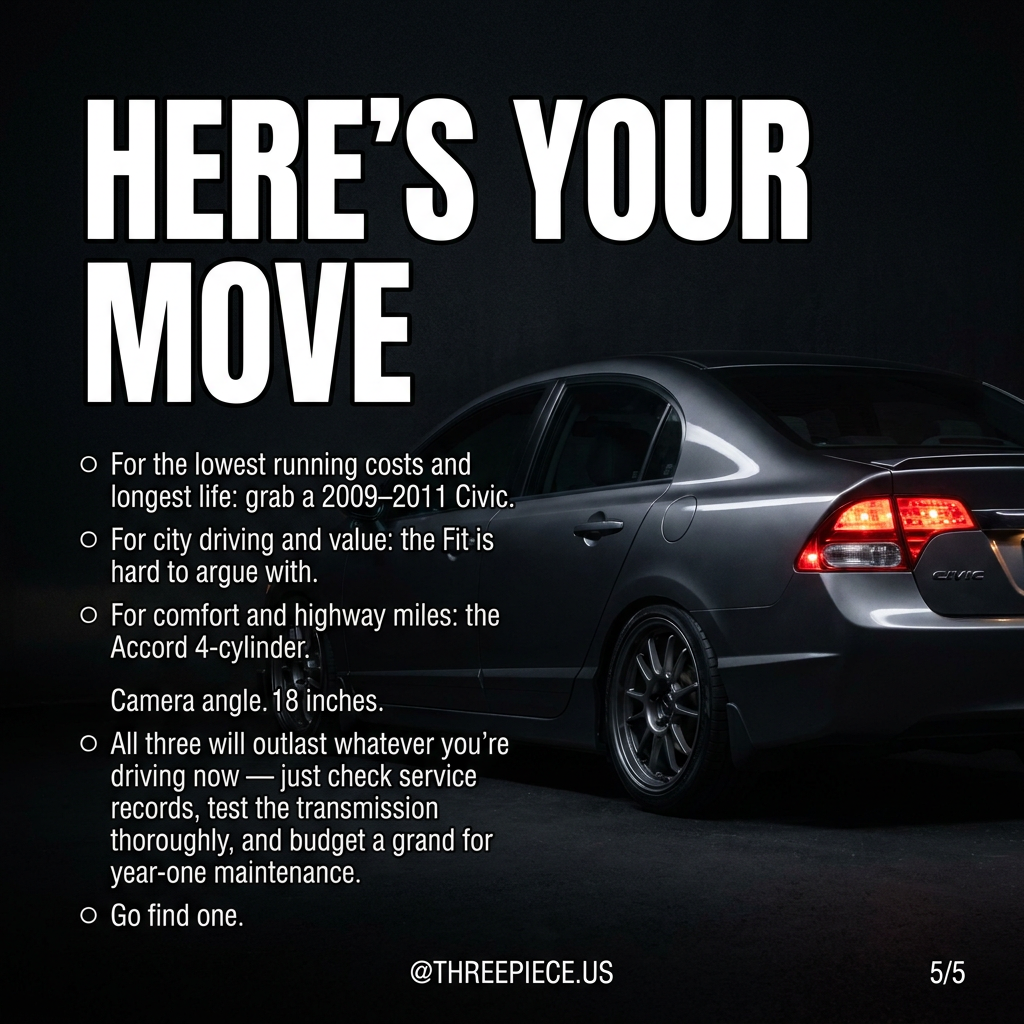
For the lowest running costs and longest life, grab a 2009–2011 Honda Civic with the R18. For city driving and outright value, the Fit Sport is impossible to argue with at $4,500–$7,500. For comfort and highway miles, the 8th-gen Accord 4-cylinder is the proven choice. All three will outlast whatever you're driving now — just check service records, test the transmission, and budget that first-year maintenance fund.
Once you've locked one down, the 5x114.3 bolt pattern opens up the entire JDM wheel catalog. Browse Work Wheels for the best selection of 2-piece and 3-piece options, or explore the Work Emotion series for lightweight designs that suit these platforms perfectly. Finish the look with a Work Wheels license plate frame at $14.99 and a set of Work VS reproduction center caps at $50 each.
Go find one.