
BRZ FR-S Wheel Fitment Guide: Square vs Staggered (2013-2020)
The 2013-2020 Subaru BRZ / Scion FR-S has one of the most debated fitment conversations in the sport-compact world — and most of the advice floating around forums is either outdated or flat-out wrong. The ZC6/ZN6 platform runs a 5x100 bolt pattern with a 56.1mm center bore and M12x1.25 lugs, which means your wheel options are more limited than a 5x114.3 car but the builds that do exist are extremely well-documented. This guide covers exactly what clears, what rubs, and whether you should run square or staggered — based on confirmed owner builds, not spec-sheet guessing.
Quick links
- Factory specs you need to know
- Why square is the move on this chassis
- When staggered makes sense (and when it doesn't)
- What actually rubs — and how to fix it
- Your spec cheat sheet: street daily to aggressive flush
- Coilovers that make these specs work
- Tire sizing for 245/40R17 and 255/35R18
- The takeaway
Factory Specs You Need to Know
Before you start shopping for wheels, here's the baseline. The Gen 1 86 platform left the factory on 17x7 +48 wheels with 215/45R17 tires on most trims. The Performance Package and tS models bumped to 18x7.5 +48 with 215/40R18 rubber. That +48 offset tucks the wheel deep into the fender — which is why every stock BRZ looks like it's wearing wheels two sizes too small. The bolt pattern is 5x100 (not 5x114.3 — a common mistake that costs people return shipping), the center bore is 56.1mm, and the lug thread is M12x1.25. If you're coming from a 5x114.3 platform and have a set you want to reuse, you're out of luck without adapters, and adapters on a lightweight RWD chassis are a compromise you shouldn't make.
The important thing about the factory spec is what it tells you about headroom. Going from a 7" wide wheel at +48 to a 9" wide wheel at +35 is a massive visual and mechanical jump, and the 86 chassis handles it surprisingly well — which is why this platform has become one of the most popular fitment playgrounds in the sport-compact world. If you're building the second-gen, our 2022-2026 BRZ fitment guide covers the updated chassis, and the GR86 fitment guide handles the Toyota side.
Why Square Is the Move on This Chassis
The BRZ/FR-S has a 53/47 front-to-rear weight distribution. That's nearly perfect balance, and it's the entire reason this car exists. Running the same wheel and tire size at all four corners — a square setup — respects that balance instead of fighting it. You get consistent grip front to rear, predictable rotation at the limit, and the ability to swap tires front-to-back when they wear unevenly. On a car with 200 horsepower, you're not power-limited enough to need extra rear grip. You're traction-limited everywhere equally, which is exactly what square addresses.
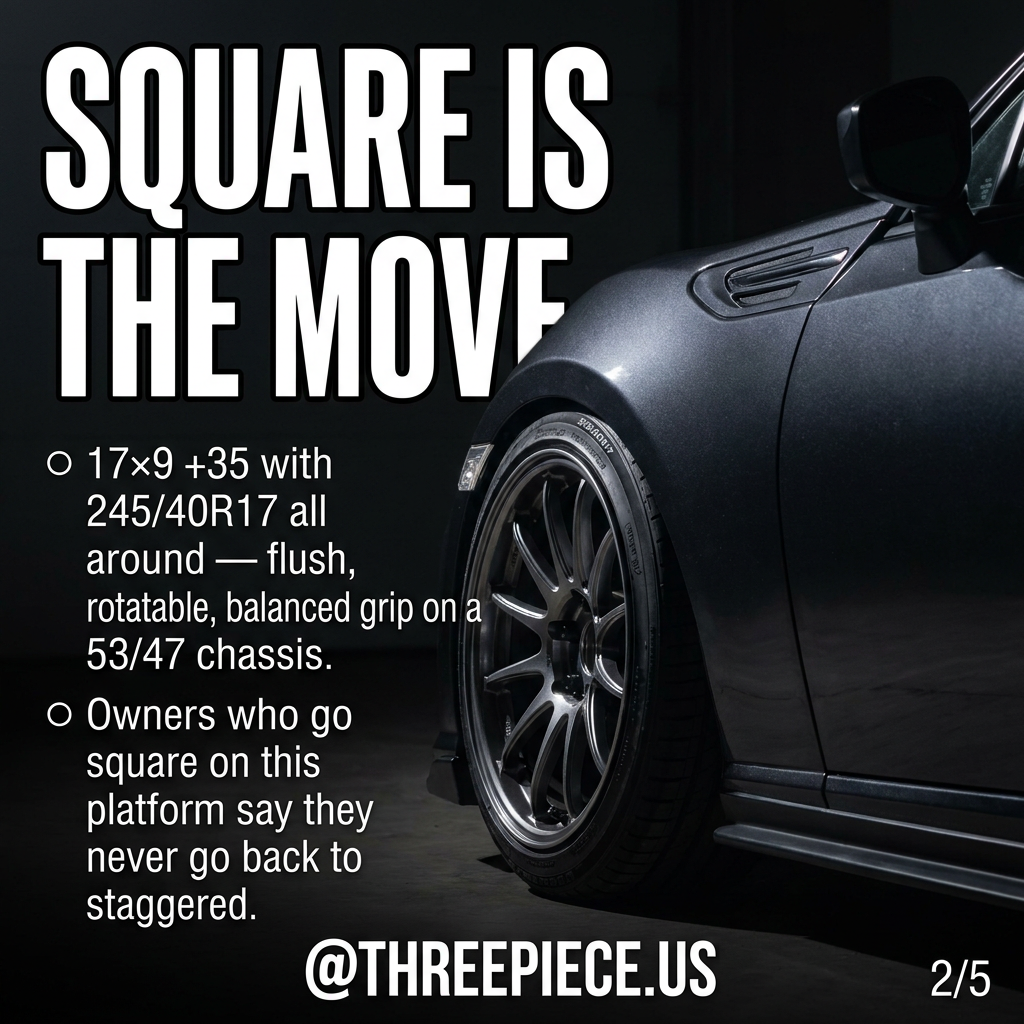
The sweet spot that owners keep landing on is 17x9 +35 with 245/40R17 all around. It fills the fenders without requiring bodywork, it clears stock brakes and Performance Package Brembos on most spoke designs, and the 245-width tire on a 9" barrel gives you a slight stretch that protects the lip without looking like a rubber band. This is the setup you see on track-prepped 86s at every HPDE event, and it's the setup that owners on the FT86 forums consistently say they wish they'd started with instead of chasing staggered specs first.
If you want to go wider, 18x9.5 +38 square with 255/35R18 is the next step — but you're crossing into territory that needs coilovers and rolled rear fenders. More on that in the cheat sheet section. For wheel options in this bolt pattern, browse 17x9 wheels in 5x100 to see what's currently available. The Work Emotion series is a natural fit here — lightweight, aggressive spoke designs, and available in the offsets this chassis needs.
If you're weighing forged vs. flow-formed for this build, our breakdown of Volk TE37 vs Enkei RPF1 covers the real-world weight and cost differences on lightweight platforms where every pound matters.
When Staggered Makes Sense (and When It Doesn't)
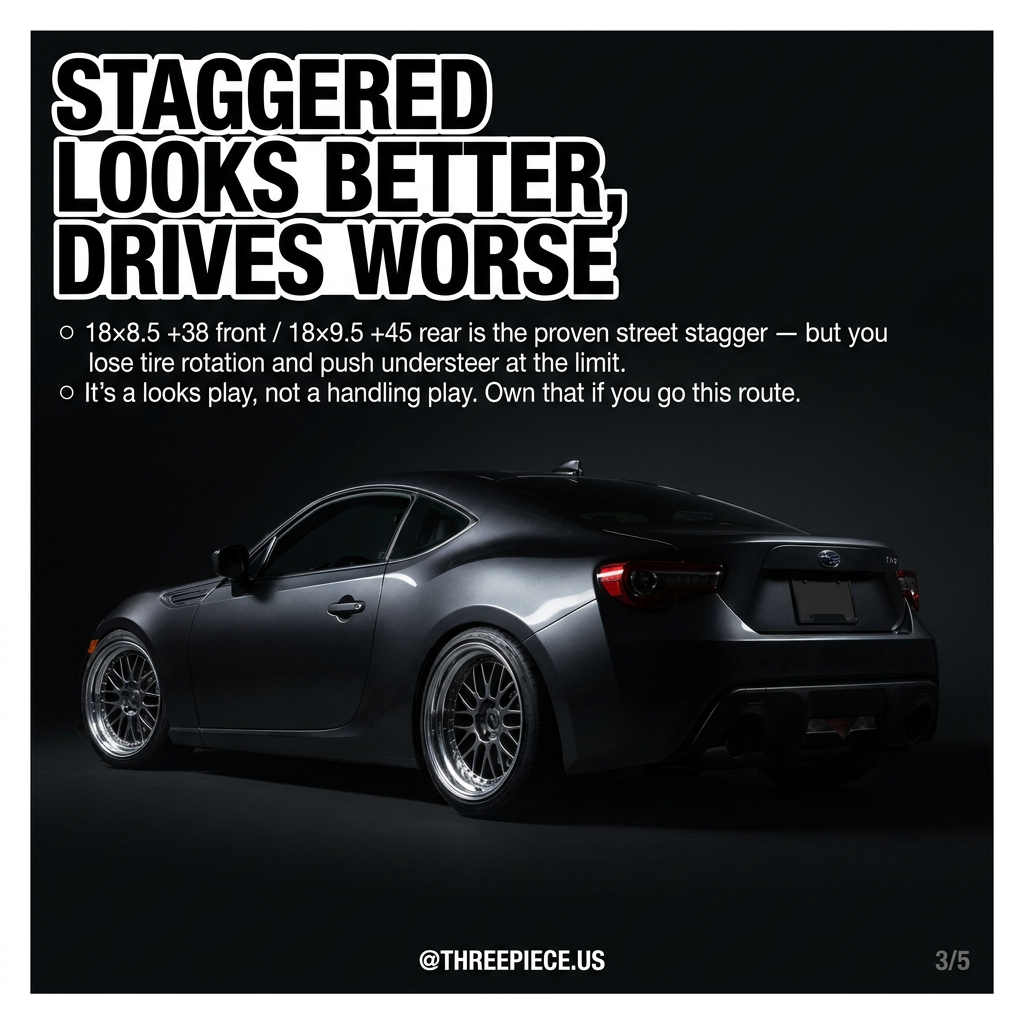
Let's be honest: staggered looks better. A wider rear with a meatier tire fills the rear quarter in a way that square never quite matches, and on a low coupe like the 86, that visual width difference reads as aggressive without being cartoonish. The proven street stagger is 18x8.5 +38 front / 18x9.5 +45 rear, and it's a clean setup that plenty of owners run without issues.
But here's what you're giving up. You lose tire rotation entirely — front and rear tires are different sizes, so when the fronts wear faster (and they will on this chassis), you're buying fronts separately. On a car where tire budget is a real consideration, that adds up fast. More importantly, the wider rear pushes the balance toward understeer at the limit. The 86 was designed to rotate, to let you trail-brake into oversteer and manage it with throttle. A staggered setup with 275/40R18 rears and 225/40R18 fronts fights that philosophy — you're building the car to push instead of slide, which is the opposite of why most people bought it.
If you're building a show car or a street cruiser and you never plan to push the chassis, staggered is fine — own that decision. If you're doing any track time, autocross, or spirited canyon driving, square is objectively the better choice for this platform. Our 350Z vs BRZ suspension comparison goes deeper into why the 86's double-wishbone rear is optimized for balanced setups. And if you're curious how this same debate plays out on a muscle car, the S550 Mustang square vs staggered guide is worth reading — different car, same fundamental question.
What Actually Rubs — and How to Fix It
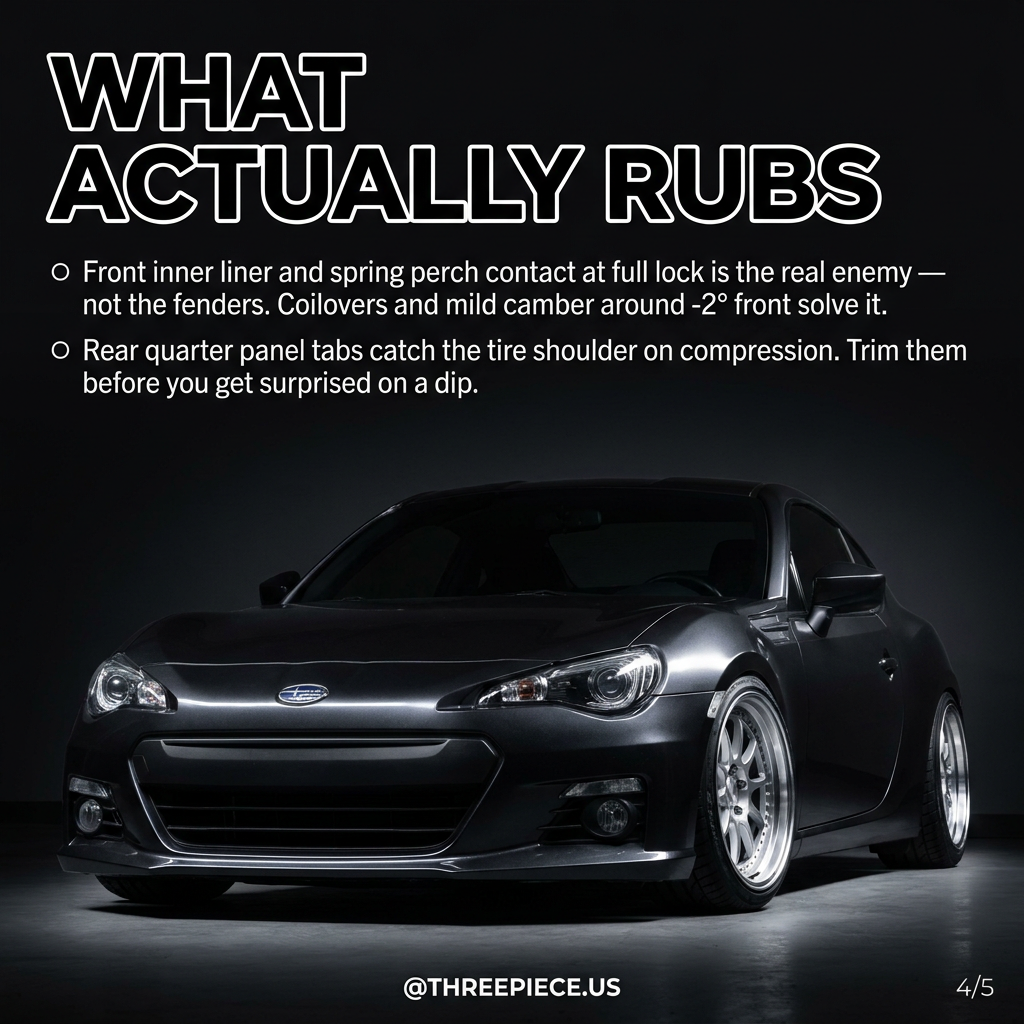
This is where most fitment guides get it wrong. People assume the fenders are the problem. They're not — at least not first. On the BRZ/FR-S, the front inner fender liner and spring perch are what contact the tire at full steering lock. You'll hear a scrubbing sound on sharp parking-lot turns before you ever see fender contact. The fix is straightforward: coilovers with proper ride height adjustment and -2° of front camber pull the top of the tire inward and give you the clearance you need. On most setups up to 9" wide, that's all it takes up front.
The rear is a different story. The rear quarter panel has stamped metal tabs on the inner lip that catch the tire shoulder during compression — hitting a dip, loading the rear through a corner, or even speed bumps on a lowered car. These tabs are easy to trim with a pair of tin snips, and you should do it proactively before you get surprised. A light fender roll on the rears handles everything up to 9.5" wide at +38. Beyond that — 10" wide, offsets below +35 — you're into fender pulling territory, aggressive camber, and possibly rack limiters to prevent full-lock contact.
Brake clearance is the other variable nobody talks about until it's too late. The stock brakes clear almost everything in 17" and 18" diameters. The Performance Package Brembos are wider, and spoke shape matters — flat-faced multi-spoke designs sometimes interfere where a deeper concave or split-spoke design clears fine. If you're running Brembos, always confirm clearance with the wheel manufacturer before ordering. Our GR86/BRZ offset and width guide has additional brake clearance data for the updated caliper. If you're considering a 3-piece wheel where you can specify exact disc depth and barrel width, that's where the custom wheel options become genuinely useful — you're specifying clearance to the millimeter instead of hoping a catalog size works.
Your Spec Cheat Sheet: Street Daily to Aggressive Flush
Here are the two setups that cover 90% of BRZ/FR-S builds, with the exact specs and mod requirements for each.
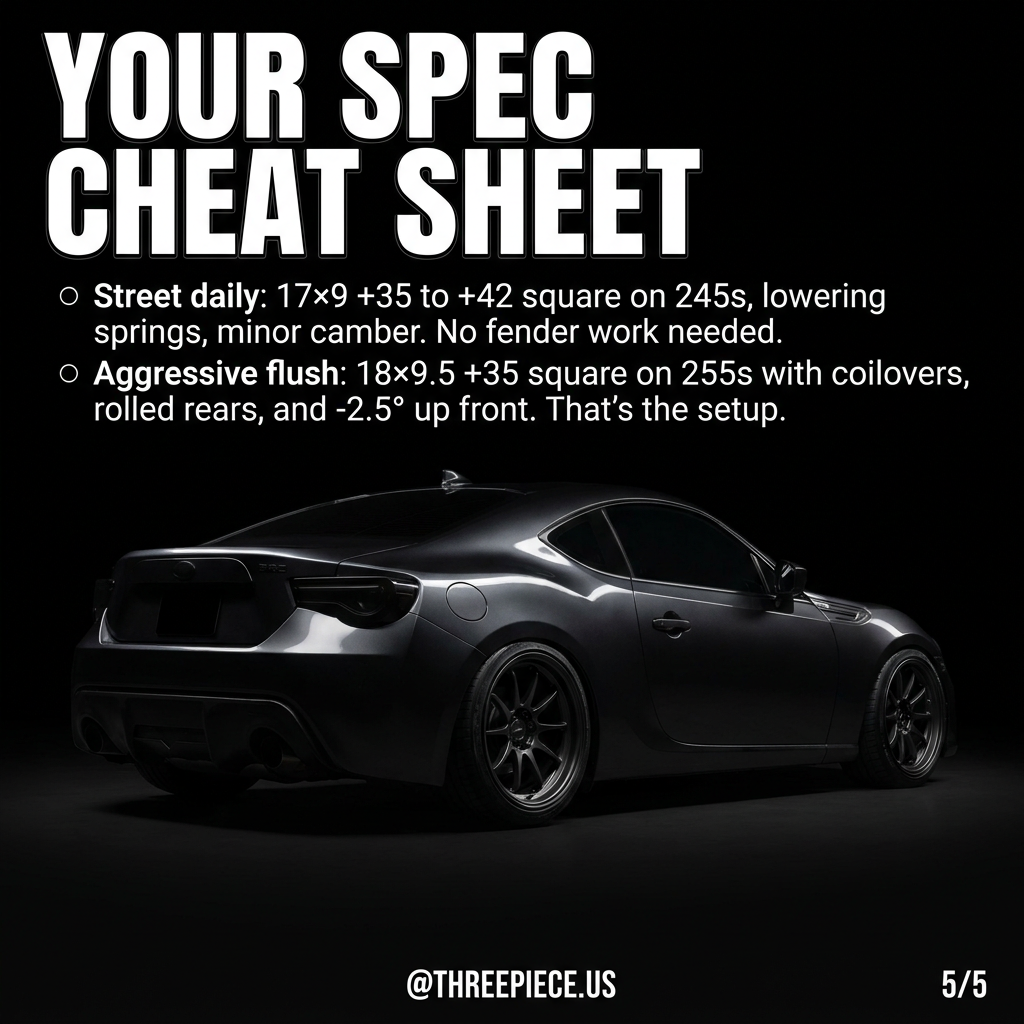
Street daily (no bodywork): 17x9 +35 to +42 · 245/40R17 · square. Pair with lowering springs or entry-level coilovers, dial in -1.5° to -2° front camber, and you're done. No fender rolling, no liner trimming, no surprises. This is the setup for the person who wants the car to look right and handle well without turning every weekend into a fabrication project. The 17" diameter also means lighter unsprung weight compared to 18s — on a 2,800-lb car with 200 hp, you feel that difference.
Aggressive flush (mild bodywork): 18x9.5 +35 · 255/35R18 · square. This requires proper coilovers (not lowering springs — you need damping adjustment), rolled rear fenders, trimmed inner liner tabs, and -2.5° front camber. The result is a nearly flush fitment that fills the fenders completely and puts serious rubber on the ground. Owners running this setup on coilovers with 225/40R18 stretched on the 9.5" barrel report no rubbing at all, but going to a 255 in proper fitment means you need that rear fender work.
For 18x9.5 wheels in 5x100, the options are more limited than 5x114.3 — which is exactly why getting the offset right matters more. A +35 that's actually +38 from a no-name brand will change your fitment entirely. Stick with manufacturers that publish verified offsets.
Coilovers That Make These Specs Work
You can't run aggressive fitment on stock suspension. The factory ride height doesn't give you the fender gap control you need, and stock dampers aren't valved for lowered spring rates. Here's what's available for the ZC6 chassis at different budget levels.
For the street daily build, the F2 Function & Form Type 2 Coilovers at $980 are the entry point — 32-level damping adjustment, full-height adjustability, and they're proven on this platform. If you want more adjustability for occasional track days, the Function and Form Type 3 at $1,590 adds a pillowball upper mount for camber adjustment — useful when you're dialing in that -2° up front.
For the aggressive flush build or anyone doing regular HPDE, the BC Racing DS-Series at $1,395 is the most popular choice in the 86 community for good reason — 30-level damping, adjustable ride height independent of preload, and they clear everything up to 18x9.5. The BC Racing RM-Series at $1,495 steps up to monotube construction if you want sharper response.
If budget isn't the constraint, the Fortune Auto 500 Series for the BRZ at $1,799 is the enthusiast-grade option — custom-valved Swift springs, digressive damping, and a lifetime revalve service. The Fortune Auto 500 Super Low at $2,199 includes front endlinks and is designed specifically for aggressive drops — which is what you want if you're running 18x9.5 +35 and need every millimeter of clearance dialed in. For the full track-weapon build, the Fortune Auto 510 Series at $2,399 adds remote reservoirs for sustained high-heat use.
Tire Sizing for 245/40R17 and 255/35R18
Getting the wheel right and the tire wrong is a special kind of frustration. For the street daily square setup on 17x9, the Continental ExtremeContact Sport 02 in 245/40R17 at $234.99 is one of the best max-performance summer tires you can put on this car — excellent dry grip, communicative steering feel, and a tread life that doesn't evaporate after one season. The Continental ContiSportContact 5 in 245/40R17 at $234 is another strong option if you want slightly more compliance for daily driving.
For budget-conscious builds, the Falken Ziex ZE960 A/S in 245/40R17 at $183 gives you year-round usability if you're in a climate where summer-only tires aren't practical, and the Cooper Zeon RS3-G1 in 245/40R17 at $204 splits the difference between grip and longevity. For deeper tire knowledge, our Michelin Pilot Sport 4S review and Federal 595 RS-RR review cover the performance tire spectrum from budget semi-slick to street benchmark.
For the aggressive 18" setup, search 255/35R18 tires to see current availability. If you're running the staggered street setup with 225 fronts, check 225/40R18 options as well.
The Takeaway
The BRZ/FR-S is one of the few modern platforms where the fitment conversation actually matters to how the car drives — not just how it looks. A square 17x9 +35 · 245/40R17 setup on proper coilovers transforms this car from "slow but fun" to "the best-handling thing in its price class, period." A staggered setup looks incredible parked, but you're paying for that look with compromised dynamics on a chassis that was built around balance.
Get the specs right the first time. Measure your brake calipers, check your spoke clearance, budget for coilovers, and trim those rear quarter panel tabs before they trim your tire for you. Browse 5x100 wheels to start your search, and check the vehicle gallery for real builds on this platform.
Square or staggered — which way did you go on your 86, and would you do it the same way again?