
S550 Mustang Wheel Fitment Guide: Square vs Staggered Setups
The 2015-2023 Ford Mustang S550 is one of the most common platforms at any track day, car meet, or canyon run in America — and yet the wheel fitment conversation around it is still dominated by bad forum advice and copy-paste spec sheets. The real question isn't just "what fits" — it's whether you should run a square or staggered setup, what each one actually costs you in performance and maintenance, and which specific sizes clear the S550's notoriously tight front strut towers and Brembo calipers without destroying your fender liners. This guide covers every S550 trim from the base EcoBoost to the PP2 GT, with real owner-verified specs and the mods required to make them work. If you've already read our breakdown of why the S550 GT is worth buying right now, this is the next step.
Quick links
- Core specs: bolt pattern, center bore, lug hardware
- OEM wheel and tire sizes by trim
- Square setup: the case for 19×10 +35 all around
- Staggered setup: 19×10/19×11 that clears Brembos
- The clearance work square demands up front
- Common fitment failures and how to avoid them
- Suspension: coilovers and camber plates that matter
- Tire sizing for both setups
- Final verdict: which setup is right for you
Core Specs: Bolt Pattern, Center Bore & Lug Hardware
Every single S550 Mustang — EcoBoost, GT, Bullitt, Mach 1, GT350, GT500 — shares the same foundation:
- Bolt pattern: 5×114.3 mm (5×4.5")
- Center bore: 70.6 mm (some aftermarket wheels spec 70.5 mm — use hubcentric rings to eliminate vibration)
- Lug size: M14×1.5, torqued to 150 ft-lbs
This is the same bolt pattern as the 370Z, G37, and most modern Hondas — which means the aftermarket wheel selection is enormous. Browse 5×114.3 wheels to see what's currently available. If you're running 3-piece wheels on this platform, make sure your assembly hardware is torqued correctly — the S550's unsprung weight and torque output punish loose bolts fast. For a deeper dive into how hub bore and bolt pattern interact, our Elantra N fitment guide covers the 5×114.3 fundamentals in detail.

OEM Wheel & Tire Sizes by Trim
Understanding what Ford shipped from the factory is critical context for any aftermarket fitment decision. Here's the breakdown:
- V6 / EcoBoost base (2015-17): 17×7.5 +37.5 on 235/55-17
- EcoBoost / GT base (all years): 18×8 +40 on 235/50-18
- PP1 / Bullitt / Mach 1: 19×9 +45 front / 19×9.5 +52.5 rear on 255/40-19 front and 275/40-19 rear
- OEM 20" staggered (GT Premium, etc.): 20×9 +40 front / 20×10 +50 rear on 265/35-20 front and 285/35-20 rear
- PP2: 19×10.5 +45 front / 19×11 +52.5 rear with 305/30-19 all around
The PP2 is the most relevant factory spec for anyone going square, because Ford already proved that 305/30-19 fits the S550 platform with the right offset and suspension geometry. That's your baseline. If you're curious about how staggered fitment works more broadly, our WRX offset deep-dive explains why offset choice alone can wreck your handling balance.
Square Setup: The Case for 19×10 +35 All Around
This is the setup that the track-day crowd and serious canyon drivers are converging on, and for good reason. Running 19×10 +35 on 285/35-19 tires all four corners gives you:
- Tire rotation: You can finally rotate fronts to rears and back. On a car that eats rear tires in staggered form, this alone saves you hundreds of dollars per set.
- Reduced understeer: Owners consistently report sharper turn-in and more neutral balance compared to the factory stagger. The wider front contact patch and matched grip levels front-to-rear transform the S550's handling character.
- Predictable limit behavior: When all four tires are the same size and compound, the car communicates more clearly at the limit. You feel the breakaway coming instead of getting surprised by sudden push or snap oversteer.
The trade-off? You lose a small amount of visual aggression out back, and the front clearance work is non-negotiable. More on that below. For wheel options in this exact spec, search 19×10 wheels in 5×114.3. The Work Emotion series is a strong choice here — lightweight, available in aggressive widths, and they look correct on American muscle in a way most JDM wheels don't.

Staggered Setup: 19×10/19×11 That Clears Brembos
If you want the classic muscle car stance — wider rear, aggressive fender fill, and maximum straight-line traction — the proven staggered spec is 19×10 +35 front / 19×11 +50 rear with 275/35-19 front and 305/30-19 rear tires. This clears the PP1 Brembo calipers without spacers and fills the rear fenders properly without excessive poke.
For 20" builds, the equivalent is 20×10 +40 front / 20×11 +50 rear on 275/35-20 and 305/30-20. This is closer to what Ford offered on the factory 20" package, just wider. Check 20×11 options in 5×114.3 for the rear and 20×10 for the front.
The downside of staggered is real: you cannot rotate tires, rear tires wear roughly twice as fast as fronts on a GT with any power mods, and the handling balance always biases toward understeer because the rear has more grip than the front. Budget for rear tires twice as often. If you're building a 3-piece staggered set, Work step lips starting at $399 let you build the exact width split you need — deeper lip on the rear barrels, conservative up front.
The Clearance Work Square Demands Up Front
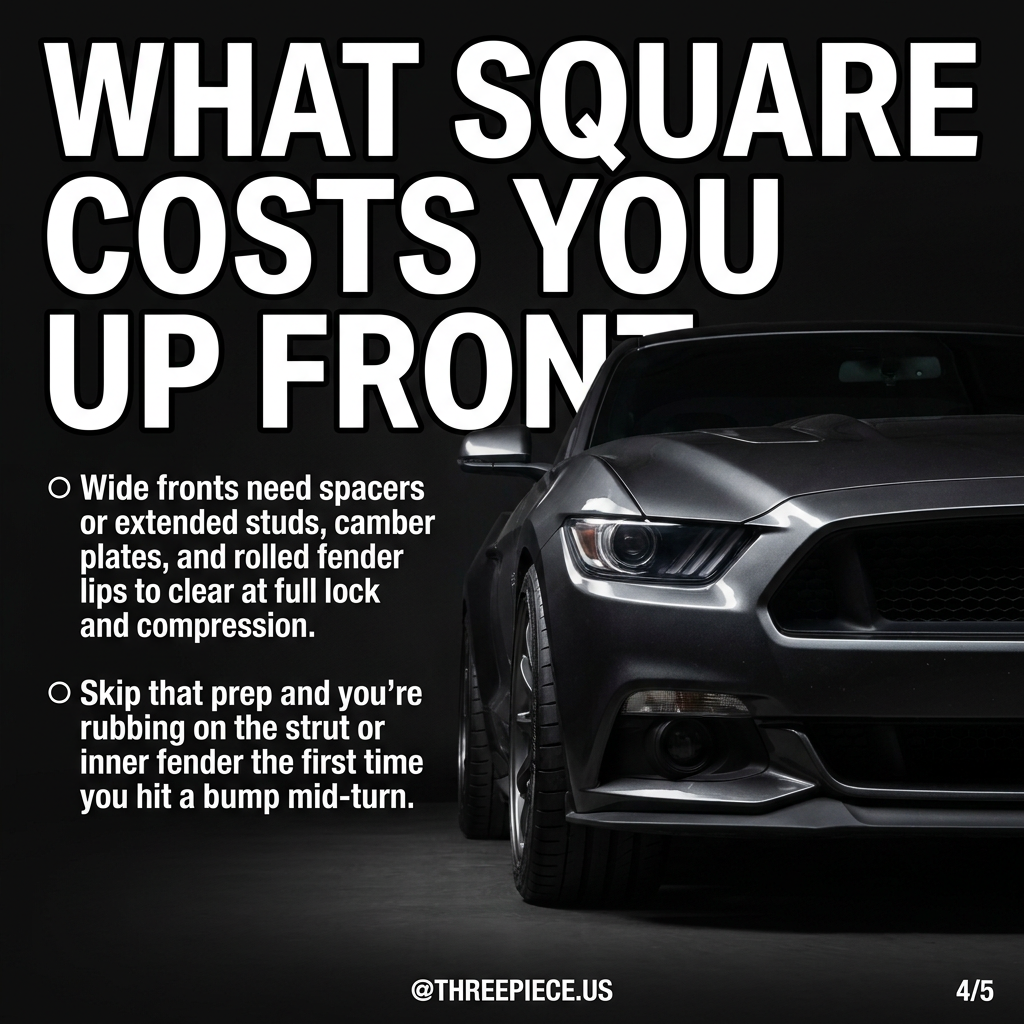
Here's where most S550 owners get into trouble. Running wide wheels up front — anything 10" or wider — requires prep work that you cannot skip:
- Front spacers: 10-25 mm spacers are typically required to push the wheel outboard enough to clear the front strut body. A 2016 GT PP owner running 19×11 +50 squared needed a 20 mm spacer up front and still only had 4.5 mm of clearance to the strut. Extended studs are mandatory with spacers — budget $150-$300 for quality hardware.
- Negative camber: You need -1.5° to -3.5° front camber to prevent the tire from contacting the inner fender and strut at full lock and during compression. Camber bolts get you about -1.5°. Beyond that, you need caster/camber plates.
- Fender lip rolling: The front fender lips need to be rolled or trimmed. The inner plastic liner also often needs trimming. This is a $50-$100 job if you do it yourself, more at a shop.
Skip any of these steps and you're rubbing on the strut or inner fender the first time you hit a bump mid-turn. That's not cosmetic damage — that's sidewall failure waiting to happen. Proper suspension components are the foundation here. The Fortune Auto 500 Series Coilovers for S550 at $1,799 include front endlinks and separate-style rears — they give you the ride height adjustment and damping control needed to make wide square setups work without destroying your fenders.
Common Fitment Failures & How to Avoid Them
These are the three issues that wreck S550 fitment builds most often:
1. Front strut contact under cornering or full lock. Caused by too-wide front wheels combined with insufficient negative camber and no spacers. The tire's inner sidewall contacts the strut body, causing fabric damage that compromises the tire's structural integrity. Fix: spacers, extended studs, camber plates, and rolled fender lips. Every one of those is required, not optional.
2. Rear rubbing on parking brake cables or caliper brackets. The inside of the rear barrel contacts the parking brake cable bracket when the suspension compresses under load. This is especially common with offsets below +45 on 11" wide rears. Fix: bend the parking brake cable bracket inward slightly, or run a higher offset (+50 vs +40). This is covered extensively on Mustang6G and Vorshlag's build threads.
3. Visible poke or ugly gap. Low offsets on wide wheels push the face past the fender — this looks bad and can fail inspection in some states. On the S550, keeping your front offset at +35 or higher on 10" wide wheels and rear offset at +50 or higher on 11" wide wheels keeps you flush without flares. If you're unfamiliar with how offset and backspacing interact, our G80 M3 fitment guide breaks down the math in detail.
Suspension: Coilovers & Camber Plates That Matter
The S550's independent rear suspension is a massive upgrade over the S197's live axle, but the front MacPherson strut design is what creates all the fitment headaches. The strut body sits close to the wheel's inner barrel, and the factory geometry doesn't leave much room for wider wheels without camber correction.
For anyone going square with 10"+ fronts, coilovers are effectively mandatory. You need ride height control to set your fender gap correctly, and you need the damping adjustment to keep the suspension from bottoming out into your wider tires. The Fortune Auto 510 Series for S550 at $2,399 is the step-up option with remote reservoirs — worth it if you're doing regular track days where heat soak becomes a factor.
If you're on a tighter budget and coming from an S197, the Fortune Auto 500 Series for S197 at $1,799 is the equivalent setup for the previous generation. Camber plates are a separate purchase on most S550 coilover kits — aftermarket options from Steeda, BMR, and Whiteline are the go-to choices in the Mustang6G community. Read our strut tower bar breakdown before you bolt one on thinking it'll help — on the S550, it usually doesn't do what people think.

Tire Sizing for Both Setups
Tire choice matters as much as wheel spec on this platform. Here's what works:
Square 19×10 +35: Run 285/35-19 all four corners. This is the widest you can comfortably go on a 10" wide wheel without the sidewall bulging excessively. Some owners push to 295/35-19, but the additional width creates more clearance issues up front with minimal grip benefit. Browse 285/35-19 tires for current options.
Staggered 19×10/19×11: Run 275/35-19 front and 305/30-19 rear. The 305 on an 11" wide wheel is the sweet spot — it fills the barrel correctly and gives you maximum rear traction without excessive stretch or bulge. For rear tires, check 305/30-19 options. For fronts, 275/35-19 tires are the move.
For 20" staggered builds: 275/35-20 front and 305/30-20 rear mirrors the factory 20" package with more width. If you want to understand how tire ratings actually translate to real-world performance, our UTQG rating explainer is essential reading before you buy.
Final Verdict: Which Setup Is Right for You
This isn't complicated once you're honest about how you use the car:
Go square 19×10 +35 on 285/35-19 if you drive canyons, attend track days, or simply want even tire wear and a more balanced car. Do the front clearance work — spacers, extended studs, camber plates, rolled fender lips. It's a one-time investment that pays for itself in tire longevity and driving confidence. The handling transformation is real and well-documented across Mustang6G, S197forum, and Vorshlag's development threads.
Go staggered 19×10 +35 / 19×11 +50 on 275/305 if you want the classic muscle stance, maximum straight-line traction, and don't mind buying rear tires twice as often. This is the easier install — the rear clears with no modifications on most trims, and the front only needs minor camber adjustment.
Either way, start with the right wheels and the right suspension. Browse the full wheel catalog for options that fit the S550's bolt pattern, and check the vehicle gallery for real builds on this platform. If you're running 3-piece wheels, 90-degree valve stems at $3.80 are a must — standard straight stems won't clear most brake calipers on a wide S550 setup. Finish the look with proper center caps and you're done.
Want to see what actually fits? Browse real Ford Mustang wheel fitments — owner setups with full specs on our fitment gallery.