

UTQG Rating Explained: What Tire Grades Actually Mean
The UTQG rating — Uniform Tire Quality Grading — is stamped into the sidewall of almost every passenger tire sold in the United States. Three numbers. Three grades. And most enthusiasts either ignore them completely or trust them way too much. The reality is somewhere in between: UTQG ratings were designed by the DOT in the late 1970s to help consumers compare tires, but because manufacturers grade their own tires with no cross-brand standardization, the system has serious blind spots. Here's what actually matters, what doesn't, and how to use these numbers without getting misled.

Quick links
- What UTQG actually is
- Treadwear, traction, and temperature explained
- Why the traction grade is misleading
- When UTQG numbers actually help
- How to use UTQG the right way
- Pairing the right tires with the right wheels
What UTQG actually is
UTQG stands for Uniform Tire Quality Grading. It's a federal standard codified under 49 CFR § 575.104, enforced by NHTSA, and required on nearly all passenger tires since March 31, 1979. The idea was simple: give consumers a standardized way to compare tires across brands. The execution, however, left a massive gap — manufacturers conduct or subcontract the testing themselves, and NHTSA doesn't run independent verification. That means a treadwear 400 from Michelin and a treadwear 400 from a budget brand are not calibrated against the same baseline. It's like letting students grade their own exams.
Light-truck tires, dedicated winter/snow tires, and certain off-road or specialty tires are exempt from UTQG requirements entirely. If you don't see a UTQG rating on a tire, it doesn't necessarily mean the tire is low quality — it might just fall outside the regulation's scope. For a deeper look at how tire sizing interacts with these ratings, check out our guide to hub-centric vs. lug-centric wheels — because getting the tire right means nothing if the wheel isn't centered properly.
Treadwear, traction, and temperature explained
Every UTQG rating reads as three values in a fixed order — for example, TREADWEAR 480 TRACTION A TEMPERATURE A. Here's what each one actually measures.
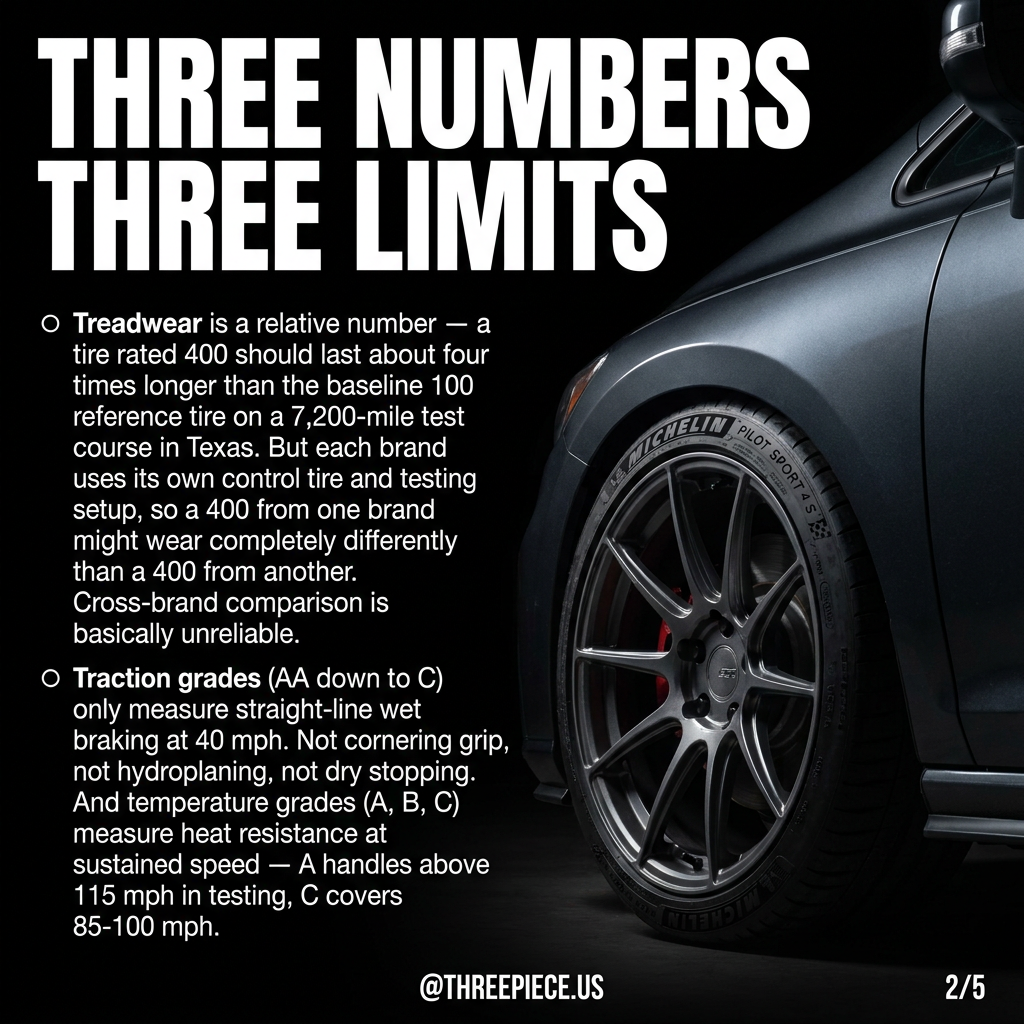
Treadwear
This is a relative number. The baseline is 100, set by a Control Monitoring Tire (CMT). A tire rated 200 should theoretically last twice as long as the reference tire; 400 four times as long. Testing is done on public roads — typically a 7,200-mile convoy course in West Texas — where candidate tires and the CMT run together and wear is measured comparatively.
The problem: each manufacturer uses its own control tire and testing methodology. A treadwear 400 from Brand X may wear out faster in the real world than a 300 from Brand Y. Forum users have documented this extensively — the number is only meaningful when comparing tires within the same brand and product line. Across brands, it's essentially noise. Driving style, alignment, inflation pressure, vehicle weight, and climate all dramatically affect actual tire life beyond what the test captures.
Traction
Traction is graded AA, A, B, or C — highest to lowest. It measures the tire's coefficient of friction during straight-line wet braking at 40 mph on both wet asphalt and wet concrete surfaces. The tire is mounted on a traction trailer, the brakes are locked to force a skid, and sensors measure the resulting forces.
What this test does not measure: cornering grip, hydroplaning resistance, wet handling, or dry stopping distance. Only locked-wheel straight-line braking on a wet surface. That's a massive limitation, and it leads directly to the most misunderstood part of the UTQG system.
Temperature
Temperature resistance is graded A, B, or C. It indicates how well a tire dissipates heat during sustained high-speed operation. An A-rated tire withstands continuous speeds above 115 mph in testing. B covers 100–115 mph, and C covers 85–100 mph. The minimum legal grade for passenger tires is C. If you're running a performance setup — especially with aftermarket wheels on a car you push hard — you want an A rating here, period.
Why the traction grade is misleading
This is the part that wrecks people. Owners have reported — and independent testing has confirmed — that tires with a "B" traction rating can outperform "A"-rated tires in real-world wet cornering and even independent wet braking tests. How? Because the UTQG traction test only evaluates locked-wheel skidding in a straight line. A tire engineered for excellent wet cornering grip — with aggressive tread block geometry, advanced silica compounds, and asymmetric patterns — can score lower on a locked-wheel slide test than a tire that's simply good at skidding to a stop on wet concrete.
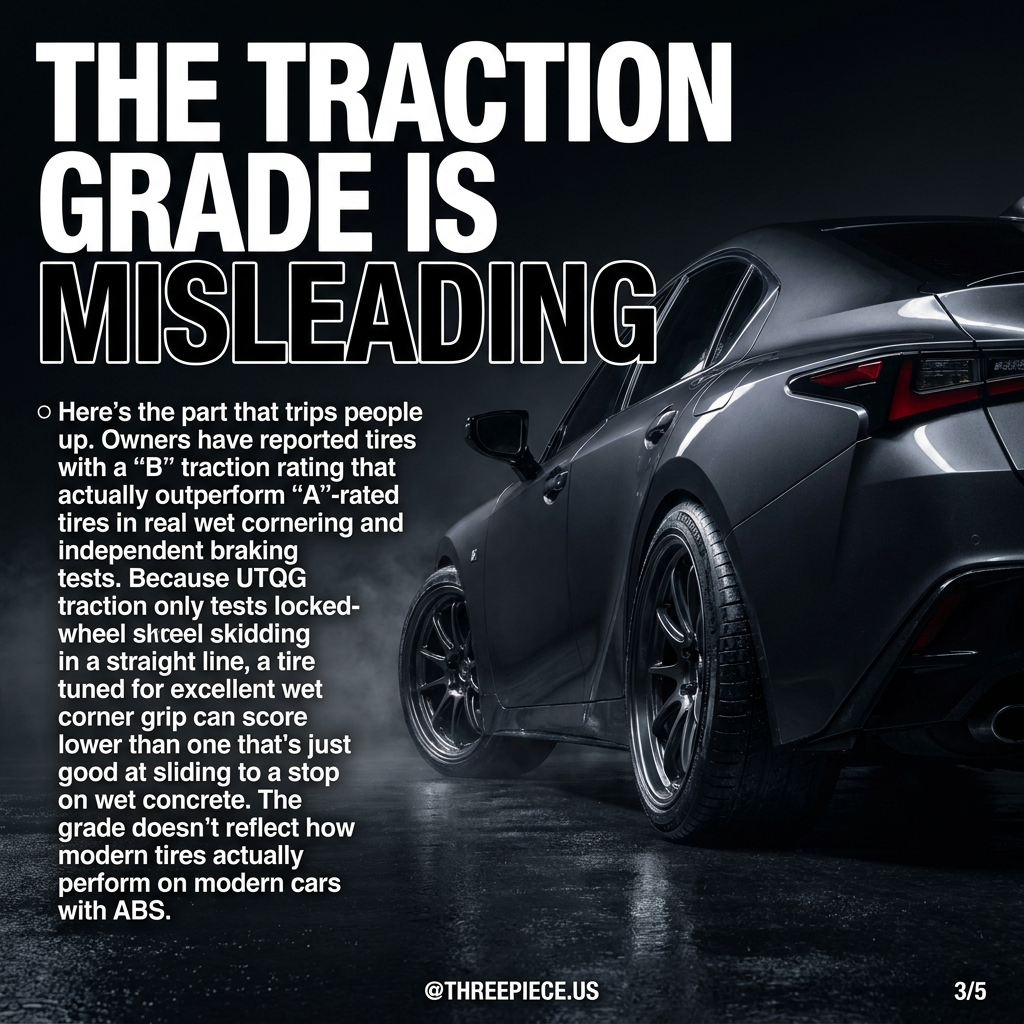
Modern cars have ABS. Nobody is locking their wheels to stop in 2025. The test methodology hasn't kept pace with how tires and vehicles actually interact. Forum discussions repeatedly highlight this disconnect — a sticky 200-treadwear performance tire with a "B" traction grade can feel dramatically better in the rain than a touring tire rated "AA." The grade doesn't reflect how modern tires perform on modern cars. If you're choosing tires for a build with proper wheel offset and fitment, real-world grip data matters infinitely more than a letter on the sidewall.
For anyone running semi-metallic brake pads, this compounds the confusion — your pad compound affects wet stopping distance as much as the tire's traction grade does.
When UTQG numbers actually help
UTQG isn't useless — you just have to know when it tells the truth and when it doesn't.
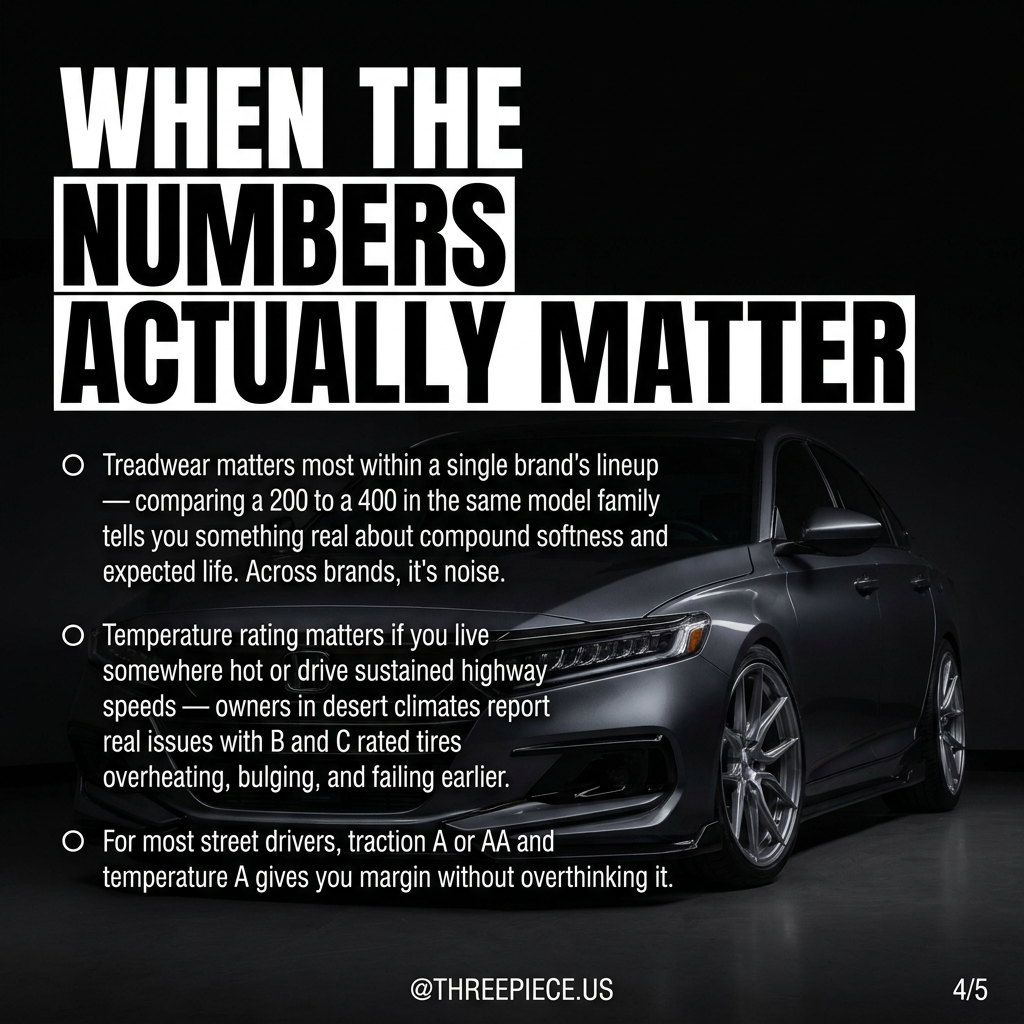
Treadwear within a single brand's lineup: This is where the number works. Comparing a treadwear 200 to a treadwear 400 in the same tire family (say, Michelin Pilot Sport 4 S vs. Michelin Primacy) tells you something real about compound softness and expected life. The 200 is grippier and wears faster. The 400 lasts longer but sacrifices some performance. Within the same brand's testing methodology, that comparison is valid.
Temperature rating in hot climates: Owners in Arizona, Texas, Nevada, and other desert states have documented real problems with B and C temperature-rated tires — sidewall bulging, premature failure, and structural issues from sustained heat exposure on long highway drives. If you live somewhere hot or regularly drive at sustained highway speeds, an A temperature rating isn't optional. It's insurance against tire failure. This is especially relevant if you're running wider, lower-profile tires on aftermarket wheels — more sidewall stress means heat management matters even more. Browse our vehicle gallery for builds running proper fitment in demanding conditions.
Setting a floor for performance tires: For most enthusiasts buying tires for a street-driven performance car, setting a minimum of Traction A and Temperature A gives you a reasonable safety margin without overthinking it. Below that, you're accepting compromises that most builds don't need to make.
How to use UTQG the right way
Think of UTQG as a starting filter, not a final answer. It narrows the field. It does not pick the winner.
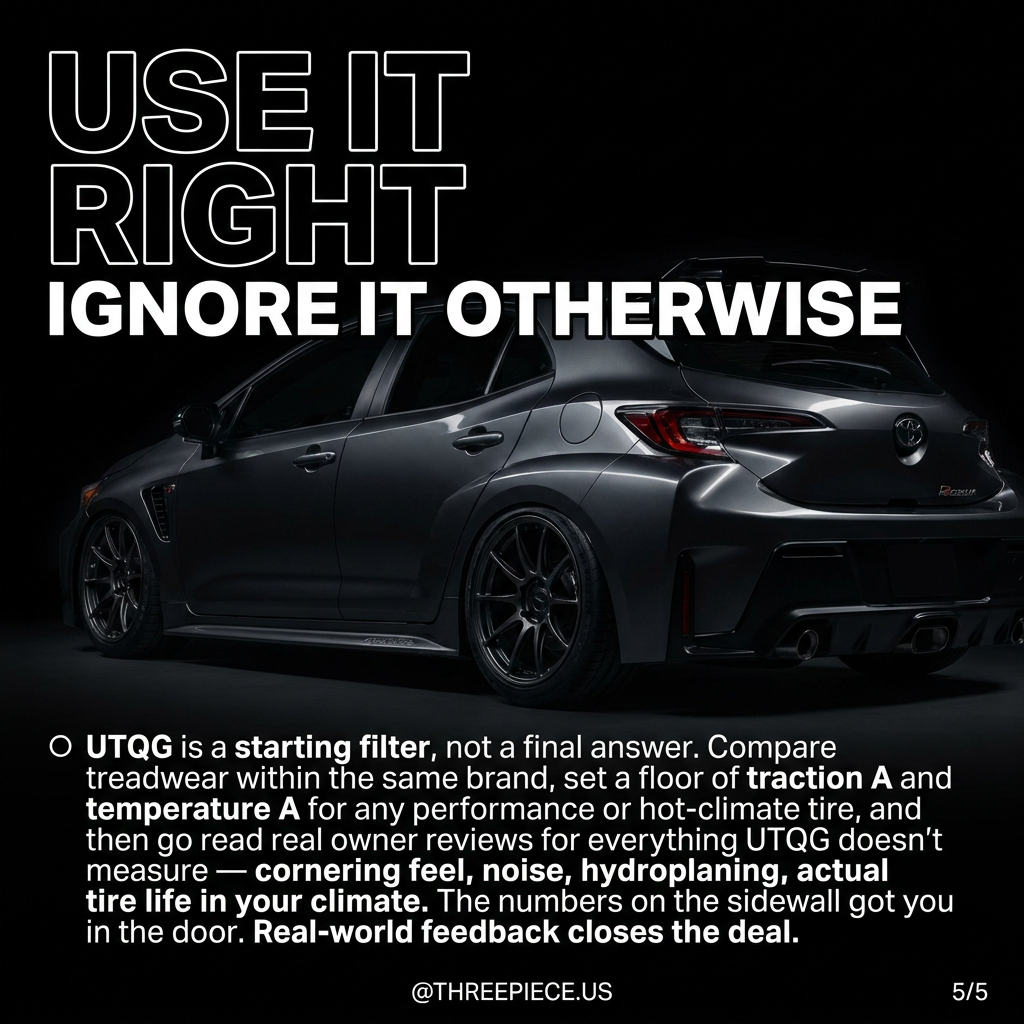
Step one: compare treadwear within the same brand to understand where a tire sits in that manufacturer's lineup — softer compound vs. longer-wearing compound. Step two: set your floor at Traction A and Temperature A for any performance or hot-climate application. Step three: ignore UTQG for everything it doesn't measure — cornering feel, road noise, hydroplaning resistance, actual tire life in your climate on your car with your alignment — and go read real owner reviews and forum threads for that data.
The numbers on the sidewall got you in the door. Real-world feedback closes the deal. And if you're building a car with aggressive wheel fitment, the tire you choose is half the equation — the other half is getting the wheel spec right. Our breakdown of RX-8 wheel fitment and BMW M2 wheel fitment both include tire-size recommendations paired with specific offsets — that's the level of detail UTQG will never give you.
Pairing the right tires with the right wheels
UTQG tells you about the tire in isolation. It says nothing about how that tire performs on your specific wheel width, offset, and bolt pattern. A 245/40R18 tire rated treadwear 300 on a 18x8.5 wheel will wear differently than the same tire stretched onto a 18x9.5. Fitment changes contact patch geometry, which changes wear patterns, heat distribution, and grip characteristics — all things UTQG doesn't account for.
If you're shopping for 245/40R18 tires or 275/35R19 tires, make sure you're matching them to the correct wheel width. Running a tire at the edge of its approved rim width range will alter the contact patch and invalidate whatever the UTQG rating predicted about tread life. For wheel sizing fundamentals, our Q50 Red Sport wheel guide walks through how width, offset, and tire sizing interact on a real platform.
If you're building a 3-piece wheel setup, getting the barrel width right is critical for tire fitment. Work step lips and Work reverse lips are both available starting at $399, and choosing the correct lip profile determines your final wheel width and tire clearance. For SSR owners, SSR step barrels at $399 offer the same flexibility. And don't overlook the details — a 90-degree valve stem at $3.80 makes inflation checks dramatically easier on deep-dish setups where straight stems get blocked by brake components.
If you're sealing a freshly assembled 3-piece wheel before mounting tires, grab silicone sealant at $10.99 — a proper bead seal is what keeps your tire pressure stable after all the UTQG analysis is done and the rubber is actually on the car.
UTQG is a 46-year-old system that still has utility if you use it correctly. Compare within brands. Set your traction and temperature floors. Then do the real research — owner reviews, track data, and proper wheel-tire fitment — to make the decision that actually matters for your build.