
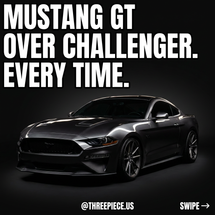
Mustang GT vs Challenger: Why the Coyote Wins Every Time
The Dodge Challenger and Ford Mustang GT sit at the same price point, make nearly identical power, and run the same quarter-mile times — yet one of them is a fundamentally better car to own, modify, and live with. The Mustang GT's 5.0L Coyote V8 is lighter, more reliable, cheaper to insure, and backed by an aftermarket so deep the Challenger can't touch it at the same dollar. If you're cross-shopping these two right now, this is the breakdown nobody gives you at the dealer.
Quick links
- Same Power, 500 Fewer Pounds
- The Coyote's Long-Term Reliability Edge
- Ownership Costs: Insurance, Mods, and Hidden Expenses
- Suspension and Wheel Fitment for Both Platforms
- When the Challenger Still Wins
- The Verdict
Same Power, 500 Fewer Pounds
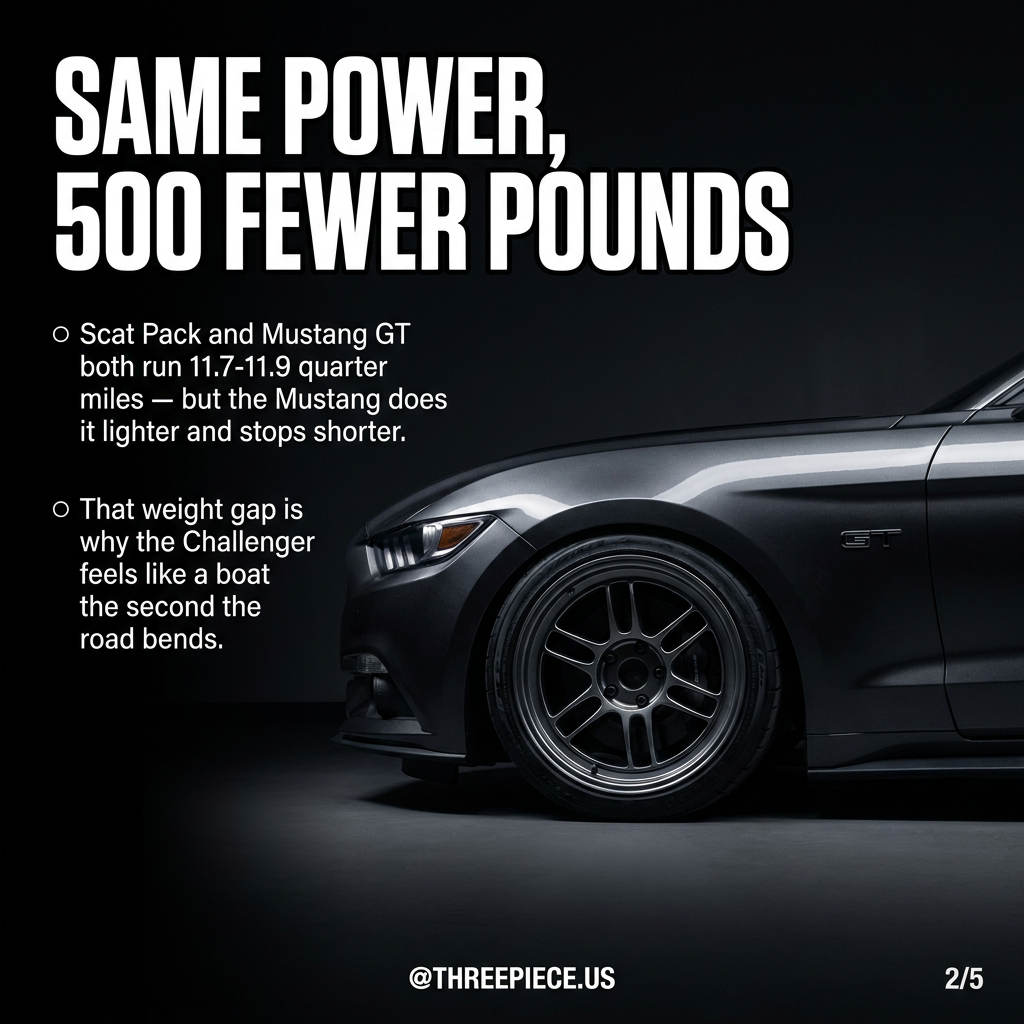
A Scat Pack 392 makes roughly 485 hp / 475 lb-ft. A current Mustang GT makes 480 hp / 415 lb-ft. On paper, the Challenger has a torque advantage. In practice, both cars run 11.7–11.9-second quarter miles at around 115 mph — because the Mustang carries roughly 500 fewer pounds to the stripe. That's not a rounding error. That's the difference between a car that rotates into a corner and a car that plows through one like it's clearing snow.
Weight doesn't just affect straight-line speed. It compounds everywhere: braking distances shrink, tire wear drops, suspension components last longer, and the car simply feels more alive. The Challenger's curb weight — north of 4,400 lbs in Scat Pack trim — means you're asking more from every component every single mile. If you're choosing a car to actually drive rather than park at a meet, that weight penalty is the single biggest factor in this comparison. For more context on how weight and power interact in real ownership, our Corvette generations buyer's guide walks through a similar power-to-weight evolution across decades.
The Coyote's Long-Term Reliability Edge
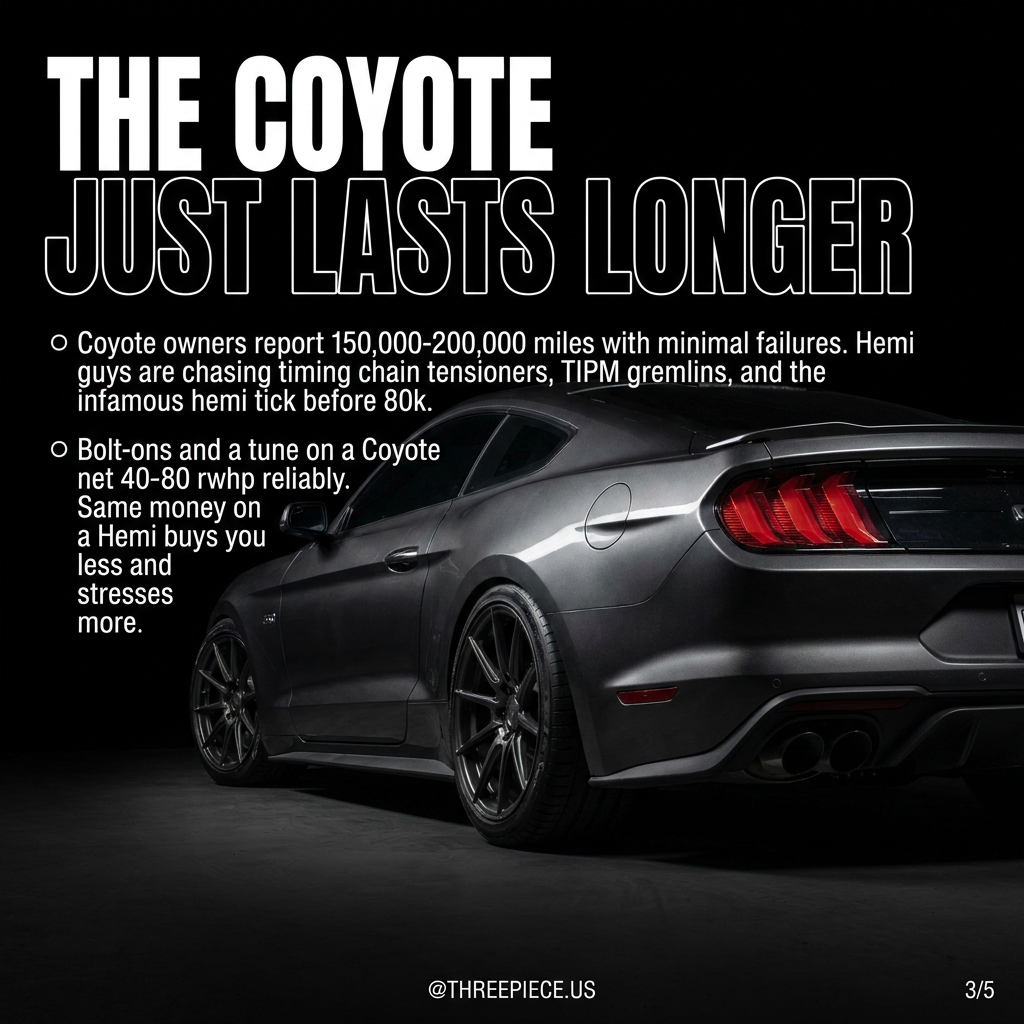
The 5.0L Coyote is one of the most overbuilt V8s Ford has ever shipped. Forged crankshaft, plasma-transferred wire arc cylinder linings, and a bottom end that was designed to absorb abuse. Owners on forums routinely report 150,000–200,000+ miles with nothing more than scheduled maintenance. It's the kind of engine you can bolt a supercharger onto and still sleep at night.
The 5.7L Hemi tells a different story. Timing chain tensioner failures — especially on 2009+ models — are well-documented. The infamous "Hemi tick" is often dismissed as harmless until it turns into a lifter or camshaft issue. Forum threads document camshaft failures at 80,000 miles, TIPM electrical gremlins, and valve spring issues that turn a weekend cruiser into a weekend project. The 6.4L is more robust, but it's still a heavier, thirstier engine sitting in a heavier car.
On the mod side, the gap widens further. A bolt-on intake, exhaust, and a quality tune on a Coyote reliably picks up 40–80 rwhp without cracking the motor open. The same money on a Hemi buys you less actual power and more stress on components that were already working harder. Ford Performance even offers factory-backed kits that push older S550 Coyotes toward 670 hp at the crank with the warranty intact. The Mopar aftermarket simply doesn't match that depth at the same price point. If you want to understand how different wheel construction tiers handle the stress of added power, that's worth reading before you start bolting on boost.
Ownership Costs: Insurance, Mods, and Hidden Expenses
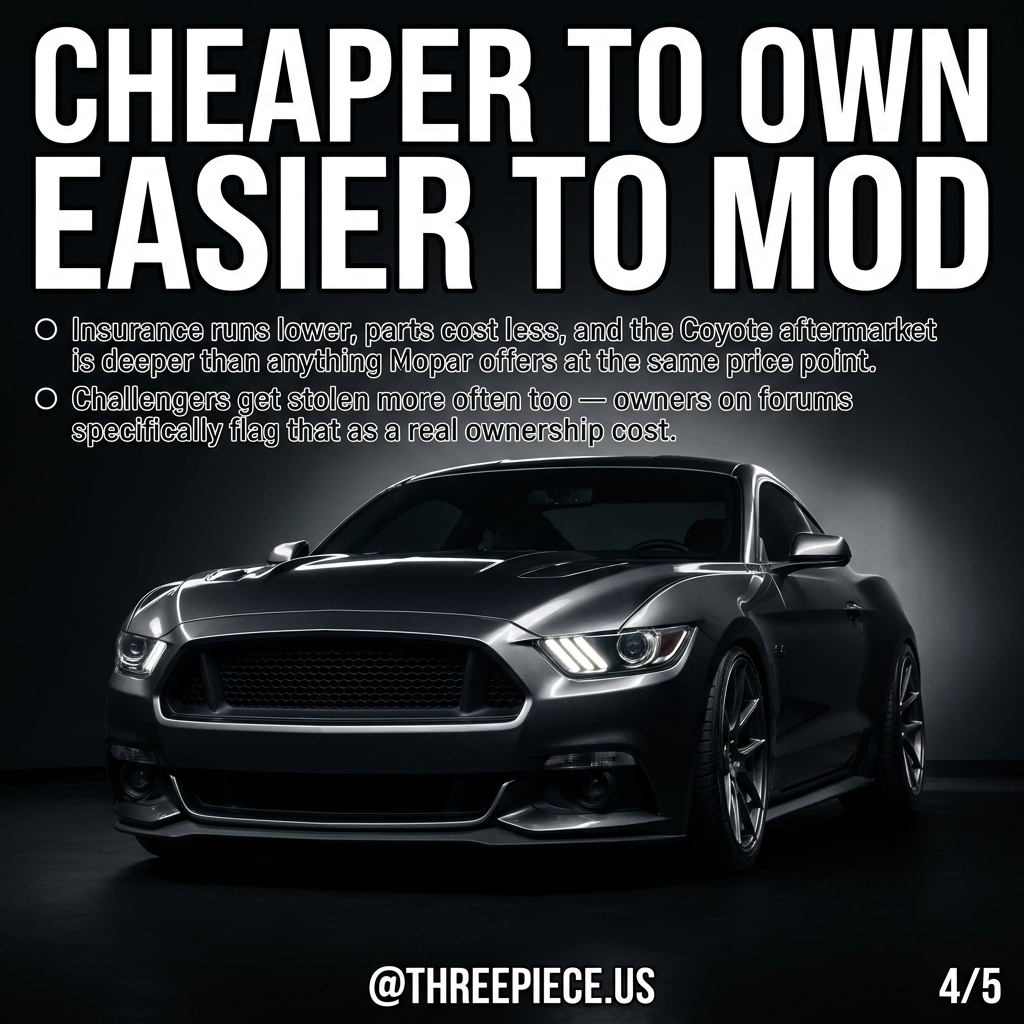
Here's where the Mustang quietly runs away with it. Average annual repair costs sit around $709 for the Mustang GT versus $650 for the Challenger — close enough to call a wash. But insurance is where the Challenger starts bleeding money. Scat Pack and Hellcat variants carry significantly higher premiums, and owners on forums consistently flag this as a real ownership cost that gets overlooked during the purchase high.
Then there's the theft problem. Challenger owners — particularly Hellcat and Scat Pack owners — specifically warn about theft rates in enthusiast forums. It's become enough of an issue that some owners factor it into their insurance and parking decisions. The Mustang isn't immune, but it doesn't carry the same target on its roof.
The Mustang's smaller footprint also means less rubber to replace. A 4,400-lb Challenger chewing through 275-width rears is a real consumable cost that nobody talks about at the dealer. The Mustang's lighter curb weight extends brake pad life, tire life, and suspension bushing life in ways that add up over years of ownership. If you're shopping for summer performance tires versus all-seasons, the Mustang's lighter weight gives you more flexibility to run a stickier compound without destroying them in 8,000 miles.
For Mustang owners looking to upgrade suspension properly, the Fortune Auto 500 Series Coilovers for S550 Mustang at $1,799 are one of the most well-regarded options in the community — separate-style rear with front endlinks included. If you're on an S197, the Fortune Auto 500 Series for S197 covers you at the same price. And for the track-day crowd pushing harder, the Fortune Auto 510 Series for S550 at $2,399 adds adjustability that justifies the step up.
Suspension and Wheel Fitment for Both Platforms
The S550 Mustang runs a 5x114.3 bolt pattern, which opens up one of the widest wheel selections in the aftermarket — from budget flow-formed options to full 3-piece forged setups. The sweet spot for most S550 GT builds is 19x10 +40 front / 19x11 +50 rear with 275/35R19 and 305/30R19 tires respectively. That staggered setup fills the fenders properly without requiring aggressive camber or fender work. Browse 19-inch wheels in 5x114.3 to see what's available for the platform.
The Challenger's 5x115 bolt pattern is less common in the enthusiast aftermarket, which limits your options — especially if you're looking beyond OEM-style replicas. The Voxx Replica Dodge Challenger 20x9 +20 in Gloss Black Machined Face at $300 is a solid OEM+ option for Challenger owners who want to refresh the look without custom-drilling. For Challenger owners committed to the platform, the Function and Form Type 4 Coilovers for 2015+ Challenger at $2,180 will get the stance right, while the Silvers Neomax for Hellcat/Scat Pack at $1,399 offers a more budget-friendly entry point with single-way damping adjustment.
If you're choosing between wheel construction types for either platform — cast, flow-formed, or forged — our breakdown of monoblock vs 3-piece wheels covers the real-world tradeoffs. And if you're running a staggered setup on the Mustang, our Michelin Pilot Sport 4S review covers why that tire remains the benchmark for street-performance applications on cars like these. Check 275/35R19 tires and 305/30R19 tires for current availability.
When the Challenger Still Wins
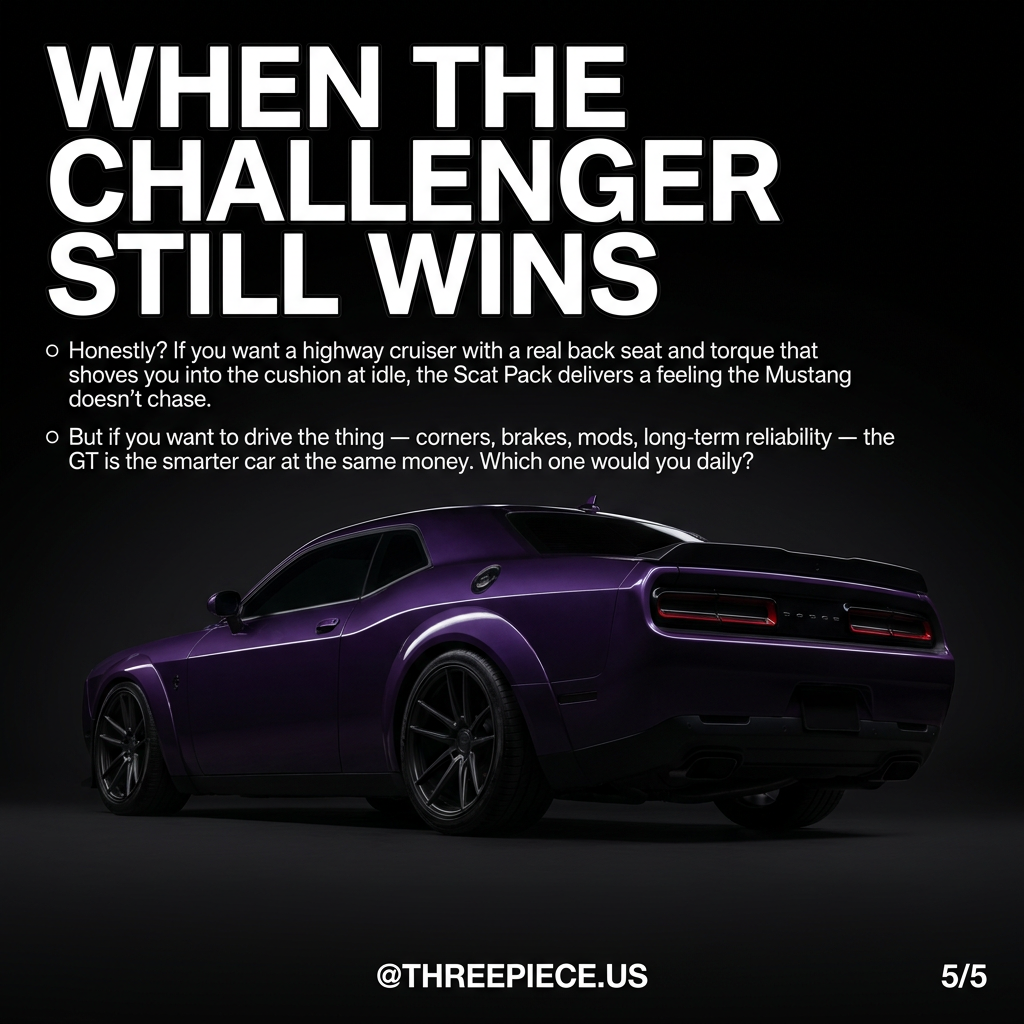
Here's where honesty matters more than tribalism. The Challenger does things the Mustang simply doesn't attempt. Nothing else on the road carries that presence — the widebody Scat Pack takes up the entire lane and makes everyone in the parking lot look. The back seat is actually usable. The trunk swallows luggage. And that low-rpm Hemi torque — the kind that shoves you into the seat cushion at idle — is a visceral experience the Coyote's higher-revving character doesn't replicate.
If your use case is highway cruising, car meets, and straight-line pulls from stoplight to stoplight, the Challenger is genuinely the better tool. It's a modern muscle car in the most literal sense: big, loud, comfortable, and intimidating. That's a valid purchase. The problem is when people buy a Challenger expecting it to be a performance car that also cruises, rather than a cruiser that also makes power. Those are two very different things.
The Challenger is also now a discontinued platform, which creates an interesting value proposition. Production ended, and clean examples — especially manual Scat Packs — will likely hold value better than the market expects. If you're buying one as a future collectible rather than a daily performance car, the calculus changes entirely. For context on how discontinued platforms appreciate, our Corvette generations ranked guide shows how this plays out over decades.
The Verdict
If you want to drive — corners, brakes, mods, long-term reliability — the Mustang GT is the smarter car at the same money. The Coyote is more durable, the aftermarket is deeper, insurance is cheaper, and the car weighs less than a mid-size sedan. If you want presence, comfort, and a car that makes a statement just sitting in a parking lot, the Challenger delivers something the Mustang doesn't chase.
But here's the part nobody says out loud: most people buying a Challenger would be happier with a Mustang GT Performance Pack after six months of actual ownership. The weight, the insurance, the mod limitations, and the handling compromises add up. The Challenger wins the poster test. The Mustang wins everything else.
For S197 owners building on a tighter budget, the Function and Form Type 3 Coilovers for S197 at $1,590 are a strong entry point before stepping up to Fortune Auto. Check the ThreePiece vehicle gallery for real fitment examples on both platforms, and browse our full wheel catalog to start planning the right setup for whichever side of this argument you land on.
Which one would you daily — and what's the first mod you'd do?