

Eight generations, seven decades, and a community that still can't agree on which one is the best. The Chevrolet Corvette is the longest-running sports car nameplate in American history, and every generation brought a fight — between engineers, between accountants, and between the owners who swear their era is the only one that matters. This isn't a history lesson. It's a ranking, with the trap years, the sleeper buys, and the wheel fitments that make each generation look like it was always supposed to.

Quick links
- C1 & C2: The Origin and the Untouchable
- C3 & C4: The Malaise and the Comeback
- C5: The Best Value Corvette Ever Made
- C6: The Analog Sweet Spot
- C7 & C8: Last Front-Engine and the Mid-Engine Revolution
- Every Generation's Trap Year
- Corvette Wheel Fitment Across Generations
- The Final Ranking
C1 & C2: The Origin and the Untouchable
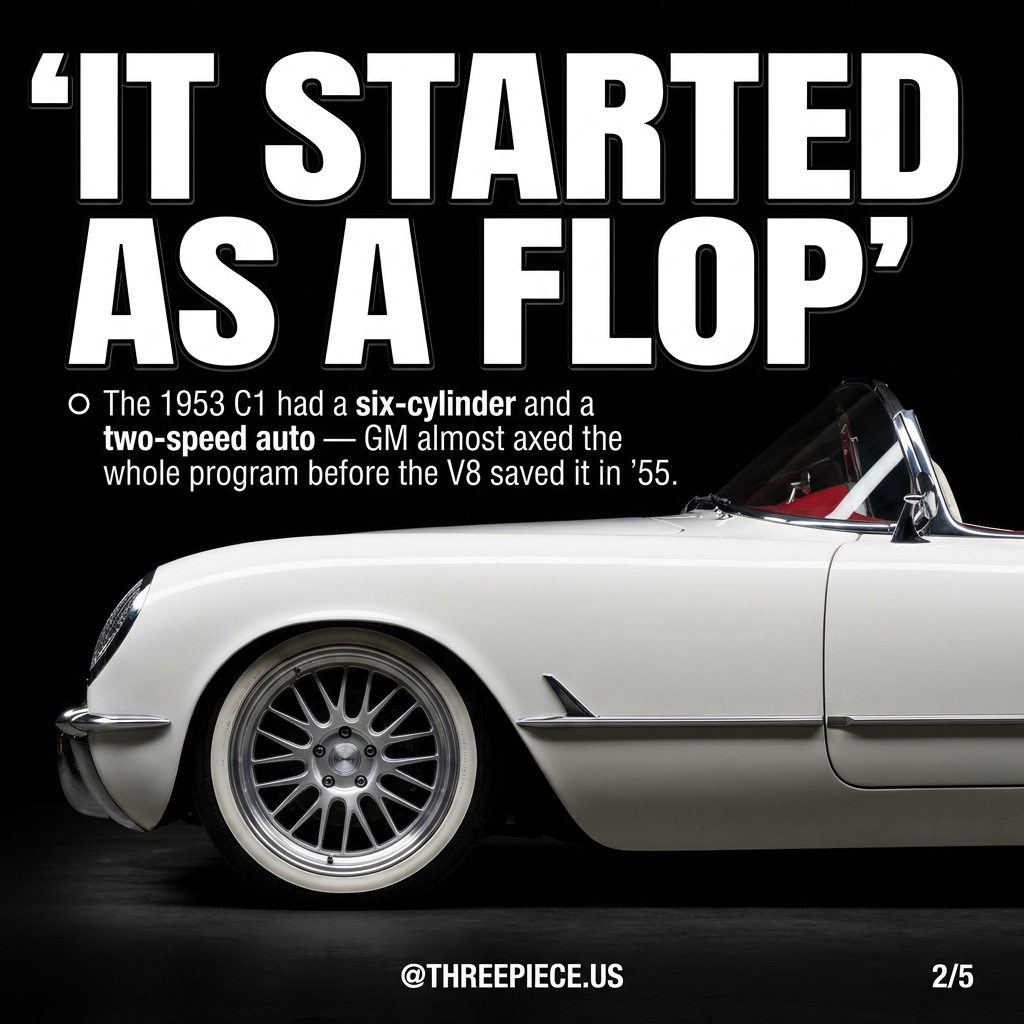
The C1 almost ended the Corvette before it started. A 235-cubic-inch Blue Flame inline-six making roughly 150 horsepower through a two-speed Powerglide automatic — that's what GM thought a sports car should be in 1953. It wasn't. The car was slow, the interior was cheap, and Chevrolet reportedly considered scrapping the entire program. Zora Arkus-Duntov changed everything when the 265-ci small-block V8 arrived in 1955, and by 1962 the C1 was making 360 horsepower from a 327 and running to 60 in the mid-fives. The fiberglass body was revolutionary, but it hides frame rust underneath — something C1 buyers learn the expensive way.
The C2 Stingray (1963–1967) is where most enthusiasts stop arguing. Independent rear suspension, disc brakes, and the split-window coupe in '63 created a design so pure that GM dropped the split window after one year because it blocked rearward visibility — which is exactly why a clean '63 split-window now commands six figures. By 1967, the L88 big-block was rated at 430 horsepower on paper, though real dyno numbers were closer to 550. The C2 is the poster car, the auction headliner, and the generation that set the visual DNA for everything after it. Forum polls on Corvette Forum and CorvetteForum.com have put the C2 at or near the top of every "best generation" thread for over a decade.
C3 & C4: The Malaise and the Comeback
The C3 (1968–1982) is the most romanticized and the most dangerous to buy blind. Early pre-smog cars — especially the 1969–1971 big-blocks — are legitimate performers. A 454 LS6 in 1970 made 460 horsepower gross, and the ultra-rare ZL1 was an aluminum-block monster producing roughly 600 horsepower in a car that weighed under 3,400 pounds. But here's the trap: by the mid-1970s, emissions regulations had strangled the Corvette down to 165 horsepower in the worst years. A 1975 L48 Corvette with the California emissions package was slower than a modern Camry. Body panel fitment was inconsistent, electrical gremlins were common, and the T-top seals leaked on almost every car. If you're shopping C3s, the year matters more than on any other generation.
The C4 (1984–1996) is the generation that enthusiasts are finally reconsidering. For years it was the "cheap Corvette" — digital dash failures, the bizarre 4+3 manual transmission in early cars, and the Opti-Spark distributor that turned engine bays into diagnostic nightmares. But the C4 ZR-1 with the Lotus-engineered LT5 DOHC V8 making 405 horsepower was genuinely exotic. It topped 180 mph and set endurance records at Bonneville. The problem is parts: the LT5 was built by Mercury Marine, and replacement components are scarce and expensive. Late C4s with the LT1 (1992–1996) are the smarter buy — 300 horsepower, better electronics, and they're still under $15K for clean examples. If you want to understand the difference between monoblock and multi-piece wheel construction, the C4 is actually a great platform to learn on because aftermarket wheel options are enormous and prices are low.
C5: The Best Value Corvette Ever Made
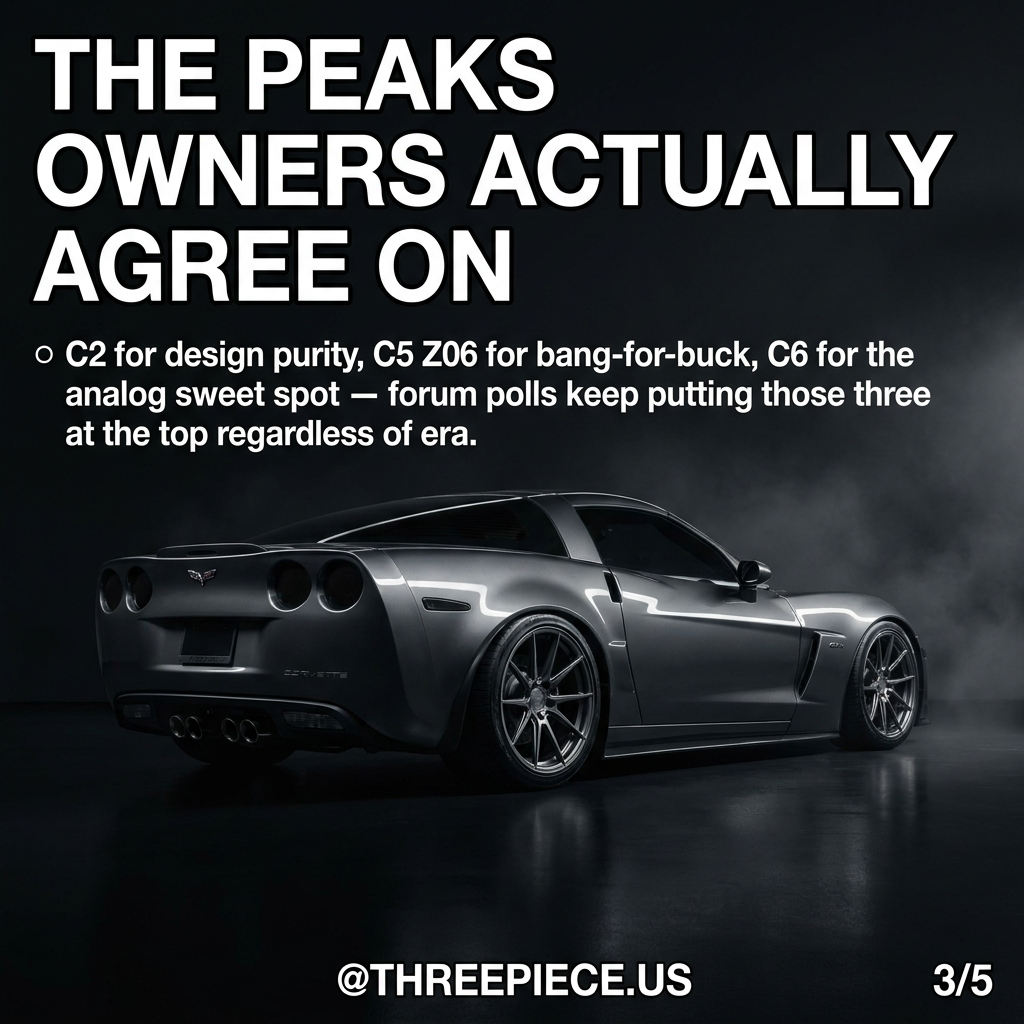
The C5 (1997–2004) is where the Corvette became a genuinely modern sports car, and it's still the generation that delivers the most performance per dollar spent. The LS1 producing 345 horsepower in a car weighing under 3,300 pounds was a revelation. The chassis was stiffer than anything Chevrolet had built before, the rear transaxle layout gave near-perfect weight distribution, and the fixed-roof hardtop coupe was the lightest of the bunch.
The C5 Z06 (2001–2004) is the one to chase. The LS6 made 405 horsepower, curb weight sat around 3,115 pounds, and these cars ran low-12-second quarter miles bone stock. Clean examples with under 80K miles are still available for under $30,000 — which is absurd when you consider what you're getting. Common issues are minor: fuel tank sending units corrode from sulfur in gas, the column lock module throws false security warnings, and the hazard switch fails. None of these are expensive fixes.
For C5 and C6 owners looking to tighten up the chassis, the aFe Control Sway Bar Set for C5/C6 at $668 is one of the best bolt-on handling upgrades available — it reduces body roll without destroying ride quality. If you want the Johnny O'Connell-spec version with stiffer rates, the Johnny O'Connell sway bar set is $960 and tuned for track duty. Pair either with the aFe PFADT Series Featherlight coilover system for C5/C6 at $3,483 and you've got a suspension package that transforms the car from a grand tourer into something that embarrasses track-prepped Porsches. Our C8 wheel and tire upgrade guide covers the newer platform, but the C5 Z06 remains the generation where your dollar stretches furthest.
C6: The Analog Sweet Spot
If the C5 is the best value, the C6 (2005–2013) is the best Corvette to actually drive right now. The base car started with the LS2 at 400 horsepower and moved to the LS3 at 430 horsepower — both naturally aspirated, both communicative in a way that modern turbocharged cars have largely abandoned. The interior finally didn't feel like a parts-bin Camaro. The chassis was tighter, the steering was better, and the aluminum-frame Z06 was a genuine supercar competitor.
The C6 Z06 with the LS7 — 7.0 liters, 505 horsepower, 8,000+ RPM redline — is the most visceral naturally aspirated V8 GM ever put in a production car. It's also the generation with the most documented reliability landmine: the valve guide issue on 2008–2011 LS7 heads. A supplier machined the valve guides off-center, causing premature wear that leads to oil consumption, misfires, and eventually dropped valves. The "wiggle test" — physically checking rocker arm play — became a required inspection step for any used C6 Z06 purchase. If the car passes, you've got one of the greatest analog sports cars ever built. If it doesn't, you're looking at a $3,000–$5,000 head rebuild.
The C5/C6 platform shares the same bolt pattern — 5x120.65 — and the same sway bar and coilover mounting points, which is why the aFe PFADT Featherlight coilovers cover both generations. Browse 18-inch wheels in 5x120.65 for the C5, or step up to 19-inch wheels in 5x120.65 for the C6 Z06's wider fenders. A staggered setup — 18x9.5 front / 19x11 rear — is where most serious C6 builds land. If you're weighing the merits of running different sizes front and rear, our monoblock vs. 3-piece breakdown covers why a multi-piece wheel gives you the lip and offset flexibility that staggered Corvette fitments demand.
C7 & C8: Last Front-Engine and the Mid-Engine Revolution
The C7 (2014–2019) was the final front-engine Corvette, and it went out swinging. The base LT1 made 455 horsepower, the Z06's supercharged LT4 produced 650 horsepower and 650 lb-ft, and the ZR1 pushed past 755 horsepower. These are supercar numbers from a car that started under $60K. The C7 also had the best interior Corvette had ever offered — finally a cabin that didn't require an apology.
But the C7 Z06 had problems. Early cars overheated on track — the supercharged LT4 generated more heat than the cooling system could manage during sustained lapping. The Z07 performance package with Michelin Pilot Sport Cup 2 tires was so aggressive that it cracked factory wheels on rough surfaces. And the 7-speed manual had synchro issues in second and third gear during the first model year. By 2016, most of these were addressed, which is why second- and third-year C7 Z06s are the ones to target.
The C8 (2020–present) moved the engine behind the driver for the first time in Corvette history and split the community harder than any generation since the C4. A base C8 with the LT2 makes 495 horsepower and runs 0-60 in under 3 seconds through a dual-clutch transmission — performance that walks cars costing three times as much. The C8 Z06 with the flat-plane crank LT6 producing 670 horsepower at 8,600 RPM is the most exotic engine Chevrolet has ever built. First-year 2020 C8s had DCT shudder issues and some interior trim quality concerns — the 2022+ models are the sweet spot. For C8 owners upgrading exhaust, the aFe Twisted 304SS headers for the C8 at $1,868 unlock the LT2's voice in a way the stock manifolds simply can't. Our full C8 wheel and tire upgrade guide covers sizing, offset, and the specific clearance issues you'll hit with aftermarket wheels on the mid-engine platform.
Every Generation's Trap Year
This is the section that saves you money. Every Corvette generation has at least one model year that owners quietly warn each other about — the first-year production issues, the supplier defects, the cost-cutting that got corrected a year later. Here's the cheat sheet:
- C1: 1953 — only 300 built, all with the anemic six-cylinder and Powerglide. Collector pieces, not driver's cars.
- C3: 1975–1979 — smog-era power lows. The 1975 base made 165 horsepower. Avoid unless you're buying purely for the body.
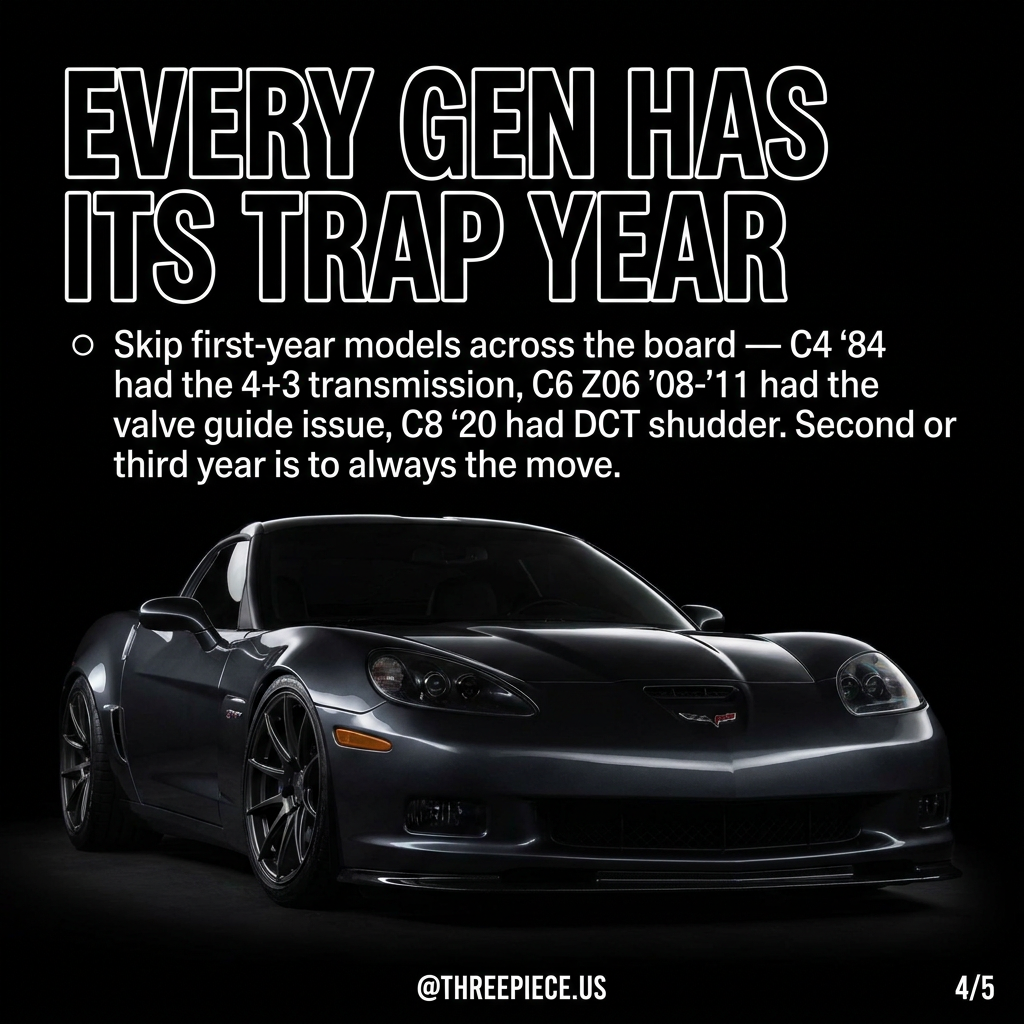
- C4: 1984 — the 4+3 manual transmission (a 4-speed with an overdrive unit bolted on) was unreliable and unpleasant. The 1985+ cars with the standard 4-speed or later 6-speed are dramatically better.
- C5: 1997 — first-year teething issues with electronics and interior trim. The 1998+ cars are more sorted.
- C6 Z06: 2008–2011 — the valve guide machining defect on LS7 heads. Always perform the wiggle test before buying.
- C7 Z06: 2015 — overheating on track, synchro issues, cracked wheels. The 2016+ cars addressed most of these.
- C8: 2020 — DCT shudder, early production quality inconsistencies. The 2022+ models are the move.
This pattern — skip the first year, buy the second or third — holds across almost every Corvette generation. It's the same advice the WRX STI generation ranking follows, and it applies to nearly every performance car. If you're shopping any used sports car with known failure points, our IS300 buying guide walks through the same inspection-first approach — different platform, same philosophy.
Corvette Wheel Fitment Across Generations
The wheel setup is what separates a clean Corvette build from a forgettable one, and every generation has different clearance constraints, bolt patterns, and offset windows. Here's a quick reference:
- C4: 5x120.65 bolt pattern. Factory was 17x9.5 on later ZR-1 models. Aftermarket sweet spot is 17x9.5 +38 to +56 depending on body style.
- C5: 5x120.65. Factory Z06 ran 17x9.5 front / 18x10.5 rear. Staggered 18x9.5 / 19x11 is where most builds land now.
- C6: 5x120.65. Z06/Grand Sport widebody opens up to 19x10 front / 20x12 rear territory. Base cars fit 18x8.5 / 19x10 comfortably.
- C7: 5x120.65. Factory Z06 was 19x10 / 20x12. Aftermarket builds push to 19x10.5 / 20x12.5 with careful offset selection.
- C8: 5x120 (note the change from 5x120.65). Factory stagger is 19x8.5 front / 20x11 rear on the Stingray, 20x10 / 21x13 on the Z06.
The C8's switch to 5x120 from the legacy 5x120.65 pattern is a detail that trips people up — the two are not interchangeable without adapters. Browse 19-inch wheels in 5x120 for C8 front fitments or 20-inch wheels in 5x120 for rears. For C5 and C6 owners on the older pattern, search 18-inch wheels in 5x120.65. And if you're running a 3-piece setup on any Corvette, assembly hardware matters — the M8x32 chrome assembly bolts at $10 each are the standard for most American-bolt-pattern 3-piece builds. Don't forget 90-degree valve stems at $3.80 — deep-dish rear wheels with tight caliper clearance make straight stems nearly impossible to air up. Check the vehicle gallery for real-world Corvette builds with proper fitment specs.
The Final Ranking
Here's where it lands after accounting for driving experience, value, reliability landmines, and how each generation ages as a platform to build on:
- C2 (1963–1967) — Untouchable for heritage and design. The split-window '63 is the grail. If you can afford one, nothing else scratches the same itch.
- C6 (2005–2013) — The one to drive right now. The LS7 Z06 is the most rewarding naturally aspirated V8 experience GM ever produced, and prices haven't caught up to what the car actually is. Just do the wiggle test.
- C5 Z06 (2001–2004) — The best performance-per-dollar in Corvette history, possibly in all of American sports cars. A sub-$30K car that runs 12s stock and responds to mods like nothing else in its price range.
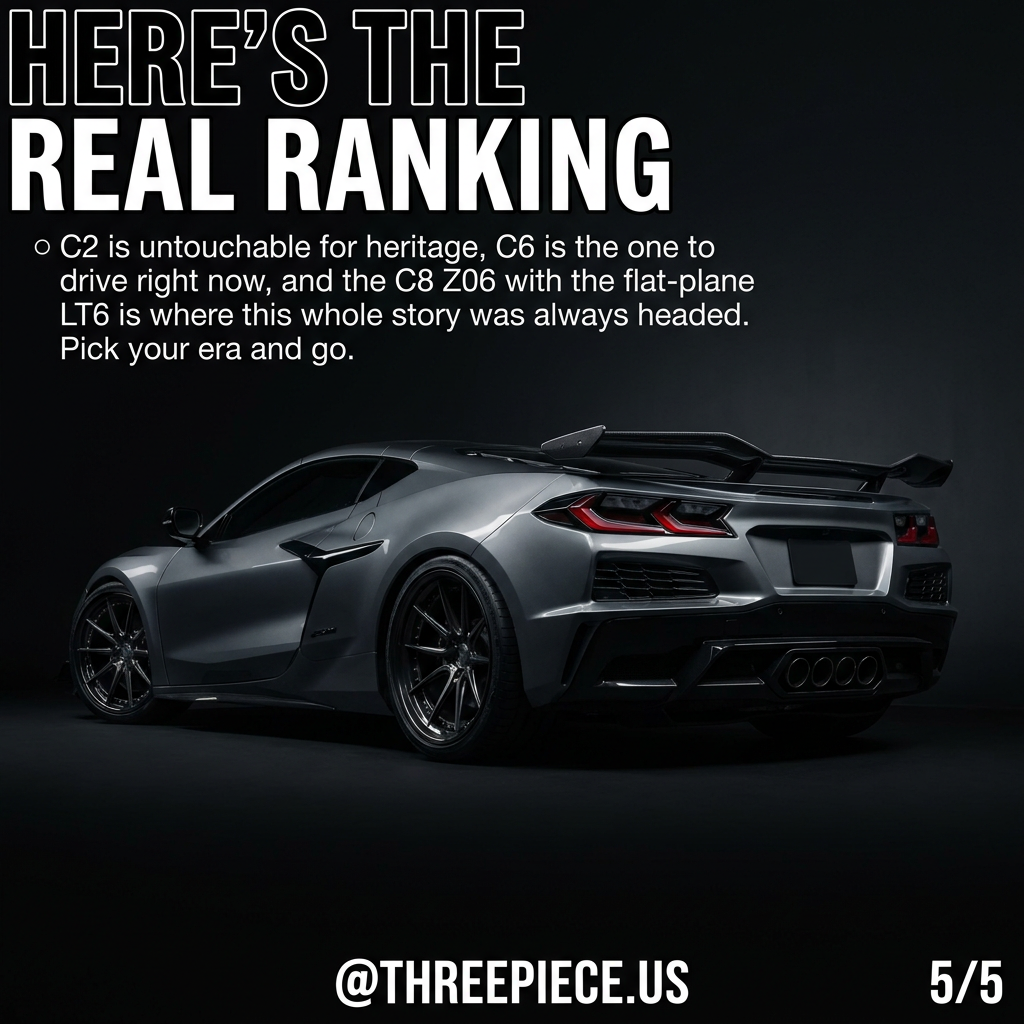
- C8 Z06 — The flat-plane LT6 is where this whole story was always headed. It's the most technically ambitious Corvette ever built, and the mid-engine layout finally matches the performance the nameplate always promised.
- C7 (2014–2019) — The best all-rounder. Comfortable enough to daily, fast enough to embarrass exotics, and the last front-engine Corvette — which will matter to collectors eventually.
- C4 ZR-1 (1990–1995) — Underrated and climbing. The LT5 is a genuine engineering marvel, but parts scarcity keeps it from being a practical recommendation for most buyers.
- C3 (1968–1974 only) — Beautiful and culturally iconic, but only the pre-smog years deserve the hype. The post-1974 cars are style over substance.
- C1 (1953–1962) — The origin story. Important, beautiful, and historically significant — but as a driving experience, every generation after it is better.
Your Corvette generation says something about what you value — raw heritage, analog engagement, dollar-for-dollar performance, or cutting-edge engineering. There's no wrong answer, but there are wrong model years. Know the trap years, do the inspections, and when you're ready to finish the build, the wheel setup is where the car stops looking like a commuter and starts looking like yours. Browse the full wheel catalog or check the suspension lineup — including the aFe PFADT Featherlight coilovers for C7 at $3,745 — to get the stance and the handling dialed together.
Which generation is your endgame — and which trap year did you learn about the hard way?