
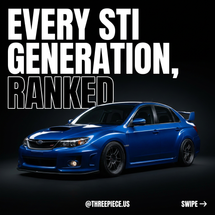
Subaru WRX STI History: Every Generation Ranked
The Subaru WRX STI was never supposed to be a street car. It was a homologation receipt — a rally weapon that Subaru needed to build in small numbers so the real car could compete in the WRC. Somewhere between the GC8's stripped-out cockpit and the VA's heated seats, the STI became one of the most debated nameplates in Japanese performance. Every generation changed the formula, and every generation has a faction that swears it's the best one. Here's where they actually stand — with real specs, real failures, and real prices — so you know what you're walking into before you wire money on something with a cracked ringland.
Quick links
- GC8: The Rally Receipt (1994–2000)
- GD: The One That Made It Real (2001–2007)
- GR/GV: The Hatchback They Regret Ignoring (2008–2014)
- VA: Comfort Over Character (2015–2021)
- The Final Ranking
- Wheel Fitment Across All STI Generations
- Suspension: The Mod That Changes Everything
- Which STI Should You Actually Buy?
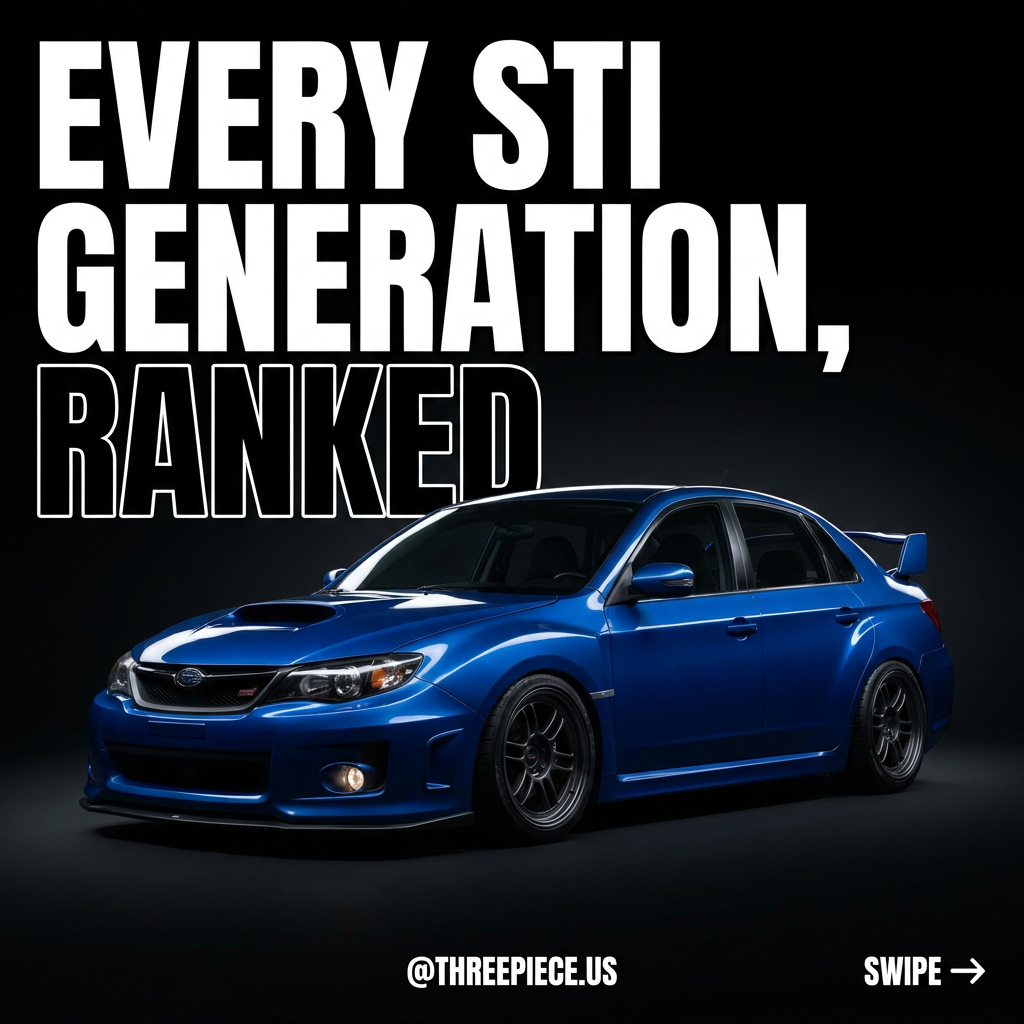
GC8: The Rally Receipt (1994–2000)
The original STI wasn't marketed. It was rationed. Subaru Tecnica International needed a street-legal Impreza to homologate the car for Group A rallying, and the GC8 was the result — a ~2,700 lb sedan with a 2.0L EJ20 turbo making 250–280 PS depending on the version. The RA trims went further, deleting air conditioning, sound deadening, and ABS to shave every gram possible. This wasn't a comfortable car. It was a parts-bin rally stage car with license plates.
The crown jewel is the 1998 22B STI — only 400 units built, widebody, 2.2L EJ22 making 280 PS, and now trading hands for six figures when clean examples surface. The 22B is the poster that started a thousand builds, and it's the reason every subsequent STI gets measured against a car most people will never sit in.
DCCD (Driver Controlled Center Differential) arrived with Version III, giving drivers adjustable torque split — a feature that defined the STI's mechanical identity for every generation after. The GC8 is also where the multi-plate LSD culture around Subaru builds really started, with rear diffs taking serious abuse in rally and tarmac events alike.
Known failures: EJ20 head studs pulling at high boost, head gasket seepage starting around 80,000–100,000 km on abused cars, and ECU tuning variability that made some cars run dangerously lean from the factory. Budget $2,000–$4,000 for head studs, gaskets, and port matching on any GC8 you're importing. This isn't optional — it's the cost of entry.
GD: The One That Made It Real (2001–2007)
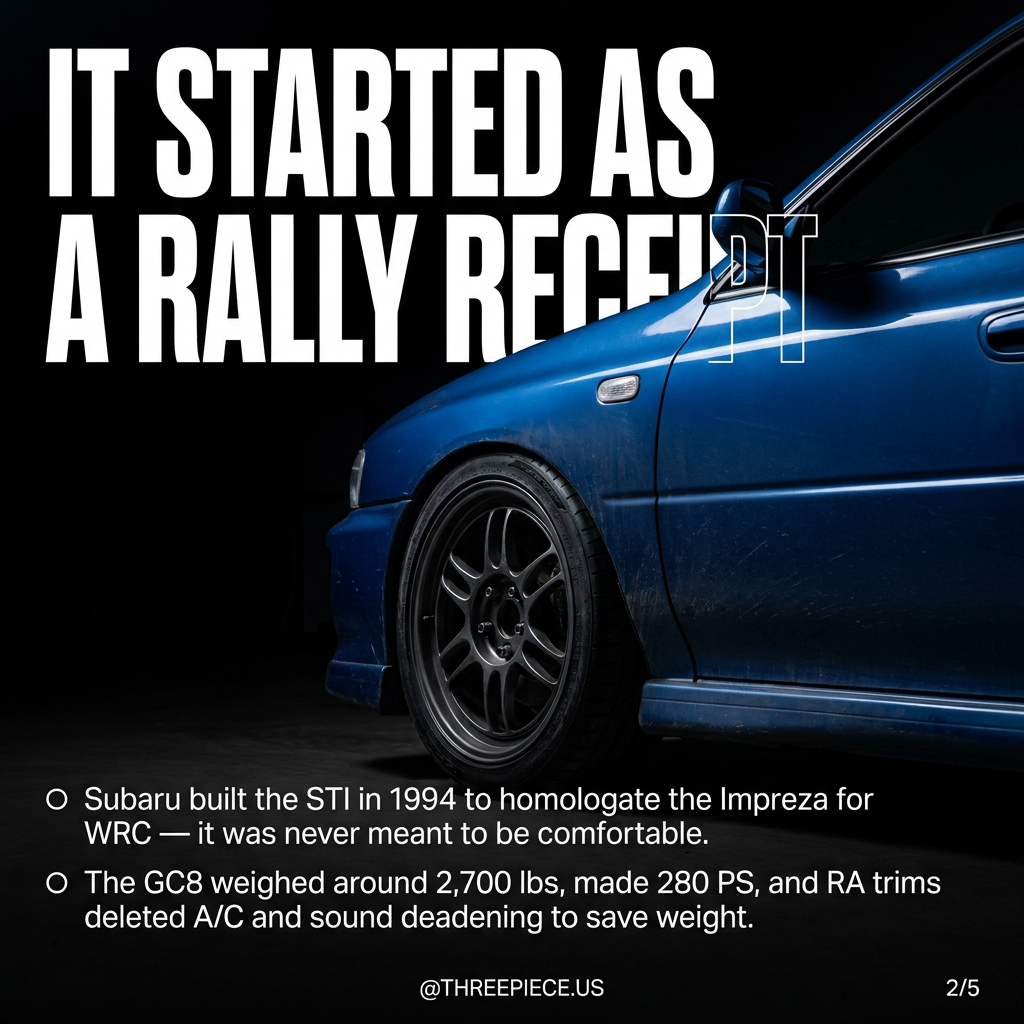
The GD generation is where most Americans met the STI. The 2004 US launch brought the EJ257 2.5L turbo, a proper 6-speed manual, and Brembo brakes — the first time you could walk into a Subaru dealer and buy a real STI without an import broker. The chassis was 120% stiffer in torsional rigidity than the GC8, which is why the GD feels planted where the GC8 feels alive.
The styling evolution across this generation — Bug-Eye (2002–03), Blob-Eye (2004–05), Hawkeye (2006–07) — is one of the best visual progressions any Japanese car has ever had. The Hawkeye, in particular, is the one that shows up on bedroom walls and forum avatars. It's the STI that looks exactly as aggressive as it drives.
Real dyno numbers on stock US-spec GD STIs typically show 270–290 whp, not the claimed 300. With a Stage 2 setup — downpipe, midpipe, and a proper tune — these cars reliably push into the low 12-second quarter mile. The mod ceiling is high, but the EJ257's ringland weakness means you're playing with fire above 400 whp on stock internals.
Critical detail for wheel buyers: The GD switched from 5×100 in early models to 5×114.3 in the 2005+ (Rev F) cars. This matters enormously for fitment. If you're shopping Volk Racing 21A 5x114.3 18X9.5+0 Bronze, you're covered on the later cars. Early GD owners need to search Volk Racing 21A 5x114.3 18X9.5+0 Bronze or plan a hub conversion.
Known failures: 2006 models had liquid-filled engine mounts that cracked and caused harsh vibration — Subaru quietly replaced them with 2005-style rubber mounts under warranty. Third gear in the 6-speed is the weak link at high power. And the EJ257's ringlands remain the boogeyman of every GD build thread you'll ever read. If you're not familiar with how turbo AWD platforms compare, the GD STI is the benchmark everyone else is chasing.
GR/GV: The Hatchback They Regret Ignoring (2008–2014)
The GR hatchback STI was polarizing when it launched and is now the generation everyone wishes they'd bought at $25,000 three years ago. Clean GR hatches are commanding $30,000–$38,000 in 2024–2025, and the trajectory hasn't slowed down. The five-door made the STI genuinely usable — you could fit wheels in the back, road-trip with gear, and still have a car that put down ~305 hp through the same DCCD-equipped AWD system.
The chassis was stiffer again, with a wider track and pillowball front lower arm bushings from the factory — a detail that most aftermarket companies charge extra for. The GR is the STI that feels the most composed at the limit, which is exactly why purists who wanted the GC8's chaos found it boring. Those purists are now outbid on every clean hatch that hits the market.
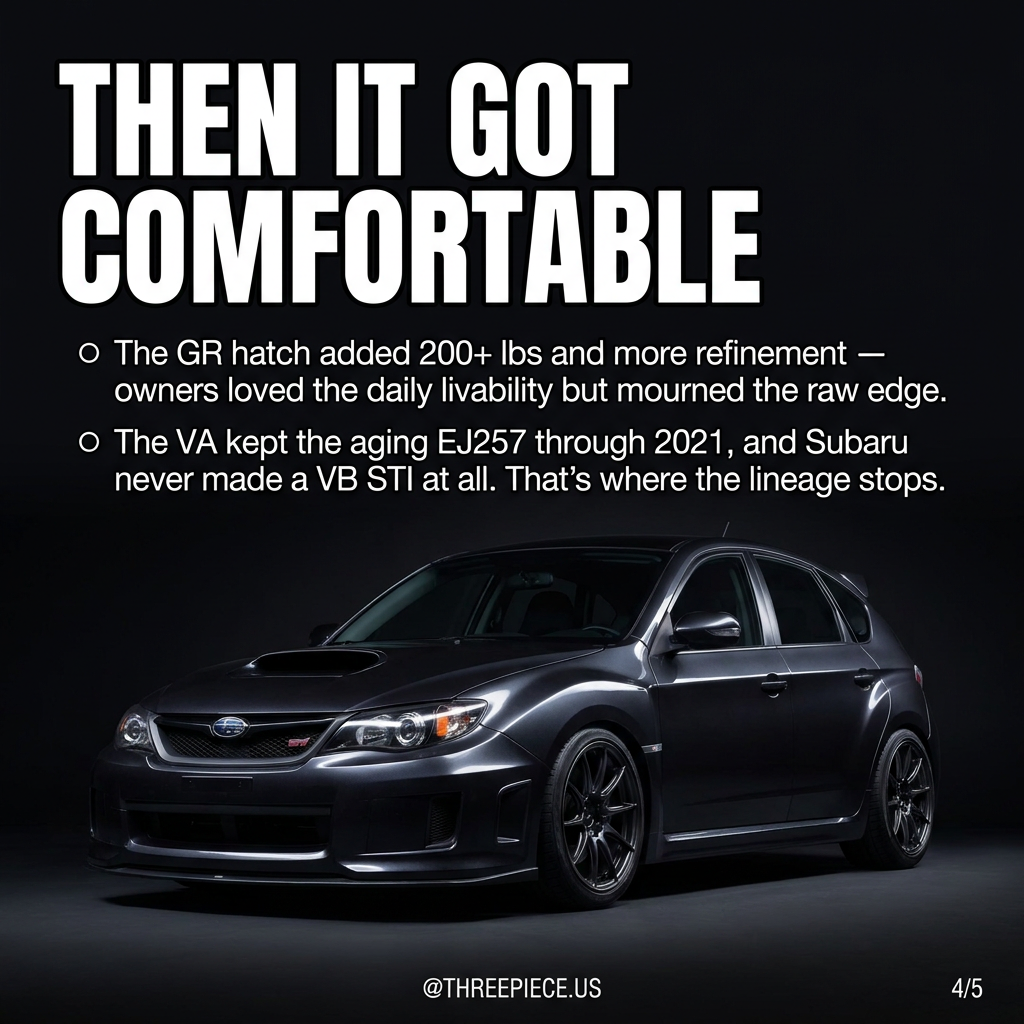
The weight problem is real, though. The GR added 200+ lbs over the GD, and you feel it in transitions. Braking heat fade under sustained track use is the most common owner complaint — the stock Brembos are adequate for street duty but need upgraded pads and cooling ducts for any serious lapping. Rotors warping by 30,000–40,000 miles in hot climates is well-documented.
The EJ257 carried over with all its familiar demons: ringland failure, head bolt seepage, turbo shaft wear on the TD04, and oil return line coking. Budget $4,000–$6,000 for a rebuild if the engine lets go. This is the generation where "how was it maintained" matters more than mileage — a 90,000-mile car with oil analysis records is worth more than a 40,000-mile car with no history.
If you're building a GR, the Fortune Auto 500 Series Coilovers for the GRB at $1,799 are the suspension upgrade that transforms the car's weight into an asset — you get the compliance tuning to actually use the wider track instead of fighting the extra mass through corners.
VA: Comfort Over Character (2015–2021)
The VA is the STI that finally felt like a finished product — and that's both its greatest strength and the reason hardcore owners rank it last for driving engagement. The interior improved dramatically, the chassis was stiffer, the DCCD got smarter, and the daily driving experience was genuinely pleasant. The problem is that "pleasant" was never what people bought STIs for.
Subaru kept the EJ257 through the entire VA run. By 2021, this engine architecture was nearly two decades old in the STI, and it showed. 305 hp / 290 lb-ft stock, with real dynos showing 280–295 whp depending on the year. The FA20 in the base WRX was already making comparable power with better efficiency and a more modern design. The STI's advantage was the drivetrain — DCCD, Brembo brakes, 6-speed — not the engine.
The limited editions tried to compensate. The Type RA got a carbon fiber roof, BBS wheels, and a slightly bump in power. The S209 (US exclusive, 209 units) pushed to 341 hp with an HKS turbo and forged pistons. The EJ25 Final Edition — only 75 built globally — sent off the EJ with gold BBS forged wheels and a numbered nameplate. These are already appreciating hard, and the S209 in particular is becoming a legitimate collector piece.
Then Subaru launched the VB-generation WRX without an STI variant at all. The lineage stopped. No VB STI exists, and Subaru has given no indication one is coming. That finality is what's driving VA prices up — especially for manual S209s, Type RAs, and clean low-mileage Final Editions.
For VA owners looking to sharpen the car, the Fortune Auto 500 Series Coilovers for the VA2 STI at $1,799 bring back some of the mechanical feel the stock suspension smoothed away. Pair that with a proper Volk Racing 21A 5x114.3 18X9.5+0 Bronze and you've got a VA that actually rotates like the earlier cars intended.
The Final Ranking
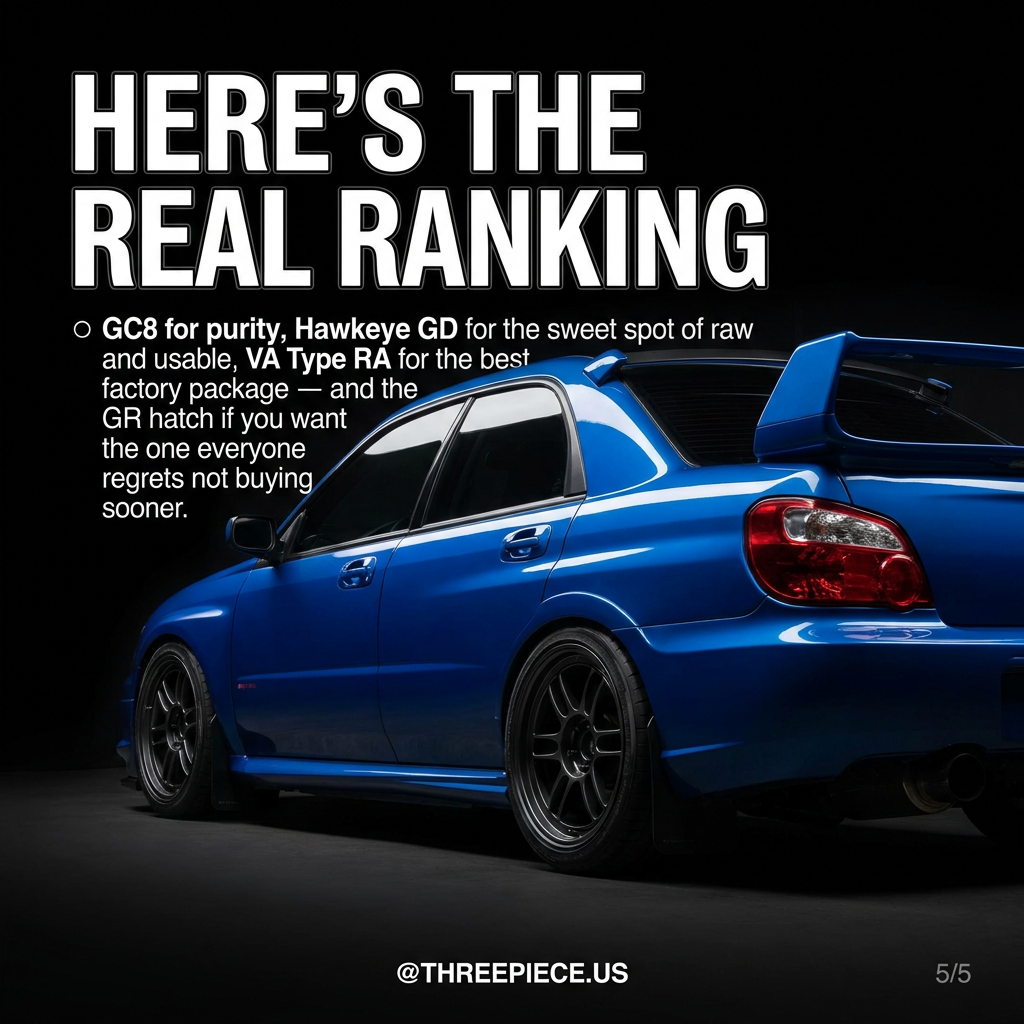
Here's where they land, and this ranking is about driving connection — not lap times, not comfort, not resale value. Every generation was fast enough. The question is which one made you feel the most when you turned in.
1. GC8 — The purest expression of the STI idea. Light, raw, mechanically transparent. The 22B is the grail, but even a base Version III with DCCD is more engaging than anything that came after. You'll spend money keeping it alive. You won't care.
2. GD Hawkeye (2006–2007) — The sweet spot. Enough chassis rigidity to be predictable, enough rawness to be exciting, and the Hawkeye face that still looks right with Work Emotion wheels twenty years later. The Fortune Auto 500 Series for the GDB-E/F at $1,799 is the single best upgrade you can make on this platform.
3. GR Hatchback — The one everyone slept on. The five-door shape, the wider track, and the stiffer chassis make it the most capable STI for mixed-use builds. The weight penalty is real, but so is the practicality. If you can find one that hasn't been thrashed, buy it before the next price jump.
4. VA — The most refined, least memorable. A great daily driver that happens to have the STI badge. The limited editions (Type RA, S209, Final Edition) transcend the base car's personality problem, but they're priced accordingly. The base VA is the STI for people who want an STI experience without the STI inconveniences — and that's a valid choice, just not the top of this list.
Wheel Fitment Across All STI Generations
Bolt pattern is the first thing that trips people up on STI builds, because it changed mid-generation. Here's the quick reference:
- GC8 (all): 5×100 — browse Volk Racing 21A 5x114.3 18X9.5+0 Bronze
- GD (2002–2004): 5×100
- GD (2005–2007): 5×114.3 — browse Volk Racing 21A 5x114.3 18X9.5+0 Bronze
- GR/GV (2008–2014): 5×114.3
- VA (2015–2021): 5×114.3
The community sweet spot for GD through VA STIs is 18×9.5 +35 to +38 with 255/35R18 tires. That sizing fills the fenders without excessive poke on stock-height cars, and with coilovers you can push to +22 to +30 for a more aggressive stance. For track-focused builds, 18×9.5 +35 keeps you safe on camber and clears the stock Brembos without spacers.
The GC8 is a different animal — 17×8 +35 with 235/40R17 is the classic fitment, and going wider than 8.5 usually requires fender work. If you're running the GC8 on track, the Volk TE37 vs Enkei RPF1 comparison is worth reading — weight savings matter more on the lightest STI chassis.
Regardless of generation, the Work Wheels lineup has been the aspirational choice for STI builds since the GC8 era. The Work Emotion CR Kiwami starting at $270 is the entry point into the Work catalog — flow-formed, light, and available in the sizes STI owners actually need. For the full 3-piece experience, the Work Emotion CR 3P at $895.50 per wheel lets you spec exact width and offset for your chassis, which is why 3-piece exists in the first place — custom fitment that off-the-shelf can't match.
Suspension: The Mod That Changes Everything
Every STI generation shares one truth: the stock suspension is a compromise between rally heritage and dealer-lot ride quality. Coilovers are the single mod that transforms the driving experience more than any intake, exhaust, or tune — and on a turbo AWD car with this much mechanical grip, the difference between stock struts and proper dampers is the difference between a fast car and a connected one.
Fortune Auto 500 Series coilovers are available for every STI generation that matters:
- 2004 WRX STI (GDB) — $1,799
- 2005–2007 WRX STI (GDB-E/F) — $1,799
- 2008–2014 WRX STI (GRB) — $1,799
- 2015+ WRX STI (VA2) — $1,799
- Tein 00-07 Subaru WRX STi Flex Z Coilovers - VSS28-C1SA4 — $1,799
The 500 Series uses monotube construction with adjustable damping — 24 clicks of compression and rebound adjustment. On the STI platform specifically, this matters because the DCCD system is sending torque around based on what the tires are doing, and inconsistent damping from worn stock struts confuses the differential's logic. Fresh, properly valved coilovers don't just improve handling — they let the AWD system work the way Subaru designed it to.
For a deeper look at how suspension geometry affects these platforms, our multi-link vs double wishbone breakdown covers the engineering principles that apply to the STI's rear suspension as well.
Which STI Should You Actually Buy?
If you want the driving experience, buy the oldest one you can afford to maintain. The GC8 is the purest, the Hawkeye GD is the most balanced, and both reward mechanical sympathy in a way that newer cars simply don't. Budget for head studs, gaskets, and a quality tune on top of the purchase price — these are not buy-and-forget platforms.
If you want a daily driver that happens to be an STI, the VA is the honest answer. It's the most livable, the most reliable in stock form, and the easiest to insure. The limited editions (Type RA, S209) are already collector territory, but a clean base VA with the 6-speed is still attainable and still a proper STI under the skin.
If you want the one everyone regrets not buying, find a GR hatch. The five-door STI is never coming back, the prices reflect that, and every month you wait costs you another thousand dollars.
Whichever generation you land on, the build starts with wheels and suspension. Browse the ThreePiece vehicle gallery for real STI builds with full specs, or explore Volk Racing 21A 5x114.3 18X9.5+0 Bronze to see what's available for your chassis right now. The STI lineage is finished — the cars that exist are all there will ever be. The only question left is which one has your name on it, and whether you're going to build it right.