
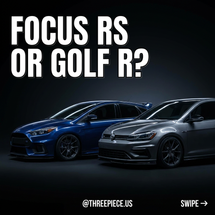
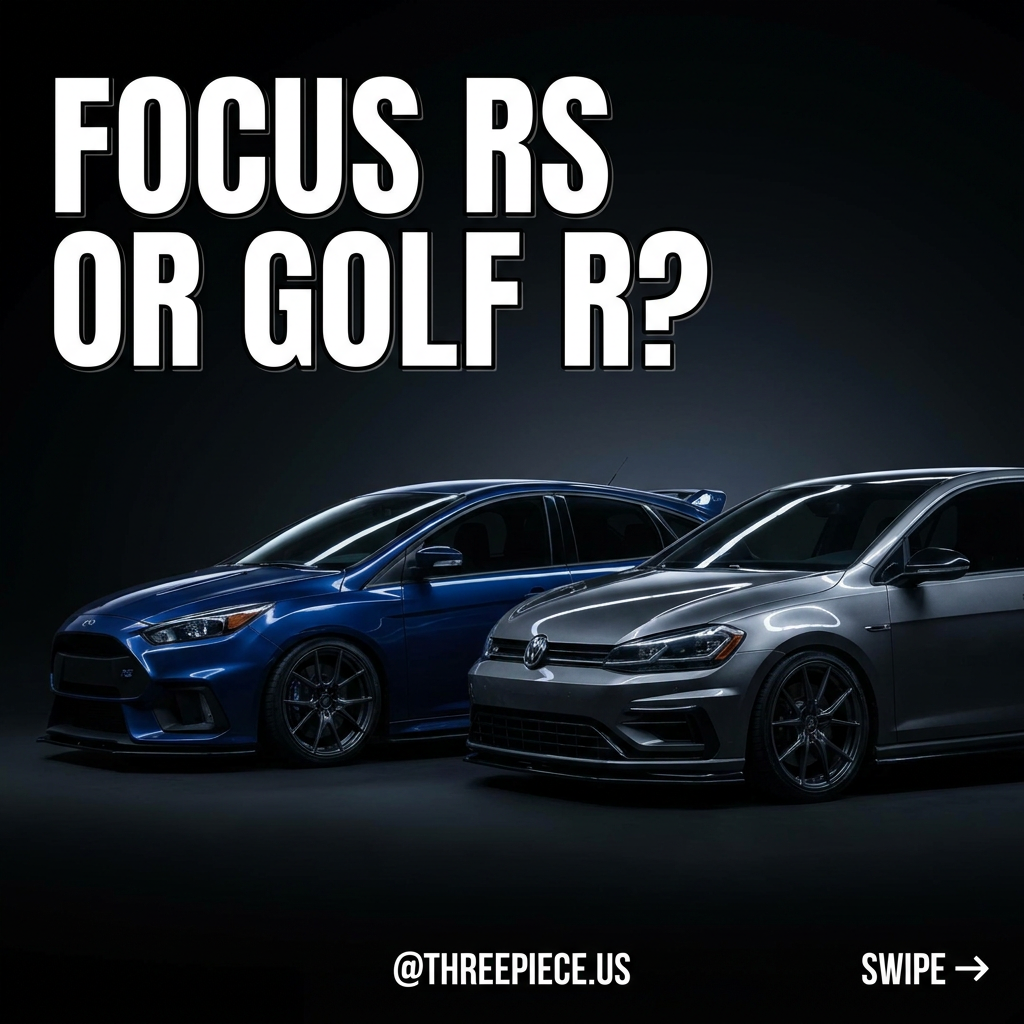
Focus RS vs Golf R: Which AWD Hot Hatch Should You Buy?
The Ford Focus RS and the Volkswagen Golf R look like the same car on paper — around 350 horsepower, all-wheel drive, hatchback bodies, and the ability to gap most things on a back road. But after 60,000 miles of ownership, they couldn't be more different. One wants to ruin your spine on the commute. The other makes 90% of the same speed feel like running errands. If you're cross-shopping these two right now, the decision comes down to what you're actually willing to live with — and what you're willing to budget for when things go wrong.
Quick links
- The RS is the rowdy one
- The Golf R is the grown-up
- Tuning and mod ceiling compared
- What actually breaks on each car
- Wheel and tire fitment for both platforms
- Suspension upgrades that actually matter
- The real answer
The RS Is the Rowdy One
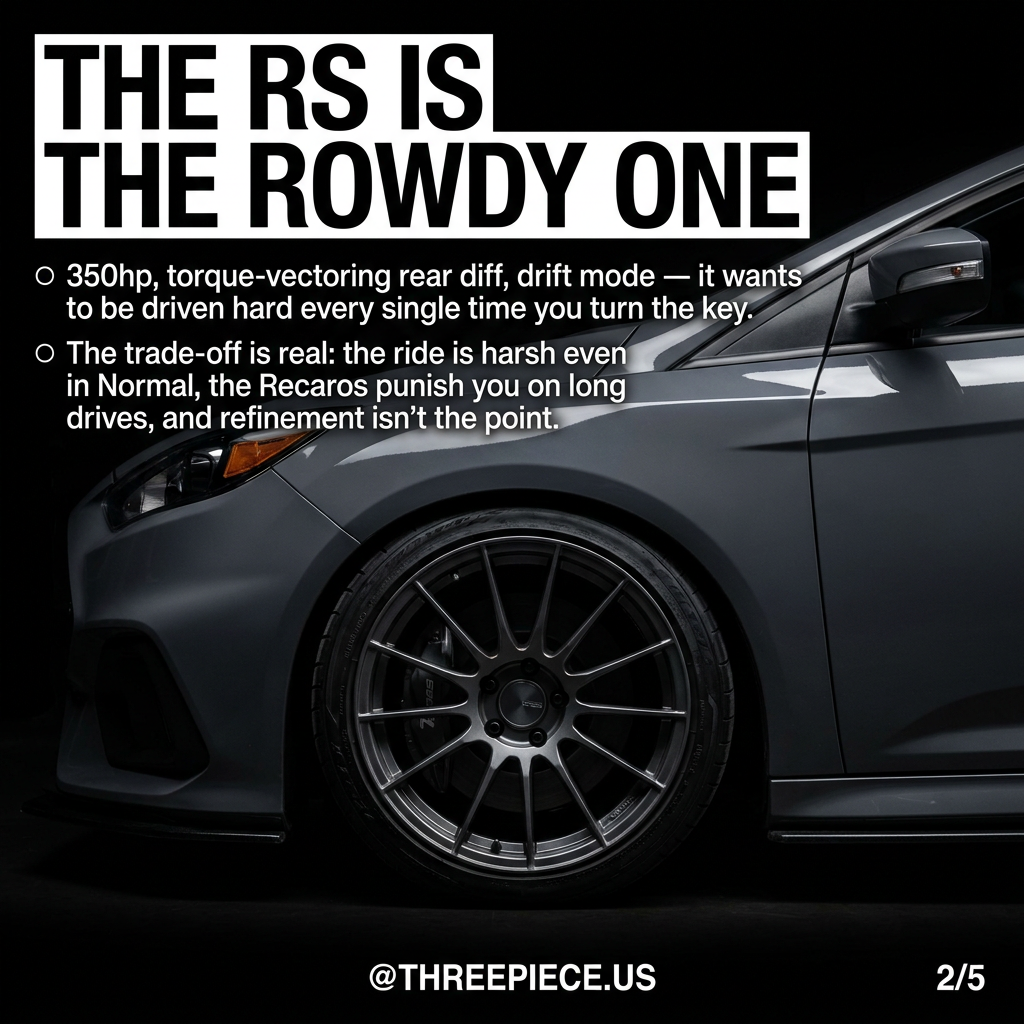
The Focus RS makes 350 hp and 350 lb-ft from its 2.3L EcoBoost four-cylinder, and it delivers every bit of that through a torque-vectoring rear differential that actively pushes the rear end around. Drift mode isn't a gimmick — it's a genuine mechanical feature that overdrives the rear clutch packs to send up to 70% of torque rearward. That system is what makes the RS feel completely unhinged compared to every other front-biased AWD hot hatch on the market.
The trade-off is brutal daily livability. Even in Normal mode, the ride quality is punishing. The factory Recaro shells are deeply bolstered — great for holding you in place during a track session, terrible if you're over six feet tall or have any kind of back issue. Multiple owners on forums who switched to the Golf R cite "back pain going away" as a genuine reason for the trade. Interior refinement, NVH, and tech features are all secondary to the RS's mission: make every drive feel like an event. If you're the type who enjoys a car that demands your attention, this is the one. If you want comfort, keep reading.
The Golf R Is the Grown-Up
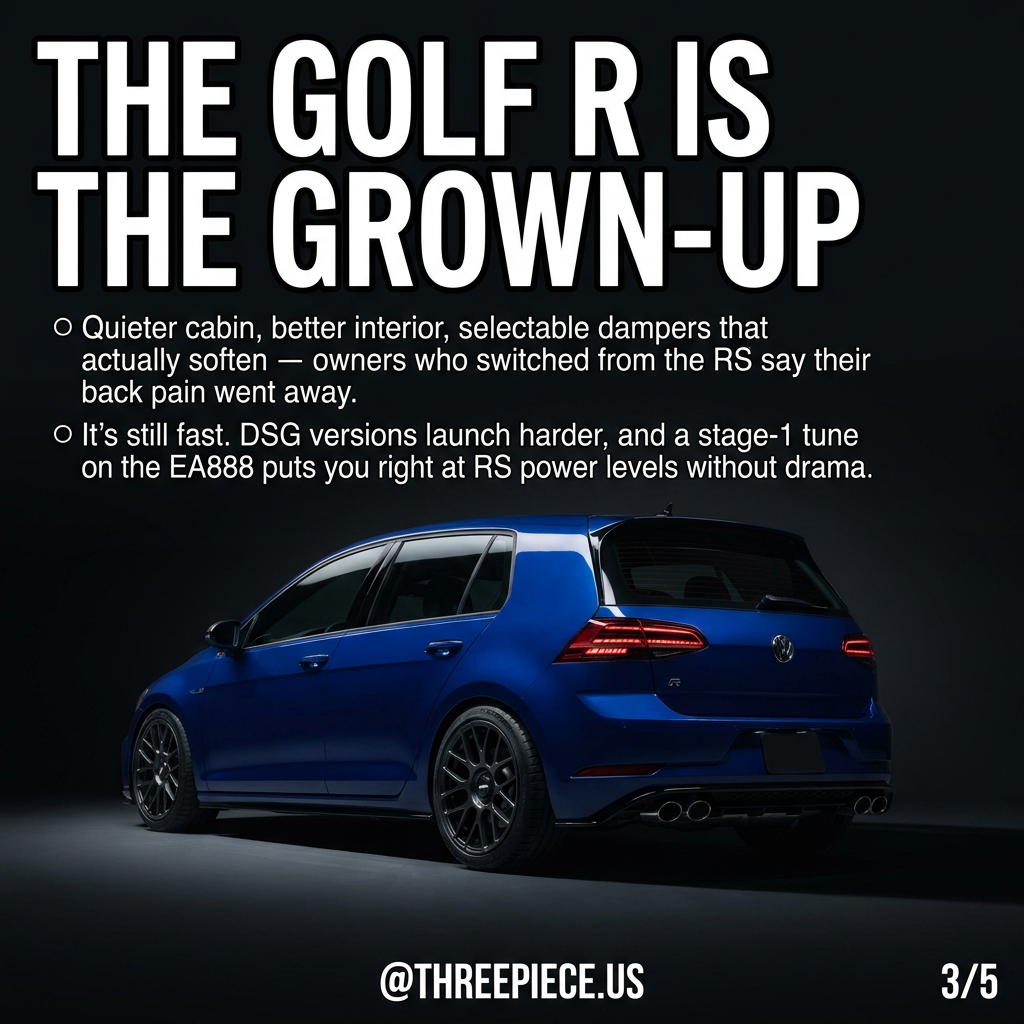
The Mk7/Mk7.5 Golf R makes 292-328 hp depending on year and market, running the EA888 Gen3 2.0T platform that VW has refined across millions of units. It's not as powerful as the RS in stock form, but the DSG transmission launches harder than any manual can, and a simple stage-1 software tune puts you right at RS power levels — 330-350 hp — without any hardware changes. That's a significant advantage for anyone who wants the speed without the drama.
The Golf R's real strength is that it disappears into traffic. The cabin is quieter, the materials are better, the selectable dampers actually soften the ride, and the rear seats are genuinely usable. Your neighbors won't know what it is. Owners who've lived with both cars consistently say the Golf R is the one you keep longer because it doesn't punish you for choosing it as a daily. The Mk7 GTI fitment guide we published covers the same 5x112 bolt pattern and most of the same sizing considerations apply to the R — the platform is nearly identical from the hubs out.
Tuning and Mod Ceiling Compared
Both platforms respond well to bolt-ons and software, but the ceilings are different and the weak points show up at different stages.
The Focus RS EcoBoost starts running out of stock turbo capacity around 380-400 crank hp on pump gas. The reliable mod ceiling before you need forged internals or risk drivetrain wear is generally considered ~400 WHP / ~425 lb-ft. Common bolt-on path: downpipe, intake, intercooler upgrade, and a proper tune. Supporting mods like upgraded fuel delivery and oil catch cans are considered essential, not optional. Our Focus RS Mk3 build guide covers the exact mod order and what to address before you start bolting things on — read that before you spend anything.
The Golf R EA888 is arguably the more accessible tuning platform because of the massive aftermarket ecosystem. Stage-1 software gets you 330-350 hp with zero hardware. Stage-2 with a downpipe pushes further. But the stock clutch — whether DSG or manual — is the limiting factor. DSG units start slipping beyond stage-1 torque levels, and manual clutches are even weaker. Budget for a clutch upgrade if you're going beyond software. If you're curious about how the EA888 compares to other tuner platforms, the Veloster N build guide covers a similar "turbo four with AWD potential" philosophy at a lower price point.
What Actually Breaks on Each Car
This is where the decision gets real. Both cars have documented, well-known failure modes that will cost you money if you ignore them.
Focus RS critical issues:
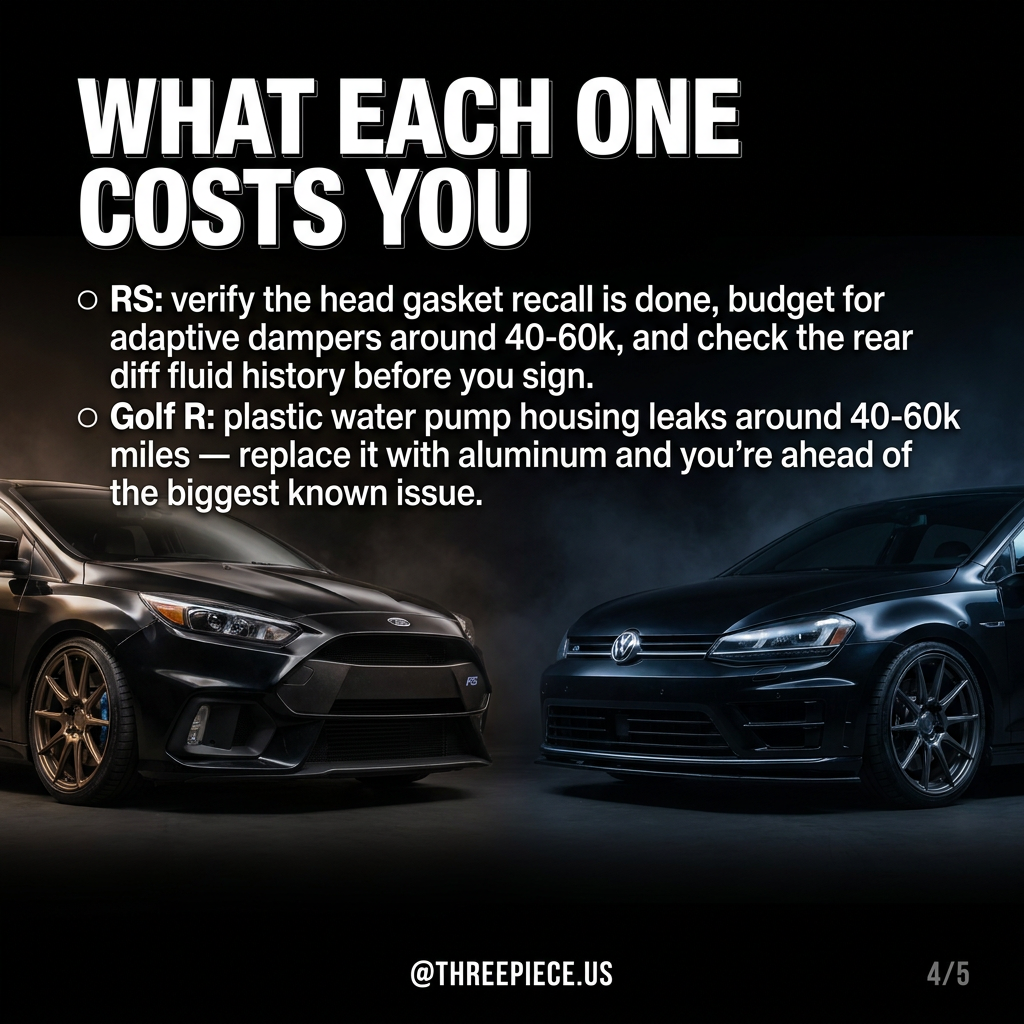
- Head gasket failure — cars built between August 2015 and July 2017 are most affected. Symptoms include random misfires (often P0303), coolant/oil mixing, and warped heads. Ford issued a recall; verify it's been completed before you buy.
- Cracked block (V4 vs V5 engine revision) — earlier "V4" engines are prone to cracked blocks. Check for a riveted starter casing (V4, bad) vs. hex plug (V5, better). This is a pre-purchase inspection item, not something you discover later.
- Motor mounts start failing around 60-70k miles.
- Timing chain and oil pump tensioner — skipping teeth, limp mode, cam timing retard codes. These show up at surprisingly low mileage.
- Various small leaks: timing cover gasket, valve cover, PCV system. Individually minor, collectively expensive.
Golf R critical issues:
- Plastic water pump and thermostat housing — leaks and warps between 40-60k miles. This is the single most common failure. Replace with an aluminum housing proactively and you're ahead of the biggest known problem.
- Carbon buildup on intake valves — GDI engines don't wash the valves with fuel. Symptoms: rough idle, misfires, reduced power. Walnut blasting every 40-50k miles is the accepted solution.
- DSG / Haldex / bevel box maintenance — if the fluid changes are neglected, rough shifting and delayed engagement follow. The rear diff bevel box can leak or fail under load, especially on tuned cars.
- Electronics gremlins: infotainment freezes, battery drain, minor cosmetic failures. Annoying, not catastrophic.
The RS has more catastrophic potential failures (cracked block, head gasket). The Golf R's issues are more predictable and preventable with proactive maintenance. That distinction matters if you're buying used — and both of these cars are now firmly in the used market. For a deeper look at how common failures stack up on other platforms, our breakdown of Genesis G70 common failures uses the same failure-mode analysis approach.
Wheel and Tire Fitment for Both Platforms
These two cars run completely different bolt patterns, so wheel shopping is platform-specific from the start.
The Focus RS runs 5x10⁸ with a 63.3mm hub bore. Factory size is 19x8 ET55, which is conservative. Most RS owners drop to 18x8.5 with an offset around +40 to +45 for a better stance without rubbing, paired with 245/40R18 tires. The 18" drop also opens up better tire options and reduces unsprung weight. Browse Vision Street-Designs 349 Savage 5x10⁸ 17x8+40 Satin Black to see what's currently available for the RS platform. If you want a lightweight option that actually saves rotational mass, read our Enkei RPF1 vs Konig Hypergram comparison — both are popular choices on this platform.
The Golf R runs 5x112 with a 57.1mm hub bore. Factory Mk7 R size is 19x8 ET50. The sweet spot for aftermarket is 18x8.5 +42 to +45, which fills the fenders properly without aggressive camber. Pair with 245/40R18 for a near-perfect setup. Our updated VW GTI 5x112 fitment guide covers the same platform dimensions. Browse Vision Street-Designs 349 Savage 5x10⁸ 17x8+40 Satin Black for the Golf R.
For either platform, the Work Emotion series offers some of the best lightweight flow-formed options in these sizes. The Work Emotion CR Kiwami starting at $270 is a strong choice for a street/track setup — it's light, it clears most brake packages, and the concave face looks right on both of these cars. For a 2-piece option with more depth, the Work Emotion T7R 2P at $531 gives you a genuine multi-piece wheel with custom width and offset options. Check our vehicle gallery for real-world examples of these fitments on similar platforms.
Suspension Upgrades That Actually Matter
Both cars benefit enormously from proper coilovers, but for different reasons.
The Focus RS desperately needs a suspension that can actually be tuned for comfort when you want it. The factory setup is one-note harsh. The Fortune Auto 500 Series Coilovers for the 2016+ Focus RS at $1,799 include front endlinks and separate-style rears — they give you adjustable damping that the factory suspension simply doesn't offer at a reasonable price point. If you want even more track capability with higher-spec valving, the Fortune Auto 510 Series for the Focus RS at $2,399 is the step up.
The Golf R already has decent damping, but coilovers let you dial in ride height without the compromises of lowering springs on stock struts. The Fortune Auto 500 Series for the Mk7 Golf GTI/R at $1,799 fits the R platform and gives you proper height and damping adjustment. The Fortune Auto 510 Series for the Mk7 at $2,399 is the track-focused option. Both are a massive improvement over the factory adaptive dampers for anyone who's actually tracking the car or wants precise ride height control. If you're on a tighter budget and running a Mk6 platform, the Function & Form Type 1 kit for the Mk6 GTI at $882 is a solid entry point.
The Real Answer
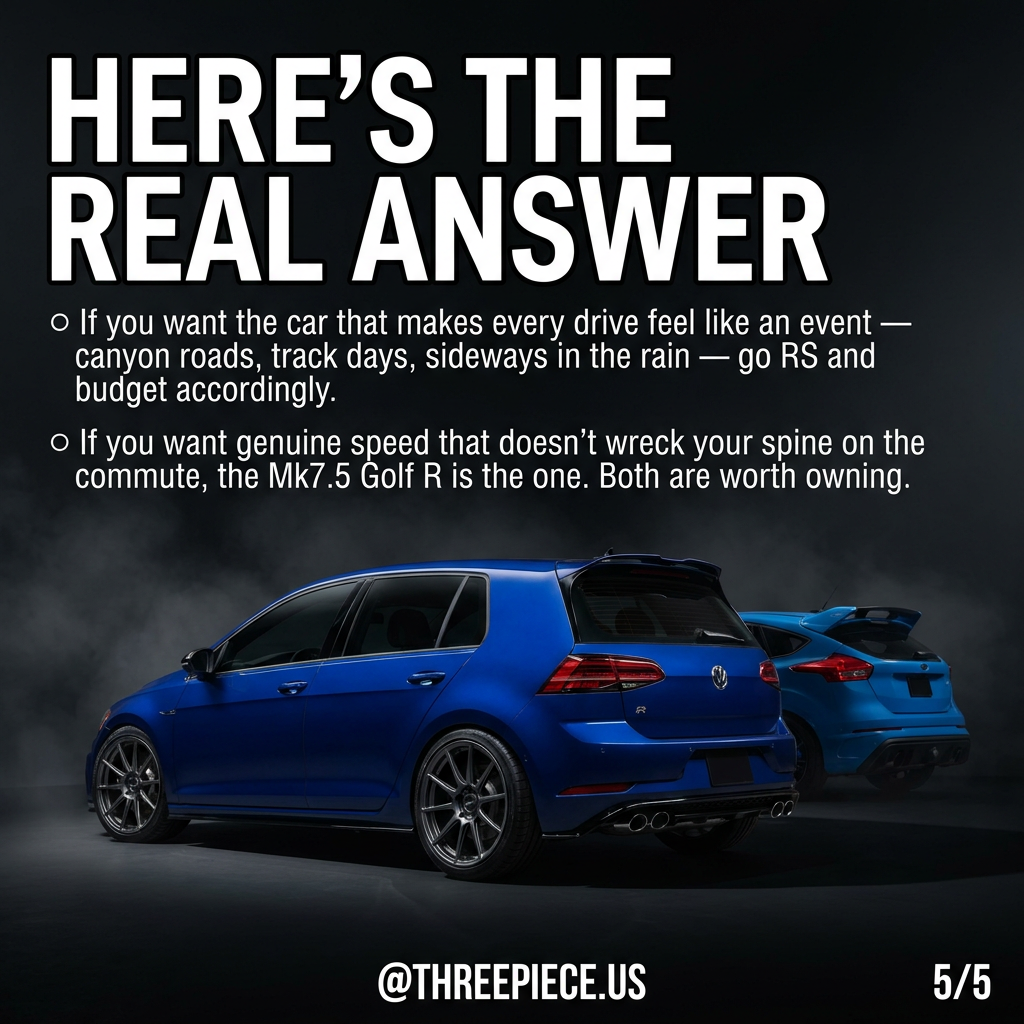
Here's the honest take: the Focus RS is the more special car. Ford discontinued it with no successor, and values have been climbing steadily because of that. It's raw, it rewards driver skill, and the torque-vectoring rear diff is a genuinely unique piece of engineering in this segment. But it demands that you accept its compromises — the harsh ride, the cramped Recaros, the more serious potential failure modes. You're buying a car that was engineered by people who clearly didn't care about comfort, and that's either exactly what you want or a deal-breaker.
The Golf R is the smarter purchase for most people. It does 90% of what the RS does in terms of straight-line speed, it's dramatically more comfortable, a stage-1 tune closes the power gap entirely, and VW keeps making new ones — which means parts availability and aftermarket support will only get better. The Mk7.5 specifically is the sweet spot: refined enough to daily without complaint, old enough to be affordable, and the EA888 platform is one of the most well-understood engines in the tuning world.
If you want the car that makes every canyon run feel like an event — go RS and budget for the head gasket check, motor mounts, and proper suspension. If you want genuine speed that doesn't wreck your body on the commute, the Mk7.5 Golf R with a set of proper wheels and coilovers is the move. Both are worth owning. Neither is the wrong answer — as long as you know what you're signing up for.
Which one are you taking — and what's the first mod you're doing to it?