

Ford Focus RS Mk3 Build Guide: 2.3L EcoBoost Mod Order
The 2016-2018 Ford Focus RS Mk3 is one of the most modification-responsive platforms you can buy right now. The 2.3L EcoBoost four-cylinder responds to basic bolt-ons harder than almost anything in its class — owners are documenting 50+ whp and 70-80 wtq over stock with just a tune, intercooler, and charge pipes. That's a massive jump before you even touch the turbo. But mod order matters here more than on most platforms. Get the sequence wrong and you're chasing heat soak, head gasket issues, and wasted money. Here's the build path that actually works, pulled from real owner threads on FocusRS.org and documented dyno results.

Quick links
- Tune First, Cool Second
- Intercooler and Charge Pipes
- Suspension That Actually Works
- Why 18x9.5 Is the Fitment Sweet Spot
- Clutch and Drivetrain Upgrades
- Exhaust, Fueling, and Beyond
- Known Issues to Budget For
- Where This Platform Actually Sits
Tune First, Cool Second
Start with an ECU flash on 93 octane. Cobb, Mountune, or Livernois Stage 1 gets you 15-25 whp immediately and transforms the throttle response. The stock calibration is conservative enough that even a basic flash changes the character of the car. If you're curious about what Stage 1 and Stage 2 tunes actually deliver on a dyno, the gains on the EcoBoost platform track closely with what we've documented across other turbo fours.
But here's the catch — the stock intercooler heat-soaks fast, especially in warm weather. Owners report charge air temps dropping from 30°F over ambient to 10-15°F over ambient after swapping to an aftermarket front-mount intercooler. That's your second move: tune first, then intercooler and charge pipes. The tune unlocks the potential; the cooling hardware lets you keep it through consecutive pulls instead of watching the car fall on its face after the second run.
Intercooler and Charge Pipes
Once you've flashed the ECU, the intercooler and charge pipe upgrade is the single biggest supporting mod you can do. ETS and Mountune FMICs are the most common choices in documented builds. One owner with a tune, drop-in filter, and ETS FMIC saw roughly +70 whp and +70 wtq over stock. Another hit +51 hp and +82 ft-lbs on California 91 octane with a Mountune calibration and FMIC package. Those are real, repeatable numbers from forum dyno sheets — not marketing claims.
Charge pipes matter here because the stock plastic pieces are a known weak point under boost. Upgraded aluminum charge pipes prevent boost leaks and handle the higher pressures from a tuned map. The cold air intake question comes up constantly on this platform — the short answer is that a drop-in filter is fine for Stage 1, but a full intake becomes more relevant once you're pushing past the stock turbo's limits. Prioritize the intercooler and pipes first.
The AWE Tuning Focus RS SwitchPath Cat-back Exhaust at $2,776 is worth mentioning here — it pairs well with the intercooler and charge pipe stage because it reduces backpressure without being obnoxiously loud on the daily. The SwitchPath system gives you a quiet mode that actually works, which matters if you're building a car you also commute in.
Suspension That Actually Works
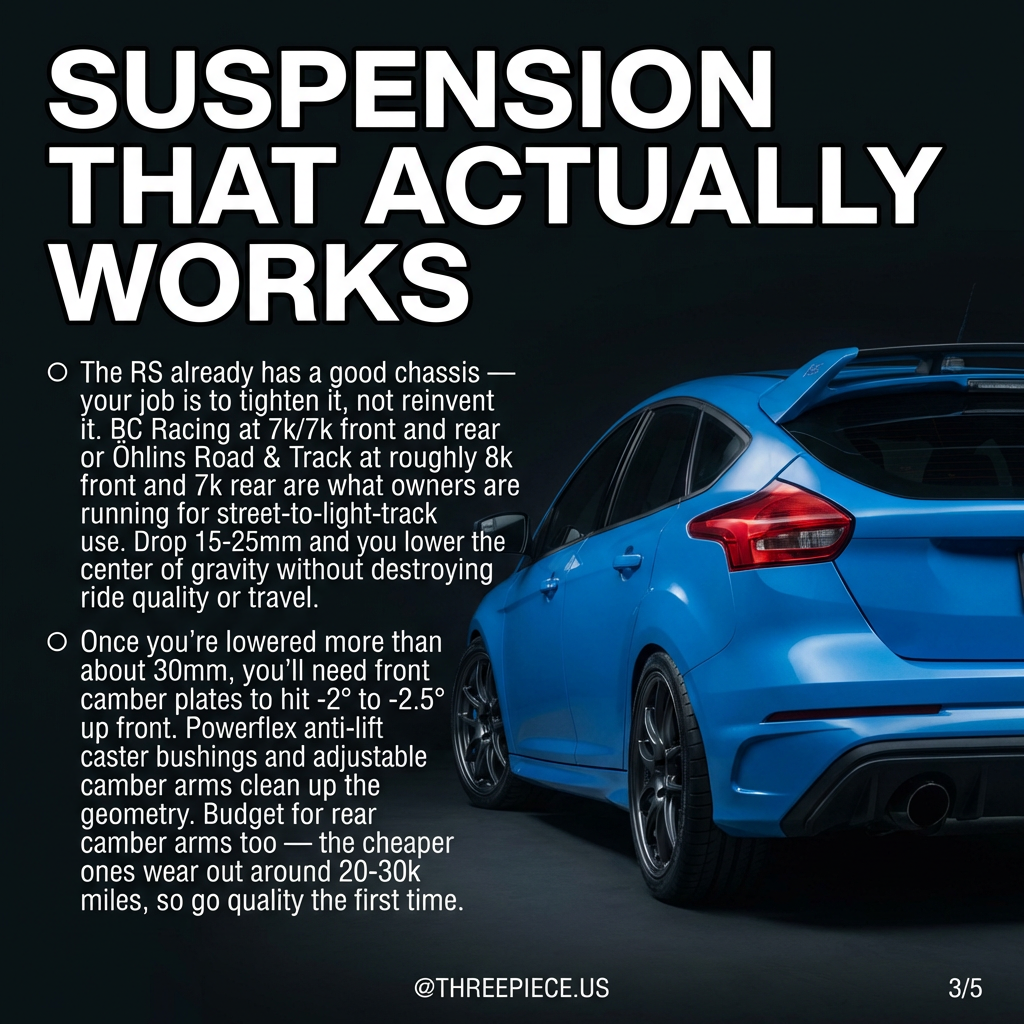
The RS already has a good chassis — your job is to tighten it, not reinvent it. BC Racing at 7k/7k front and rear or Öhlins Road & Track at roughly 8k front and 7k rear are what owners are running for street-to-light-track use. Drop 15-25mm and you lower the center of gravity without destroying ride quality or travel. If you're weighing whether coilovers make sense on a car you also daily, we covered that decision in depth in our coilover daily driver guide. The RS is one of the platforms where the answer is definitively yes — the stock dampers are tuned for a compromise that coilovers let you move past.
Once you're lowered more than about 30mm, you'll need front camber plates to hit -2° to -2.5° up front. Powerflex anti-lift caster bushings and adjustable camber arms clean up the geometry. Budget for rear camber arms too — the cheaper ones wear out around 20-30k miles, so go quality the first time. The 586whp build thread on FocusRS.org ran Powerflex adjustable front camber bushes, Powerflex anti-lift caster bushes, massive rear camber arms, and Whiteline front and rear sway bars with Steeda end links. That's the proven combination for a car that tracks well without being miserable on the street. Our guide on common coilover mistakes applies directly here — don't cheap out on spring rates or skip the alignment arms.
Why 18x9.5 Is the Fitment Sweet Spot
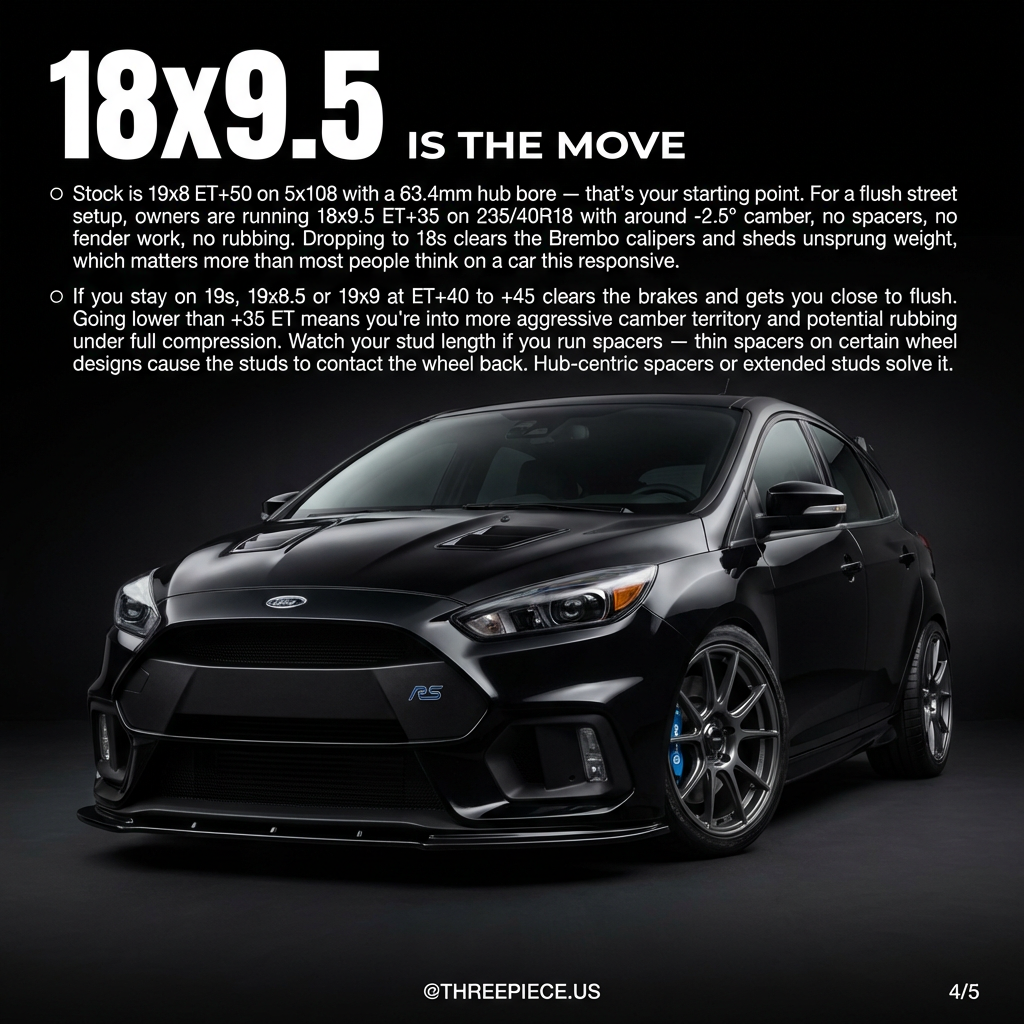
Stock is 19x8 ET+50 on 5x10⁸ with a 63.4mm hub bore — that's your starting point. For a flush street setup, owners are running 18x9.5 ET+35 on 235/40R18 with around -2.5° camber, no spacers, no fender work, no rubbing. Dropping to 18s clears the Brembo calipers and sheds unsprung weight, which matters more than most people think on a car this responsive. If you want to understand Focus RS fitment in full detail, we have a dedicated resource on that.
Browse Enkei NT03+M 5x10⁸ 18x9.5+40 Gunmetal to see what fits this platform. For tires, the American Roadstar Sport AS 235/40R18 at $319 for a set of four is a solid daily option that won't break the bank. If you want a dedicated performance tire, search 235/40R18 tires for the full selection.
If you stay on 19s, 19x8.5 or 19x9 at ET+40 to +45 clears the brakes and gets you close to flush. Going lower than +35 ET means you're into more aggressive camber territory and potential rubbing under full compression. Watch your stud length if you run spacers — thin spacers on certain wheel designs cause the studs to contact the wheel back. Hub-centric spacers or extended studs solve it. Check our hubcentric rings if you're running aftermarket wheels that don't match the 63.4mm hub bore — eliminating vibration is non-negotiable on a car that does highway miles.
Clutch and Drivetrain Upgrades
The stock clutch on the Focus RS starts slipping around 350-380 wtq — which means if you've done the tune, intercooler, and charge pipes, you're already at the limit. This is the mod that people skip because it's expensive and invisible, and then they wonder why the car feels sluggish under boost. The ACT XT/Race Sprung 6 Pad Clutch Kit at $1,689 is purpose-built for the Focus RS and ST platform and handles the torque levels that a full bolt-on car produces. Pair it with the ACT XACT Streetlite Flywheel at $713 for faster revs and better pedal feel.
The 586whp build thread ran a competition twin-disc clutch, a Steeda clutch spring, and a Quaife LSD in the front box. At that power level, the transmission itself needs a full build — carbon synchros, stainless bearings, heat-treated gears. But for a 340-400 whp street car, the ACT clutch kit with the factory transmission is the proven combination. Supporting pieces like a Coolerworx carbon shifter shaft and solid shifter bracket bushings make the shift feel dramatically better and are cheap relative to the clutch.
Exhaust, Fueling, and Beyond
A catless downpipe and cat-back system are the next steps after the core bolt-on package. The AWE Tuning Ford Focus RS SwitchPath Cat-back Exhaust - Chrome Silver Tips - 3025-32024 is the premium choice for the RS specifically, but there are cheaper options if you're budget-conscious. The exhaust itself doesn't add huge power on this platform — maybe 10-15 whp with a downpipe and tune revision — but it reduces backpressure and opens up the top end.
Where things get serious is fueling. Once you're past the stock turbo's efficiency range (roughly 380-400 whp), you're looking at XDi injectors (1000-2000cc), an upgraded high-pressure fuel pump, and E30-E50 ethanol blends. The 586whp build on FocusRS.org ran an XDi EVO HPFP, XDi2000 injectors, and tuned on E70 with four map slots. The 725whp build used a 2.5L stroker, Precision 6266 turbo, and auxiliary fuel with a Radium surge tank. Those are $30,000+ builds. For most owners, the sweet spot is the bolt-on package with a proper tune — you're making 340-370 whp through an AWD system that actually puts it down, and the car is still completely streetable.
For builds in the VW/Audi turbo four space that share a similar mod philosophy, our Golf R Mk7 buying guide covers the platform that's most directly comparable to the RS in terms of price point and power potential.
Known Issues to Budget For
The Focus RS has a well-documented head gasket issue on cars built between August 2015 and July 2017. Ford issued a recall (FSA) for affected vehicles — if you're buying one, verify that the recall was completed properly. Symptoms include misfires (especially random misfire codes like P0303), oil/coolant mixing, and warped heads. This is not a rare problem. It's the single most important pre-purchase check on this platform.
Beyond the head gasket, watch for:
- Motor mounts — factory mounts wear out around 60-70k miles. Budget for replacements.
- Timing chain/oil pump tensioner — some owners have reported chain skipping teeth due to oil pump tensioner issues, even at low mileage. Symptoms: cam timing retard codes, limp mode, metallic noises.
- Purge valve failures — common and cheap to fix, but annoying.
- Timing cover gasket leaks — where the timing cover meets the head gasket surface.
None of these are platform-ending issues, but they're things you need to inspect before buying and budget for during ownership. The RS rewards proactive maintenance. If you're coming from another AWD turbo platform like the Subaru WRX STI or GD STI, the Focus RS maintenance schedule is honestly easier to manage than the EJ257's ringland and rod bearing concerns.
Where This Platform Actually Sits
A tuned Focus RS with an FMIC, charge pipes, proper suspension, and 18x9.5 wheels is genuinely one of the best street performance cars you can build for the money. You're making 340+ whp through an AWD system that actually puts it down, on a chassis that was already sorted from the factory. The Mazdaspeed 3 is the budget alternative, the FK8 Civic Type R is the FWD competitor, and the Golf R Mk7 is the closest cross-shop — but the RS has the most aggressive AWD system of the group and the most headroom for power modifications.
Check the head gasket recall, budget for motor mounts if it's over 60k, and build it in the right order: tune, intercooler, charge pipes, suspension, wheels, clutch, exhaust. Browse our vehicle gallery for build inspiration, and explore wheels and suspension to start your Focus RS build the right way.