

Multi-Plate LSD Wear: Shim Stack, Clutch Packs & Rebuild Guide
Your multi-plate limited slip differential is wearing out right now — and the first thing to go isn't the gears. It's the clutch pack preload. By the time you feel chatter in a parking-lot turn or notice one tire spinning easier on corner exit, the friction plates are already glazed, the Belleville washers have fatigued, and the shim stack that controls your initial torque bias has effectively lost its job. This is the most misunderstood failure mode on platforms like the Honda S2000 and Mitsubishi Evo, and most owners don't learn about it until a shop hands them a four-figure rebuild quote.

Quick links
- It's Not the Gears First — It's the Clutch Pack
- What the Shim Stack Actually Controls
- The Symptoms You're Ignoring
- S2000 LSD: The Hybrid Design Nobody Explains
- Evo LSD: The Factory Plate-Stacking Controversy
- Rebuild Timing: Schedule vs. Symptoms
- Wheels and Tires That Accelerate (or Protect) LSD Wear
- The Bottom Line
It's Not the Gears First — It's the Clutch Pack
A clutch-type LSD uses alternating friction plates and steel plates sandwiched inside the differential housing. Some plates are keyed to the side gears, others to the case itself. Under a torque difference — one wheel losing grip — springs or Belleville washers press the stack together, resisting differential action and transferring torque to the wheel with traction. That's the entire mechanism. No electronics, no viscous fluid, just metal-on-metal friction controlled by clamping force.
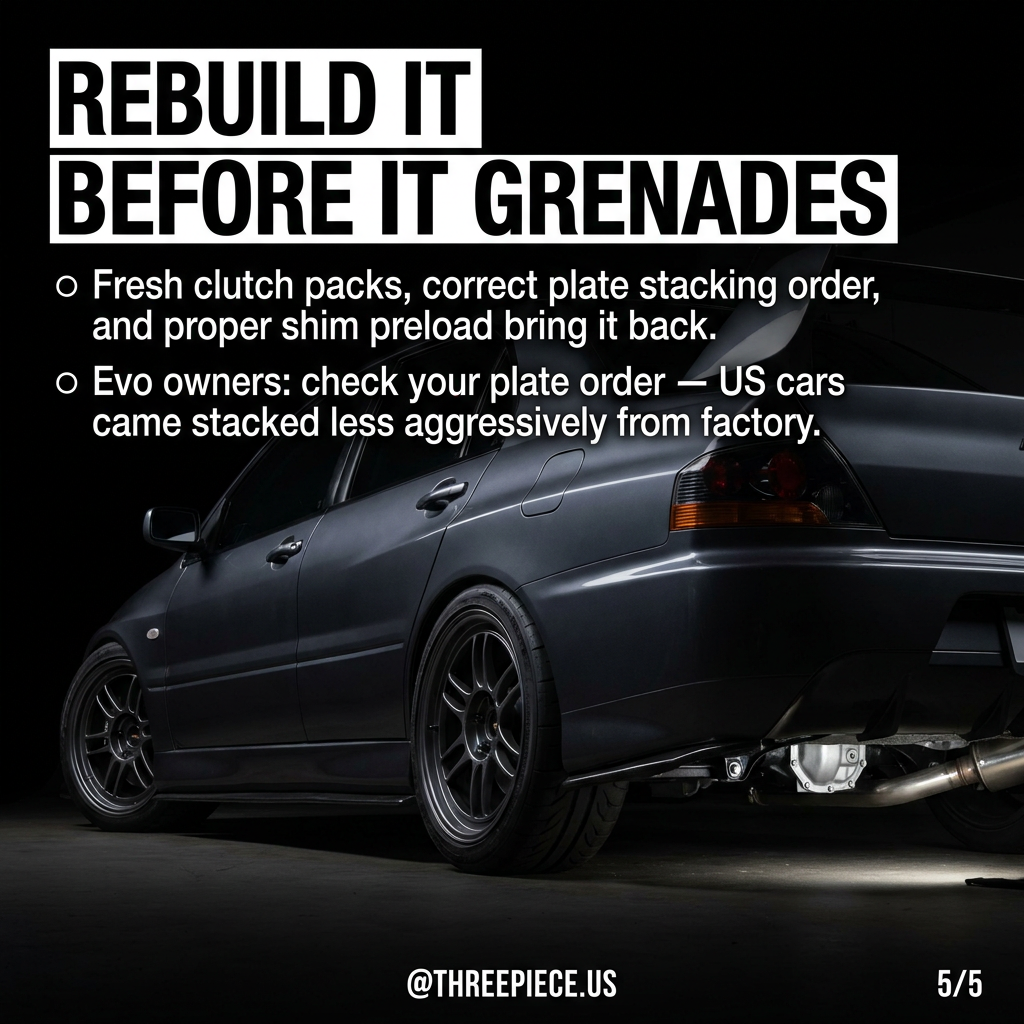
The failure sequence is predictable: friction plates glaze and thin over thousands of heat cycles, springs fatigue, and the static preload — the clamping force applied when the car is just driving straight — drops. Once static preload fades, the diff behaves like an open differential under light throttle. You still get some locking under hard acceleration because the gear geometry generates its own clamping force, but the progressive, confidence-inspiring initial bite is gone. If you've ever driven an S2000 that felt "loose" on corner exit compared to a fresh example, this is almost certainly why. For anyone building an S2000 on a budget, our S2000 build guide covers the mods that actually matter before you touch the diff.

What the Shim Stack Actually Controls
The shim stack is the most misunderstood component inside a clutch-type LSD. Here's what it does in plain terms:
Shims behind the clutch springs or preload spacer set how much force the Belleville washers or coil springs apply to the clutch pack at rest. Thicker shims mean more static preload, which means more initial torque transfer before any wheel-speed difference even occurs. This is what gives a properly set-up LSD that "tied together" feeling where both rear wheels pull as a unit on corner exit. Too thin, and the diff feels open at part-throttle. Too thick, and you overload the carrier bearings and housing — on an S2000, that side-thrust goes directly into the aluminum case, which is already the weak link.
There's a second type of shim that's equally critical: bearing-cap shims on the gear side and non-gear side. These set ring-and-pinion backlash — the tiny gap between the meshing teeth. Evo owners rebuilding rear diffs measure this with a dial indicator, targeting 0.008–0.010 inches of backlash using shim thicknesses around 0.101–0.110 inches. Get it wrong and you get binding under load or accelerated gear-tooth wear. This is the kind of precision work that separates a rebuild that lasts 60,000 miles from one that lasts 6,000. Understanding how tolerances and centering work in your wheel setup is the same philosophy — small measurements, big consequences.
The Symptoms You're Ignoring
Most owners attribute early LSD wear symptoms to something else — tire pressure, alignment, or "just how the car drives now." Here's what to actually listen for:
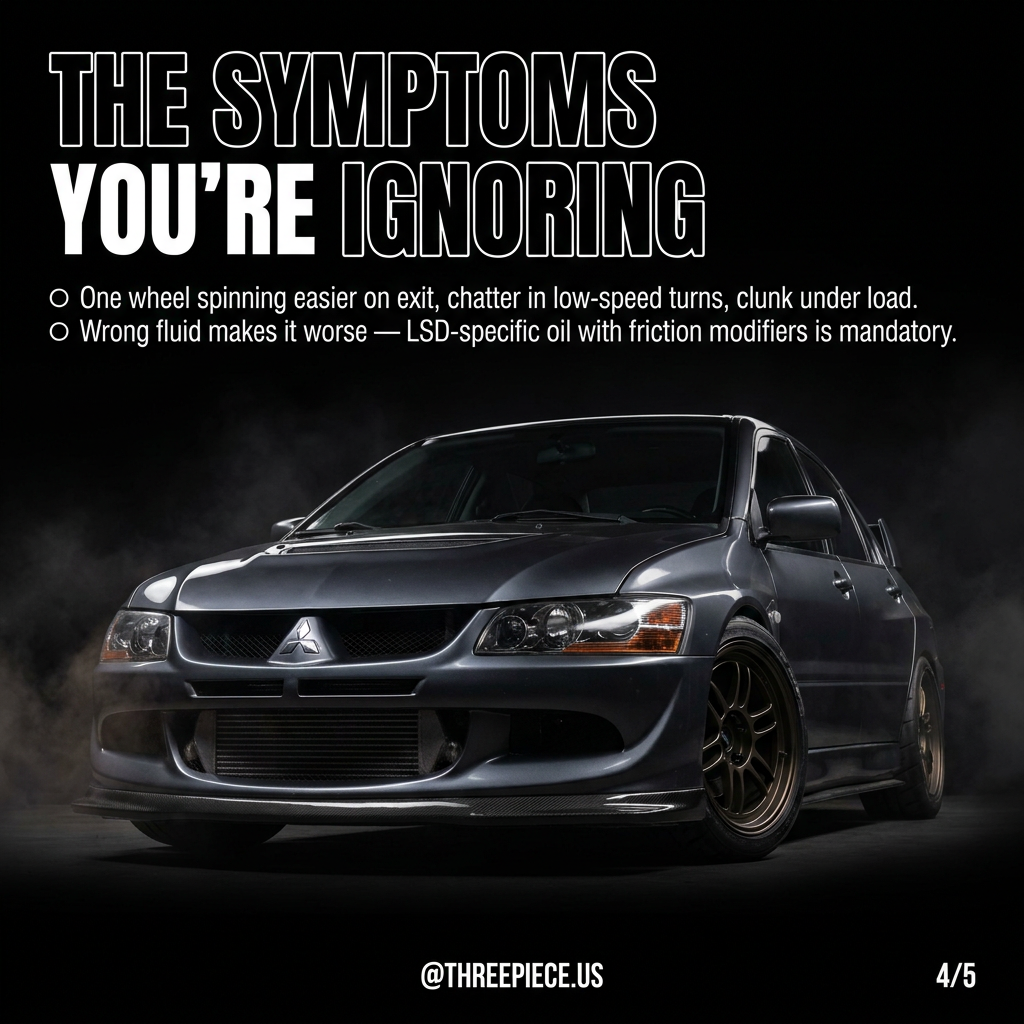
- One wheel spinning easier on corner exit — this is the clearest sign of lost preload. The diff isn't transferring torque to the loaded wheel early enough.
- Chatter in low-speed turns — especially in parking lots. The clutch plates are grabbing and releasing unevenly because they're glazed or the plate stacking order is wrong.
- Clunk under load transitions — on/off throttle clunking that wasn't there at lower mileage often points to excessive backlash from worn shims or bearing caps.
- Metal particles in diff fluid — if you drain your diff oil and see glitter, the damage is already progressing. On S2000s, this often precedes crown-wheel and pinion failures that crack the aluminum bearing caps.
Wrong fluid makes every one of these symptoms worse. A multi-plate clutch LSD requires LSD-specific gear oil with friction modifiers. Running standard GL-5 without the LSD additive creates harsher engagement, more chatter, and faster plate glazing. This is the cheapest "mod" you can do — and the one most people skip. For more on maintenance items that get overlooked, our brake pad problems article covers similar friction-material misconceptions.
S2000 LSD: The Hybrid Design Nobody Explains
Honda's S2000 differential isn't a simple clutch-type LSD. It's a multi-plate clutch combined with helical-type planetary gears — a hybrid torque-sensing design that Honda documented in the original service manual but almost nobody reads. The helical gear paths generate their own clamping force proportional to torque input, while the clutch pack provides the initial static preload via springs. It's a clever system that works beautifully when fresh and degrades subtly enough that most owners never notice until it's too late.
The specific failure mode on S2000s that forums have documented extensively: the helical/hypoid gear geometry creates side thrust under hard acceleration. That thrust pushes against the side adjuster screw, which bears directly into the aluminum differential housing. Over time — especially with sticky tires and aggressive launches — the bearing caps crack and the bolt flanges fail. Once metal shavings enter the oil, the cascade is underway. Clicking in tight turns that develops after track sessions is the classic early warning.
The S2000's 5x114.3 bolt pattern means you have a massive selection of wheel options. If you're running this car on track and accelerating LSD wear, at least make sure the wheel and tire setup is optimized. Browse 17-inch wheels in 5x114.3 for a track-focused setup, or step up to 18-inch options for street builds. The Work Emotion lineup is a natural fit for AP1 and AP2 builds — lightweight, strong, and available in the right offsets.
Evo LSD: The Factory Plate-Stacking Controversy
This is where it gets interesting. Multiple Evo owners on forums and Reddit have documented what appears to be an intentional factory decision: US-market Evo 8 and 9 rear LSDs came with clutch plates stacked less aggressively than JDM counterparts. The claim — repeated across the MitsubishiEvolution subreddit and DSMtuners — is that Mitsubishi "stacked a couple wrong in there" to reduce rear-end oversteer tendencies for the American market, making the LSD less chatty but also less effective.
Whether this was a deliberate detuning or a manufacturing variance, the fix is the same: pull the diff, inspect the plate order, and restack with correct alternating clutch-steel-clutch-steel sequence. Owners who've done this report noticeably more aggressive rear locking behavior and, predictably, more oversteer on throttle. If you're building a 4G63 Evo, this is essentially a free power delivery upgrade during any rebuild. Our Eclipse GSX buyer's guide and 2G Eclipse GSX build guide cover the same 4G63 drivetrain family and many of the same differential concerns apply.
For Evo rear diffs, the 5x114.3 bolt pattern again opens up the full JDM wheel catalog. A properly rebuilt rear LSD paired with the right wheel width and offset transforms corner-exit behavior. Check out 18x9.5 wheels in 5x114.3 for a setup that fills the Evo's rear fenders without excessive poke. Pair them with 265/35R18 tires for the grip that actually justifies a fresh LSD rebuild.
Rebuild Timing: Schedule vs. Symptoms
The enthusiast community is genuinely split on this. One camp pulls the diff every 30,000 miles, measures shim-stack preload with a torque wrench, and swaps clutch plates before any symptom appears. The other camp argues that if it's still locking under power and you're not getting one-tire-fires out of corners, leave it alone.
Here's the reality: both approaches work, but for different use cases. If you're tracking the car regularly — especially an S2000 on 200-treadwear tires generating serious mechanical grip — the side-thrust loads on the differential housing are significant enough that preventive rebuilds make financial sense. Catching a worn crush collar before it cracks a bearing cap saves you the cost of a new housing. If you're street-only with occasional spirited driving, symptom-based rebuilds are fine, but change your diff fluid every 15,000–20,000 miles with proper LSD-rated oil and actually inspect what comes out.
For tracked cars, the wheel and tire combination directly affects how hard you're working the LSD. Stickier rubber means more grip, which means more torque difference between wheels in corners, which means more clutch-pack engagement cycles per session. Understanding UTQG tire ratings helps you choose a treadwear that matches your rebuild interval tolerance. If you're running a chassis stiffening setup, that's even more load transferred through the diff.

Wheels and Tires That Accelerate (or Protect) LSD Wear
This isn't something most people think about, but your wheel and tire setup has a direct relationship with LSD longevity. Heavier wheels increase rotational inertia, which means more stress on the clutch pack during rapid speed changes. Wider tires with lower treadwear ratings generate more grip, which increases the torque differential between inside and outside wheels in corners — more work for the LSD on every single turn.
That doesn't mean you should run skinny tires to save your diff. It means you should factor LSD maintenance into your build plan the same way you factor in brake pads and fluid. If you're stepping up to 18x9.5 +38 with 265/35R18 semi-slicks, budget for diff fluid changes twice as often and a clutch-pack inspection every 20,000 miles.
For S2000 owners looking at lightweight forged options, the Work Wheels catalog has some of the best weight-to-strength ratios in the game. The Emotion CR 2P is a track favorite for a reason. Finish the build with proper Work center caps and 90-degree valve stems at $3.80 each for easy pressure checks between sessions. If you're exploring whether forged construction is worth the investment for a car you're also maintaining at the differential level, our TE37 replica vs. real comparison breaks down exactly where the money goes.
Evo owners running aggressive fitment can browse the Work VS series for deep-lip 3-piece options that clear Brembo calipers. Pair them with hubcentric rings to eliminate any vibration that could mask differential noise during diagnosis. And for builds where you're refreshing lips or barrels during a wheel refinish, Work reverse lips and Work step barrels start at $399 — a fraction of what a neglected diff rebuild costs.
The Bottom Line
Your multi-plate LSD is a wear item, not a lifetime component. The shim stack and clutch pack are doing the real work inside that housing, and they degrade so gradually that most owners adapt to the loss without realizing it. By the time you feel chatter or see one-tire-fires, you're already driving what is functionally an open differential with extra steps.
If you own an S2000, understand that the aluminum housing and crush collar are the weak links — not the clutch plates themselves. If you own an Evo, pull the diff and check your plate stacking order before you spend money on anything else. And regardless of platform, run the correct LSD-rated gear oil and change it on schedule. This is the cheapest, highest-impact drivetrain maintenance you can do.
Check out our vehicle gallery for S2000 and Evo builds running proper wheel setups, and browse our full wheel catalog when you're ready to finish the exterior side of your build. The diff does its job underneath — make sure what's visible is just as sorted.
Are you on a preventive rebuild schedule or do you ride it out until the diff tells you it's finished? And what mileage did your LSD start showing symptoms?