2G Eclipse GSX Build Guide: AWD Turbo Mod Order
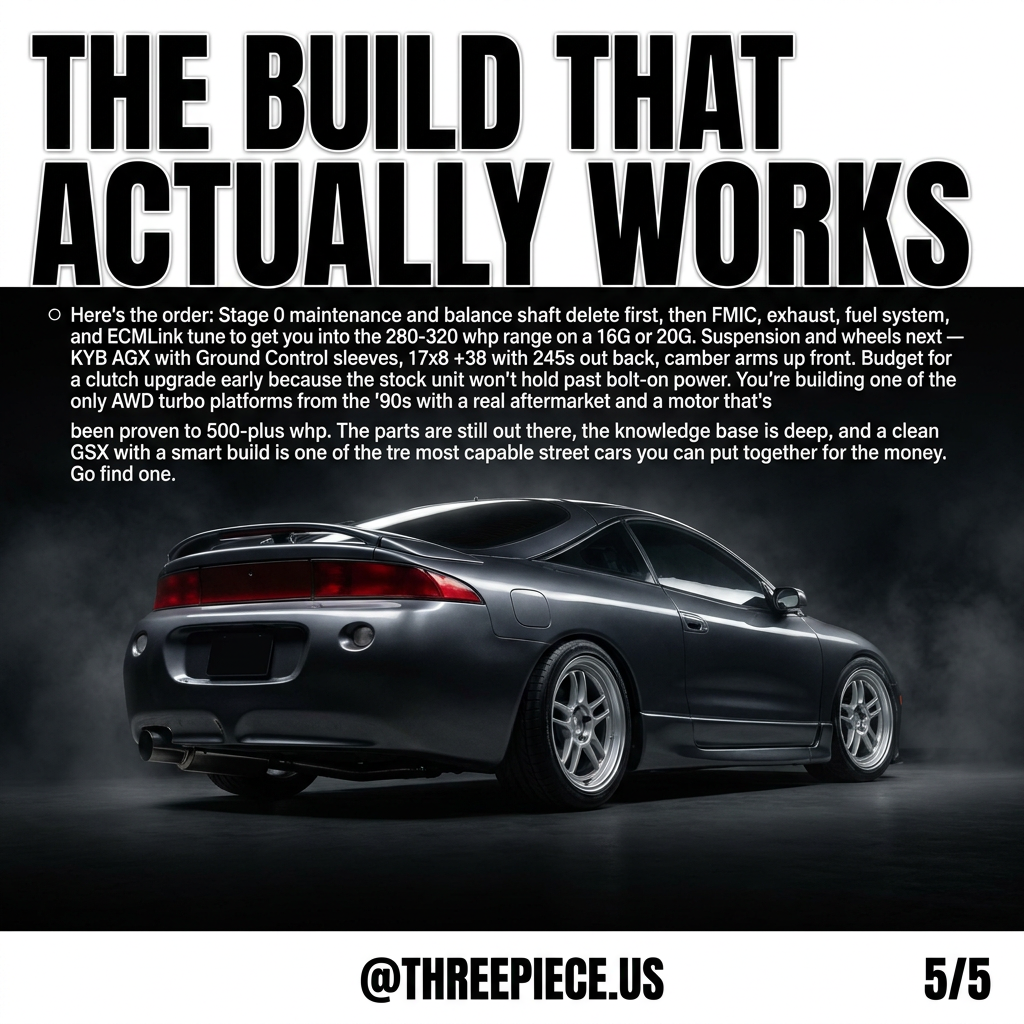
The 1995–1999 Mitsubishi Eclipse GSX is one of the most slept-on AWD turbo platforms from the '90s. A factory 4G63T bolted to a five-speed manual and a full-time all-wheel-drive system — all for under $25k new. Nothing else in that era offered the same combination at that price point. The 2G GSX makes 160–175 whp stock, but the 4G63 is arguably the most buildable four-cylinder ever produced, with documented owner builds pushing past 510 whp on 93 octane. Here's the build order that actually works, from Stage 0 maintenance to full turbo upgrade, with the wheel and suspension specs the DSM community has proven over two decades of forum threads and broken transfer cases.

Quick links
- Stage 0: The Maintenance That Saves Your Motor
- Street Power Roadmap: 260–510 WHP
- The AWD Drivetrain Ceiling
- GSX Wheel Fitment: 17x8 +38 Is the Setup
- Suspension: What the Community Actually Runs
- The Build Order That Actually Works
Stage 0: The Maintenance That Saves Your Motor
Every DSM forum veteran will tell you the same thing: do not touch a single bolt-on until Stage 0 is finished. The 2G GSX has specific failure points that will wreck your bottom end before you ever see a boost gauge move, and skipping this step to chase power is how most of these motors end up as paperweights.
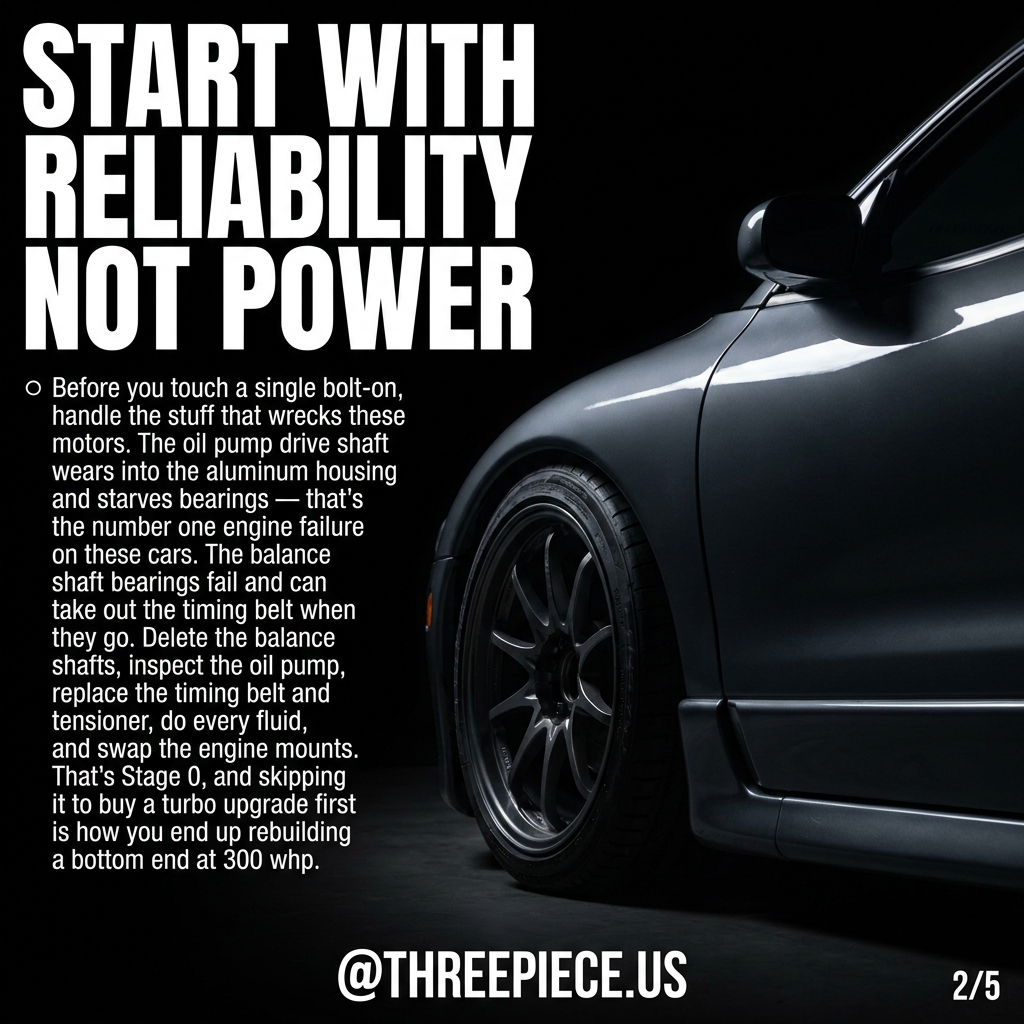
The oil pump drive shaft wears into the aluminum housing over time and starves the rod bearings of oil pressure. That's the number-one engine failure on these cars. The balance shaft bearings are the second — they fail and can take out the timing belt when they go, which bends valves on an interference motor. Every experienced 2G owner deletes the balance shafts entirely. Beyond that, you're replacing the timing belt and tensioner, doing every fluid, and swapping the engine mounts. Poly motor mounts from brands like Avid or Energy Suspension are the standard move — they reduce drivetrain slop and cost under $100. If you want to understand why an oil catch can matters on a turbocharged motor running PCV, that applies here too.
Stage 0 isn't exciting. It doesn't make more power. But it's the difference between a 4G63 that lives to see 400 whp and one that spins a bearing at 280.
Street Power Roadmap: 260–510 WHP
Once Stage 0 is handled, the 2G GSX responds to bolt-ons better than almost any turbo four-cylinder from its era. The first round of mods is straightforward: a front-mount intercooler, 3-inch turbo-back exhaust (downpipe through cat-back), a Walbro 255 lph fuel pump, 550cc injectors, and a proper tune through ECMLink V3. That combination gets you to 260–320 whp on the stock T25 turbo or a 16G/20G swap — no built internals required. If you're wondering whether that downpipe upgrade is actually worth it, on a 2G Eclipse the answer is an unqualified yes — the stock unit is extremely restrictive.
The fuel system becomes the wall around 400–450 whp. At that point, you're upgrading to 1050–1250cc injectors (FIC Blue Max is the community standard), a higher-flow fuel rail, and a proper fuel pressure regulator. The stock 7-bolt bottom end is the other ceiling. If you're chasing more than 350–400 whp reliably, you're into a 6-bolt block swap with forged rods (Eagle or MapPerformance billet steel), forged pistons (Wiseco at .020" over), ARP head studs, and a bigger turbo — a GT30R or PTE6262 in T3 configuration with a .82 AR turbine housing.
One documented owner build on DSMtuners hit ~510 whp on 93 octane pump gas with a PTE6262 on a fully built 2.3L stroker using a Manley forged crank, MapPerformance billet rods, FP4 cams, Supertech oversized valves with beehive springs, and FIC 1250cc injectors. That's the realistic ceiling for a street car on pump gas. Understanding how air-fuel ratio works becomes critical once you're tuning at these power levels — the 4G63 does not forgive lean conditions under boost.
For monitoring boost and oil pressure on the 2G, the Autometer 95-99 Eclipse Triple 52mm Pillar Pod at $143.48 is a direct-fit solution that holds three gauges without any custom fabrication — boost, oil pressure, and wideband are the standard trio for a DSM build.

The AWD Drivetrain Ceiling
The AWD system is what makes the GSX special — and it's also what breaks first once you're past 350 whp. The stock transfer case, rear differential, and axles were designed for a 210 hp factory output. Owners chasing 400+ whp on DSMtuners consistently report broken transfer cases, and the 510 whp stroker build mentioned above went through multiple units getting there.
Budget for a clutch upgrade early — the stock unit won't hold past basic bolt-on power. The community-proven options are a South Bend Stage 2 for street builds under 350 whp, an ACT 2600 for moderate power, or a Quarter-Master twin-disc for anything above 450 whp. Solid subframe bushings and upgraded motor mounts reduce drivetrain lash and help the transfer case survive longer. STM shifter plates, cable bushings, and carrier bearing bushings are cheap insurance that every build thread recommends.
The honest reality: if you're building a 2G GSX for 500+ whp, the drivetrain becomes the most expensive part of the build. Many owners at that level convert to FWD to avoid the transfer case problem entirely, which defeats the purpose of buying a GSX in the first place. The sweet spot for a reliable, AWD street car is 300–380 whp with a clutch upgrade and solid bushings. That's where the platform shines without constantly replacing driveline components.
GSX Wheel Fitment: 17x8 +38 Is the Setup
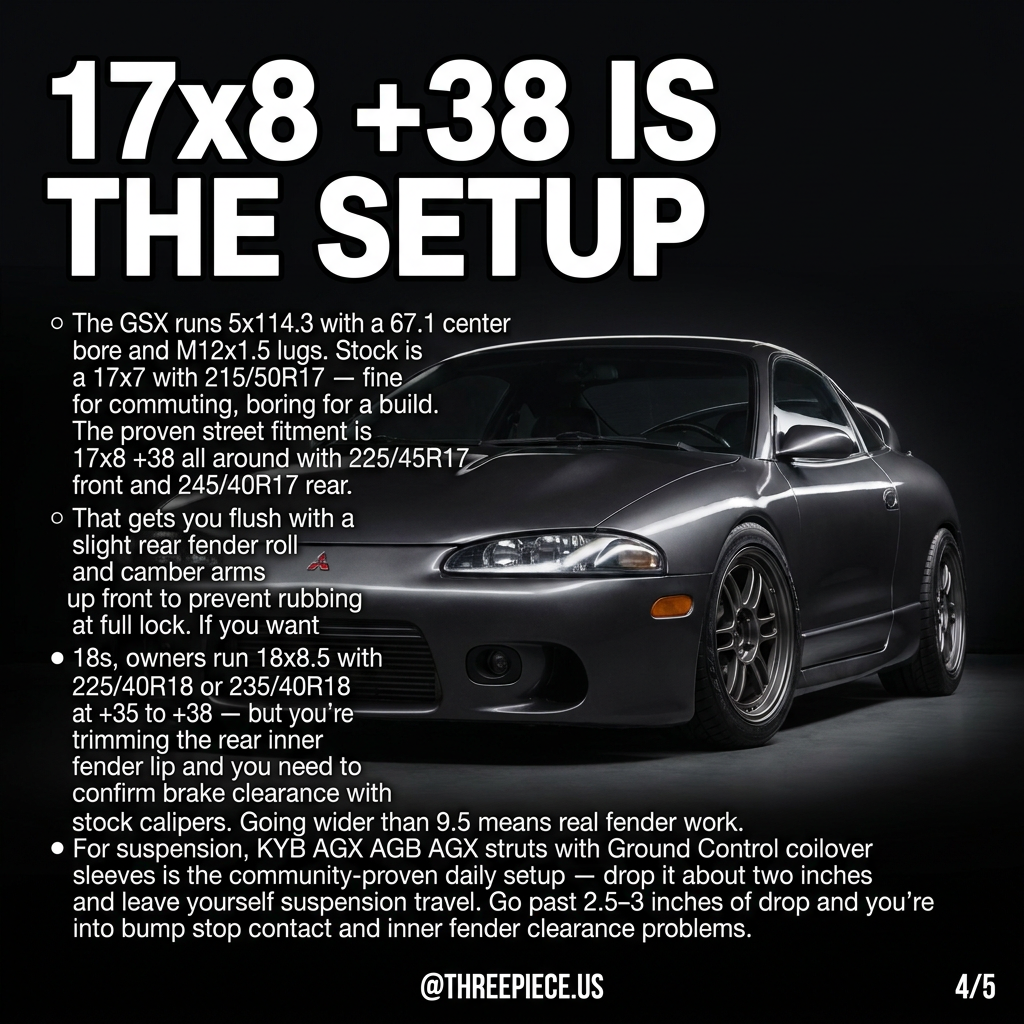
The 2G Eclipse GSX runs 5x114.3 with a 67.1mm center bore and M12x1.5 lugs. Stock is a 17x7 with 215/50R17 — adequate for commuting, completely wrong for a build. If you're not sure why center bore matters, our guide on hub-centric vs. lug-centric wheels covers it in detail.
The proven street fitment is 17x8 +38 all around with 225/45R17 up front and 245/40R17 in the rear. That gets you flush with a slight rear fender roll and camber arms up front to prevent rubbing at full steering lock. Browse 17x8 wheels in 5x114.3 to see what fits. For tires, search 245/40R17 options for the rear and 225/45R17 options for the front.
If you want 18s, owners run 18x8.5 +35 to +38 with 225/40R18 or 235/40R18 — but you're trimming the rear inner fender lip and you need to confirm brake clearance with stock calipers. Search 18x8.5 wheels in 5x114.3 if you're going that route. Going wider than 9.5" means real fender work — pulling, rolling, and possibly cutting. For most GSX builds, 17s are the smarter choice because they offer better sidewall protection, lighter weight, and easier brake clearance.
The Work Emotion series is a natural fit for a 2G Eclipse — the spoke designs complement the '90s body lines without looking anachronistic. If you're running 3-piece wheels on a DSM build, Work step lips starting at $399 let you build a custom-width setup that matches your exact offset needs. Check the ThreePiece vehicle gallery for build inspiration on similar platforms.
Suspension: What the Community Actually Runs
The community-proven daily setup for a 2G GSX is KYB AGX adjustable struts with Ground Control coilover sleeves. This combination has been the default recommendation on DSMtuners and DSMforums for over fifteen years because it works, it's affordable, and it gives you adjustable damping with a proper coilover spring rate. Drop it about two inches and leave yourself suspension travel. Go past 2.5–3 inches of drop and you're into bump stop contact and inner fender clearance problems.
For a more complete bolt-on solution, the Function and Form Type 3 Coilovers for the 96-00 Eclipse are a direct-fit kit that simplifies the install — no mixing and matching struts with sleeves. If you need to understand why rear camber arms matter on a lowered car, it's especially relevant on the GSX: the multilink rear suspension pulls significant negative camber when lowered, and without correction you'll chew through rear tires and lose traction under acceleration — which defeats the entire point of AWD.
Front sway bars, rear sway bars, and strut tower bars are common additions. The "sypherzero" build thread on DSMtuners ran Stillen front and rear sway bars with matching strut tower bars and Energy Suspension polyurethane bushings throughout. Speaking of Energy Suspension, the Energy Suspension Rear Control Arm Bushing Set for the Eclipse AWD at $76.82 is a direct replacement that eliminates the worn-out rubber bushings causing vague rear-end behavior on every high-mileage 2G.
The Build Order That Actually Works
Here's the sequence, based on what documented DSM build threads consistently recommend:
Phase 1 — Stage 0 Maintenance: Balance shaft delete, oil pump inspection, timing belt and tensioner replacement, all fluids, engine mounts, and a new accessory belt (the Gates Micro-V Belt for the '99 Eclipse is $50.26 and one of those parts everyone forgets until it snaps). This is non-negotiable.
Phase 2 — Bolt-On Power: Front-mount intercooler, 3-inch turbo-back exhaust, Walbro 255 fuel pump, 550cc injectors, ECMLink V3 tune. Optional 16G or 20G turbo swap. Target: 260–320 whp. Budget for a clutch upgrade here — South Bend Stage 2 or ACT 2600.
Phase 3 — Suspension and Wheels: KYB AGX struts with Ground Control sleeves (or Function and Form Type 3 coilovers), 17x8 +38 wheels on 5x114.3, 245/40R17 rear tires, camber arms up front. Add the Energy Suspension rear control arm bushings while you're under the car.
Phase 4 — Big Power (Optional): 6-bolt block swap with forged internals, GT30R or PTE6262 turbo, 1050–1250cc injectors, upgraded fuel rail and regulator, head work with oversized valves and aftermarket cams. Target: 400–510 whp. Budget for transfer case rebuilds at this level.
If you're comparing the GSX to other AWD turbo platforms from this era, there really isn't a direct competitor at the same price point. The Subaru WRX didn't arrive in the US until 2002. The Evo didn't land here until 2003. The 2G GSX was doing factory AWD turbo before either of those existed stateside, and the 4G63 that powers it is literally the same motor family that went into the Evo. If you're interested in how wheel offset affects performance on AWD platforms, that WRX offset guide applies conceptually to the GSX as well.
You're building one of the only AWD turbo platforms from the '90s with a real aftermarket, a motor proven to 500+ whp, and a chassis that still turns heads. The parts are still available, the knowledge base on DSMtuners runs twenty years deep, and a clean GSX with a smart build order is one of the most capable street cars you can put together for the money. If you're upgrading or rebuilding 3-piece wheels for the project, browse the full wheel catalog and wheel parts selection at ThreePiece.us to find exactly what fits your build.