
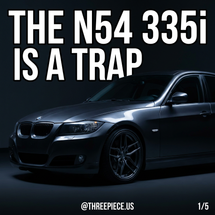
BMW E90 335i N54 Problems: Why You Should Not Buy One
The BMW E90 335i is one of the most compelling used performance sedans on the market right now — a twin-turbo inline-six with genuine 300 hp from the factory, rear-wheel drive, and a chassis that still embarrasses modern sport sedans on a back road. You can find them for $8,000–$12,000. That price looks like a steal until you realize the car you're buying is one fault code away from a repair bill that exceeds the purchase price. The N54 engine has three catastrophic failure points — wastegate rattle, HPFP failure, and injector drift — and they don't happen separately. They cascade. Here's exactly what to check before you hand over cash, what the repairs actually cost, and how to tell if the seller is dumping deferred maintenance on you.
Quick links
- HPFP: The N54's Most Notorious Failure
- Wastegate Rattle: More Than Just Noise
- Injector Drift: The Silent Budget Wrecker
- Why These Three Failures Cascade
- The Other Bills Waiting Behind Door Number Four
- The Pre-Purchase Checklist That Saves You Thousands
- Buy One — But Buy Smart
HPFP: The N54's Most Notorious Failure
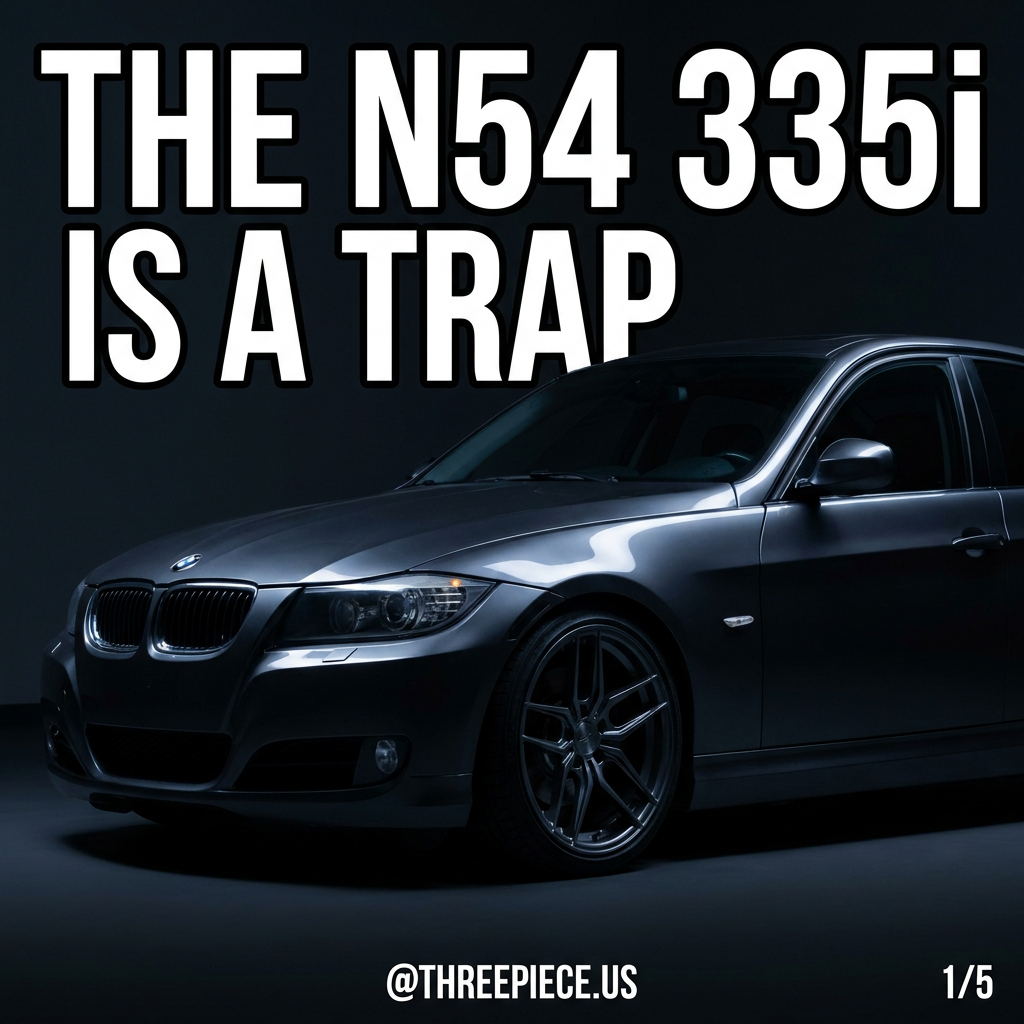
The high-pressure fuel pump is the single most documented failure on the N54 platform, and it's the reason BMW issued an extended warranty covering 10 years / 120,000 miles on 2007–2010 models. That warranty window is now closed on every single car in this generation, which means the replacement is entirely on your dime.
Symptoms start subtle — long cranking, rough idle, intermittent power loss under boost — and escalate quickly. When the pump starts failing, fuel pressure drops below ~100 bar under load. Pull codes with any OBD2 scanner and look for P0089 (Fuel Pressure Regulator Performance). That code on a high-mileage N54 is essentially a diagnosis.
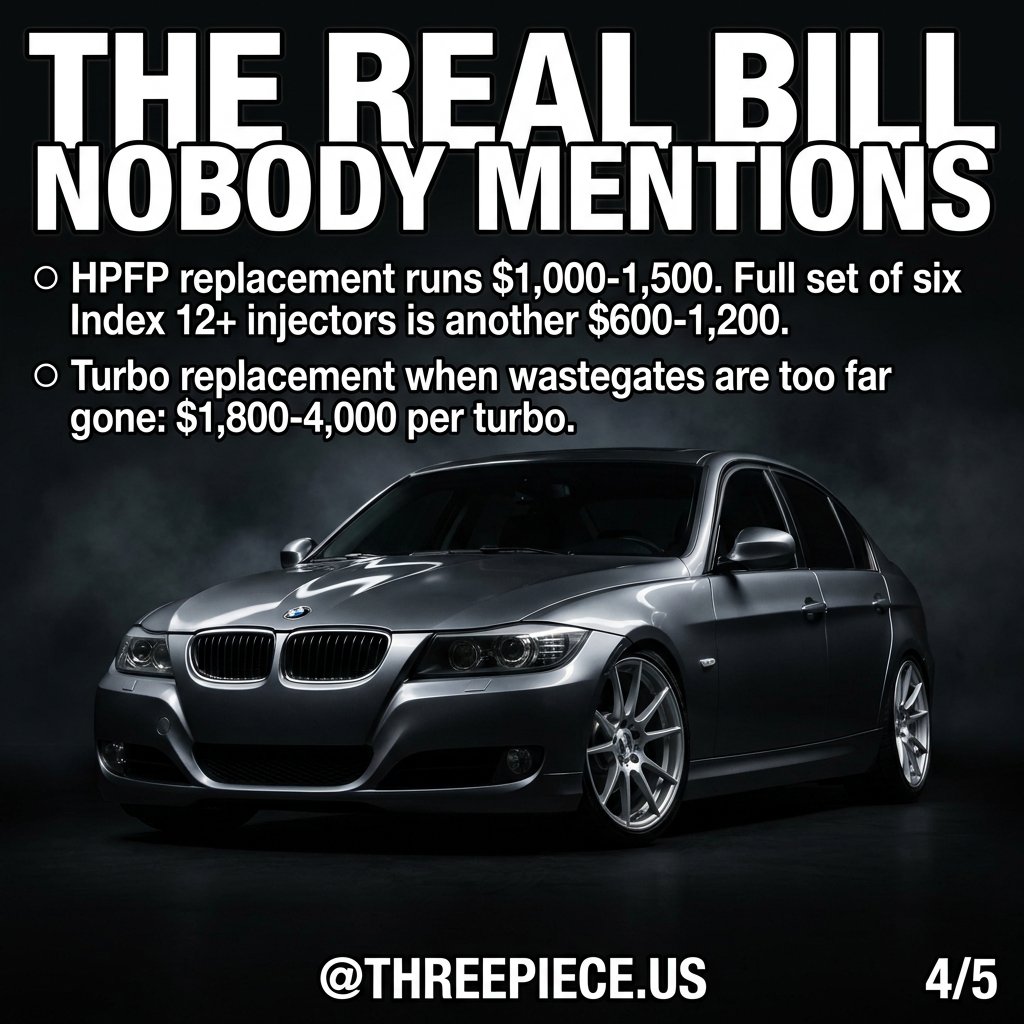
But here's the part most buyers miss: a failing HPFP doesn't just stop delivering fuel. It throws metal shavings into the fuel rail, which travel downstream and wreck your injectors. One pump failure can trigger a second, far more expensive repair. Early Bosch units — the pre-revision designs with weak O-ring seals — are the worst offenders. Revised pumps carry part numbers ending in -881 or -943. If the car you're looking at still has an original early pump past 80,000 miles, budget $1,000–$1,500 for replacement parts and labor immediately.
If you're already deep into the N54 platform and want the full picture on what makes these cars worth the trouble, read our companion piece: BMW E90 335i N54: Three Reasons to Buy One Now. The engine's potential is real — but only if you buy one that hasn't already been hollowed out by deferred maintenance.
Wastegate Rattle: More Than Just Noise
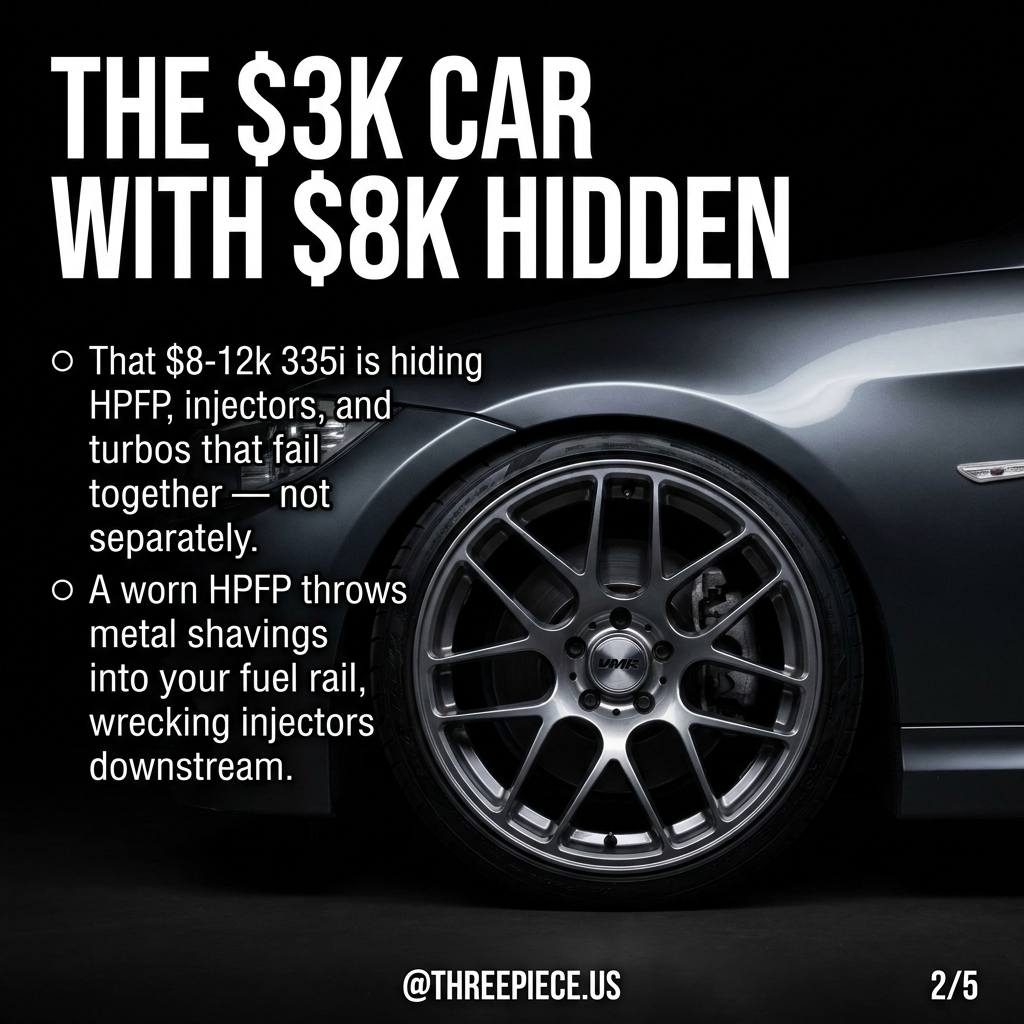
Start the car cold and listen. If you hear a metallic chattering between 1,500–3,000 RPM — a sound like a handful of loose bolts bouncing around inside the turbo housing — that's wastegate rattle. BMW dealers will tell you it's "normal operating noise." Forum owners who've lived with it for 50,000 miles will tell you it's the sound of your boost curve slowly falling apart.
The cause is wear in the wastegate actuator rod bushings, actuator arms, and flapper pivot shafts. Vacuum hoses — those 3.5 mm inner diameter lines running to both turbines — dry out and crack over time, causing the wastegate to stay partially open under low load. The result is boost leaks, incorrect boost curves, and in severe cases, 30–40 hp losses that most owners attribute to something else entirely.
Most N54s develop noticeable rattle by ~80,000 miles. The diagnostic code to watch for is 30FF (boost leak / turbo under-boost). Some owners use MHD's software-based wastegate rattle fix or adjust the actuator arm manually — both reduce noise but rarely eliminate the underlying wear. Upgraded actuator rods run about $150 for a pair. OEM actuators are $650–$900. And if the wastegates are too far gone, you're looking at turbo replacement: $1,800–$4,000 per turbo, installed. On a twin-turbo car. Do the math.
This is the same kind of cascading maintenance burden we documented on the Audi B9 S4 — German turbo platforms that are brilliant when maintained and financial sinkholes when neglected. The pattern is identical: forced induction components wear at predictable mileage intervals, and the second owner inherits all of it.
Injector Drift: The Silent Budget Wrecker
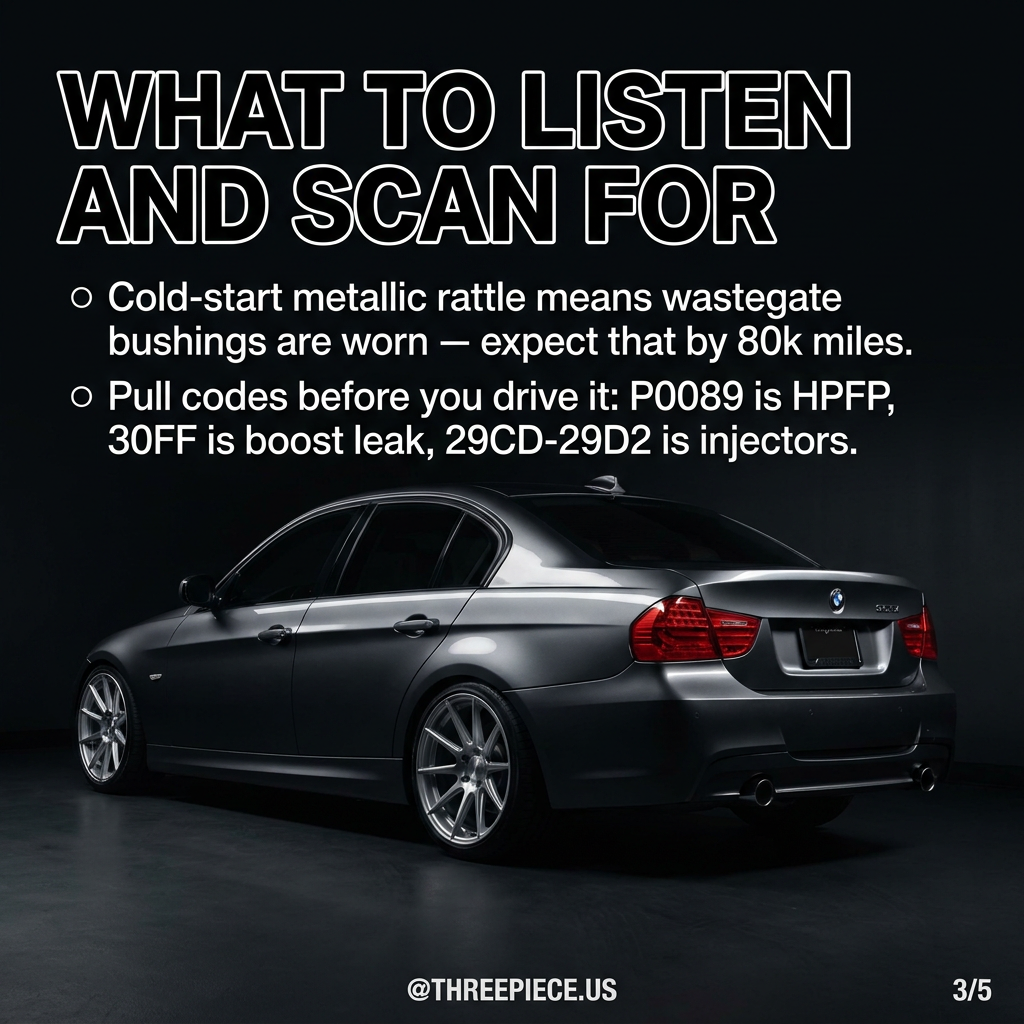
The N54 uses piezo-electric injectors grouped by index numbers. Early units — Index 1 through 11 — have known manufacturing weaknesses in the piezo materials and sealing. They fail between 60,000–100,000 miles, and when they go, you get misfires under boost, rough idle, fuel odor, and a constellation of phantom codes (29CD–29D2) that will have you chasing electrical gremlins for weeks before you realize it's a mechanical failure.
The fix is upgrading to Index 12+ injectors, which use improved piezo materials and better sealing. You must replace all six to maintain balance. A full set of six Index 12+ injectors plus labor runs $600–$1,200 on the low end — but if the previous HPFP failure sent metal shavings downstream, you may be looking at $2,500–$3,500 for OEM injectors, fuel rail cleaning, and the labor to do it right.
Here's the problem with the used market: injector index numbers are almost never disclosed in listings. Most sellers don't know what index their injectors are, and many don't even know what "index" means in this context. If you're looking at a car with 90,000+ miles and the seller can't tell you the injector index, assume you're buying Index 7 or lower and budget accordingly. Request an injector test or pull live data for flow rate deviations before you commit.
Why These Three Failures Cascade
This is the part that separates the N54 from other "maintenance-heavy" platforms. On most cars, failure points are independent — a bad water pump doesn't wreck your turbo. On the N54, the three big failures are mechanically linked:
- A failing HPFP sends metal debris into the fuel rail, which damages injectors downstream.
- Damaged injectors cause misfires, which dump unburnt fuel into the exhaust, which can damage catalytic converters.
- Meanwhile, wastegate wear creates incorrect boost curves that put additional stress on the already-compromised fuel system.
A $4,000 335i with all three problems unaddressed isn't a $4,000 car. It's a $4,000 car plus $6,000–$10,000 in deferred repairs. That's not a deal — it's someone else's exit strategy. The same principle applies to any high-mileage turbo platform; we've seen identical patterns on the Subaru Legacy Spec B and the R35 GT-R budget build trap.
The Other Bills Waiting Behind Door Number Four
Even if the big three check out, high-mileage N54s have a secondary layer of known issues that add up fast:
- Oil filter housing gasket — leaks on virtually every N54 past 80,000 miles. Oil drips onto the serpentine belt and alternator. Not catastrophic alone, but it tells you exactly how much deferred maintenance you're inheriting.
- Valve cover gasket — leaks into spark plug wells, creating misfire conditions and, in worst cases, a fire hazard when oil reaches the exhaust manifold.
- Electric water pump — fails between 80,000–120,000 miles. The pump itself isn't outrageously expensive, but the labor on this platform is.
- Carbon buildup on intake valves — direct injection means no fuel washing the backs of the valves. By 60,000 miles, you need a walnut blast to restore airflow. Budget $400–$600 for the service.
- Charge pipe — the factory plastic charge pipe cracks under boost, especially on tuned cars. It's a cheap fix ($50–$150 for an aluminum replacement), but a cracked charge pipe on a car for sale tells you the previous owner was running a tune and pushing the car hard.
If you're planning to address the suspension side of an E90 build — and you should, because the stock dampers are usually finished by 80,000 miles — BC Racing BR-Series coilovers for the E90/E92 start at $1,195 and are one of the most common upgrades in the community. Pair them with the Eibach 28mm front & 15mm rear anti-roll kit at $568 and the chassis transforms — the E90's geometry is genuinely excellent once you give it hardware that isn't worn out.
The Pre-Purchase Checklist That Saves You Thousands
Print this. Screenshot it. Send it to whoever is about to buy an N54 335i without doing their homework:
- Ask for the HPFP part number. Revised units end in -881 or -943. If the seller doesn't know, assume it's an original early unit and budget $1,000–$1,500.
- Ask for the injector index. You want Index 12 or higher. If the seller can't answer this question, you're buying someone else's deferred maintenance bill.
- Cold-start the car and listen. Metallic rattling at idle or between 1,500–3,000 RPM is wastegate rattle. Check both sides — it's a twin-turbo car.
- Pull codes before you drive it. P0089 = HPFP. 30FF = boost leak. 29CD–29D2 = injector faults. Any of these on a high-mileage car is a negotiation point worth thousands.
- Check for oil leaks around the oil filter housing and valve cover. Leaks here past 80k are expected — but they tell you whether the previous owner maintained the car or just drove it.
- Inspect the charge pipe. If it's already been replaced with an aluminum unit, the car was tuned. That's not necessarily bad, but it changes your risk profile on every other component.
- Ask about the water pump. If the original electric pump is still in the car past 100,000 miles, it's living on borrowed time.

Buy One — But Buy Smart
None of this is meant to scare you away from the N54. The engine is genuinely one of the best twin-turbo inline-sixes ever produced. The platform responds to bolt-ons and tuning like almost nothing else in its price range — 400 whp on a stock block with a JB4 and downpipes is a well-documented, repeatable result. The E90 chassis is balanced, communicative, and still looks right with the correct wheel setup. A set of 18-inch wheels in 5x120 in a proper concave profile — something like the Work Emotion T7R 2P starting at $531 — completely transforms the E90's stance. If you want to understand how monoblock vs. 3-piece construction affects both weight and fitment flexibility on a platform like this, that breakdown is worth reading before you commit to a wheel spec.
The point is this: a well-bought N54 335i with documented maintenance, revised HPFP, and Index 12+ injectors is one of the best performance values in the used market. A poorly-bought one is a money pit that will drain your mod budget before you ever get to enjoy the car. The difference between those two outcomes is about fifteen minutes of inspection and two questions the seller either can or can't answer.
If you're building an E90, check out the ThreePiece vehicle gallery for fitment inspiration, and browse suspension options to get the ride height sorted before you commit to a wheel spec. The E90 community is one of the most active in the sport-compact world for a reason — the car rewards the owners who do the homework.
What's the highest mileage N54 you've seen that was still running strong — and what had already been replaced on it?