
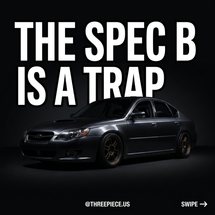
Subaru Legacy Spec B Problems: Why You Should Not Buy One
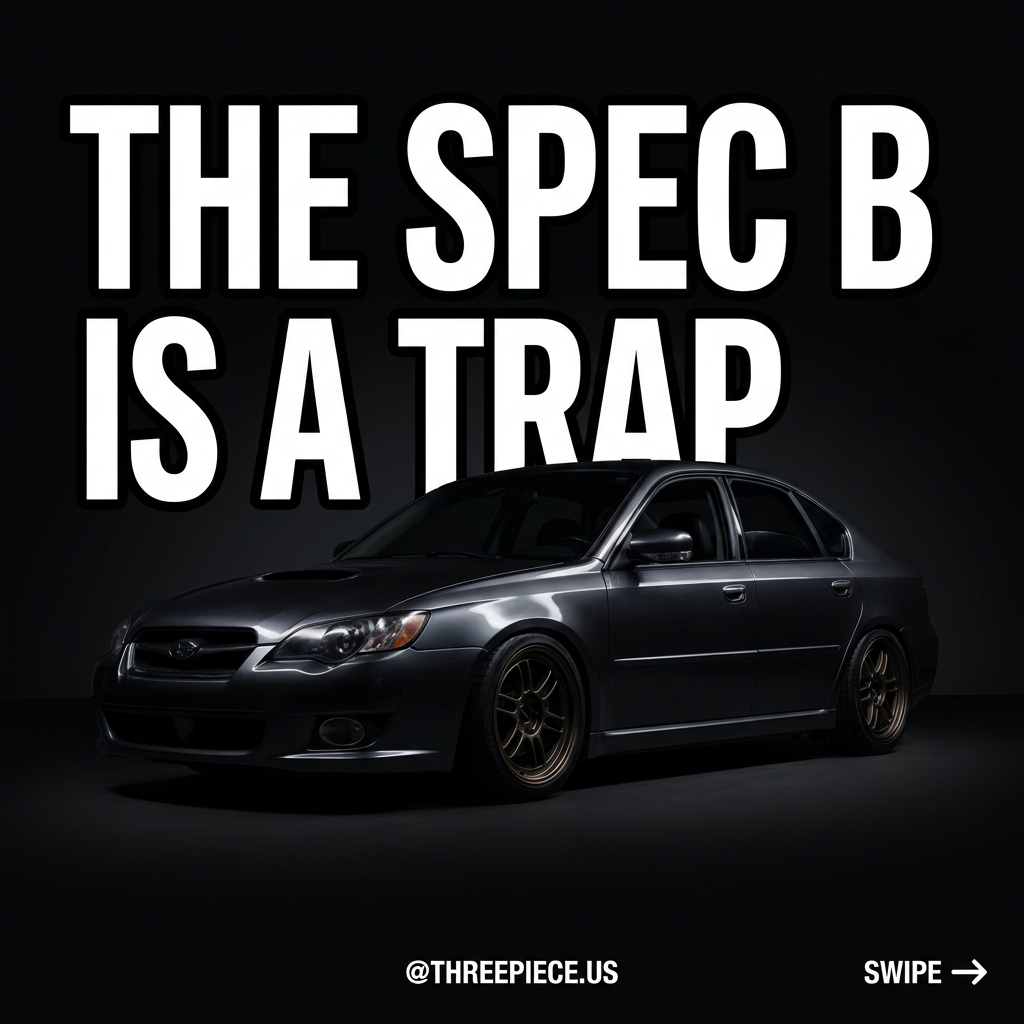
The 2005–2009 Subaru Legacy Spec B is one of those cars that looks perfect on paper — rare AWD sport sedan, six-speed manual, factory Bilstein suspension, turbocharged EJ255 flat-four — and then systematically empties your bank account once you actually own it. A clean Spec B listing at $8,000–$10,000 feels like you've outsmarted the market. You haven't. You've found someone else's exit strategy, and this guide breaks down exactly why.
Quick links
- The EJ255 Engine: A Ticking Time Bomb
- Turbo Oil Starvation and the Banjo Bolt Screen
- Center Diff Binding and Transmission Issues
- Bilstein Shock Fade and Suspension Wear
- The Hidden Cost Stack Nobody Warns You About
- Red Flags: When to Walk Away
- Who Should Actually Buy a Spec B
- Wheels and Fitment for the Legacy Spec B
The EJ255 Engine: A Ticking Time Bomb
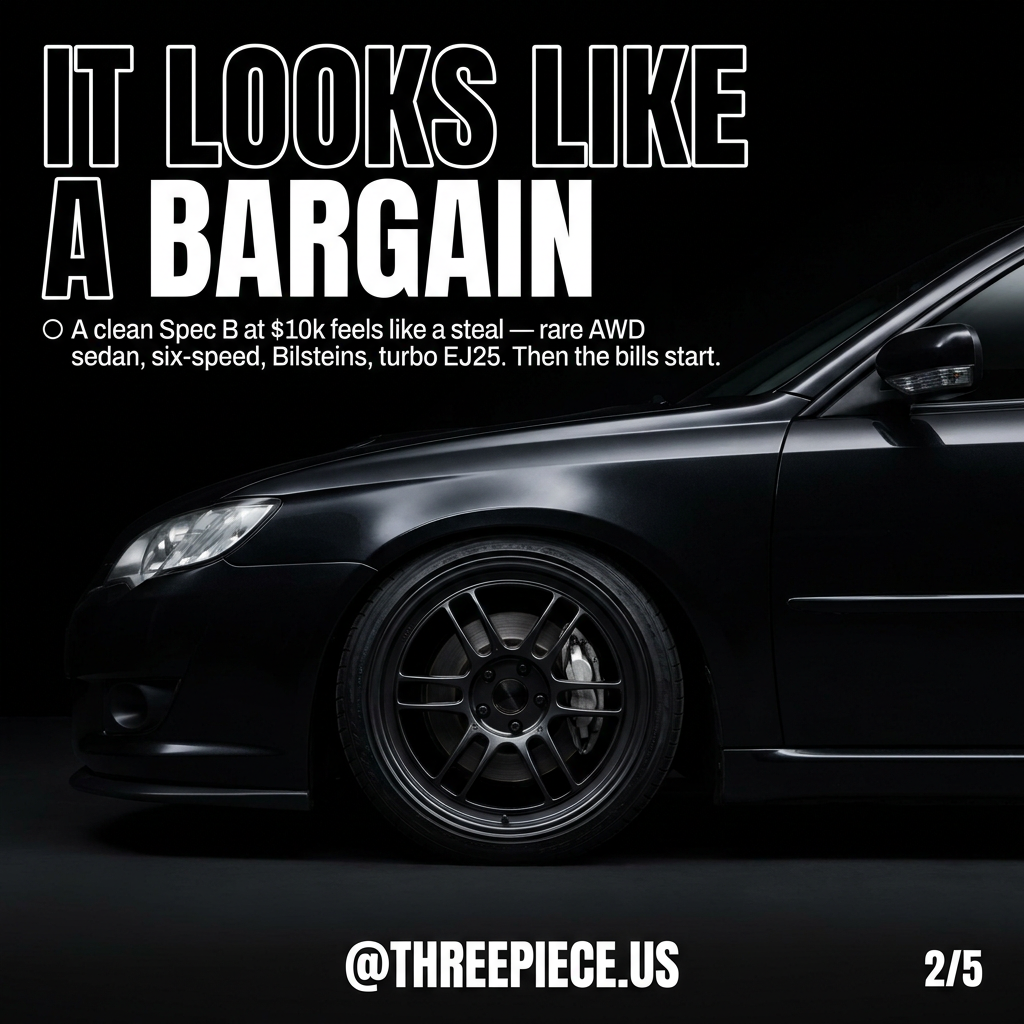
The Spec B's turbocharged EJ255 shares its fundamental architecture with the WRX and Legacy GT, which means it also shares their well-documented failure modes — except Spec B parts aren't always interchangeable with standard Legacy GT components, so you're paying more for the same headaches. The big three: ringland failure, rod bearing wear, and head gasket leaks. All of these tend to converge somewhere between 60,000 and 125,000 miles, which is exactly the mileage range where most Spec Bs are listed for sale. That's not a coincidence.
Ringland cracks are the signature EJ255 failure. The thin land between the piston rings fractures under boost, sending metal through the engine. If you're lucky, you catch it early from a compression test. If you're not, you're looking at a short block replacement running $4,000–$9,000 depending on whether you go OEM or built. Head gaskets on the EJ platform leak externally around 90,000–125,000 miles — coolant seeping down the block, sweet smell from the exhaust manifold, the classic Subaru ownership experience. Both sides need to be done simultaneously, and that job runs $2,000–$3,500. If you're shopping for a Spec B and the seller says "it's just a small seep," understand that small seeps become overheating events that warp heads. Our WRX STI generation ranking covers how Subaru's EJ platform evolved, but the Spec B got the worst of it — all the stress, none of the aftermarket support depth the STI enjoys.
Turbo Oil Starvation and the Banjo Bolt Screen
This is the failure that wrecks Spec Bs owned by people who don't know EJ turbos. The turbocharger's oil feed line has a banjo bolt with a tiny mesh screen inside it. That screen clogs with carbon and debris around 50,000–70,000 miles, starving the turbo bearing of oil. If nobody pulled that screen (or replaced the bolt with a screenless unit), the turbo is running on borrowed time. A turbo rebuild costs $1,000–$1,500, but if the oil starvation caused bearing material to circulate through the engine, you're back to short-block territory.
The fix itself is a $15 part and 30 minutes of work — which makes it even more frustrating that most sellers never did it. When you're inspecting a Spec B, ask specifically about the banjo bolt screen. If the seller doesn't know what you're talking about, that tells you everything about how the car was maintained. This is similar to the kind of hidden maintenance traps we covered in our Infiniti Q50 Red Sport hidden costs breakdown — the purchase price is never the real price.
Center Diff Binding and Transmission Issues
The six-speed manual Spec B uses a viscous coupling center differential that develops binding issues, especially after prolonged driving. Symptoms show up during low-speed tight turns — the AWD system fights itself, causing wheel skipping and grabbing. It feels like the car is trying to push straight while you're turning. Repair costs range from $1,000–$2,500 depending on whether the coupling can be refurbished or the entire diff needs replacement.
The automatic transmission Spec B (primarily the 3.0R Spec B with the flat-six) has its own issues: erratic upshifts, paddle shifters that work in one direction but not the other, and control unit failures. These aren't cheap fixes on a car with limited parts availability. The six-speed manual is the one enthusiasts want, but it comes with its own parts-sourcing nightmare — when third gear starts crunching, you're hunting forums and importing JDM transmission components because the Spec B's six-speed isn't the same unit as the STI's. The Evo X vs STI reliability comparison is worth reading here, because it puts the EJ platform's long-term ownership costs in perspective against its direct competitor.
Bilstein Shock Fade and Suspension Wear
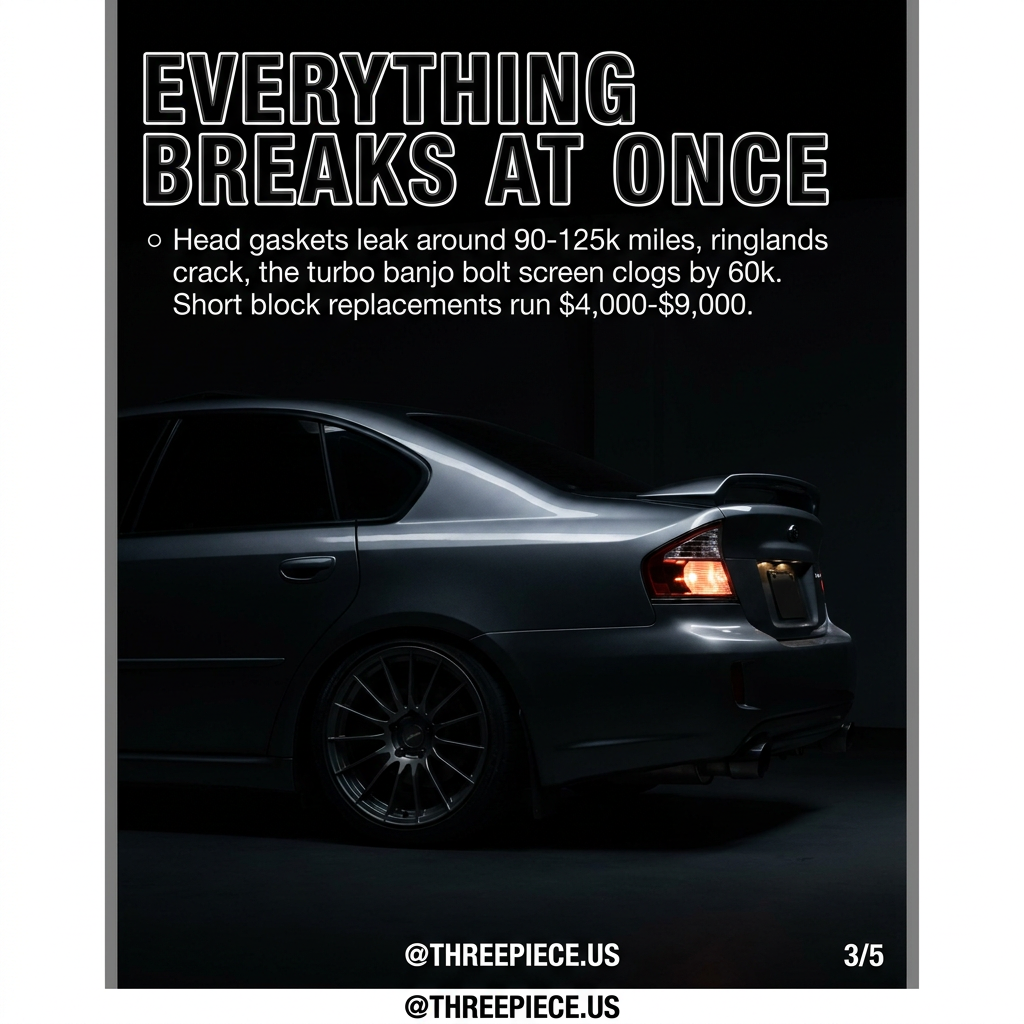
One of the Spec B's biggest selling points — the factory Bilstein dampers and inverted front struts — becomes one of its biggest liabilities on used examples. These shocks lose their damping ability around 80,000–100,000 miles, and every Spec B on the market right now is well past that threshold. Replacing all four corners with equivalent Bilstein units runs $1,200–$2,000. You could go aftermarket coilovers instead, but that's a separate budget conversation.
Wheel bearings on the Spec B also tend to fail in the same 80,000–100,000 mile window, at $300–$600 per side. If you're hearing humming that changes with speed or gets louder in turns, the bearings are already gone. Between the shocks, bearings, and the inevitable bushing refresh the chassis needs at this age, the suspension alone can stack $2,000–$3,500 in deferred maintenance. If you do end up with a solid Spec B and want to upgrade the suspension properly, budget for it from day one — don't let the factory Bilstein badge fool you into thinking the car rides well at 140,000 miles.
The Hidden Cost Stack Nobody Warns You About
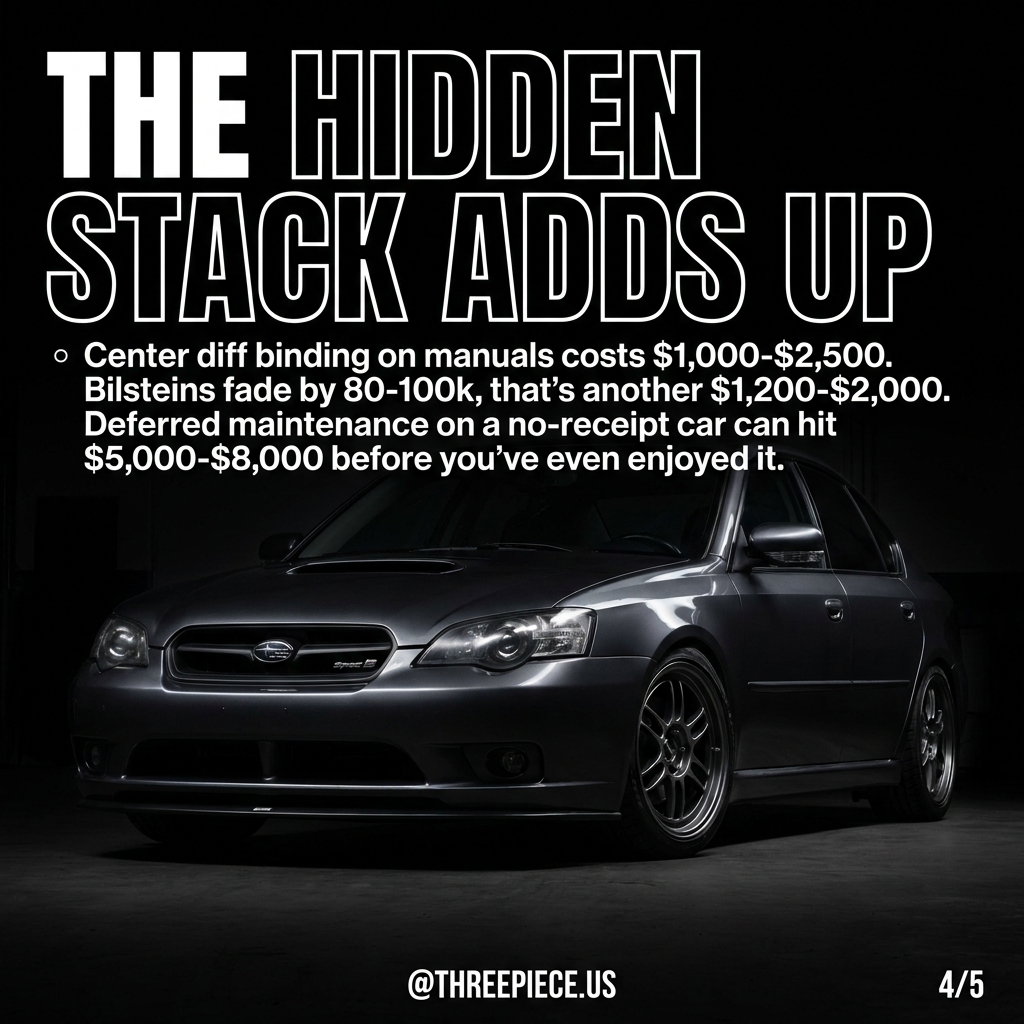
Here's where the Spec B really gets you. None of these failures happen in isolation. A typical 130,000-mile Spec B with no maintenance receipts is simultaneously due for head gaskets, turbo service, shock replacement, wheel bearings, timing belt, and potentially a center diff service. Stack those up:
- Head gaskets (both sides): $2,000–$3,500
- Turbo banjo bolt + inspection: $200–$1,500 (depending on turbo condition)
- Bilstein replacement (4 corners): $1,200–$2,000
- Center diff service/rebuild: $1,000–$2,500
- Wheel bearings (2–4): $600–$2,400
- Timing belt + water pump: $800–$1,200
That's $5,800–$13,100 in potential maintenance on top of your purchase price. On an $8,000 car. Several Spec B owners on forums have noted that by the time they've repaired ringlands, head gaskets, turbo, and diff, they could have bought a clean STI or even a well-sorted E90 335i that costs less to maintain long-term. The Spec B also requires premium fuel and returns 17–20 mpg city on the turbo models, with higher insurance premiums due to its performance trim classification. The running costs never stop compounding.
Red Flags: When to Walk Away
If you're still considering a Spec B after all of this, here are the absolute deal-breakers during inspection:
- Any coolant loss, white exhaust smoke, or milky oil: Head gaskets or worse. Walk away unless the price reflects a full rebuild.
- No maintenance receipts: A Spec B without documented turbo service, timing belt, and head gasket work is a car where every major system is an unknown. Deferred maintenance on a no-receipt car can hit $5,000–$8,000 before you've enjoyed a single weekend drive.
- AWD binding during test drive: Do a full 20–30 minute drive that includes low-speed tight turns in parking lots. If the wheels skip or grab, the center diff is binding. That's a $1,000–$2,500 repair the seller is trying to pass to you.
- Visible rust on rockers or quarter panels: Body panels for the Spec B are increasingly hard to source. Structural rust means the car is finished — there's no economical repair path.
- Sticky/deteriorating dashboard: This is a known Subaru defect from this era. It's cosmetic, but replacement parts are expensive and it signals a car that's been baking in the elements without care.
The Lexus IS300 buying guide we published covers a similar inspection philosophy for another aging Japanese sport sedan — the principle is the same: the car you're buying is only as good as the maintenance trail behind it.
Who Should Actually Buy a Spec B
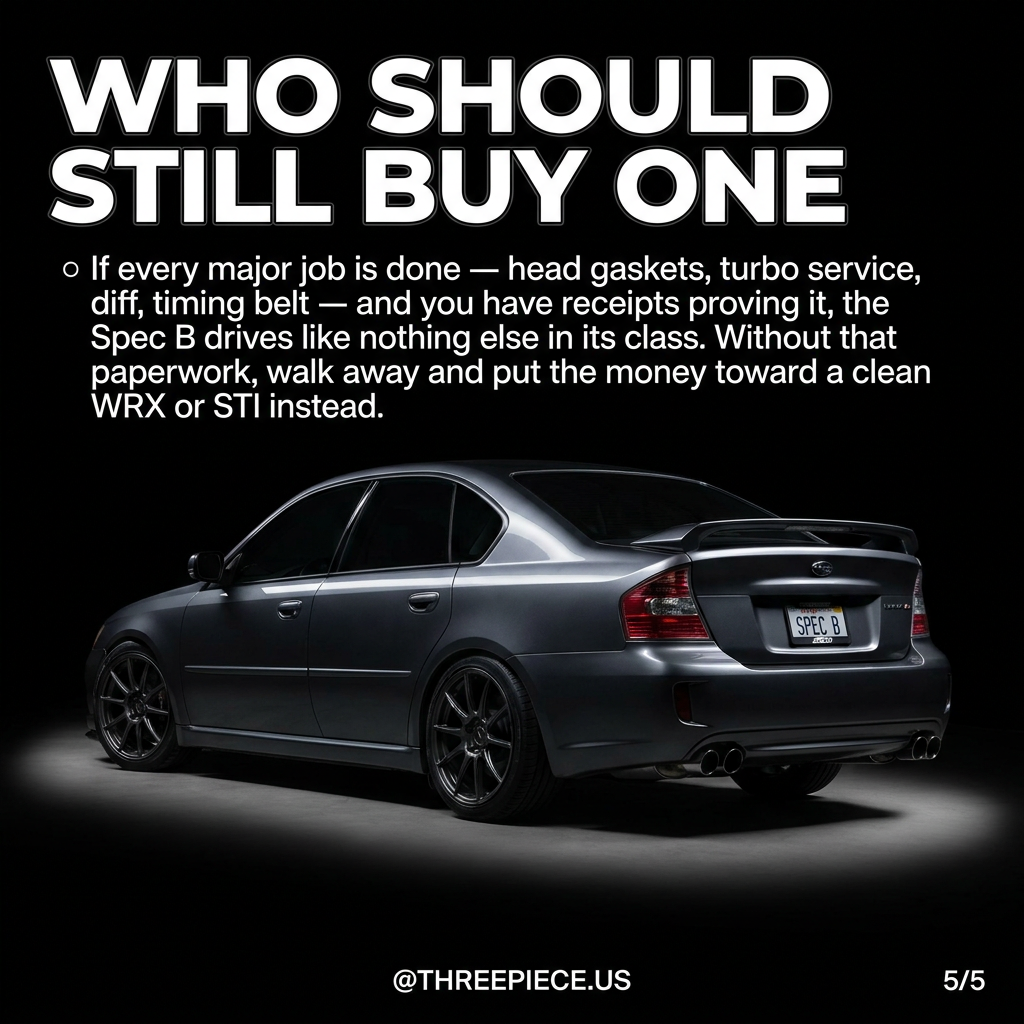
After everything above, the Spec B is still genuinely one of the most underrated sport sedans of its era — if you buy the right one. The shorter final drive ratio, the factory Bilstein suspension geometry, the SI-Drive system, and the turbocharged flat-four in a sedan body that doesn't scream "boy racer" — it's a package nobody else offered. The problem was never the car's design. The problem is that every affordable example left has been neglected by owners who didn't understand what the EJ platform demands.
The Spec B makes sense for exactly one buyer: someone who already wrenches on Subarus, understands the EJ255's maintenance schedule, and finds an example where every major service has been completed with receipts — head gaskets, turbo banjo bolt, timing belt, center diff service. That car exists, but it's not the $8,000 listing with 130,000 miles and no paperwork. It's the $12,000–$14,000 example from a Subaru-specific shop or a forum member with a binder of receipts. Without that paperwork, put the money toward a clean WRX or STI with better parts availability and deeper aftermarket support. The R35 GT-R budget build reality check applies the same logic — the purchase price is the smallest number in the equation.
Wheels and Fitment for the Legacy Spec B
If you do land a sorted Spec B, the wheel game on this platform is deeply satisfying. The Legacy runs a 5x100 bolt pattern, which it shares with the WRX (pre-2015), BRZ, and Impreza — so wheel options are wide open. The factory Spec B came on 18x7.5 wheels, but the sweet spot for an aggressive-but-functional fitment is 18x8.5 +35 to +45 with 245/40R18 tires. You can reference our BRZ/FR-S fitment guide for 5x100 sizing overlap, since many of the same wheels and offsets apply.
For wheel options, browse 18-inch wheels in 5x100 to see what fits. The Work Emotion T5R at $396 is a natural pairing — lightweight flow-formed construction that actually complements the Spec B's understated sedan lines without overdoing it. If you want a more aggressive concave face, the Work Emotion D9R at $414 fills the fenders with real depth. For the full three-piece experience, the Work Emotion CR 3P starting at $895.50 is the endgame — a proper forged multi-piece wheel on a sedan that most people can't even identify. That's the kind of build that gets a double-take at meets.
Pair your setup with 245/40R18 tires for the ideal balance of sidewall protection and grip. If you're considering whether the jump to forged wheels is worth it on a car like this, our monoblock vs 3-piece wheel breakdown covers the real-world differences. And for understanding how budget wheels compare to mid-tier options, that comparison is worth reading before you commit. Check out the ThreePiece vehicle gallery for build inspiration across similar platforms.
The Verdict: A Great Car That Punishes the Wrong Buyer
The Subaru Legacy Spec B is not a bad car. It's a car that was designed for enthusiasts and then sold to people who treated it like a commuter Camry. Every example left on the market carries the accumulated consequences of that mismatch. If you're coming in cold, thinking you found a deal on a rare turbo AWD sedan — you didn't find a deal. You found someone else's deferred maintenance bill with a fresh detail and optimistic listing photos.
Buy one only if the major services are documented, you have a Subaru-specific shop you trust, and you've budgeted $3,000–$5,000 in reserve for the surprises that will come anyway. Otherwise, save yourself the heartbreak and put that money toward a platform with better parts support and a more honest ownership curve.