

Evo X vs STI: Why the 4B11T Wins the Reliability War
The Mitsubishi Evo X vs. Subaru WRX STI debate has been running for nearly two decades, and the internet still gets it wrong. The STI has the bigger fanbase, the louder exhaust note, and the nostalgia advantage. But if you're actually spending your own money — and you plan to make power without rebuilding the engine every 40,000 miles — the Evo X with the 4B11T is the smarter buy. This isn't contrarian for the sake of it. The engineering gap between these two engines is documented, repeatable, and expensive to ignore.

Quick links
- The EJ257 problem nobody wants to admit
- The 4B11T's real-world power advantage
- Evo X weak spots you need to budget for
- Wheel fitment for the Evo X (5x114.3)
- Suspension: the mod that changes everything
- The verdict
The EJ257 problem nobody wants to admit
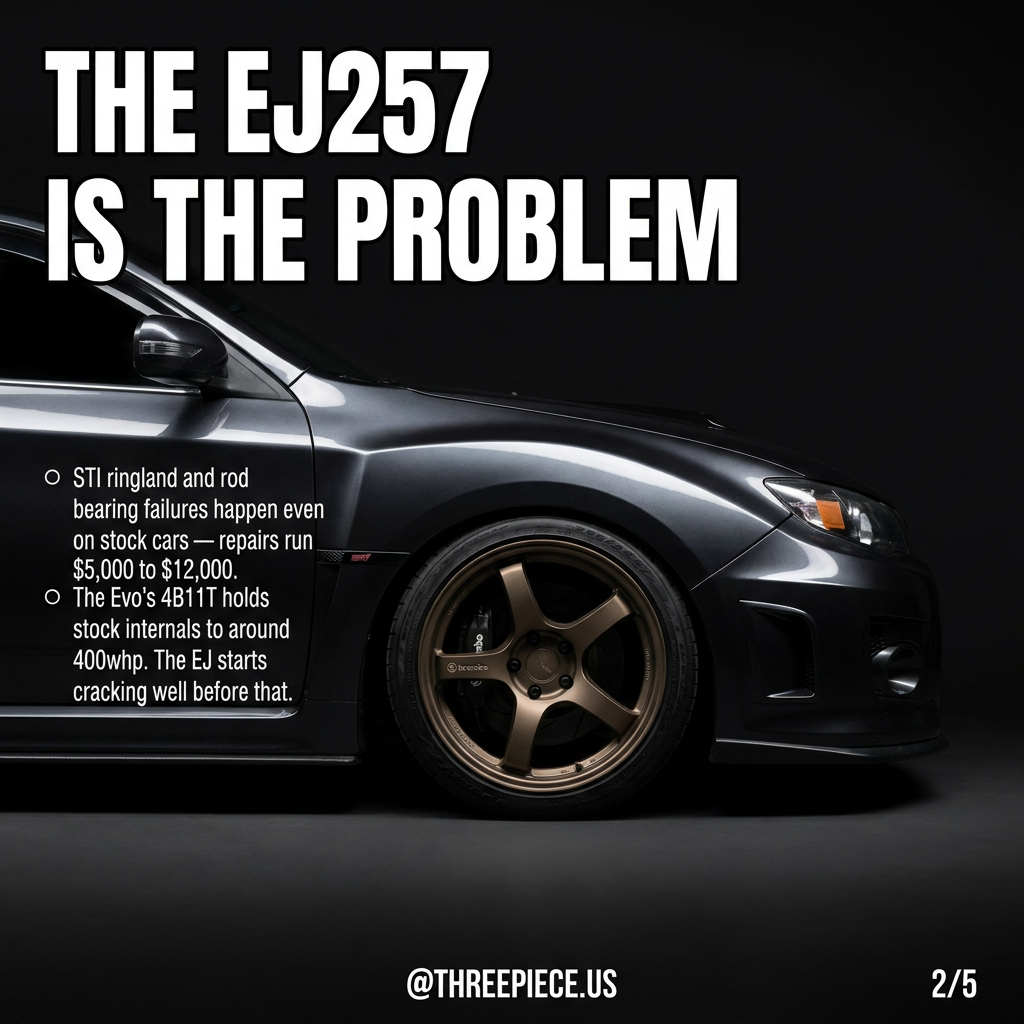
The EJ257 is a fundamentally compromised engine design that Subaru never truly fixed across the STI's entire production run. The flat-four layout creates uneven coolant distribution to cylinder #4, which runs hotter than the other three under boost. That thermal asymmetry is why ringland failures and spun rod bearings aren't freak occurrences — they're statistical inevitabilities on cars that see spirited driving. One aggregated owner database collected over 780 reports of spun rod bearings on the STI alone. Repairs for internal engine destruction run $5,000–$12,000, and that's before you address the root cause.
The cruel irony is that even stock, conservatively driven STIs aren't immune. Add a Stage 2 tune — which is basically a rite of passage in STI culture — and you're rolling the dice harder. The EJ block starts cracking ringlands well before the power levels where the 4B11T even begins to sweat. If you're coming from our deep dive on every STI generation, you already know the GD and GR chassis are brilliant — it's always been the bottom end that lets the platform down.
The 4B11T's real-world power advantage
The Evo X's 4B11T is a DOHC inline-four with MIVEC variable valve timing — a modern, square-bore design that distributes heat evenly across all four cylinders. That alone fixes the STI's biggest structural weakness. But the real story is the bottom end: owners and tuners consistently report that the stock 4B11T internals hold reliably to approximately 400 whp. That's bolt-ons, an upgraded intercooler, proper fueling, and a quality tune — no forged pistons, no short block build, no five-figure insurance policy against your own engine.
A typical Stage 1 Evo X — intake, downpipe, intercooler, and a 91–93 octane tune — puts down 320–340 whp. The STI hits similar numbers at Stage 1, but pushing past that requires confronting the EJ's fragility. Getting an STI to a reliable 400 whp almost always means a forged bottom end rebuild, which adds $3,000–$7,000 in parts and labor before you even start making the power. On the Evo, that same 400 whp comes on the stock rotating assembly. Dollar for dollar, horsepower for horsepower, the math isn't close.
This is the same principle we explored in the Eclipse GSX buyer's guide — Mitsubishi's turbo fours have always punched above their weight on stock internals. The 4G63 did it for decades. The 4B11T carries that legacy forward with better cooling and a timing chain instead of a belt.

Evo X weak spots you need to budget for
The Evo X isn't perfect, and pretending otherwise would be dishonest. Here's where your money goes if you're buying one:
Avoid the SST. The twin-clutch automated transmission was genuinely ahead of its time in 2008, but it overheats under sustained hard driving and track use. Repairs run into the thousands. Buy the 5-speed manual every time. The 5MT has its own quirk — a plastic clutch master cylinder that cracks under abuse — but replacing it with a metal unit is a cheap, one-time fix.
AYC pump failures are the Evo X's most common expensive surprise. The Active Yaw Control pump corrodes internally, throws a "Service Required" warning, and costs $900–$1,500 to address. On pre-2011 cars, differential cross-pins can also snap, leading to rear diff damage. Budget for an AYC inspection on any Evo X purchase and you won't be blindsided.
Other known issues: the "black relay" fuel pump relay that burns contacts over time (cheap fix, annoying failure), timing chain stretch on early 2008–2010 cars, and cracked exhaust manifolds on the hot side. None of these are engine-destroying — they're maintenance items that a prepared buyer handles once and moves on. Compare that to the STI's failure modes, which tend to involve the words "short block" and "machine shop."
If you're shopping for an STI anyway — maybe you already own one and you're committed — at least protect the chassis. Function and Form MITSUBISHI Lancer Evolution X (07-16) Type 4 Coilovers Kit at $1,799 give you proper damping control that the stock suspension never had. The same kit is available for the Function and Form MITSUBISHI Lancer Evolution X (07-16) Type 4 Coilovers Kit and the Function and Form MITSUBISHI Lancer Evolution X (07-16) Type 4 Coilovers Kit as well.

Wheel fitment for the Evo X (5x114.3)
The Evo X runs a 5x114.3 bolt pattern with a 67.1mm hub bore — the most common JDM fitment on the planet, which means your wheel options are essentially unlimited. The sweet spot for a street/track Evo X is 18x9.5 +22 to +38 depending on how aggressive you want to sit. A +22 offset gives you that flush, filled-fender look with proper concavity. A +38 keeps things conservative and clears Brembo calipers without spacers.
For tire sizing, 255/35R18 is the go-to on a 9.5" wide wheel — enough contact patch for the Evo's AWD system to put power down without overwhelming the fenders. Browse Volk Racing 21A 5x114.3 18X9.5+0 Bronze to see what's currently available, and check 255/35R18 tires for rubber options.
The Evo X's aggressive fender lines were designed for wide wheels. A set of Work Emotion CR Kiwami starting at $270 per wheel gives you a lightweight flow-formed option that looks right on the platform — the six-spoke design fills the Evo's angular fenders without competing with the body lines. If you're stepping up to a multi-piece setup, the Work Emotion CR 3P at $895.50 per wheel lets you dial in the exact lip width and offset for a perfect fit. For more on why that jump matters, read our breakdown of whether forged wheels are worth the price.
The STI shares the same 5x114.3 bolt pattern, so wheels are interchangeable between the two platforms — something to keep in mind if you're cross-shopping. Our vehicle gallery has real-world examples of both platforms on aftermarket setups.
Suspension: the mod that changes everything
The Evo X's chassis is its party trick. The multi-link rear with Super-AYC gives you adjustable torque vectoring that makes the car rotate on corner entry in a way the STI's mechanical setup simply can't replicate. But the stock Bilstein dampers on the MR — or the even softer units on the GSR — are tuned for comfort, not performance. Upgrading suspension is the single highest-impact mod on this platform.
The Fortune Auto 500 Series coilovers for the Evo X (CZ4A) at $1,799 are a proper 24-way adjustable damper with digressive valving — the kind of setup that lets you run a compliant street setting on Monday and a stiff track setting on Saturday without swapping anything. They're also available for every previous Evo generation: the Function and Form MITSUBISHI Lancer Evolution X (07-16) Type 4 Coilovers Kit, the Function and Form MITSUBISHI Lancer Evolution X (07-16) Type 4 Coilovers Kit, and even the Function and Form MITSUBISHI Lancer Evolution X (07-16) Type 4 Coilovers Kit. If you're building a serious track Evo 8 or 9, the Function and Form MITSUBISHI Lancer Evolution X (07-16) Type 4 Coilovers Kit at $2,399 adds remote reservoirs for sustained heat management during long sessions.
Pair proper coilovers with the right wheel and tire setup and the Evo X becomes one of the most capable sub-$25K performance cars you can buy. The combination of a strong bottom end, sorted AWD, and a chassis that actually communicates with you through the steering wheel is something the STI gets close to but never quite matches — especially once you've spent the money the STI demands just to keep its engine alive.
The verdict
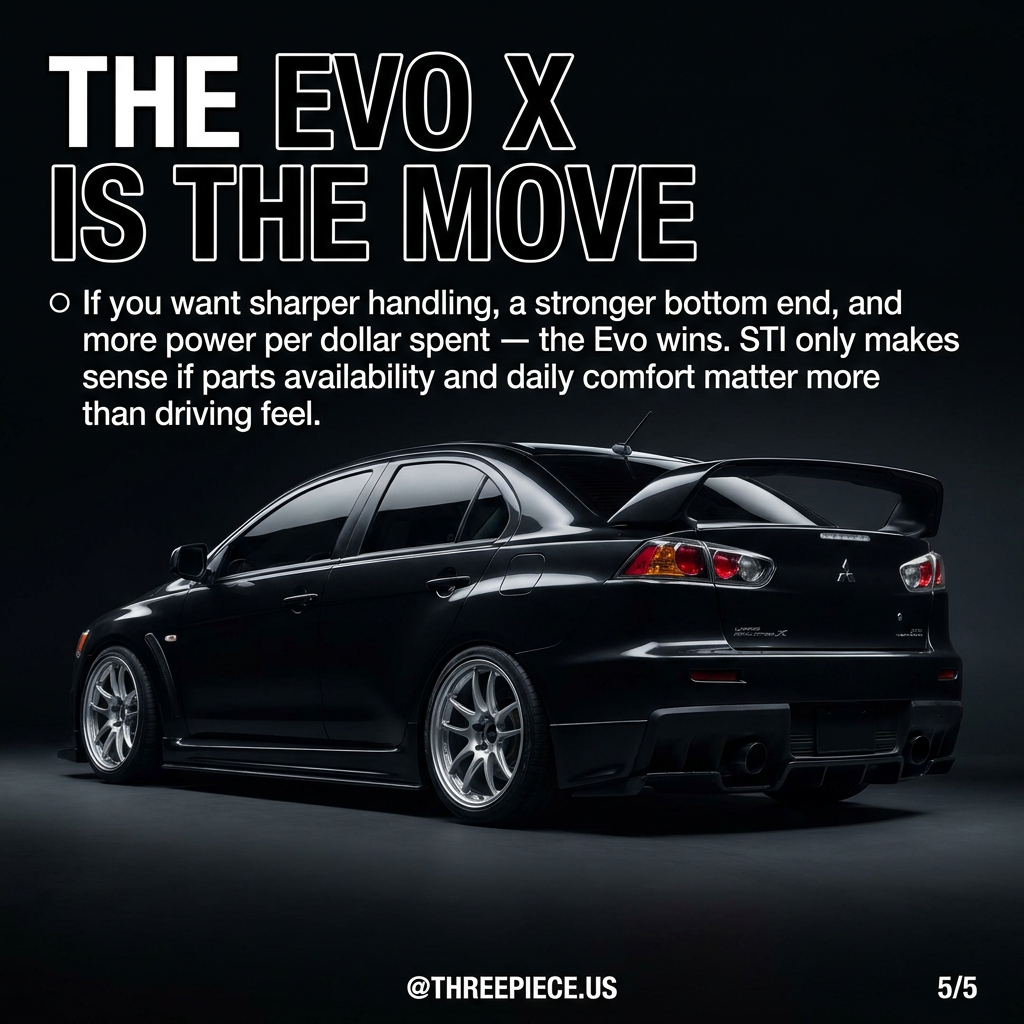
The STI has the legacy, the community, and the parts availability. Nobody's arguing that. If you need the cheapest possible replacement alternator at 11 PM on a Tuesday, the Subaru dealer network wins. If daily comfort and hatchback practicality matter more than driving engagement, the STI's softer tune makes more sense.
But if you're buying a performance car to perform — to make power reliably, to handle with precision, and to reward you every time you push it — the Evo X is the better machine. The 4B11T holds 400 whp on stock internals. The chassis rotates like nothing else in its price class. And right now, clean 5-speed Evo X examples are still trading for less than comparable STIs in most markets. That gap is closing fast — Mitsubishi ended production, the supply is finite, and the enthusiast market is catching on.
Buy the 5-speed manual. Budget for an AYC pump inspection. Put the money you saved on engine rebuilds into wheels, suspension, and seat time. That's the Evo X formula, and it's been working since 2008.
Would you take the Evo X over the STI, or is the Subaru community and parts network worth the engine risk? And if you already own an Evo X — what's the first mod you did after buying it?