
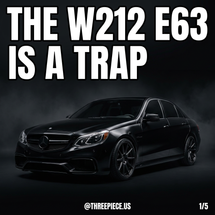
W212 E63 AMG Problems: 3 Reasons Not to Buy One
The Mercedes W212 E63 AMG is the car that ruins people at 1 AM. You're scrolling listings, you see a hand-built V8 sedan under $30,000 with 80k miles, and your brain starts rationalizing. The exhaust note in the walkaround video seals it. But that purchase price is just the deposit on a much larger financial commitment — one that most buyers aren't prepared for. Here are three documented, owner-verified reasons the W212 E63 is a car you should approach with extreme caution, or skip entirely.
Quick links
- Both engines have documented time bombs
- Everything around the engine fails too
- The AMG tax never stops
- What to buy instead: the Lexus GS F argument
- If you absolutely must buy one
Both Engines Have Documented Time Bombs
The W212 E63 spans two very different powertrains, and neither one gets a clean bill of health at high mileage. This isn't speculation — these are failure modes with Mercedes service bulletins, serial number cutoffs, and five-figure repair quotes attached to them.
M156 (6.2L NA V8) — Pre-Facelift, 2010–2011
The M156 is the naturally aspirated, high-revving unit that sounds incredible and has a structural flaw Mercedes never formally recalled. Early-build M156 engines — serial numbers before approximately 1569xx 60 060658 — used torque-to-yield head bolts that stretch, crack, or outright break over time. When they fail, coolant mixes with oil. One well-documented owner spun a rod bearing (#5) after a head bolt let go. Rebuilds including crank, rods, bearings, and heads have been quoted at $19,000+.
The first symptom is often a "low coolant" warning with no visible leak. Oil looks clean on the dipstick. By the time you pull the valve cover, the damage is already compounding. Mercedes quietly revised the head bolts on later production, but never issued a recall — so if you're buying used, you're playing detective with serial numbers and valve cover colors (black = revised, white/silver = original).
Beyond the head bolts, the M156 has a well-known valvetrain wear issue. The cam lobes are softer cast iron running against harder steel lifters, and over time — especially with extended oil change intervals — the lobes wear flat. Symptoms start as cold-start ticking, progress to intermittent misfires, and eventually require a full valvetrain overhaul. Nearly every M156 develops this to some degree. If you've read about N54 twin-turbo problems on the E90 335i, the M156 head bolt situation is the AMG equivalent — a known engineering weakness that the manufacturer never properly addressed.

M157 (5.5L Twin-Turbo V8) — Facelift, 2012–2016
The M157 biturbo replaced the M156 and brought substantially more power — 577 hp in E63 S trim — but introduced its own set of expensive failure modes. The most common is the timing chain tensioner issue. Mercedes issued Service Bulletin LI05.10-P-056435 in December 2015 acknowledging that insufficient oil pressure to the secondary chain tensioners causes a rattling noise at startup. The typical failure window is 50,000–75,000 miles. Without the tensioner replacement and check valve addition, you're looking at limp mode and a repair bill between $3,300 and $8,800.
The bigger concern is cylinder scoring. Past 75,000 miles, particularly on hard-driven examples or cars with poor warm-up habits, the cylinder walls begin to score. This is a nikasil-coating degradation issue that shows up as increased oil consumption, rough idle, and eventually misfires. The fix is a full re-sleeve or engine rebuild, typically $12,000–$20,000. Bore-scoping before purchase is now standard advice in every W212 E63 buying thread — and if the seller won't allow it, that tells you everything.
Everything Around the Engine Fails Too
Even if you find an E63 with a healthy engine, the supporting systems demand constant attention and AMG-priced parts.
AMG Speedshift MCT 7-Speed Transmission
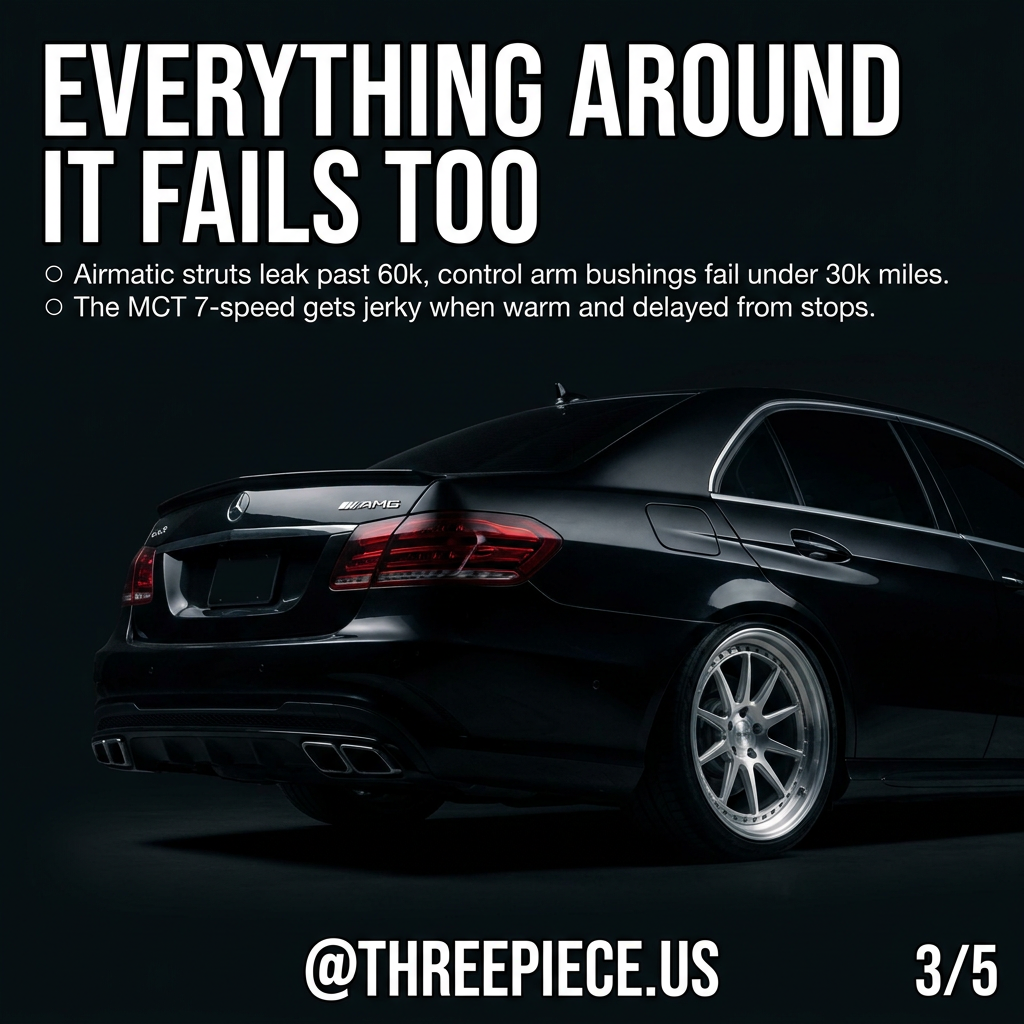
The MCT (Multi-Clutch Technology) transmission in 2012+ models — especially the 2014+ E63 S — develops rough shifts when warm, delayed engagement from stops, and generally jerky behavior as miles accumulate. Some owners resolve symptoms with a TCU (transmission control unit) reprogram, but others report the underlying hardware and clutch pack have limited service life. This isn't a "just flash it" fix on every car.
Airmatic Suspension
The rear Airmatic air struts are a known wear item that typically starts leaking past 60,000 miles. Compressors and valve blocks fail in sequence. The car sags overnight, rides unevenly, and throws fault codes. OEM replacement is expensive enough that many owners convert to coilovers to avoid repeating the expense every few years. If you're coming from the JDM world where coilover swaps are standard practice, this is one area where the E63 actually benefits from the aftermarket — but it's still a cost you're absorbing that the purchase price didn't warn you about.
Control Arms and Brakes
Front lower control arm bushings wear out early on the W212 platform. One documented owner had a bushing come completely loose at just 26,000 miles, causing vibration and steering wander. On a 577 hp sedan, that's not an annoyance — it's a safety issue.
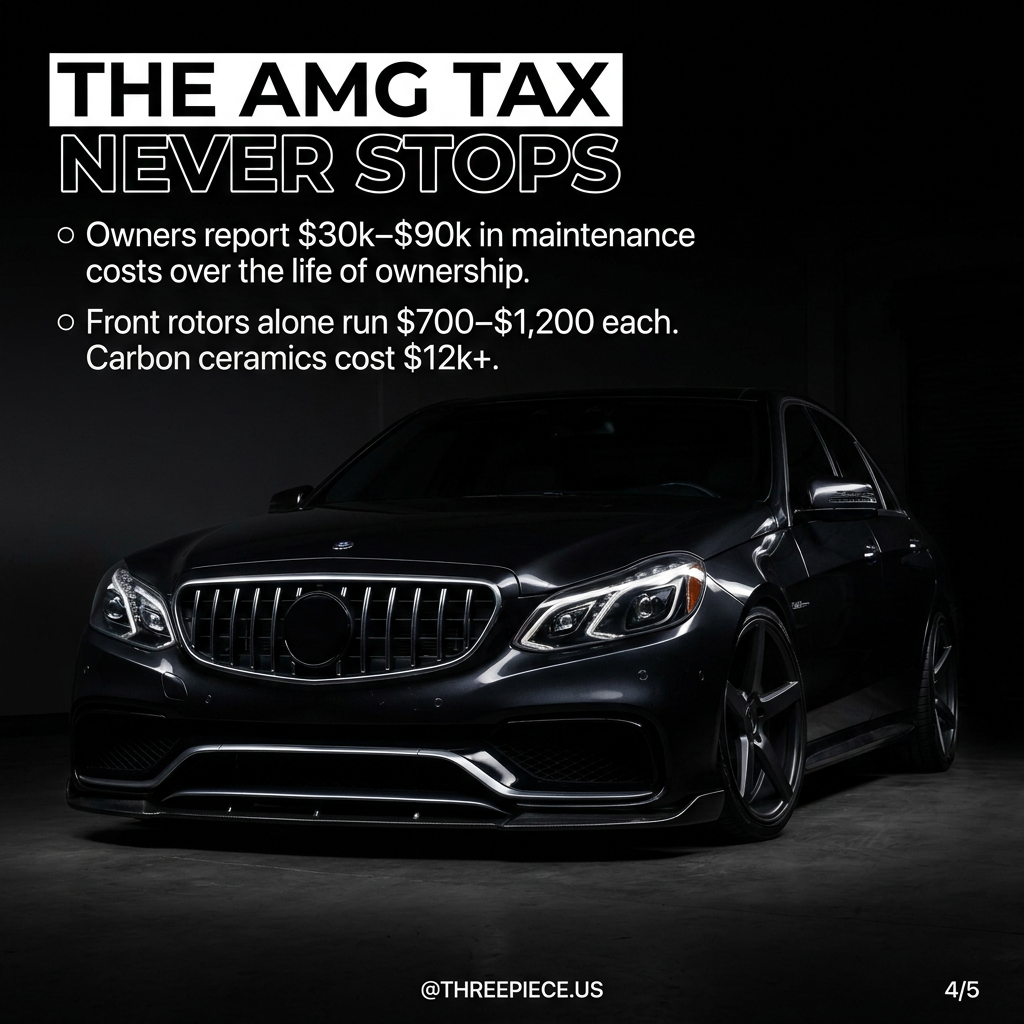
Brakes are another line item that shocks new owners. Front rotors alone cost $700–$1,200 each for OEM-spec replacements. If the car was optioned with the carbon-ceramic brake package, you're looking at $12,000+ for a full set. These aren't "if" expenses — they're "when" expenses on any E63 being driven as intended.
Rust and Corrosion
European and salt-belt examples are showing structural rust in the rear subframe — developing from the inside out around welds, which means it's invisible until it's serious. Repair costs range from €800 to €4,500+ depending on severity. Rear axle brake lines also corrode and fail after 8–10 years, particularly above the axle where road spray collects. This is the kind of hidden damage that a clean Carfax doesn't reveal.
The AMG Tax Never Stops
The W212 E63's purchase price has depreciated into attainable territory — $25,000–$35,000 for decent examples — but the maintenance costs haven't depreciated at all. Every part on this car carries the AMG surcharge. Spark plugs, sensors, accessory pulleys, engine mounts — all more expensive than standard E-Class equivalents, and there are more of them to replace.
Owners who've tracked cumulative costs report $30,000–$90,000 in maintenance and repairs once mileage climbs past 60,000. That's not a typo, and it's not limited to catastrophic engine failures. It's the accumulation of AMG-specific brake jobs, transmission services, suspension rebuilds, and the electrical gremlins that come with a decade-old German luxury car. Your $28,000 purchase price quietly becomes $45,000+ within two years of real ownership if you're maintaining it properly.
Finding a fully service-documented example is also harder than it should be. You need to verify whether head bolts were revised (M156), whether timing chain tensioners were replaced (M157), and whether the car has been bore-scoped recently. Without documentation, you're buying risk — and the seller knows it, which is why they're selling.
What to Buy Instead: The Lexus GS F Argument
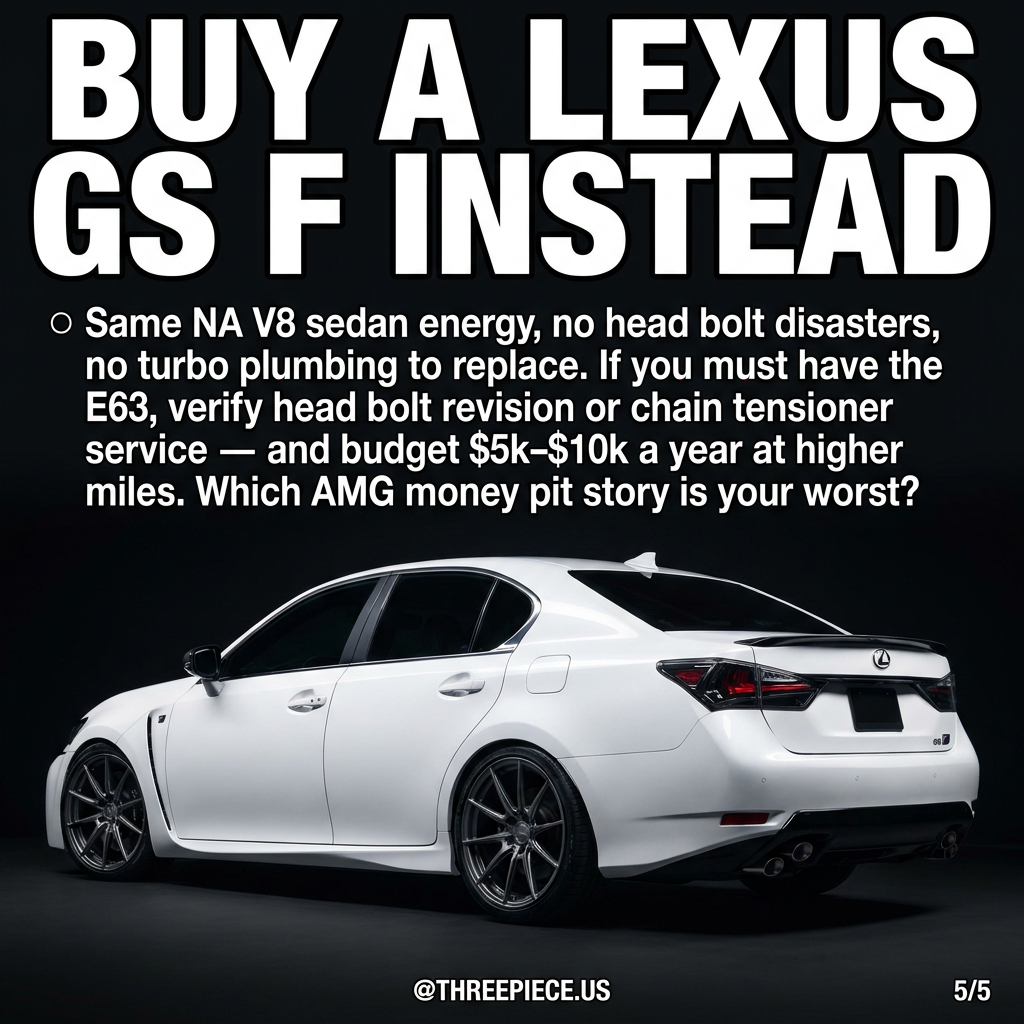
Nobody wants to hear "buy the Lexus instead," but the Lexus GS F exists in the same price bracket with a naturally aspirated 5.0L 2UR-GSE V8 that Toyota overengineered into near-immortality. Same V8 sport sedan energy. No head bolt disasters. No turbo plumbing to replace. No Airmatic struts leaking in your driveway. The GS F's biggest weakness is that it's slightly down on power compared to the E63 S — 467 hp vs 577 hp — but that delta evaporates the first time you write a check for cylinder re-sleeving.
If you're seriously considering a V8 sport sedan and want something you can actually enjoy without a dedicated maintenance fund, the GS F is the answer the internet doesn't want to give you. And if you're building one out properly, the Fortune Auto 500 Series coilovers for the GS platform at $1,799 will transform the ride and handling while eliminating the air suspension anxiety entirely. For a more budget-friendly entry point, the F2 Function & Form Type 2 coilovers for the GS start at $980. There's even a Function and Form Type 3 kit at $1,590 if you want the middle ground between adjustability and price. The GS platform responds beautifully to proper coilovers — it's one of those cars that was always better than its suspension allowed.
For wheel fitment, the GS F runs 5x114.3, which opens up the entire Japanese aftermarket. Browse 19" wheels in 5x114.3 to see what's available — a staggered 19x9.5 / 19x10.5 setup with moderate offset fills the GS F's fenders perfectly. Pair them with 255/35R19 fronts and 275/35R19 rears and you've got a setup that looks serious and performs. If you want the deep-dish JDM aesthetic, the Work VS series on a GS F is one of the cleanest VIP-meets-performance combinations you can build. Check our vehicle gallery for build inspiration across the platform.
If You Absolutely Must Buy a W212 E63
Some of you are going to buy one anyway. The sound, the presence, the hand-built engine plaque — it's intoxicating. If you're committed, here's the minimum due diligence:
- M156: Verify head bolt revision via engine serial number or valve cover color (black = revised). If unrevised, walk away or budget $5,000–$8,000 for the job proactively.
- M157: Confirm timing chain tensioner service was performed. Request a bore-scope inspection — any cylinder scoring is a deal-breaker unless the price reflects a $12,000+ rebuild.
- Both: Budget $5,000–$10,000 per year at higher mileage for maintenance. This is not pessimism — it's the median owner experience.
- Airmatic: If the struts haven't been replaced, they will need to be. Factor that into your offer price or plan a coilover conversion from day one.
- Rust: Inspect the rear subframe from underneath, around welds. Check brake lines above the rear axle. If you're in the rust belt, this is non-negotiable.
The W212 E63 is a genuinely special car that was engineered to a performance standard its depreciated price doesn't support. That gap between purchase price and ownership cost is where dreams go to get expensive. If you want the V8 sport sedan experience without the financial anxiety, the GS F — or even a well-sorted Lexus IS300 as a project platform — will deliver more smiles per dollar. For those exploring other German performance sedans, our breakdown of why the E90 335i is still worth buying covers a car with similar depreciation but a much more manageable ownership curve. And if you're weighing the monoblock vs 3-piece wheel decision for whatever sedan you land on, we've broken that down too.
Send this to the friend who's pricing one right now. What's your worst AMG ownership horror story — and did you keep the car?