
Camaro SS vs Mustang GT: Why the SS Is the Better Buy
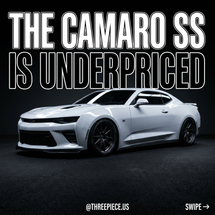
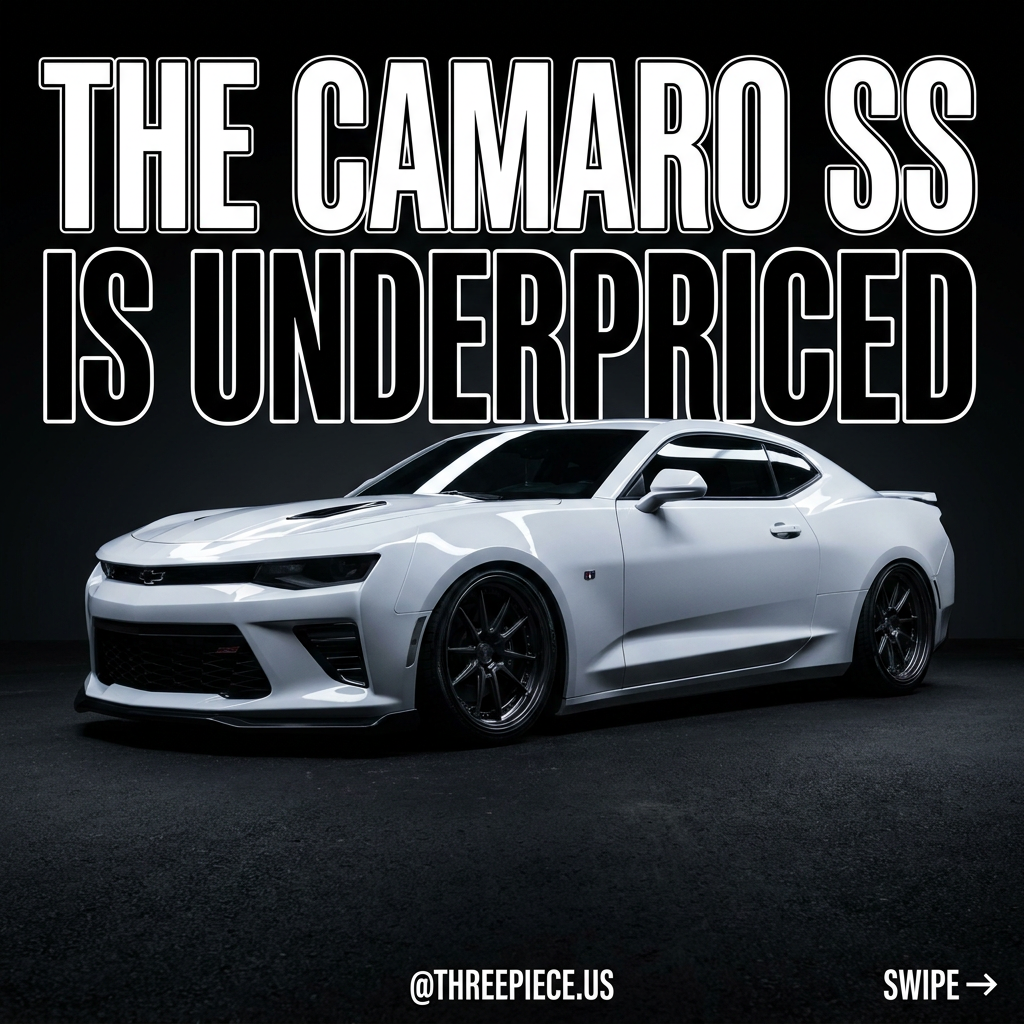
The Camaro SS is the most underpriced V8 coupe in America right now, and the Mustang GT crowd is quietly funding it. Six years of depreciation have dropped clean 6th-gen SS cars into the low $30Ks while comparable S550 GTs hold firm — and the Camaro is the better-driving car of the two. Not marginally. Structurally. This is the Camaro SS vs Mustang GT argument nobody in the muscle car aisle wants to have out loud.
Quick links
- The Alpha chassis isn't close
- LT1 vs Coyote: torque, dyno, and the #8 piston problem
- Why used SS pricing is the actual story
- The honest trade-offs: AFM, lifters, and visibility
- Camaro SS wheel fitment: 5x120 and the 1LE look
- Who should buy which
The Alpha chassis isn't close
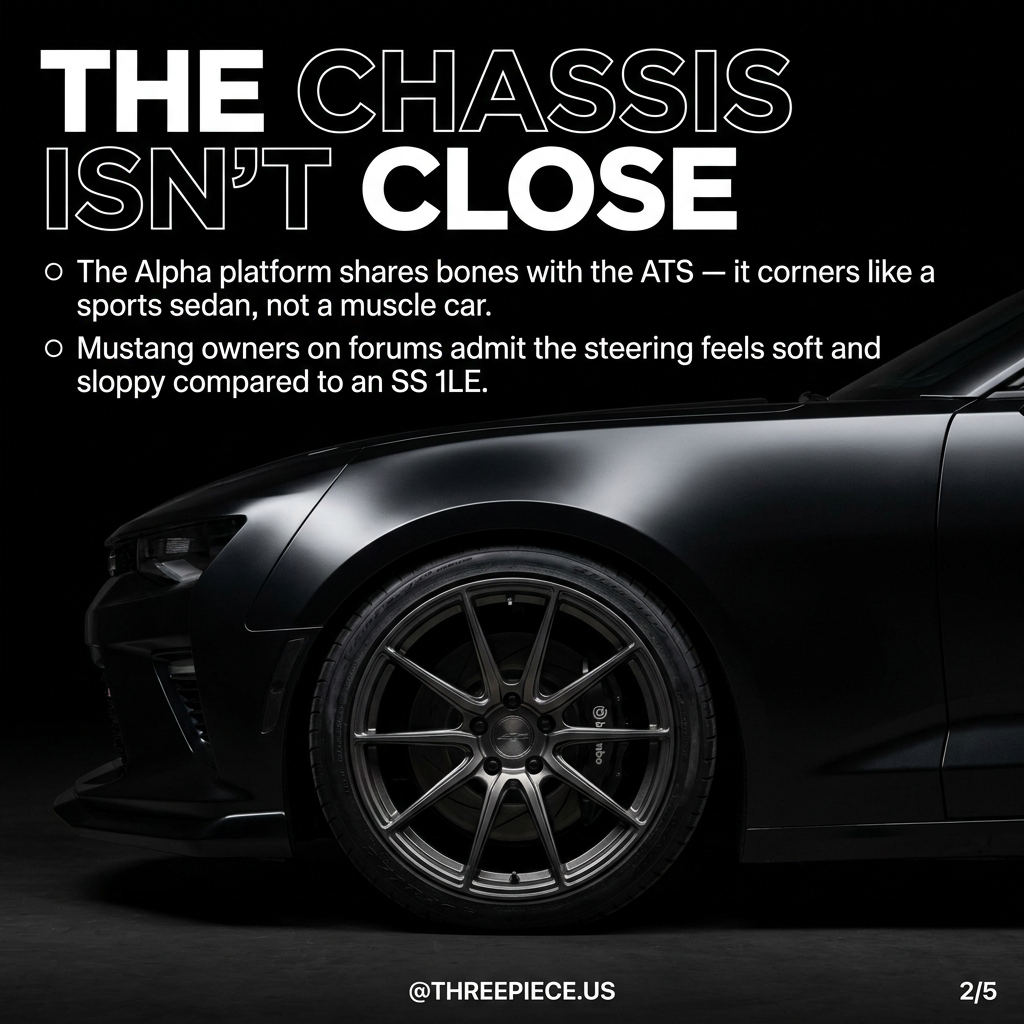
The 6th-gen Camaro rides on GM's Alpha platform — the same architecture underneath the Cadillac ATS. That's not a marketing footnote, that's why the car changes direction like a sport sedan instead of a coupe with a heavy nose and a hope. Short overhangs, a genuinely stiff structure, and a rear subframe GM spent real money validating on the Nürburgring.
The SS 1LE stacks FE4 magnetic ride, an electronic LSD, Brembo six-piston fronts, extra coolers, and factory 285/305 rubber on top of that. Mustang forum threads are full of GT owners admitting the S550's steering feels numb and soft next to a 1LE once you're past 7/10ths — and those are people who bought the Ford. If you're chasing that same feel on the blue oval side, our S550 big brake kit guide and a set of Fortune Auto 510 Series coilovers for the S550 at $2,399 get you closer — but that's several thousand dollars spent buying back what the Camaro shipped with.
LT1 vs Coyote: torque, dyno, and the #8 piston problem
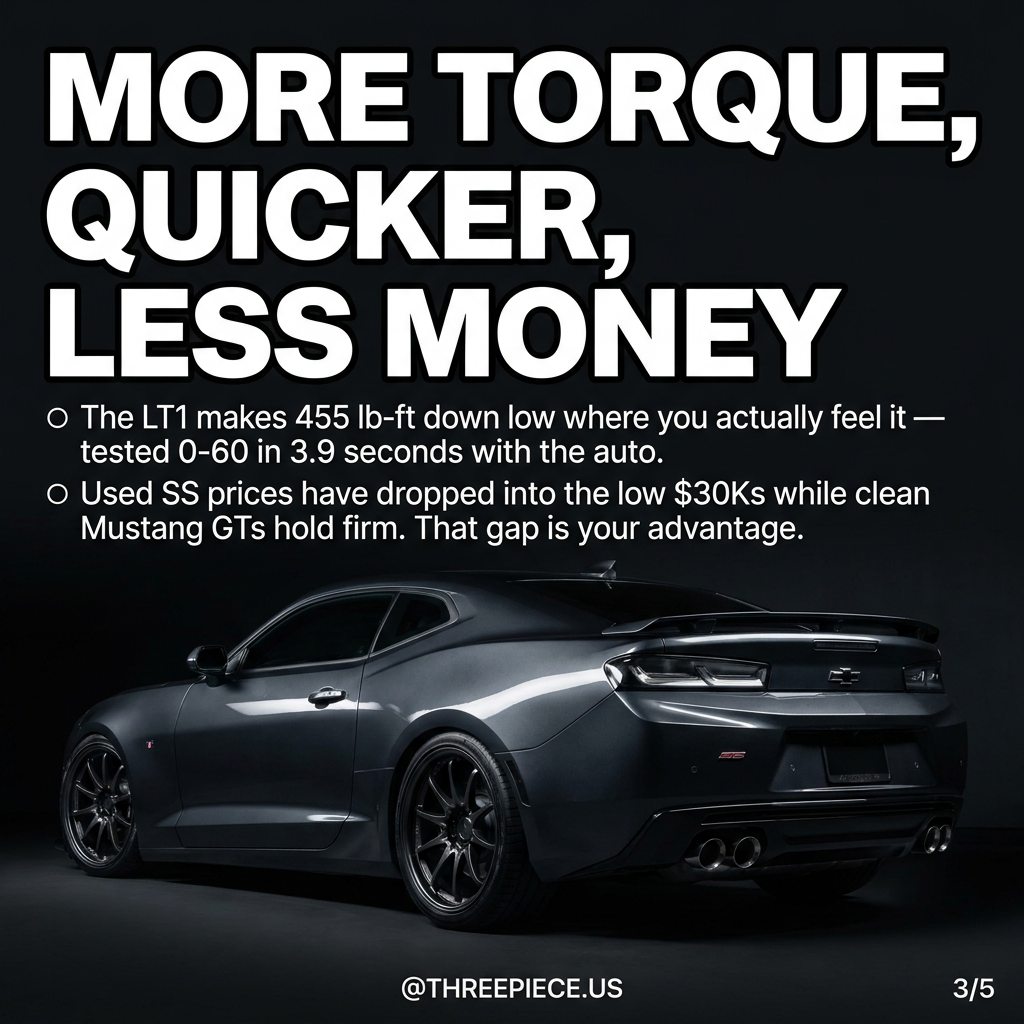
The 6.2L LT1 makes 455 hp and 455 lb-ft, and the torque number is the one that matters. It arrives low, flat, and everywhere — the SS pulls out of a second-gear corner while the Coyote is still building. Tested 0-60 in 3.9 seconds with the 8-speed auto, and in stock-vs-stock automatic drag comparisons on Camaro6, the SS consistently edges Performance Pack GTs through the quarter.
The Coyote revs prettier — no argument. But the Gen 3 5.0 has a documented weak spot: cracked ring lands on cylinder #8, with mustang6g threads showing failures as early as ~19,000-20,000 miles on 2015-2017 PP cars under mixed street and track use. Rebuilds mean forged 2618 pistons, block cooling mods, and an external oil cooler. Ford has pointed at aftermarket tunes; plenty of stock-tune cars have done it anyway. Then there's the MT-82 six-speed, which grinds and balks under exactly the torque you bought the car for. If you want the deep-dive on GM's small block lineage and where the LT1 fits, our Corvette LT1 evolution and known problems guide covers the engine family in detail.
Why used SS pricing is the actual story
Depreciation is doing the work here. Clean 6th-gen SS cars are landing in the low $30Ks, and 1LEs aren't far above that, while equivalently equipped S550 GTs sit stubbornly higher because the Mustang badge has broader mainstream pull. You're buying magnetic ride, an LSD, Brembos, and a chassis with real engineering behind it for less than a GT with the Performance Pack.
The scarcity angle is real too: GM ended 6th-gen Camaro production, so the supply of clean, unmodified 1LEs is now fixed and shrinking. That's the same market pattern that eventually caught up with the Z33 350Z and the SC300 — the discount window on a discontinued performance car doesn't stay open forever. Meanwhile Mustang attention has shifted to the S650 GT, propping up S550 values instead of softening them.
The honest trade-offs: AFM, lifters, and visibility
We're not going to pretend the Camaro is flawless. Buy blind and you'll get wrecked.
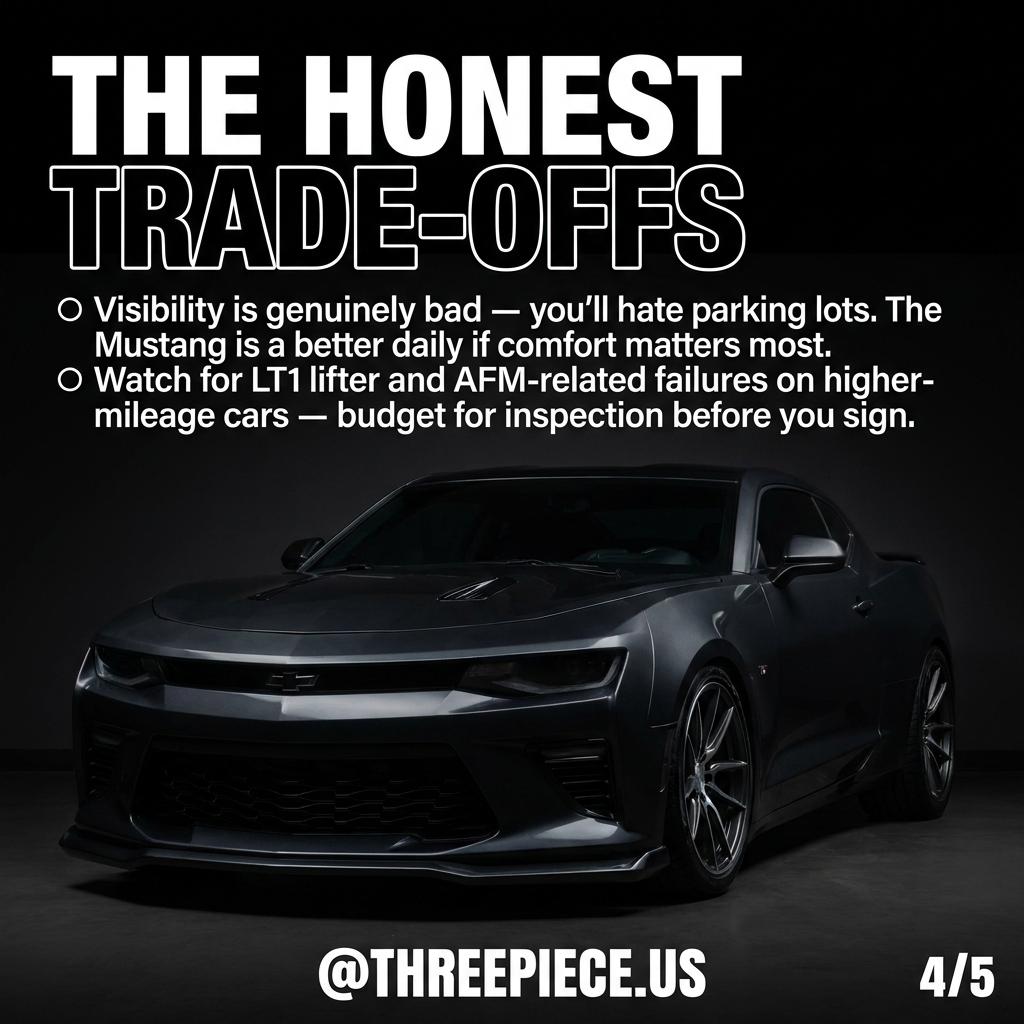
AFM / cylinder deactivation is the headline risk. Lifters stick, misfires follow, and in the worst documented cases fuel washing scores the bores. One 2023 SS 1LE owner went through two engine replacements inside 17,000 miles before GM repurchased the car under lemon law. Manual cars don't actively run in V4 mode but still carry the hardware. Thermostats, cooling fans, and water pumps are the other common complaint on 2016-2023 cars — expect anywhere from $150 to $1,200 depending on the part and who's turning the wrench. Get a compression and leakdown test before you sign, and pull service records looking for lifter work.
The counterweight: long-term 1LE track threads on camaro6 from owners with 10,000+ hard miles report replacing consumables — tires, pads, fluids, the occasional end link — and nothing else. If you're planning to actually use the car, budget for the right tire compound for your use case and read our take on 200TW vs summer performance tires before you burn money on the wrong set.
And the visibility complaint is legitimate. The Camaro's greenhouse is a mail slot. Parking structures are miserable. The back seat is a rumor. The Mustang is the easier car to live with on a Tuesday — that's the honest trade, and it's the entire reason the price gap exists.
Camaro SS wheel fitment: 5x120 and the 1LE look
The 6th-gen Camaro runs 5x120 — the same pattern as most modern BMWs, which quietly opens up a far deeper wheel catalog than people assume. Factory SS sizing is 20x8.5 front / 20x9.5 rear, while the 1LE steps up to a staggered 20x10 +23 front and 20x11 +43 rear wrapped in 285/30 and 305/30 Goodyear Supercars.
If you want the 1LE stance without hunting takeoffs, the MRR M017 20x10 +23 in gloss black and the matching MRR M017 20x11 +43 in gun metal graphite at $495 each replicate the factory 1LE spec exactly. Want something less literal? The MRR M024 20x10 +23 at $400 is the budget entry into that staggered look.
Going further up the ladder, Work Wheels builds 5x120 in the sizes this car needs — the Work Emotion T7R 2P at $531 and the Emotion CR 2P line both work on a Camaro that spends weekends at the track. Browse 20-inch 5x120 wheels for the full range, and 305/30R20 tires for the rears. Grab hubcentric rings while you're at it — 5x120 aftermarket wheels rarely match GM's 66.9mm hub bore, and a vibration you chase for three weekends is entirely avoidable. Check the vehicle gallery for real fitment references before you commit to an offset.
Who should buy which
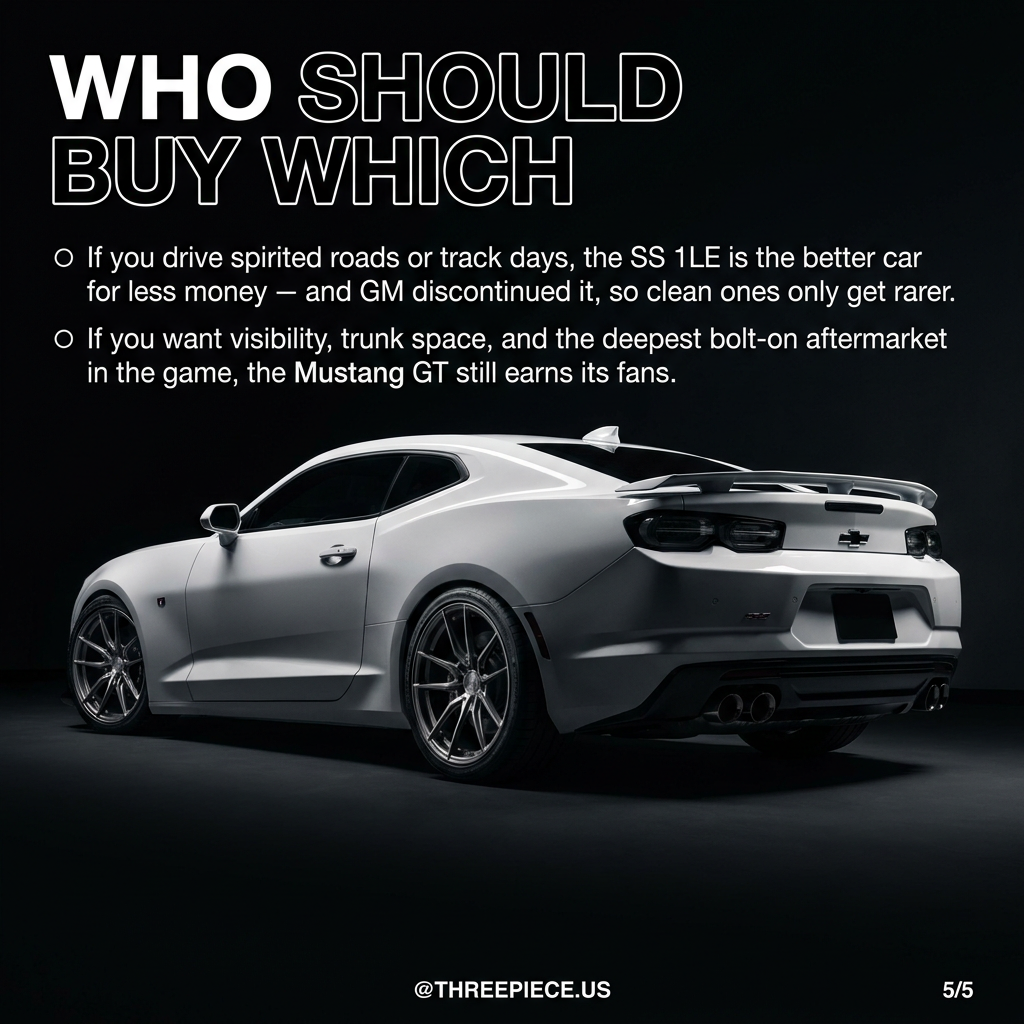
If you drive canyon roads, run HPDE weekends, or just care how a car loads up mid-corner more than how it looks in a drive-thru window, the Camaro SS 1LE is the better car for less money — and GM ended production, so the clean ones only get scarcer. Inspect for AFM and cooling history, then stop overthinking it.
If you need visibility, trunk space, a back seat that functions, and the deepest bolt-on aftermarket in American performance, the Mustang GT still earns every one of its fans. Just budget for supplemental cooling early and treat the MT-82 like the weak link it is. Either way, factory wheels are the first thing holding the car back — the wheel catalog is where the transformation actually starts, and proper lug nuts are the cheapest insurance in the build.
So settle it in the comments: you've got $33K and one weekend to buy. Are you taking a manual SS 1LE with a lifter question mark, or a PP1 GT with an MT-82 that grinds into third?