

The Lexus SC300 shares a platform, a 2JZ engine, and a nearly identical wheelbase with the MK4 Supra — and yet clean examples still sit on the market for a fraction of what any Supra commands. While Supra prices climbed into six-figure territory on the back of poster-car nostalgia and a single movie franchise, the SC300 quietly kept rewarding the people who actually understood what they were buying. This is the 2JZ car that Toyota hoped you'd forget about, and it's still one of the most undervalued platforms in the sport-compact world.

Quick links
- Same 2JZ Heart, No Supra Markup
- The Power Ceiling Is Absurd
- What Actually Breaks (Budget For These First)
- Manual vs Auto: Which SC300 to Build
- SC300 Wheel Fitment That Actually Works
- The Verdict: Stop Waiting on Supra Money
Same 2JZ Heart, No Supra Markup
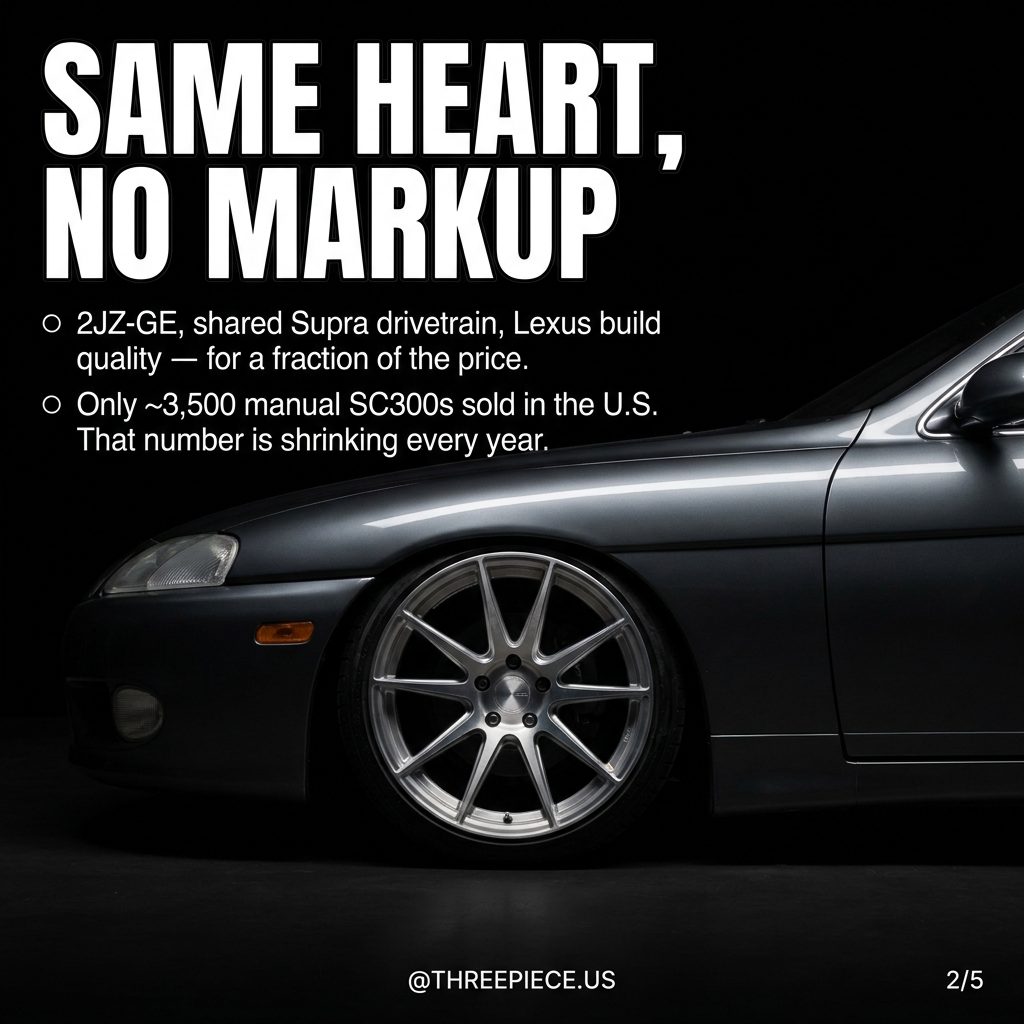
The SC300 runs the 2JZ-GE — the naturally aspirated sibling of the legendary 2JZ-GTE that made the Supra famous. Same iron block. Same overbuilt bottom end. Same capacity to absorb boost that would shatter lesser engines. Toyota wrapped it in Lexus interior quality, gave it a softer suspension tune, and marketed it as a grand tourer instead of a sports car. That branding decision is the entire reason you can still buy one for $8,000–$15,000 while equivalent-condition Supras command $60,000+.
The numbers that matter: only about 3,500 manual SC300s were sold in the U.S., primarily between 1992 and 1995 with the W58 5-speed. That number shrinks every year as cars get wrecked, parted out, or left to rot. The automatic cars are far more common, but even those are starting to thin out as the 2JZ tax slowly catches up to every chassis that houses one. If you've been watching this platform from the sidelines, the window is closing — just slower than it did for the Supra. The same pattern that turned the cheap C63 AMG into a cautionary tale is playing out here, except the SC300's mechanical foundation is dramatically more forgiving.
The Power Ceiling Is Absurd
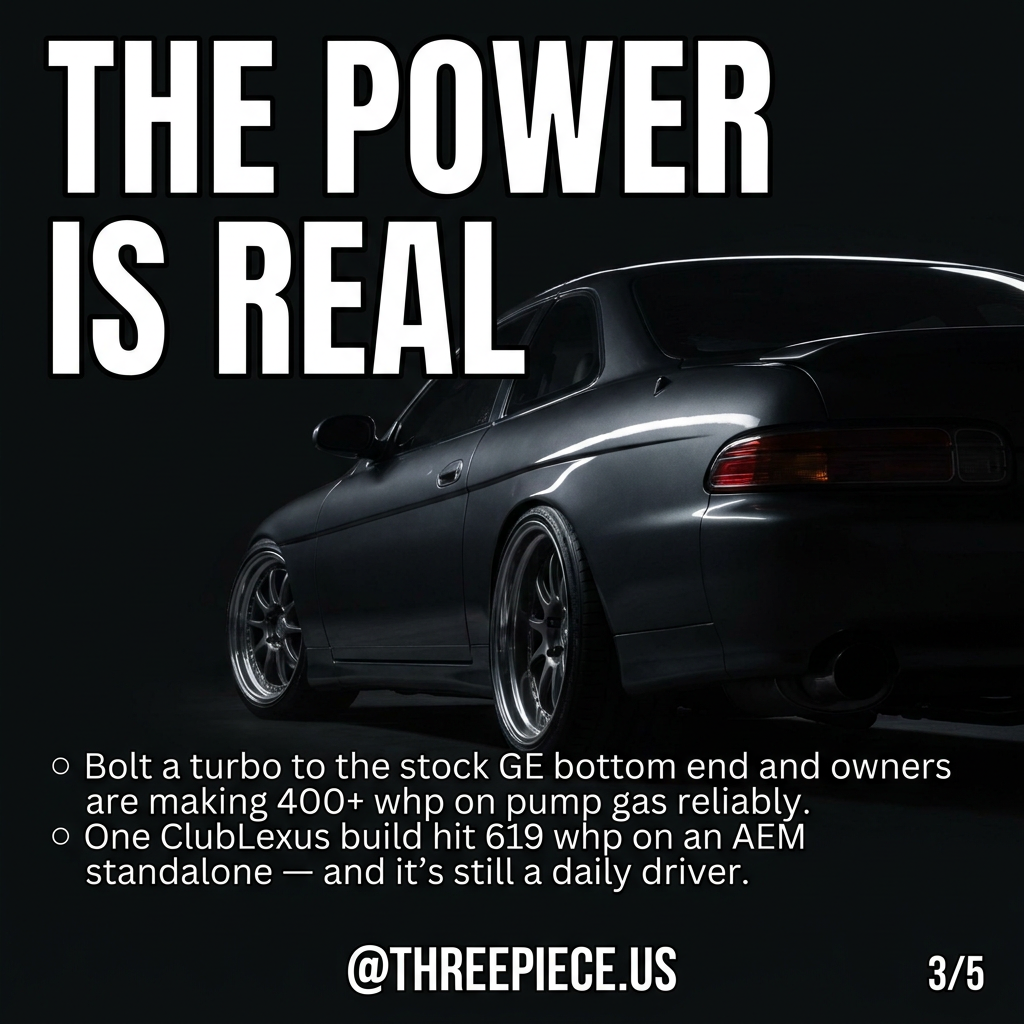
Stock, the 2JZ-GE makes about 225 horsepower at the flywheel — respectable for a '90s luxury coupe, but not the point. The point is what happens when you bolt a turbo to that stock bottom end.
Mild bolt-ons — intake, exhaust, cam gears, headers — net you an easy 20–30 whp and keep the car completely streetable. That's the safe, reliable path. But the SC300 community didn't stop there. Documented ClubLexus builds are running a BorgWarner S364.5 SXE turbo on a stock 2JZ-GE bottom end with OEM rods and pistons, ARP head studs, and proper fuel support, and making 507 whp through the W58 manual. One build hit 619 whp on an AEM standalone and the owner still daily drives it. That's the kind of headroom that makes the Supra's price premium look like pure ego tax.
For context, that 500+ whp on a stock block figure is territory that most platforms twice the price can't touch without a full forged rotating assembly. The 2JZ-GE's iron block and factory overbuild give it a turbo ceiling that embarrasses modern engines costing three times as much. If you want a deeper look at how other overlooked platforms punch above their weight, the Mazdaspeed3 400whp stock-block build guide tells a similar story — though the 2JZ's ceiling is in a different stratosphere.
What Actually Breaks (Budget For These First)
The SC300 is a Toyota underneath, which means the mechanical bones are genuinely excellent — but these cars are now 25–32 years old. Age-related failures are real, predictable, and mostly cheap to address if you know what to look for before you buy. Here's what the forums and long-term owners consistently report:
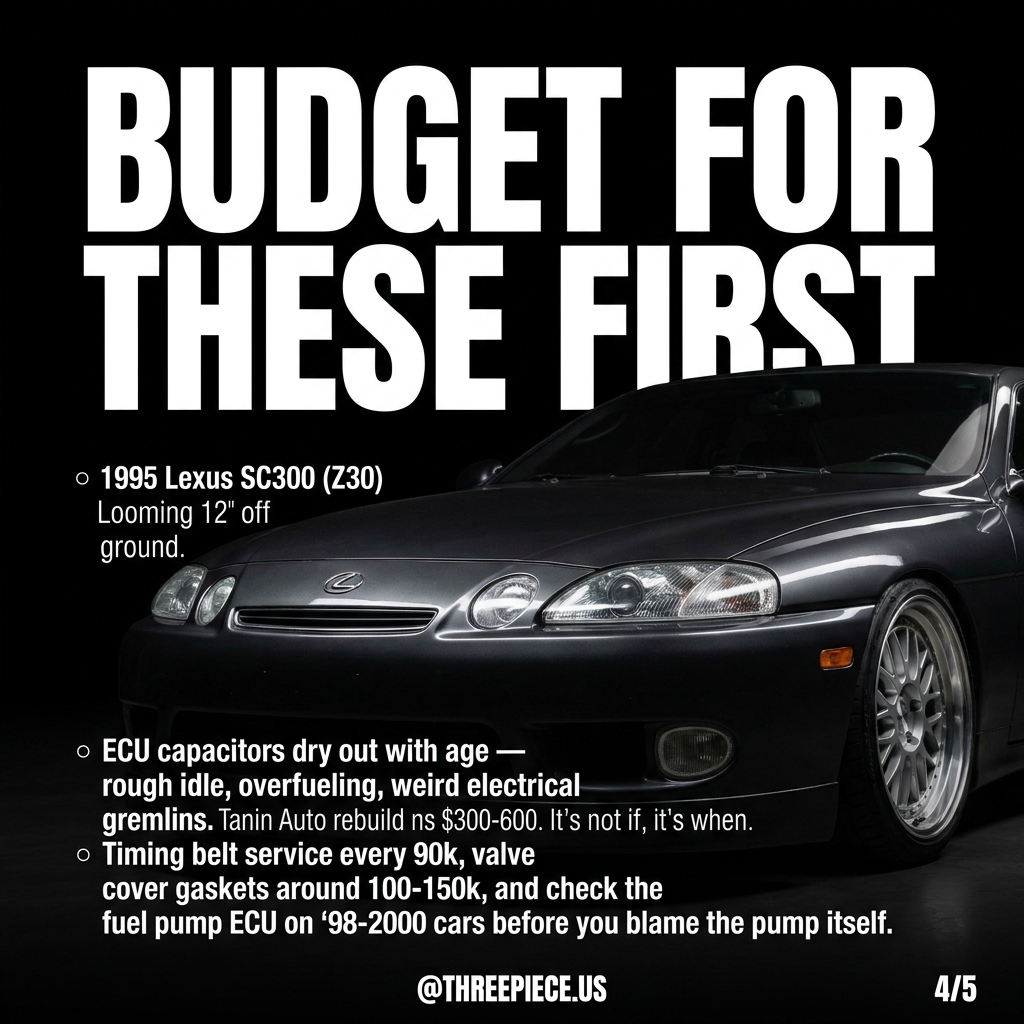
ECU capacitor failure — it's not if, it's when. The electrolytic capacitors inside the factory ECU dry out with age regardless of mileage. Symptoms are maddening: rough idle, overfueling (you'll smell it), sputtering, and electrical gremlins with no check engine light to point you in the right direction. Most owners report this hitting between 80,000–150,000 miles, but on early '90s units it's essentially guaranteed by now. A Tanin Auto Electronix rebuild runs $300–$600 and solves it completely. Budget for this on any SC300 purchase — consider it part of the acquisition cost, not a repair. This same age-related electronics decay is something N54 335i buyers learn the hard way, except the SC300's fix is a fraction of the cost.
Timing belt service every 90,000 miles. This is an interference engine. Skip this and you're looking at a catastrophic valve-to-piston meeting. The service itself runs $400–$800 at a shop, and you should replace the water pump at the same time since it's already exposed. Water pumps typically fail around 100,000–120,000 miles anyway — a $200 job when done alongside the belt, a much more expensive headache if it fails separately and overheats the engine.
Valve cover gaskets around 100,000–150,000 miles. Oil weeping around the valve covers, often combined with PCV issues. Parts are $40–$150 and the job is straightforward. Not urgent, but left alone it makes the engine bay look neglected and can drip onto the exhaust manifold.
Fuel pump ECU on 1998–2000 cars. Engine stalls and power loss get misdiagnosed as a bad fuel pump constantly. On late-model SC300s (and SC400s), the fuel pump ECU is usually the actual culprit. A used replacement runs $100–$250 and about two hours of labor. Check this before you throw a $300–$500 fuel pump kit at the problem.
Power steering control valve (PSCV). The PSCV gets brittle with heat and age, cracks, and can feed power steering fluid into the intake — which announces itself as white smoke and a whining noise on low-speed turns. Replacement runs $200–$400 and typically shows up around 150,000+ miles.
Harmonic balancer rubber degradation. The crank pulley's rubber isolator degrades on high-mileage examples (200,000–240,000 miles), causing vibration and belt misalignment. OEM damper replacement runs about $500 installed. This one's only relevant if you're buying a truly high-mileage survivor.
Manual vs Auto: Which SC300 to Build
This is where the SC300 community splits into two camps, and both have legitimate arguments.
The W58 5-speed manual is the grail configuration. It's the one that makes the car feel like the Supra sibling it actually is. The W58 handles power well with a proper clutch and supporting mods — those 507 whp builds prove the transmission can survive serious abuse when maintained. The downside: the W58's main-shaft bearing is a documented weak point. Forum reports show failures as early as 30,000 miles on abused examples, with rebuilds running $2,500–$4,000. Synchros and input/output shafts should be inspected during any rebuild. Some builders swap to a R154 or CD009 transmission for serious power goals, but that adds cost and complexity.
The automatic is more common and cheaper to acquire, but it has a hard torque ceiling. Owners report the stock automatic breaking around 450–475 ft-lbs of torque. Pushing past that requires valve body work, clutch upgrades, and custom parts that get expensive fast — one rebuild was quoted at $4,500 in 2023. The automatic ECM (part #89661-24350) is also a known failure point around 80,000–90,000 miles, causing shifting anomalies and the dreaded blinking O/D OFF light. Aftermarket or repaired ECMs run $500–$1,200.
The verdict: if you're building for power, find the manual. If you're building a clean cruiser or VIP-style car where the drivetrain stays relatively stock, the automatic is perfectly fine and significantly cheaper to buy. Either way, you're getting 2JZ bones in a chassis that costs a fraction of what comparable platforms demand.
SC300 Wheel Fitment That Actually Works
The SC300 runs a 5x114.3 bolt pattern with a factory wheel size of 16x7 on base models and 16x7.5 on later sport trims. Most builders step up to 18x8.5 +35 to 18x9.5 +22 depending on how aggressive they want the fitment. The fenders are surprisingly accommodating for a '90s Lexus — the long hood and wide rear quarters give you room to run real width without immediately needing to pull or roll.
For a street-oriented build, 18x9.5 +22 with 255/35R18 tires is the sweet spot that fills the fenders without rubbing on coilovers at reasonable ride height. Browse 18x9.5 wheels in 5x114.3 to see what's currently available. A square setup keeps tire costs down and lets you rotate — which matters on a car you're actually driving.
The SC300 is one of those platforms that looks right with Japanese wheels specifically. The body lines were designed in the same era as the golden age of 3-piece Japanese wheel design, and it shows. A set of Work Emotion T5R wheels starting at $396 gives you a lightweight flow-formed option that suits the coupe's proportions perfectly — clean enough for OEM+ builds, aggressive enough for a lowered stance car. If you're chasing a more period-correct VIP look, the Work VS series is the endgame conversation for this chassis, and you can finish them with Work VS reproduction center caps at $50 each to keep the presentation right without hunting for NOS caps.
For builders going the 3-piece route, the Work Emotion CR 3P at $895.50 lets you spec exact width and offset for the SC300's fender lines — no spacers, no compromise. That's the difference between wheels that fit and wheels that were built for your car. If you're curious about why that distinction matters, our breakdown of monoblock vs 3-piece wheels covers the mechanical and aesthetic trade-offs in detail.
Don't overlook the hardware. If you're running 3-piece wheels, M7x32 chrome assembly bolts at $10 each or the M7x32 24K gold bolt/nut sets at $15 are the details that separate a built car from a car with wheels on it. Finish with 90-degree valve stems at $3.80 for deep-dish lips where straight stems won't clear.

The Verdict: Stop Waiting on Supra Money
A clean 5-speed SC300 gives you 2JZ bones, Lexus build quality, a turbo ceiling that most cars twice the price can't touch, and a purchase price that leaves you actual budget to build the car instead of just owning it. The Supra commands what it commands because of cultural mythology. The SC300 commands what it commands because most people don't know what they're looking at — and that gap is your advantage.
The failure points are real but predictable and cheap relative to the platform's potential. Budget $300–$600 for the ECU capacitor rebuild, stay on top of the timing belt interval, and check the fuel pump ECU on late-model cars before you start throwing parts at a misdiagnosis. Do that, and the 2JZ underneath will outlast your interest in the car.
If you're building one, start with the suspension and wheels — that's where the SC300 transforms from a Lexus your uncle drove to a car people photograph at meets. Check out the ThreePiece vehicle gallery for build inspiration, and browse the full Work Wheels lineup to find the right face for your SC. The Work Emotion series and Work Meister series are both proven on this platform.
Manual or auto — which SC300 would you build, and how far would you push it before the W58 starts sweating?