

Mazdaspeed3 MZR DISI Build Guide: 400WHP Sleeper on a Stock Block
The Mazdaspeed3 was written off as a torque-steering FWD hatch for people who couldn't afford an Evo. That was a mistake. In 2025, MZR DISI owners are quietly pushing 370–400 whp on stock bottom ends, spending less than half what an equivalent EVO X build costs, and walking away from stoplights in a car that looks like a grocery-getter. While everyone was fighting over clean Evos and paying $35k for a GR Corolla, Speed3 guys built the most underrated power-per-dollar platform in the turbo compact world — and most of the car community still hasn't caught on.

Quick links
- 400 WHP on a stock block — how and why
- Fuel first or wreck everything
- What actually breaks: engine and transmission
- What to budget for a reliable 400 WHP build
- Wheel and tire fitment for the Mazdaspeed3
- Why you should find a clean one now
400 WHP on a Stock Block — How the MZR DISI Gets There
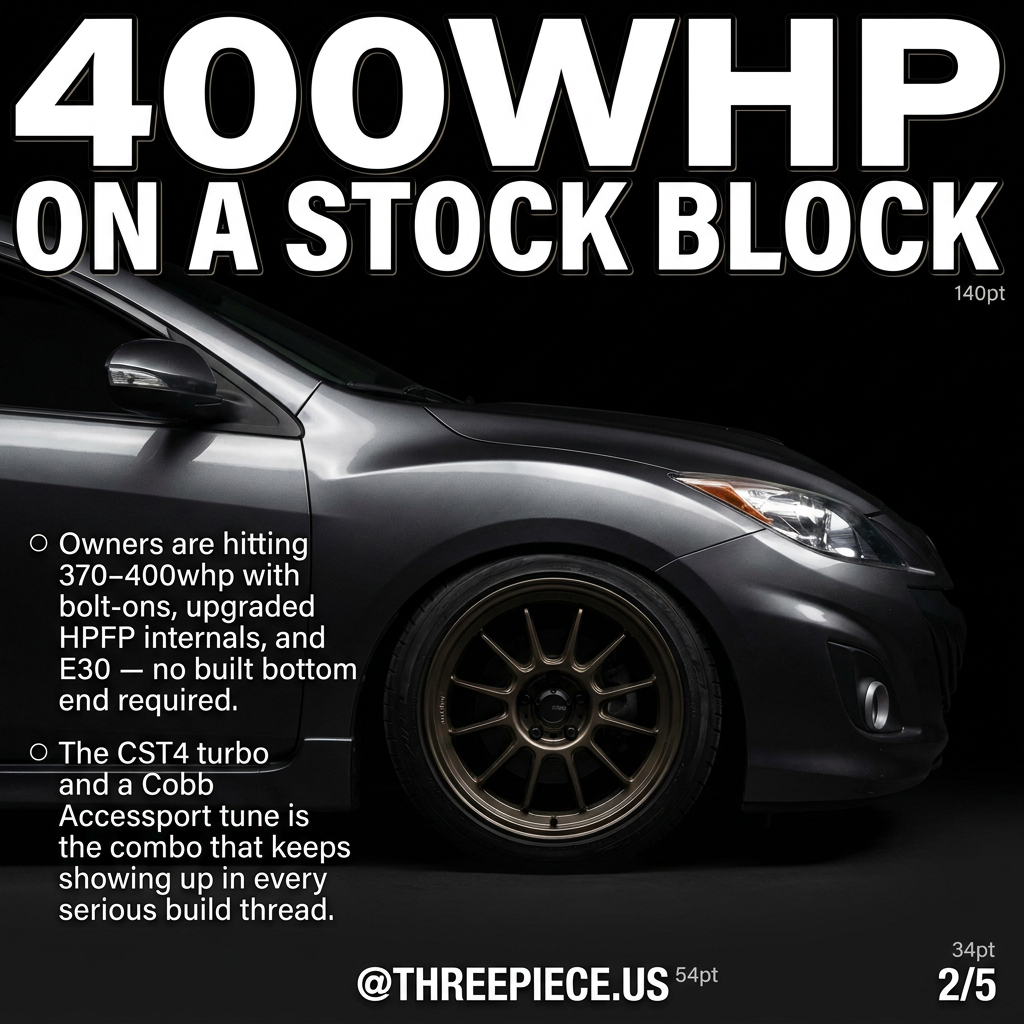
The Mazda 2.3L MZR DISI is a direct-injection turbo four that left the factory making around 263 hp. That number is conservative. The block and rods have more in them than Mazda ever intended, and the community has spent a decade proving it. The recipe that keeps appearing in every serious build thread on r/mazdaspeed3 and the MazdaspeedForums archives is remarkably consistent:
- CST4 turbo (or a similarly sized unit replacing the stock BorgWarner K04)
- Upgraded HPFP internals — Autotech or CorkSport
- E30 fuel blend or auxiliary port injection for knock resistance
- Cobb Accessport with a proper protune (not an OTS map — owners who run OTS maps at this power level are gambling)
- 3-inch downpipe, larger top-mount intercooler, and upgraded charge piping
That combination, on a car with a healthy stock bottom end, is putting down 370–400 whp on a dyno with repeatable results. Some owners have even squeezed 400 whp from the stock K04 on high boost and E30, though that's pushing the turbo's efficiency map to its ragged edge. The point is: this isn't a "built motor" power level. It's bolt-ons, fueling, and tuning. If you've followed the Evo X vs. STI reliability conversation, the Speed3 is the third option nobody brought up — and it's cheaper than both.
Fuel First or Wreck Everything
This is the single biggest mistake in the Mazdaspeed3 community, and it wrecks engines every year: bolting on a bigger turbo or cranking boost before upgrading the fuel system. The stock high-pressure fuel pump maxes out around 380 whp. Past that threshold, the HPFP can't maintain rail pressure under full load, the ECU pulls timing or the engine goes lean, and you get the kind of knock event that bends valves and cracks ring lands.
Autotech or CorkSport HPFP internals are considered mandatory before you chase any real power on this platform. This isn't optional. It's not a "nice to have." It's the difference between a car that makes reliable power and a car that becomes a parts listing. Budget $300–$500 for the pump internals and do it before anything else. If you're pushing past 380 whp, auxiliary fueling — port injection or methanol — is the next layer of insurance. The N54 335i crowd learned this same lesson with their HPFP failures; the MZR DISI is no different. Fuel system first, power second.

What Actually Breaks: Engine and Transmission Failure Points
Every platform has its gremlins. The Speed3's are well-documented, and if you know what to look for, most of them are preventable. Here's what real owners report — not forum rumors, but repeated failure patterns across hundreds of build logs.
Engine
- Timing chain stretch and VVT failure — Gen1 models (2007–2009) are the worst offenders. Expect chain rattle starting around 80,000–100,000 miles. If the chain jumps timing, you're looking at bent valves and potentially a new head. Listen for rattle on cold start. Budget for replacement if buying a high-mileage Gen1.
- Stock internals at the limit — Rods and pistons are pushed near their mechanical ceiling at 380–400 whp. You can live there on a street car with conservative timing and good fuel, but if you're planning track days or want to push past 400, forged rods and pistons are the next step. Full internal builds open the door to 450+ whp but add $3,000–$5,000 in parts and machine work.
- Oil pump collar wear — The oil pump gear collar can develop excessive clearance, leading to low oil pressure. Boundary Engineering documented this failure mode years ago. Check oil pressure on any used purchase.
- Rear main seal leaks — Common under sustained boost and heat. Not catastrophic, but annoying and messy. Replace it if you're already pulling the transmission for a clutch job.
Transmission and Drivetrain
- 3rd gear synchro failure — The single most common transmission complaint. Grinding or resistance on the 2–3 shift, especially at high RPM. Symptoms typically appear between 80,000–130,000 miles. Worn synchronizers and bent shift forks are the usual culprits. Some owners manage it with good fluid (Motul 300 is the community favorite) and deliberate shifting; others eventually need a rebuild.
- Pivot shaft seal leak — A $50–$150 fix that causes gear oil loss. If the oil level drops, 1st/2nd/3rd engagement suffers and can mimic a synchro failure. Check for leaks before assuming the worst. This is the kind of thing that Subaru Spec B owners know all about — a cheap seal that causes expensive-sounding symptoms.
- Clutch wear — Stock clutch won't hold past roughly 300 lb-ft of torque. A worn clutch slipping under boost can feel like a transmission problem. Stage 2 or sprung 6-puck clutch kits run $800–$1,500 installed. Budget for this from the start if you're building power.
- Motor mount decay — When the rear and passenger motor mounts fail (and they will — the rubber compounds Mazda used were not designed for sustained high-boost loads), the drivetrain shifts under load, misaligning the shifter linkage. This causes missed gears and grinds, especially 2–3. Upgraded polyurethane or aluminum mounts fix the issue but add NVH. It's a trade-off every Speed3 owner makes eventually.
What to Budget for a Reliable 400 WHP Mazdaspeed3
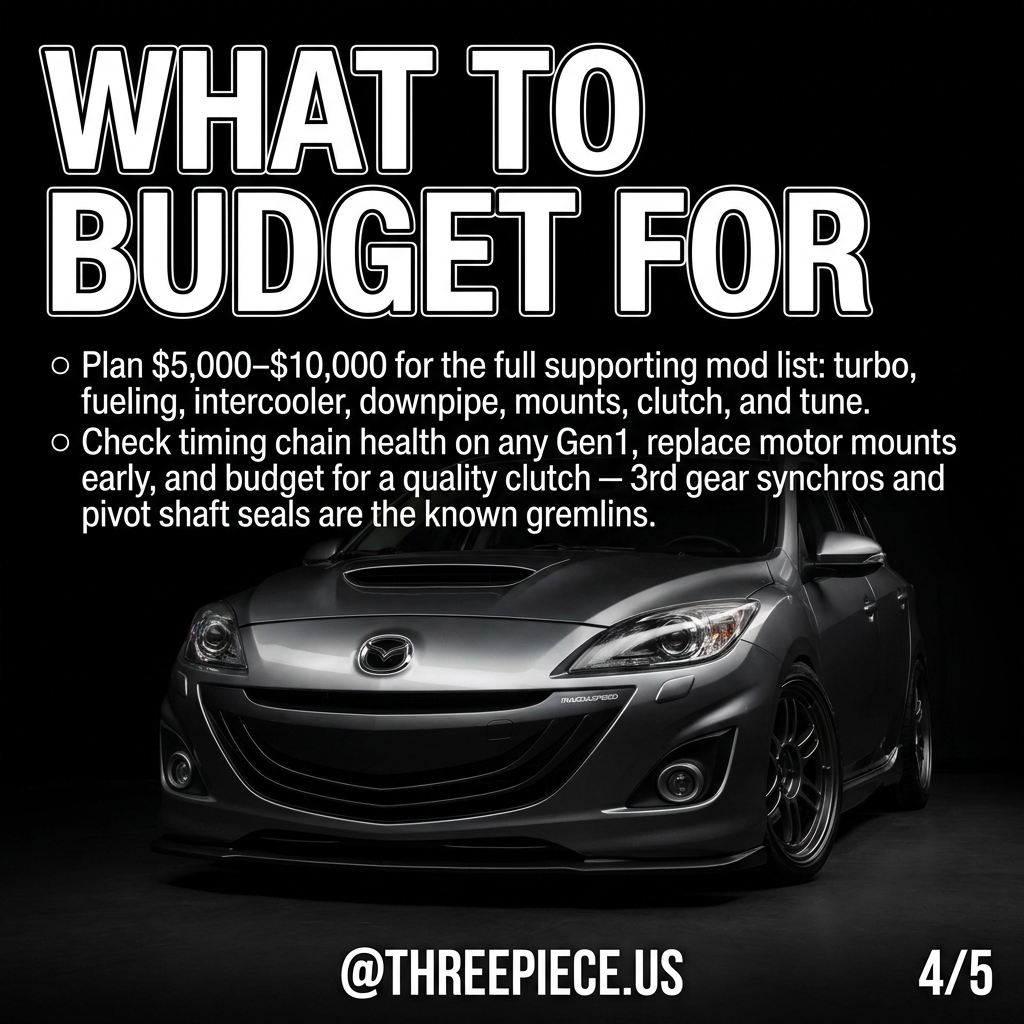
Here's what the full supporting mod list actually costs when you add it up honestly — not the "I'll do it in stages" number, but the real all-in figure:
- Turbo upgrade (CST4 or equivalent): $1,200–$1,800
- HPFP internals (Autotech/CorkSport): $300–$500
- Auxiliary fueling (port injection or meth kit): $400–$800
- Top-mount intercooler upgrade: $500–$900
- 3-inch downpipe: $300–$600
- Upgraded clutch (Stage 2/6-puck): $800–$1,500
- Motor mounts (rear + passenger): $200–$400
- Cobb Accessport + protune: $600–$1,000
- Miscellaneous (charge piping, injector seals, gaskets, fluids): $300–$600
Total: $4,600–$8,100 in parts, plus labor if you're not doing it yourself. Call it $5,000–$10,000 all-in for a shop-installed, properly tuned 400 whp Mazdaspeed3. That's the price of a set of wheels on some builds — and you're getting a 400 whp hatchback that nobody sees coming. For context, a comparable Focus RS or Golf R build to reach similar numbers costs significantly more, and neither of those platforms has the same sleeper factor.
Wheel and Tire Fitment for the Mazdaspeed3
The Mazdaspeed3 runs a 5x114.3 bolt pattern with a 67.1mm hub bore. The sweet spot that the community has settled on for a flush, aggressive look without rubbing issues is 18x8.5 +35 to +45 square, or 18x9.5 +30 to +38 if you're running coilovers and can dial in the camber. Tire sizing on the 8.5-inch width is typically 235/40R18 or 245/40R18; on 9.5-inch, 255/35R18 is the move.
If you're shopping for Volk Racing NE24 5x114.3 18x9.5+22 Matte Gun Black, the Speed3 shares its bolt pattern with a huge range of Japanese performance cars, which means fitment options are deep. The Work Emotion CR Kiwami starting at $270 is a flow-formed option that suits the aggressive hatch aesthetic perfectly — lightweight, concave, and available in the right offsets. If you're ready for the endgame set, the Work Emotion CR 3P at $895.50 per wheel lets you spec exact width and offset for your build. For something with a different spoke character, the Work Emotion D9R at $414 has the kind of deep concave face that fills the Speed3's fenders properly.
Tire choice matters on a 400 whp FWD car more than almost any other platform — you're putting all that power through the front axle. Browse 245/40R18 tires or 255/35R18 tires depending on your width. If you want the deep dive on why tire construction matters at this power level, our Michelin Pilot Sport 4S review covers the benchmark. And don't forget hubcentric rings — the 67.1mm hub bore means you'll need them for most aftermarket wheels, and skipping them on a high-torque FWD car invites vibration you'll never tune out.
For a breakdown of how monoblock, 2-piece, and 3-piece construction compares — and why it matters for a car you're actually driving hard — read our monoblock vs. 3-piece guide. And if you're comparing lightweight options across brands, the Aodhan DS03 vs. Enkei RPF1 comparison is worth reading before you commit.

Why You Should Find a Clean Mazdaspeed3 Now
A well-maintained Mazdaspeed3 with HPFP internals already done is the best turbo FWD platform under $15,000. Clean examples with service history are still out there for $8,000–$14,000 depending on generation, mileage, and mods. That's less than a clapped-out Evo X with a questionable title, and it's half the price of a Focus RS that Ford already stopped making.
Here's what to look for when you're shopping:
- HPFP internals already upgraded — this is the single best indicator that the previous owner knew what they were doing.
- Timing chain service history — especially on Gen1 (2007–2009). If it hasn't been done by 100k, budget for it immediately.
- 3rd gear feel — drive it hard through 2nd and 3rd. Any grinding or resistance means synchro work is coming.
- Motor mount condition — excessive drivetrain movement under load means the mounts are gone. Easy to check, easy to fix, but factor it into your offer.
- Oil pressure at operating temp — low pressure at idle when warm could indicate oil pump collar wear.
The Speed3 is the sleeper that actually earns the word. It's a practical hatchback that makes 400 whp for the cost of a decent vacation, and it does it while looking like nothing. That's the whole point. Browse the vehicle gallery for build inspiration, check out our Mazda 3 wheel fitment guide for sizing reference on the newer platform, and start hunting. The clean ones are getting harder to find every month.
What's the first mod you'd do on a Speed3 — HPFP internals like a responsible adult, or turbo first and pray?