
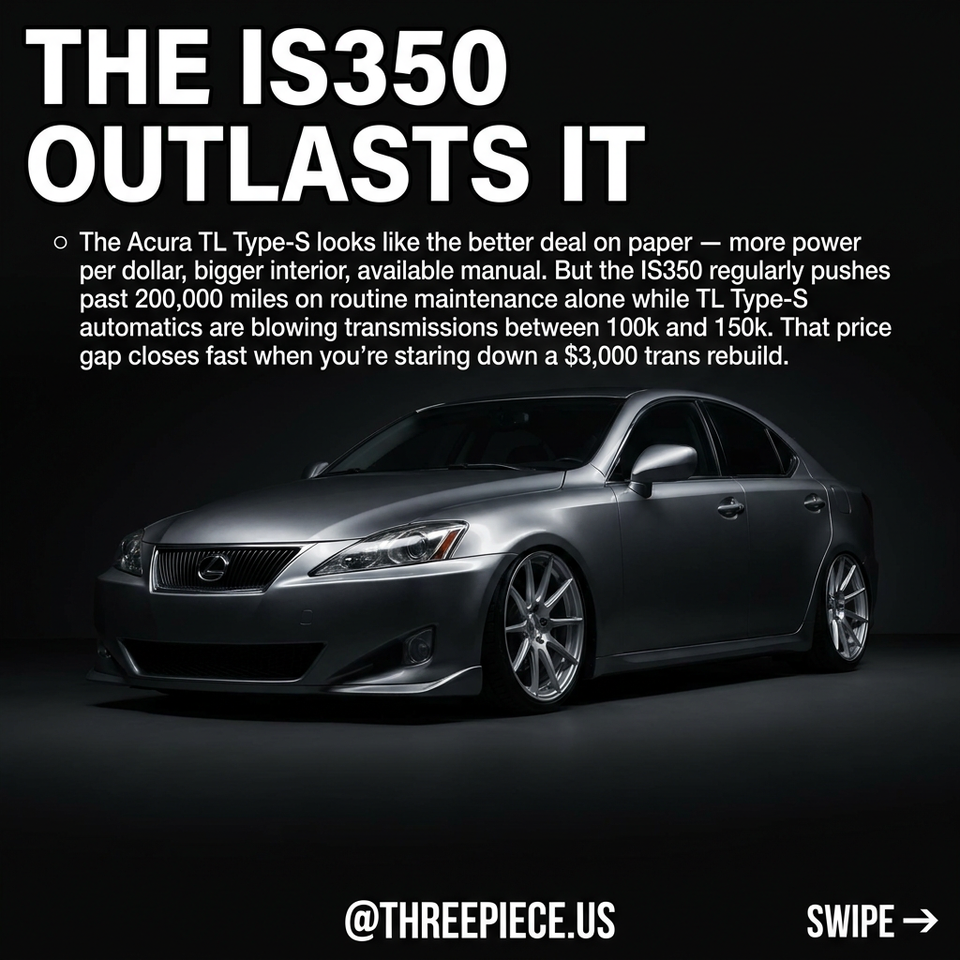
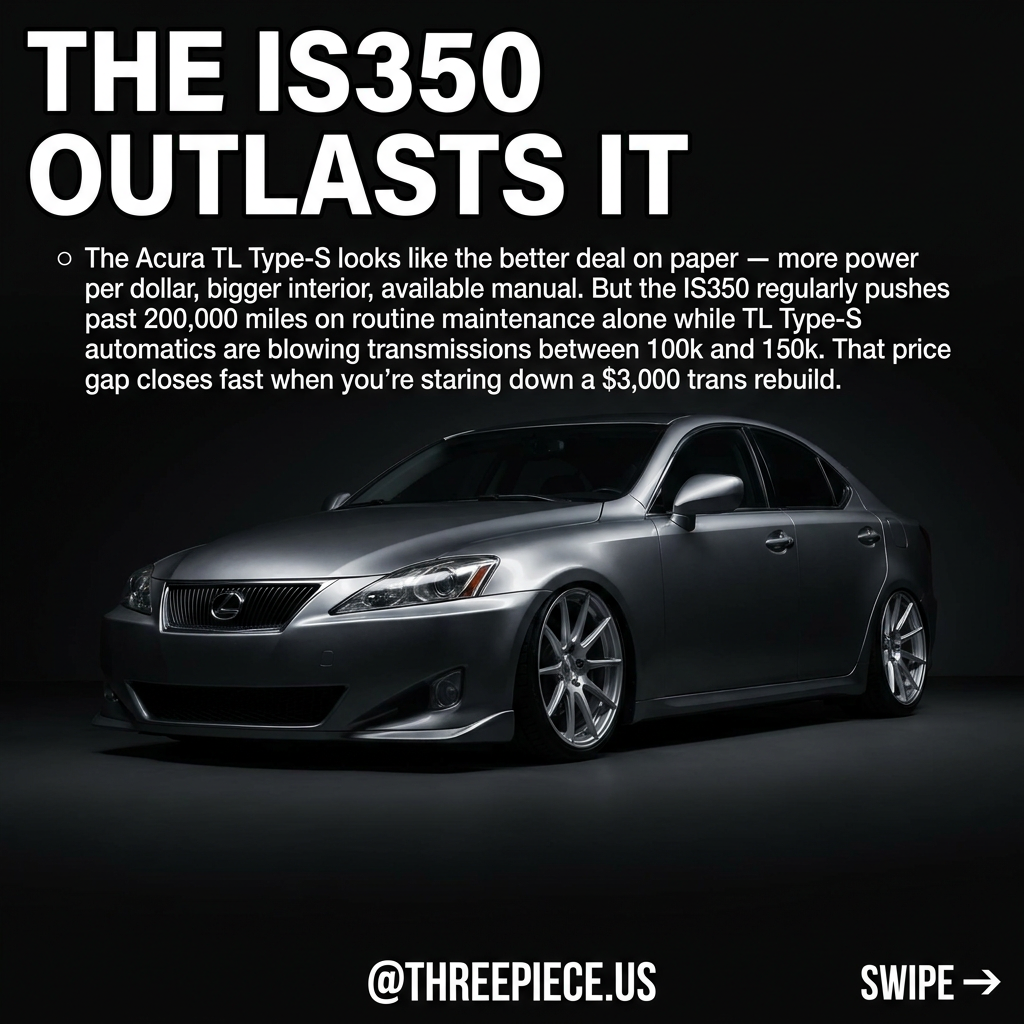
The Lexus IS350 vs Acura TL Type-S debate has been raging on forums since the mid-2000s, and most people get the answer wrong. The TL Type-S looks like the better deal on paper — more interior space, a lower buy-in price, and an available 6-speed manual. But the IS350's 2GR-FSE V6 making 306 hp through the rear wheels is one of the most bulletproof sport sedan powertrains ever built, and it changes the entire ownership equation once you look past the first year. If you're cross-shopping these two right now, here's what actually matters — not spec sheets, but what happens at 100,000+ miles when the bills start showing up.
Quick links
- The TL Type-S Transmission Problem
- 306 HP Through the Rear Wheels
- Long-Term Ownership Costs Compared
- Where the TL Type-S Actually Wins
- Wheel Fitment for Both Platforms
- Suspension Upgrades Worth Doing
- The Smart Play in 2025
The TL Type-S Transmission Problem
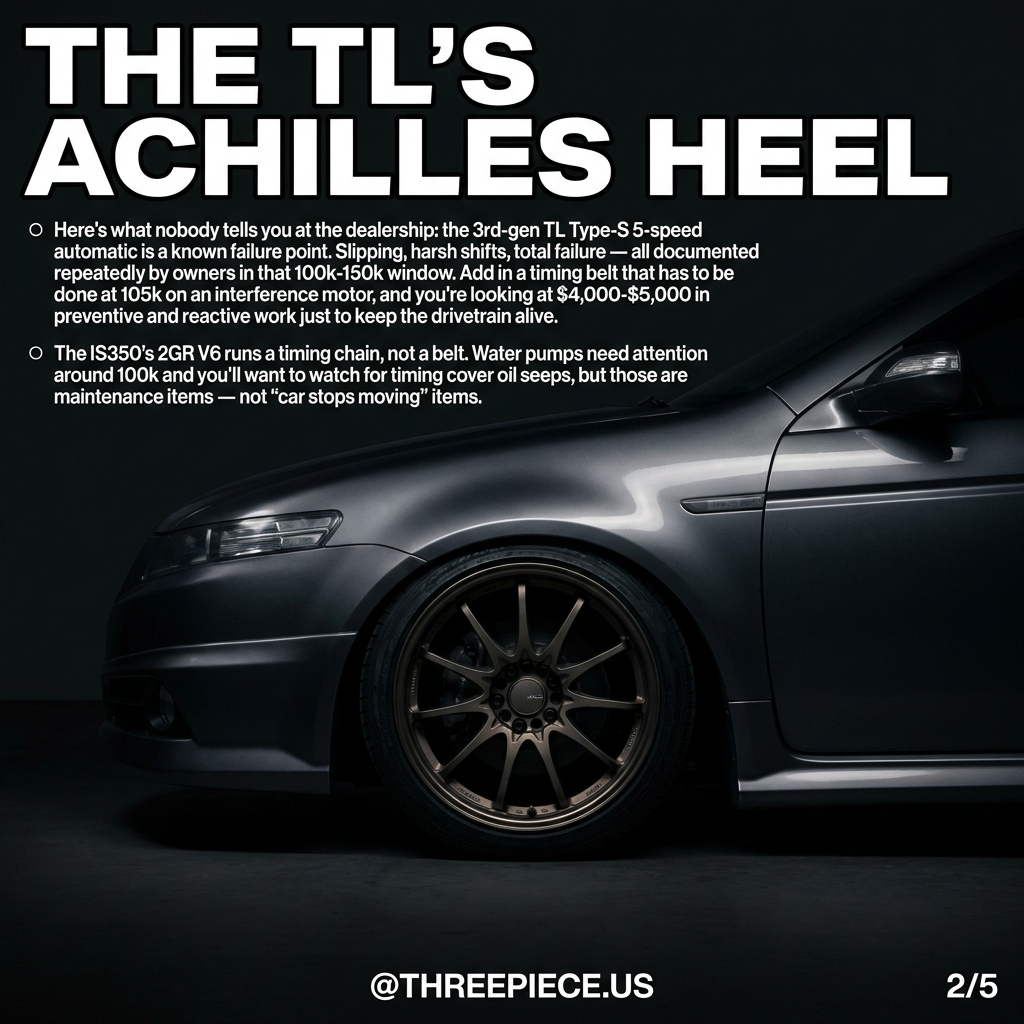
Here's the thing nobody tells you at the dealership: the 3rd-gen TL Type-S 5-speed automatic is a documented failure point. Slipping, harsh shifts, and total failure — all reported repeatedly by owners in that 100,000–150,000 mile window. This isn't a fringe issue. CarComplaints and AcuraZine threads are stacked with owners who watched their transmissions go from "a little rough" to "neutral at highway speed" in a matter of months. A rebuilt or replaced unit runs $2,500–$3,500 depending on clutch pack condition.
Then there's the timing belt. The TL Type-S runs an interference V6, which means the belt must be replaced around 105,000 miles. Skip it and you're looking at bent valves and an engine rebuild north of $5,000. Even done proactively, the belt service itself costs $800–$1,200. Add the transmission risk and you're staring at $4,000–$5,500 in preventive and reactive drivetrain work just to keep the car running. That "cheap" TL Type-S isn't so cheap anymore. For more on how these hidden costs stack up in the used sport sedan market, our breakdown of the best manual sports cars under $20K puts this in perspective.
306 HP Through the Rear Wheels
The IS350's 2GR-FSE makes 306 hp and 276 lb-ft stock — that's 20 more horsepower than the TL Type-S, and it's sent to the rear wheels. No torque steer, no FWD grip limitations, just a planted rear-drive sedan that puts power down cleanly. Owners on ClubLexus and My.IS describe the power delivery as linear and the car as "silly fast" in real-world driving compared to the TL. The difference isn't just on paper — it's in how the car behaves at 7/10ths on a back road.
The IS350 also runs a timing chain, not a belt. Water pumps need attention around 100,000 miles and you'll want to watch for timing cover oil seeps on 2006–2010 models, but those are maintenance items — not "car stops moving" items. That distinction is everything when you're buying a 15-year-old sport sedan. If you want the full history of how the IS platform evolved, our Lexus IS history guide ranked by owners covers every generation in detail.

Long-Term Ownership Costs Compared
Let's put real numbers on this. Assume you buy either car at 80,000 miles and plan to drive it to 200,000.
On the TL Type-S automatic, you're budgeting for: timing belt service at 105k ($800–$1,200), potential transmission rebuild between 100k–150k ($2,500–$3,500), oil consumption issues on the J37 engine starting around 50k–70k (PCV or piston ring work, $1,000–$2,000), and the infamous cracked dashboard on 2005–2007 models ($1,500–$2,000 to replace). Electrical gremlins — nav failures, window regulators, door actuators — add another $100–$600 each.
On the IS350, the major items are: water pump around 100k ($800–$1,000), timing cover seal jobs if you see seepage (~$1,500), suspension bushings and rear trailing arms by 80k–100k ($800–$1,500), and the sticky dashboard issue on 2006–2008 models (Lexus covered many under warranty, but not all). The IS350's big-ticket transmission issues are rarer and more concentrated in early 2006–2010 models — the 2012–2013 cars largely sidestepped those problems.
The TL's worst-case scenario is a $5,000+ engine rebuild from a snapped timing belt. The IS350's worst-case is a $5,000–$7,000 transmission rebuild, but that's far less common and mostly limited to early cars with neglected fluid changes. Overall, the IS350 has a lower probability of catastrophic failure, and its maintenance items are more predictable. Our Lexus SC400 problems guide covers similar Toyota V8 platform quirks if you're exploring other Lexus options.
Where the TL Type-S Actually Wins
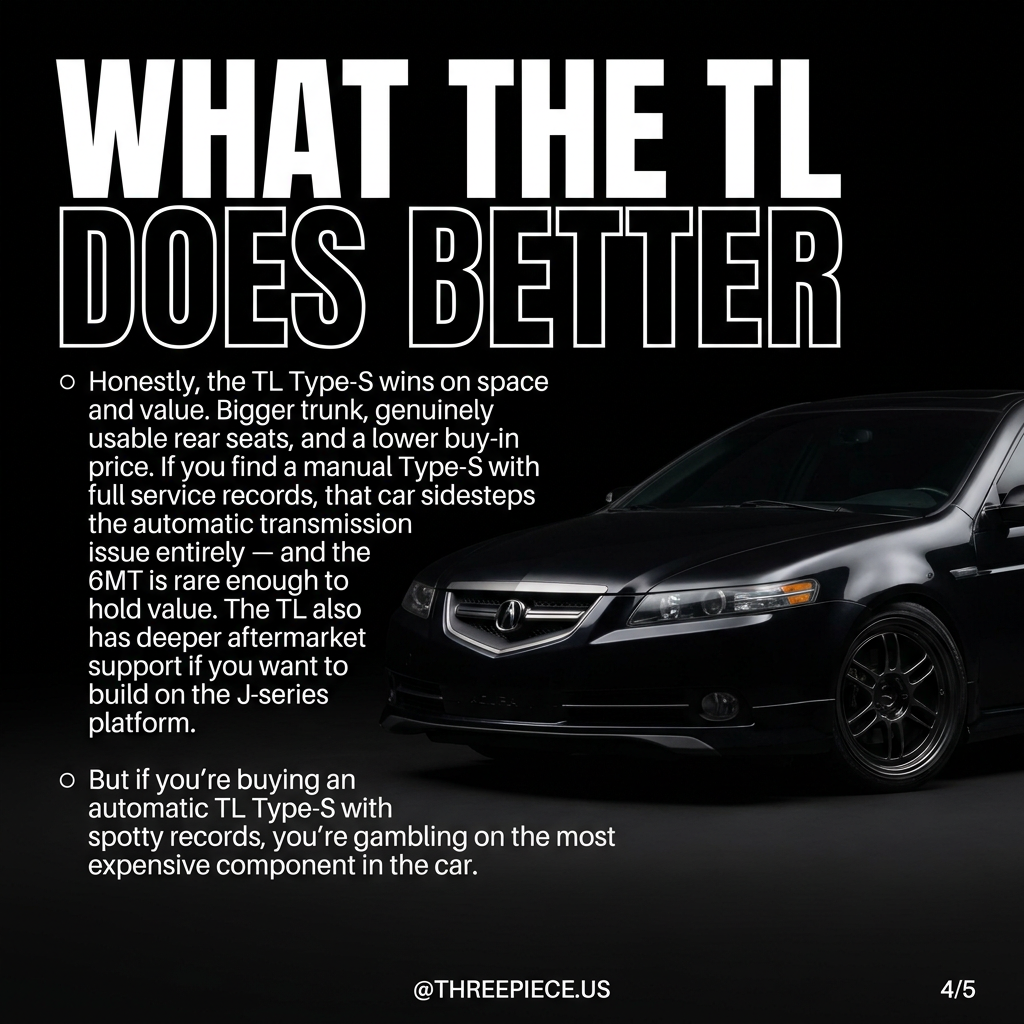
We're not haters. The TL Type-S genuinely wins in a few areas. The rear seat is significantly more usable — actual adults can sit back there, which is borderline impossible in the IS350's cramped cabin. The trunk is larger. And the buy-in price is lower, especially for automatics.
Most importantly: if you find a manual TL Type-S with full service records, that car sidesteps the automatic transmission issue entirely. The 6MT is rare enough to hold value, and the driving experience is more engaging than either car in automatic form. The TL also has deeper aftermarket support if you want to build on the J-series platform — owners report 320–340 whp with intake, header, catback, and a flash tune, though torque steer becomes a real issue at those power levels.
The TL's FWD layout also gives it an edge in snow and rain traction without needing to step up to the IS350's less common AWD variant. If you're daily driving in a northern climate and don't want to deal with winter tires on a RWD car, that matters. For more on how the Honda/Acura platform stacks up as a budget build, check out our best Honda under $8K guide.
Wheel Fitment for Both Platforms
Both of these cars look dramatically better on the right wheels, and fitment is straightforward on either platform.
The 3rd-gen TL Type-S runs a 5x120 bolt pattern with a 64.1mm hub bore. The sweet spot is 18x8.5 +35 to +40 square, or a staggered 18x8.5 front / 18x9.5 rear if you're going aggressive. Browse 18-inch wheels in 5x120 to see what fits. Pair them with 245/40R18 tires for a flush look without rubbing on stock suspension.
The IS350 runs a 5x114.3 bolt pattern with a 60.1mm hub bore. Stock IS350 F-Sport comes on 18x8 +45, but most owners drop to 18x9 +25 to +35 or go 19x8.5 front / 19x9.5 rear for a staggered setup. Check out 19-inch wheels in 5x114.3 for the IS350. If you're running aftermarket 3-piece wheels, make sure you're using the correct hubcentric rings to center them properly — our guide on hub-centric vs lug-centric wheels explains why this matters.
For the IS350, the Work Emotion series and Work VS series are both popular choices in the Lexus community. If you're rebuilding or refreshing a set of 3-piece wheels, Work Wheel Lips - Reverse start at $399 and Work Wheel Barrels - Step are also $399 — both let you change the width and offset of your existing Work wheels without buying a whole new set. Visit our vehicle gallery for build inspiration on both platforms.
Suspension Upgrades Worth Doing
Both the TL Type-S and IS350 respond well to suspension upgrades, and both need them if you're buying at high mileage. The IS350's bushings and shocks are typically worn out by 80,000–100,000 miles, and the TL's control arm bushings contribute to that vague, wandering feeling owners complain about at highway speed.
For the IS350, coilovers are the move if you're lowering and want adjustable damping. The F2 Function & Form Lexus IS350 06-13 Type 2 Coilovers at $980 are a solid entry point for street driving. If you want more adjustability, the Function and Form IS350 RWD Type 3 Coilovers at $1,590 give you full height and damping control. For 2014+ IS350 owners, the Silvers Neomax 1-Way Coilovers at $1,399 are another strong option. Budget-conscious builders can also look at the ISC Basic Coilover Kit for 2006-2013 IS350 starting at $1,081.
For the TL Type-S, the Fortune Auto 500 Series Coilovers for 2004-2008 Acura TL at $1,799 are the enthusiast favorite — Fortune Auto's valving is well-suited to the TL's weight and FWD dynamics. If you're on a tighter budget, the F2 Function & Form Acura TL 04-08 Type 1 Coilovers at $882 get the job done for daily driving. Either way, once you lower the car, read our guide on why your lowered car needs rear camber arms — both platforms develop excessive negative camber when dropped.
The Smart Play in 2025
If you wrench on your own cars, found a clean manual TL Type-S with service records, and want the bigger car with J-series mod potential — go for it. That car is genuinely special and the 6MT sidesteps the platform's biggest weakness.
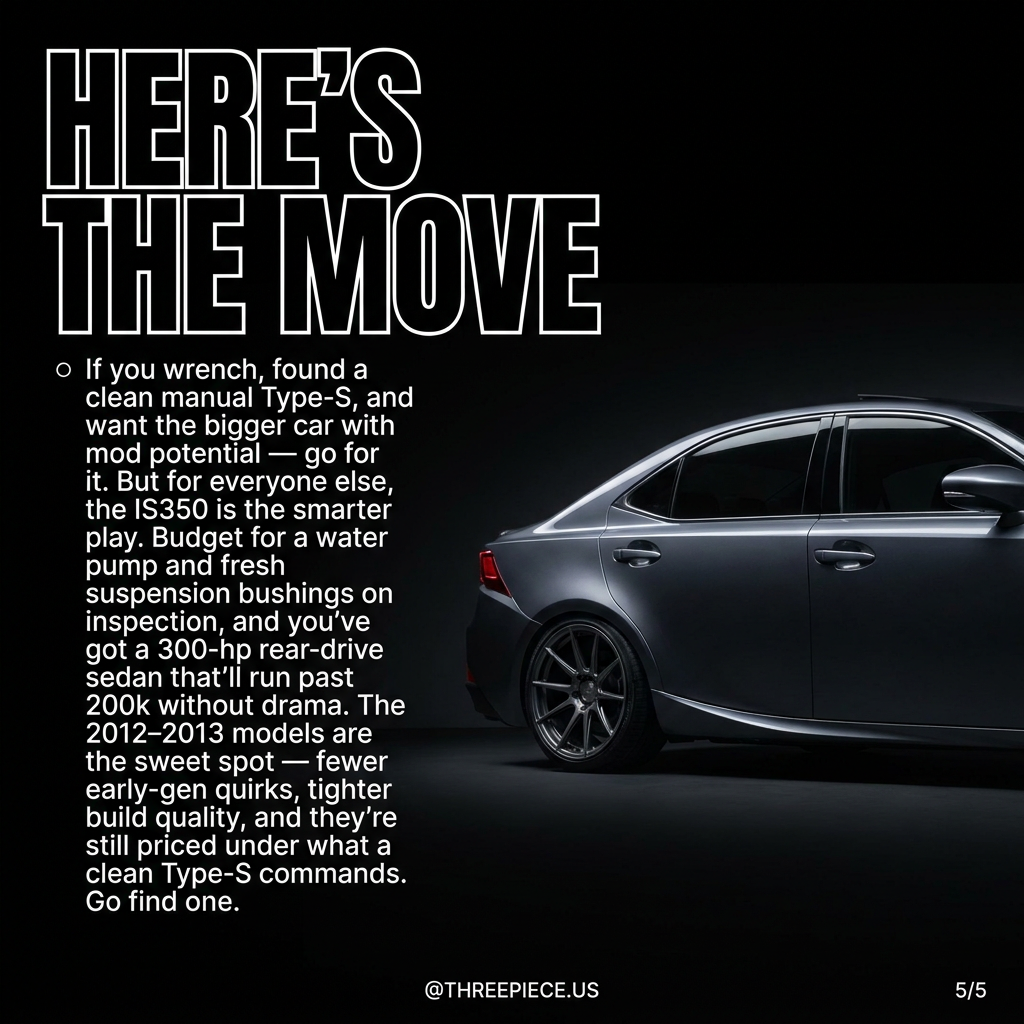
But for everyone else, the IS350 is the smarter play. Budget for a water pump and fresh suspension bushings on inspection, and you've got a 300-hp rear-drive sedan that'll run past 200,000 miles without drama. The 2012–2013 models are the sweet spot — fewer early-gen quirks, tighter build quality, and they're still priced under what a clean TL Type-S commands.
Whichever car you choose, the right wheels and suspension transform both platforms. Browse our full wheel catalog for options that fit, or check out our suspension collection to get the ride height dialed in. Both of these cars deserve better than stock wheels at 150,000 miles — go finish the build.
Want to see what actually fits? Browse real Lexus IS350 wheel fitments — owner setups with full specs on our fitment gallery.
Try wheels on your car: see the Lexus IS350 bolt pattern, wheel sizes by year and wheel builds and the Acura TL bolt pattern, wheel sizes by year and wheel builds in our free wheel visualizer.