
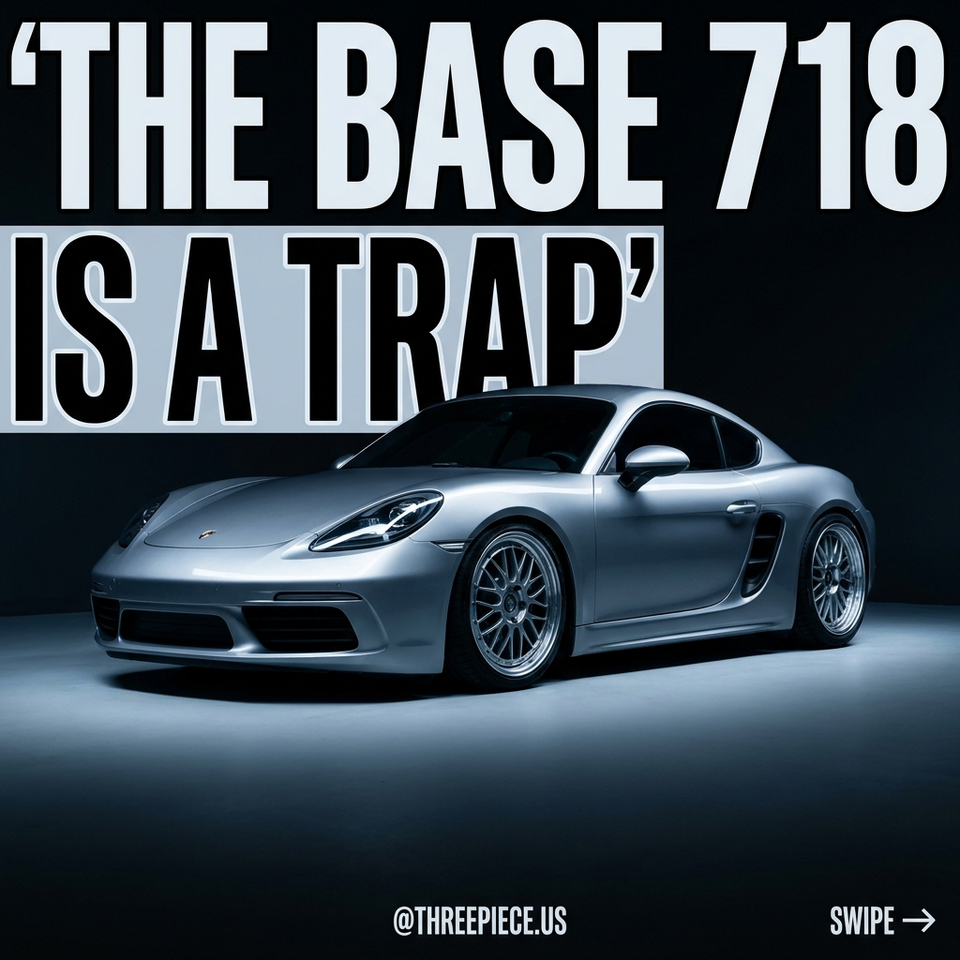
The Porsche 718 Cayman is the only modern Porsche that gets quieter the more money you throw at it. That's not an exhaust joke — it's what happens when you sign a $72,000+ check for a base 2.0T flat-four and a 20-year-old 987 rolls up next to you at Cars and Coffee sounding twice as expensive. This 718 Cayman buyer's guide isn't about whether the chassis is good. The chassis is arguably the best-handling thing Porsche builds. It's about why the four-cylinder 982 is the one car in the lineup you should walk past, and what to buy instead.

Quick links
- The flat-four problem isn't power
- Base price is a fiction
- The market already voted
- Buy the six: 981 S, GTS, or GTS 4.0
- 718 wheel fitment: 5x130 and the offset trap
- The verdict
The flat-four problem isn't power, it's identity
Let's get the easy part out of the way: the 2.0T flat-four makes 300 hp and the 2.5T in the S makes 350 hp, and both are genuinely quick. Nobody serious argues that the four is slow. Mid-engine balance, brilliant steering, a chassis that flatters you at 7/10ths and still has more left — all of that survived the engine swap intact.
What didn't survive is the noise. Mid-engine Porsche magic was always half sound, and that half is gone. You sit inches from an engine that sounds like a well-built Subaru with a resonance tube pointed at your head. Every buyer's guide that pretends this is a minor trim detail is lying to you — the same way people pretend a GS400's V8 is automatically the right choice without doing the math. Engine character is the whole product in a sports car. It's the reason a 116 hp NA Miata still holds value and a 300 hp turbo four with a Porsche crest on it gets haggled.

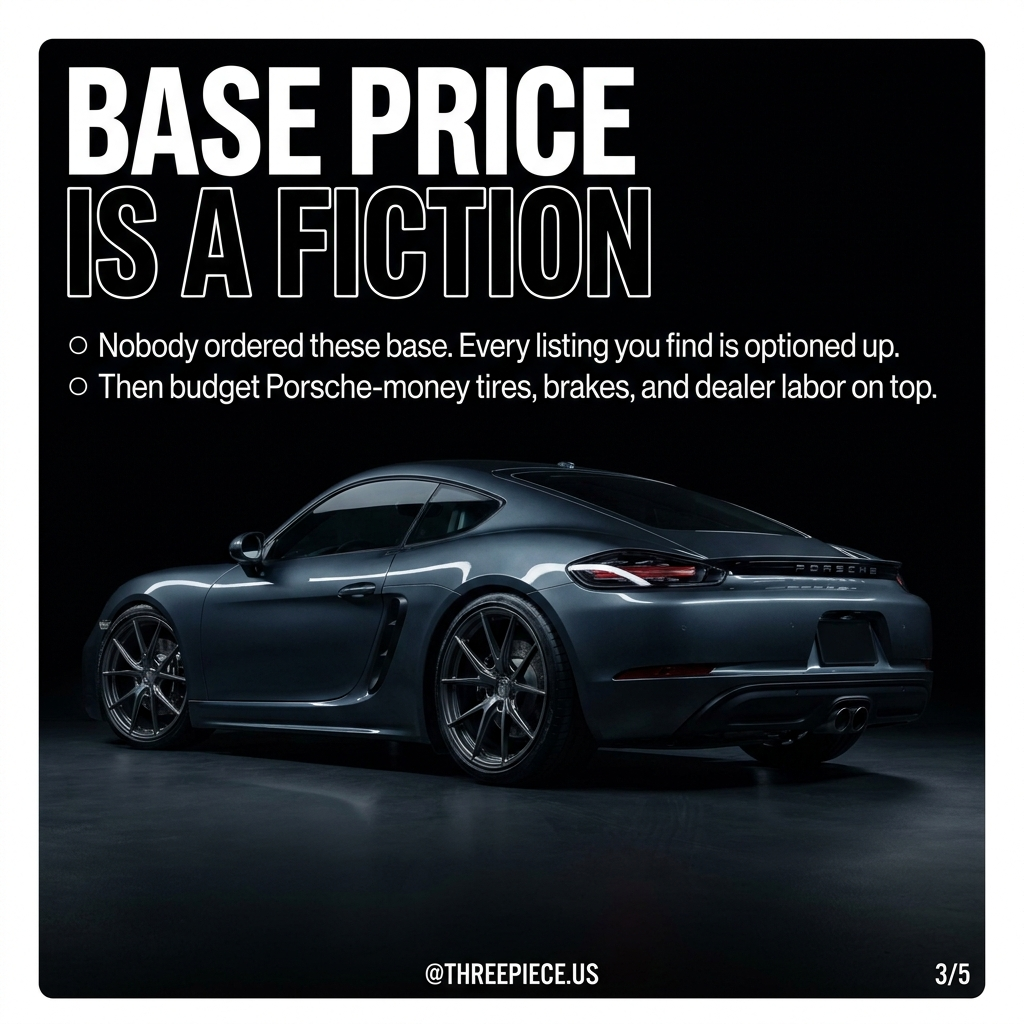
Base price is a fiction — nobody ordered one base
Here's the part dealers won't walk you through. Nobody configured a base 718 as a base 718. Every used listing you'll find has PDK, PASM, Sport Chrono, the Bose system, and the seats you actually want — because the original buyer knew that a stripped Cayman is an unpleasant ownership experience. That build sheet routinely pushes a "$72K entry Porsche" into the $85,000–$95,000 range as ordered.
Then add the ownership tax. Porsche-money tires in staggered sizes, Porsche-money brake service, and dealer labor rates that treat a 40,000-mile service as an event. A set of proper summer rubber in 235/40R19 up front and 265/40R19 out back isn't a Civic bill, and you'll be buying rears more often than you'd like on a mid-engine car. This is the same arithmetic that makes a used Mk7 Golf R look like a rational human decision by comparison.
The market already voted, and it voted against the four
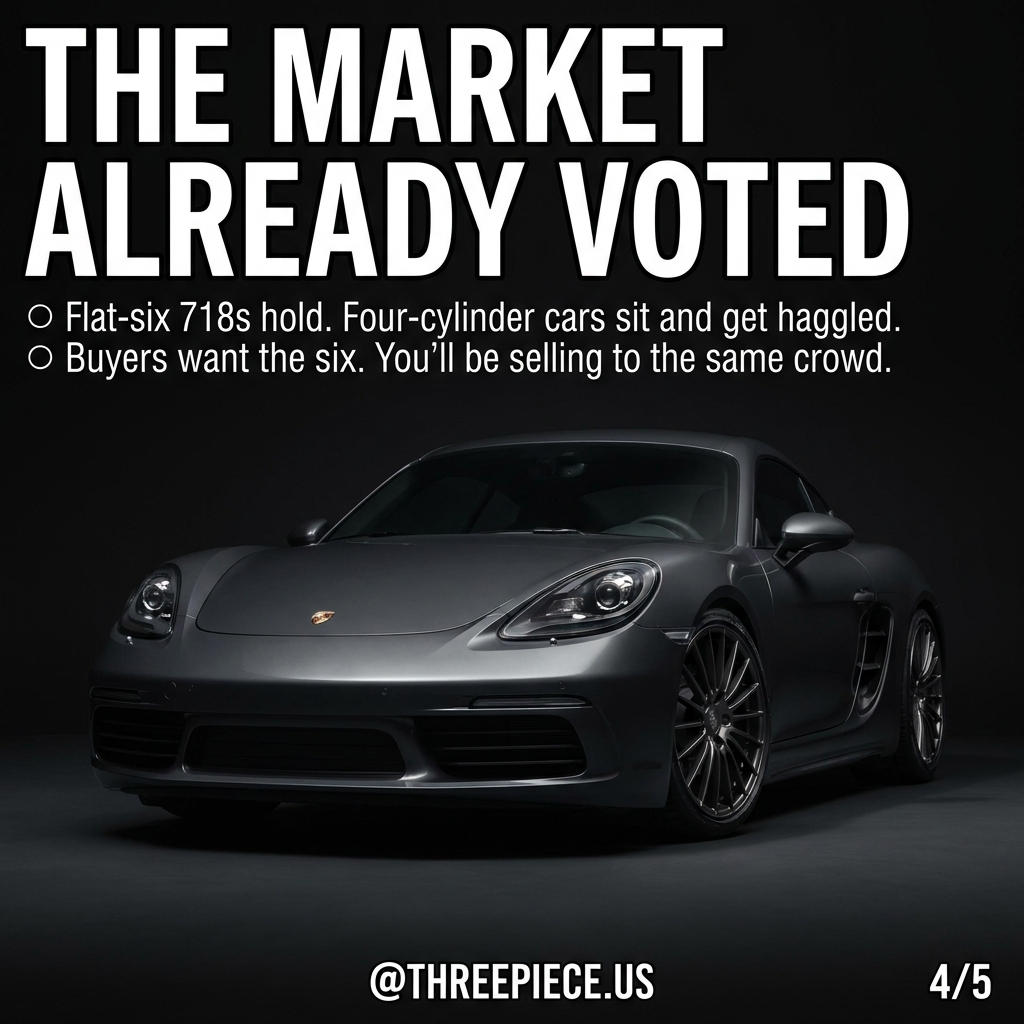
Porsche brought the flat-six back for a reason. The GTS 4.0 at 394 hp and the GT4 at 414 hp didn't arrive because the four-cylinder was broken — they arrived because the market told Porsche exactly what it thought of a turbo flat-four in a Cayman, in resale numbers.
Flat-six 718s hold. Four-cylinder cars sit on lots and get negotiated. When you go to sell, you're selling to the same enthusiast crowd you're part of right now — the one that opens the listing, reads "2.0T," and keeps scrolling. That's the whole conspiracy: the depreciation curve on a base 982 reads more like a long-term rental agreement than a car purchase. It's the exact dynamic behind 350Z versus Genesis Coupe — the engine with the reputation carries the money, and no amount of chassis superiority fixes it. Meanwhile the cars that got it right, like the manual C7 Z06, quietly stopped depreciating.
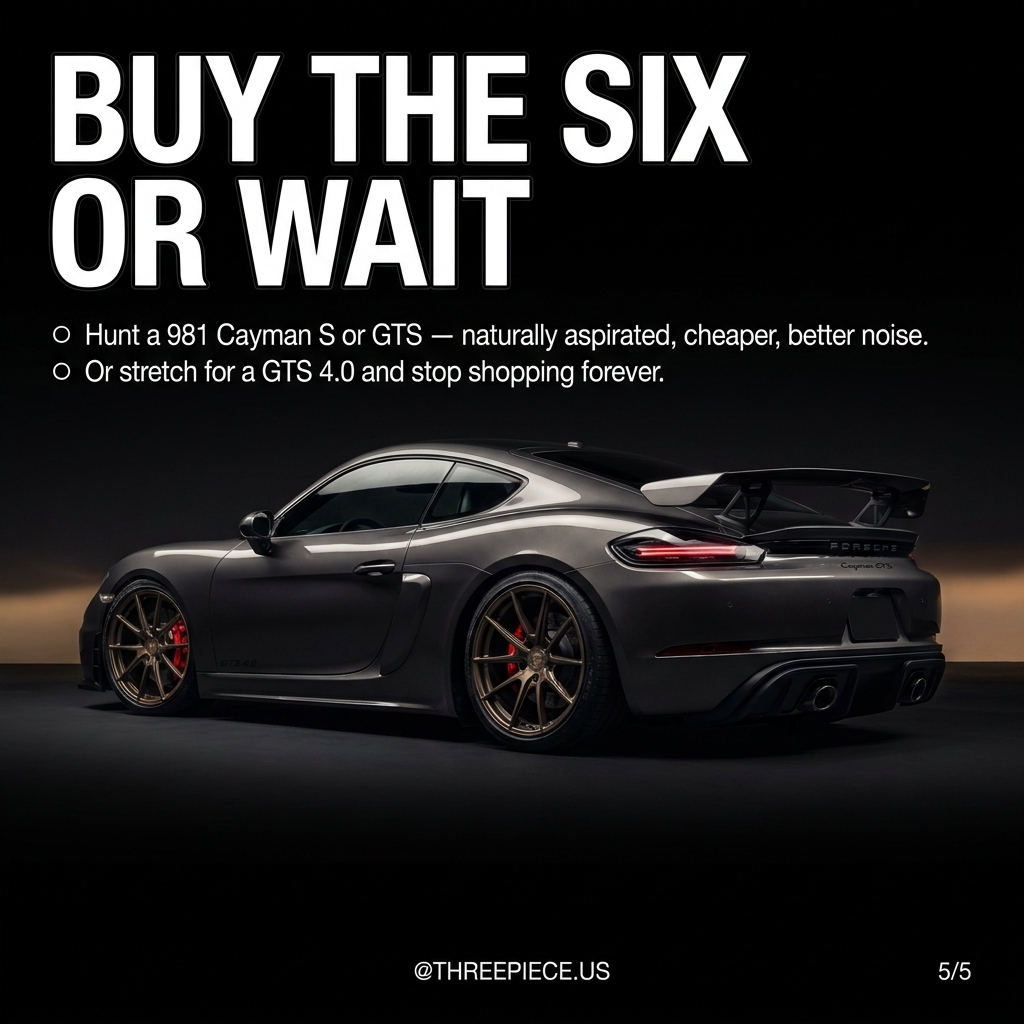
Buy the six: hunt a 981, or stretch for a GTS 4.0
Two honest exits from this trap.
Option one: the 981. A 981 Cayman S (3.4L, 325 hp) or 981 GTS (340 hp) is naturally aspirated, cheaper to buy than a loaded 982, and makes a noise that justifies the badge. The 981 is also where the modern Cayman chassis really arrived — wider track, stiffer shell, proper steering. You give up some low-end torque. You gain everything you actually bought a mid-engine Porsche for.
Option two: stretch and stop shopping. The GTS 4.0 at 394 hp with a six-speed manual is an endgame car. You drive the current thing another 18 months, keep saving, and buy something that's still worth money when you're finished with it. Then you spend the difference where it shows: suspension and wheels. Browse the suspension catalog if you're planning a track-biased setup, and read our coilover breakdown for how to judge damper valving before you buy on brand name alone. For inspiration on what a finished car looks like, the ThreePiece vehicle gallery is full of builds that got the proportions right.
718 wheel fitment: 5x130 and the offset trap
If you do buy one — base four or six — understand what you're working with. The 718 runs a 5x130 bolt pattern with a 71.6mm hub bore, and Porsche's factory offsets are high by enthusiast standards. OE staggered setups sit around 8J x 19 ET57 front / 9.5J x 19 ET45 rear on S cars, and 8.5J x 20 ET57 / 11J x 20 ET51 on the 20-inch GTS package. Those numbers look alien if you come from a 5x120 BMW, and they're the single biggest reason people order the wrong aftermarket set.
The move is to chase the factory face position, not the factory offset number — width changes the math, and a wider barrel at the same ET pokes. Start with 19-inch 5x130 wheels or step to 20-inch 5x130 if you're running the big brake package. For the classic Porsche look, the Work Brombacher Mesh at $684 was designed specifically for this world and looks correct on a 981/982 in a way no generic five-spoke manages. If you want something sharper and more modern, the Work Emitz at $711 or a full three-piece Work Emotion CR 3P at $895.50 per wheel gets you custom widths and offsets instead of whatever the catalog happened to cast. Compare that thinking to our GR Supra offset guide or the Audi TT fitment specs — same principle, different bolt circle.
Whatever you land on, do the boring parts right: correct hubcentric rings for the 71.6mm bore, and if you're running multi-piece, fresh M7 assembly hardware and proper silicone sealant at $10.99 when you re-seal the barrels. Buying a used set that needs help? Our wheel refinishing service and custom lips and barrels let you rebuild to the exact width and offset the 718 needs instead of settling.
The verdict: one car you own now, one you own longer
The base 718 Cayman is not a bad car. It's a fantastic chassis attached to the wrong argument. Buy the loaded 2.0T and you get the best-handling thing in the Porsche showroom today, plus four years of depreciation and a soundtrack you'll apologize for. Wait, and you get a 981 Cayman S or a GTS 4.0 that still has your money in it when you're done.
One of those is a car you own now. The other is a car you own longer. If you're already on the six, spend the savings where people can see it — a proper staggered Work Wheels setup in 5x130 changes the stance of a Cayman more than any bolt-on under the deck lid.
So which side are you on — loaded 2.0T today, or eighteen more months in the beater waiting on a 4.0? And if you've owned a base 718: did the sound actually stop bothering you, or did you sell it?
Try wheels on your Porsche 718 Cayman: see the Porsche 718 Cayman bolt pattern, wheel sizes by year and wheel builds in our free wheel visualizer.