

GR Supra Wheel Fitment Guide: Offsets That Actually Fit
The GR Supra wheel fitment problem isn't clearance — it's the search bar. Type "A90 Supra" into any wheel catalog and you'll watch the selection shrink by 80% while the prices climb. The MK5 rides on BMW G-chassis hardware: 5x112 bolt pattern, 66.5mm hub bore, M14x1.25 lug bolts. Shop it as the G29 Z4 it is underneath and the entire catalog reopens at normal money.

Quick links
- It's a G29 underneath — shop it that way
- Factory GR Supra wheel specs (your ruler)
- Aggressive fitment: 19x9.5 +22 / 19x11 +25
- Lug bolts are the enemy: do the stud conversion first
- Square vs staggered on a 382hp RWD coupe
- Final verdict
It's a G29 underneath — shop it that way
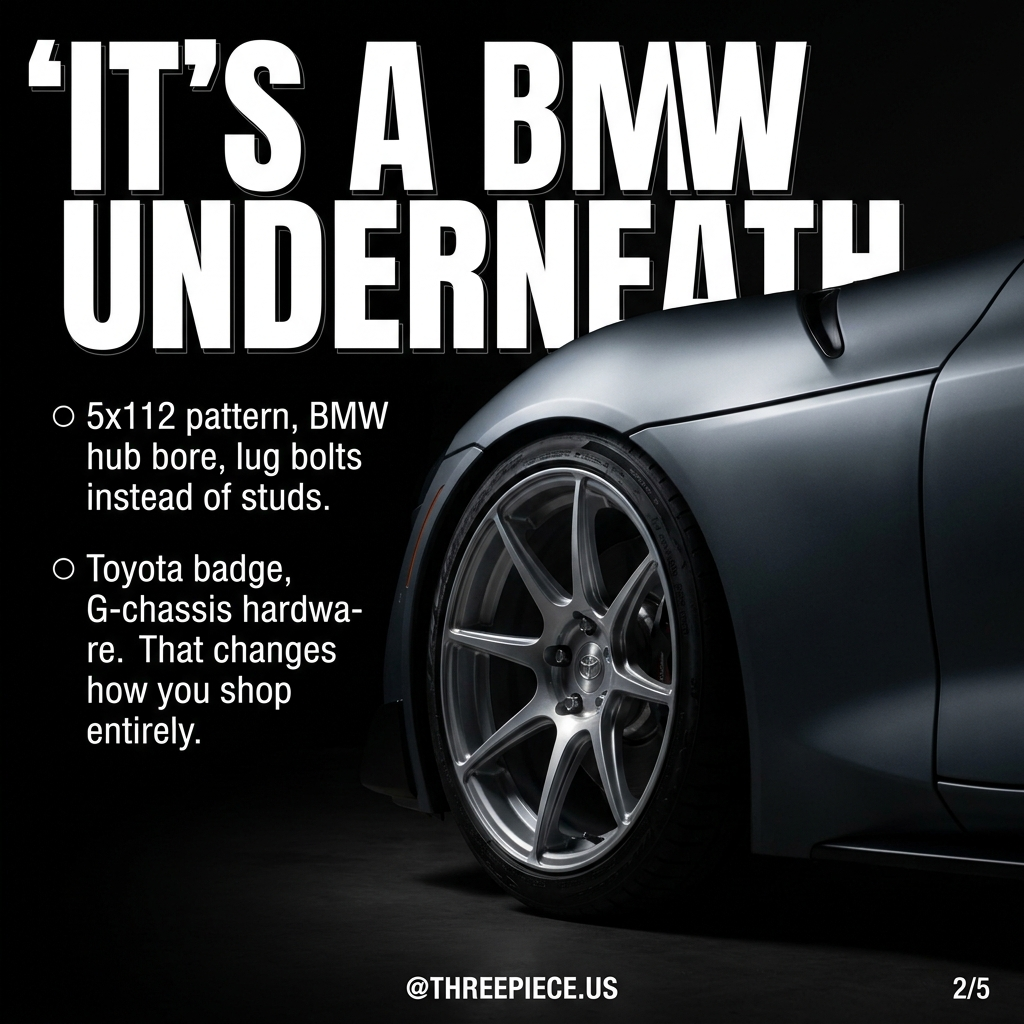
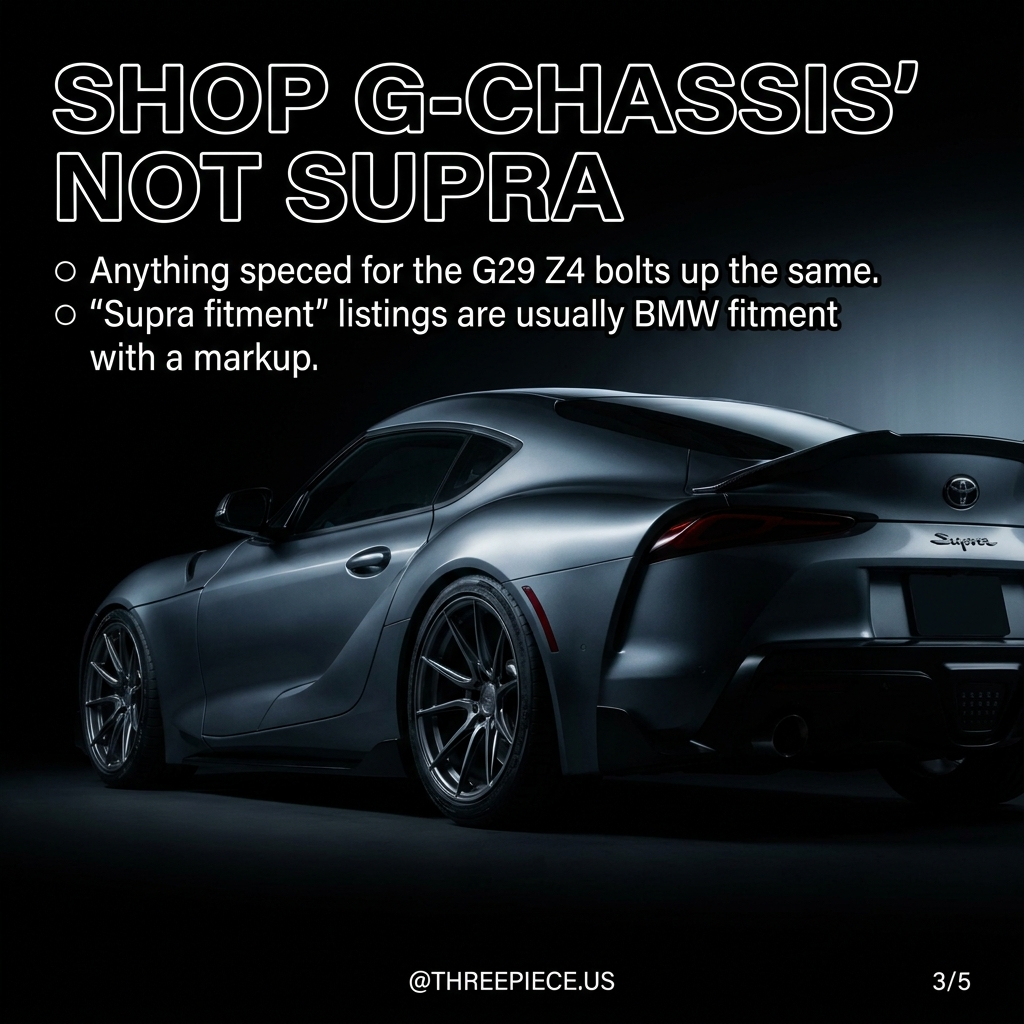
Toyota badge, BMW bones. The MK5 Supra shares its architecture, hubs, and hardware with the G29 BMW Z4, which means anything correctly specced for a modern G-chassis BMW bolts to your car without a single adapter. Same 5x112 pattern, same 66.5mm centerbore, same lug bolt thread. "Supra fitment" listings are usually just BMW fitment with a Toyota tax applied.
Practical version: when you browse 19-inch wheels in 5x112, you're now shopping the same pool as G20 3 Series, G29 Z4, and modern Audi owners — which is the exact reason our 5x112 Audi fitment guide is worth a read even though it's a different badge entirely. One caveat: most aftermarket wheels are bored larger than 66.5mm, so budget for hubcentric rings. Skipping them on a car that spends time above 100mph is how you end up chasing a vibration you'll blame on tire balance for six months.
Factory GR Supra wheel specs (your ruler)
Before you get brave, memorize the baseline. The 3.0 ships staggered from the factory:
- Front: 19x9 +32 on 255/35R19
- Rear: 19x10 +40 on 275/35R19
That's your ruler — not a forum post from someone running fender liners cut to confetti. Anything you buy gets measured against those numbers in terms of poke and clearance. A 19x9.5 +25 front, for example, sits roughly 19mm further out than stock at the face, and that's before you factor in tire sidewall bulge.
Replacement rubber in factory sizes is easy: pull up 255/35R19 and 275/35R19 and pick a compound that matches how you actually drive the car. If you're doing HPDE weekends, our breakdown of how to pick a 200TW tire saves you from buying a tire that greases up on lap three, and reading UTQG ratings properly stops you paying track money for a street tire.
Aggressive fitment: 19x9.5 +22 / 19x11 +25
The most common "next step" on a lowered A90 is 19x9.5 +22 front and 19x11 +25 rear, wrapped in 265/35R19 and 295/30R19. That setup fills the rear arch the way Toyota's designers clearly intended and still works on a street car — but it is camber and fender roll dependent. On stock ride height with stock alignment you'll rub the front at full lock and over compressions. Drop it on coilovers, dial in front camber, roll the rears, and it settles in.
Rear tire options at that width live here: 295/30R19. If you want the concave face to actually justify the width, this is where forged and multi-piece construction earns its money — the Work Emotion CR 3P at $895.50 can be specced to the exact width and offset instead of forcing you into a cast wheel's nearest guess. Cheaper entry into the same catalog: the Work Emotion T7R at $432 or the Work Emotion D9R at $414, both from the Work Emotion line. Want something nobody else at the meet has? The Work Emitz at $711. For the mesh-and-lip crowd, our Work Meister S1 3P review and SSR Professor SP1 breakdown cover the classic route — and yes, there are A90s wearing both. Browse the vehicle gallery if you want proof before you commit money.
Lug bolts are the enemy: do the stud conversion first
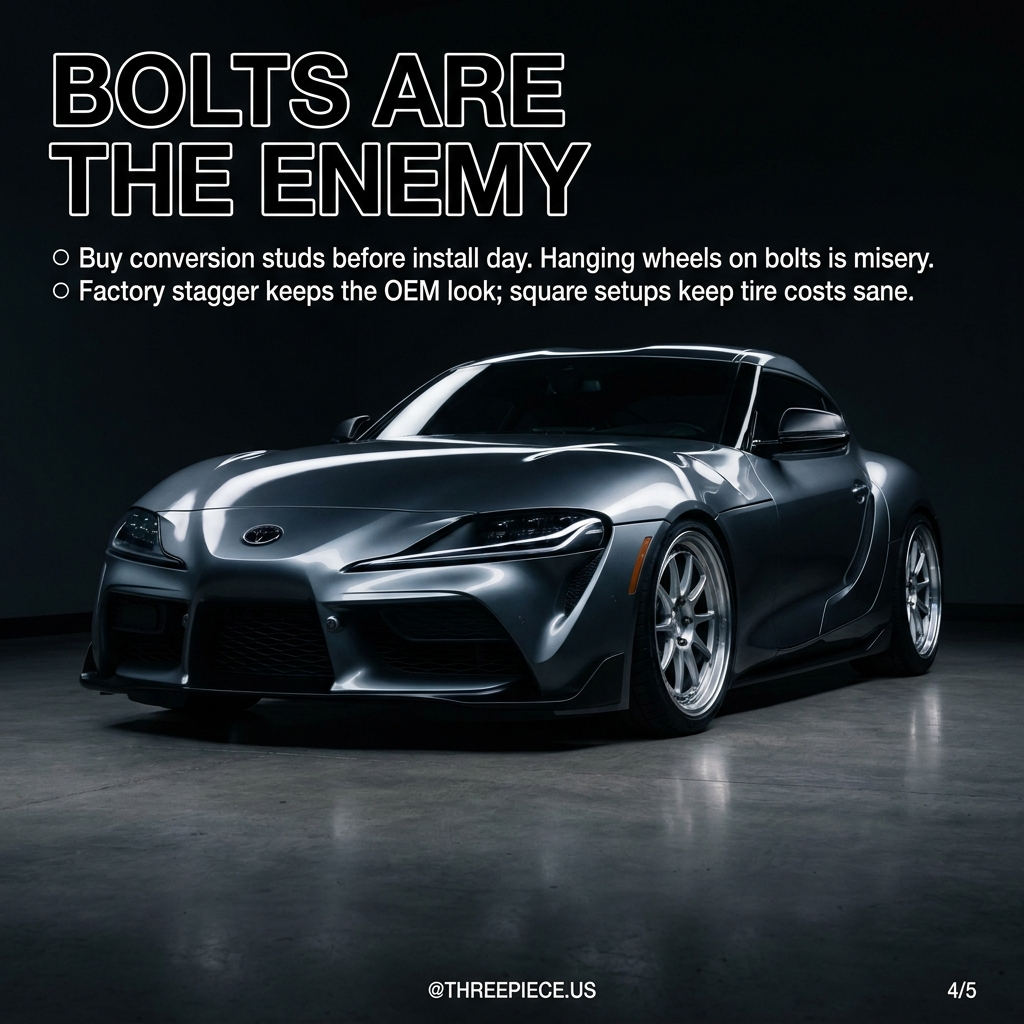
Nothing humbles a new owner like balancing a 25lb wheel on one knee in a dark garage, trying to thread a lug bolt into a hub that refuses to hold still. That's the BMW hardware experience, and the MK5 inherited all of it. Handle it before your wheels show up, not on install day.
A set of stud conversions runs around $80 and buys back about four years of your life. Add the correct lug nuts for your new wheels' seat type — ball seat versus conical is not a detail you eyeball — and grab a set of 90 degree valve stems at $3.80 each if you're running deep-face wheels where a straight stem is a knuckle-buster. Running multi-piece? Keep spare M7x32 assembly bolts at $10 on the shelf; they're the first thing to look tired on a set that's been through a winter. The BMW-adjacent ownership tax is real, and our list of things M2 owners wish they knew first applies to more of this car than Supra owners want to admit.
Square vs staggered on a 382hp RWD coupe
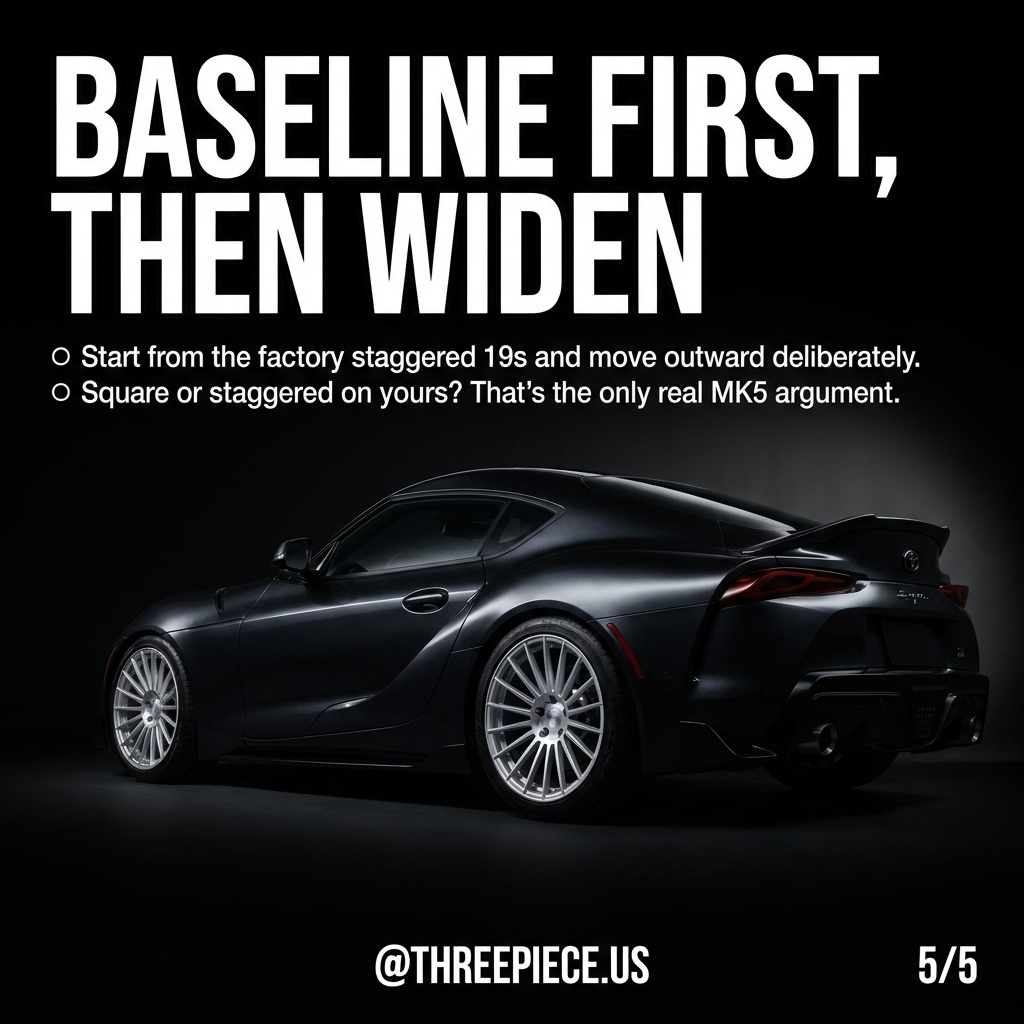
Here's the only real MK5 argument. Staggered is how Toyota drew the car — the rear arch wants that 11-inch width and the proportions fall apart without it. But square opens up tire rotation, cheaper replacements, and a car that doesn't push through corner exit once the rears are up to temperature and the fronts aren't. A square 19x10 +25 on 275/35R19 all around is a genuinely better street-and-track compromise on 382 horsepower, and it costs less over three tire cycles.
If that logic sounds familiar, it's the same debate we ran through in the GR86 and BRZ fitment guide and again in the 2022+ GR86 offset and width breakdown — except the Supra has enough power that the handling argument actually has teeth instead of being theoretical.
Final verdict
Start from 19x9 +32 / 19x10 +40, shop the wheel catalog as a G-chassis BMW instead of an A90 Supra, and do the stud conversion before the delivery truck shows up. Everything past that is taste. Most people street this car far more than they track it — so tell us which side you're on: does the rear arch win, or does tire rotation and a neutral car win? Post your setup with full specs (width, offset, tire size, ride height) and defend it.