

C7 Z06 Buyer's Guide: The Last Manual 650hp Corvette
The 2015-2019 Chevy Corvette C7 Z06 is the last 650-horsepower car General Motors will ever hand you with a clutch pedal, and the internet is still arguing about heat soak instead of buying one. That's the whole take. A supercharged 6.2L LT4, a seven-speed manual, rear-wheel drive, an aluminum frame and a dry sump — that recipe is finished, permanently, and every Z06 built after it is a two-pedal car forever. This is a C7 Z06 buyer's guide for people who already know that and want to know which one to buy and what to bolt to it.

Quick links
- 650 horsepower and a clutch pedal
- Why third gear does everything
- The heat soak argument, settled
- What to check before you wire the money
- C7 Z06 wheel fitment: 5x120, 70.3 bore, deep end only
- Suspension, brakes and where the money actually goes
- The verdict: there is no third option
650 horsepower and a clutch pedal
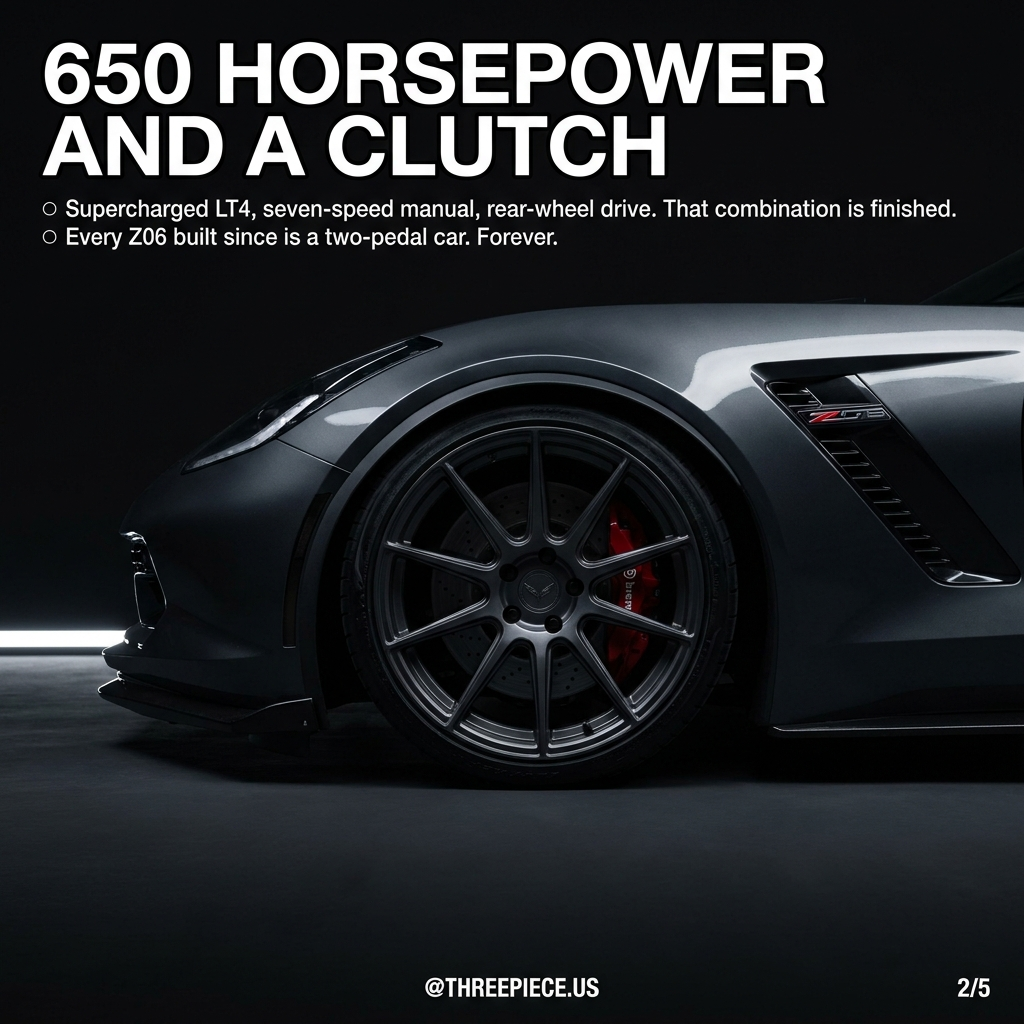
Numbers first, then the feeling. The LT4 makes 650 hp and 650 lb-ft through a 1.7L Eaton R1740 TVS blower, and the optional gearbox is a 7-speed manual with Active Rev Match. Which is why the C7 Z06 doesn't feel like a modern supercar at all — it feels like something that got out of the building before the lawyers and the emissions calendar caught up. Torque is everywhere from 2,000 rpm, so you're never selecting a gear to make speed, you're selecting a gear to decide how much of it you want.
The C8 Z06 is faster, more exotic, better on a stopwatch, and it will never do this. That's not nostalgia — that's a product decision that can't be reversed. Same reason we've argued the E92 M3's S65 is the smarter buy and that the Camaro SS beats the Mustang GT: the last car built to an obsolete recipe usually ages better than the faster thing that replaced it.
Why third gear does everything
Roots blower whine layered over a small block at full throttle is a noise that shouldn't be street legal, and third gear in a C7 Z06 covers roughly every speed you'd want to reach on a road that has other cars on it. That's the argument for the manual in one sentence — the automatic makes the car quicker and turns the drivetrain into an appliance you're a passenger in.
Owners chasing more noise usually start with the exhaust and headers rather than the blower pulley, because the LT4 is already running enough boost that the supporting systems become the limiter. If you're on a C8 instead, aFe's Twisted 304SS Header for the 2020 C8 6.2L V8 at $1,870.91 is the equivalent move. On older cars, our breakdown of C5 Corvette LS1 intake manifolds covers where induction money actually pays.

The heat soak argument, settled
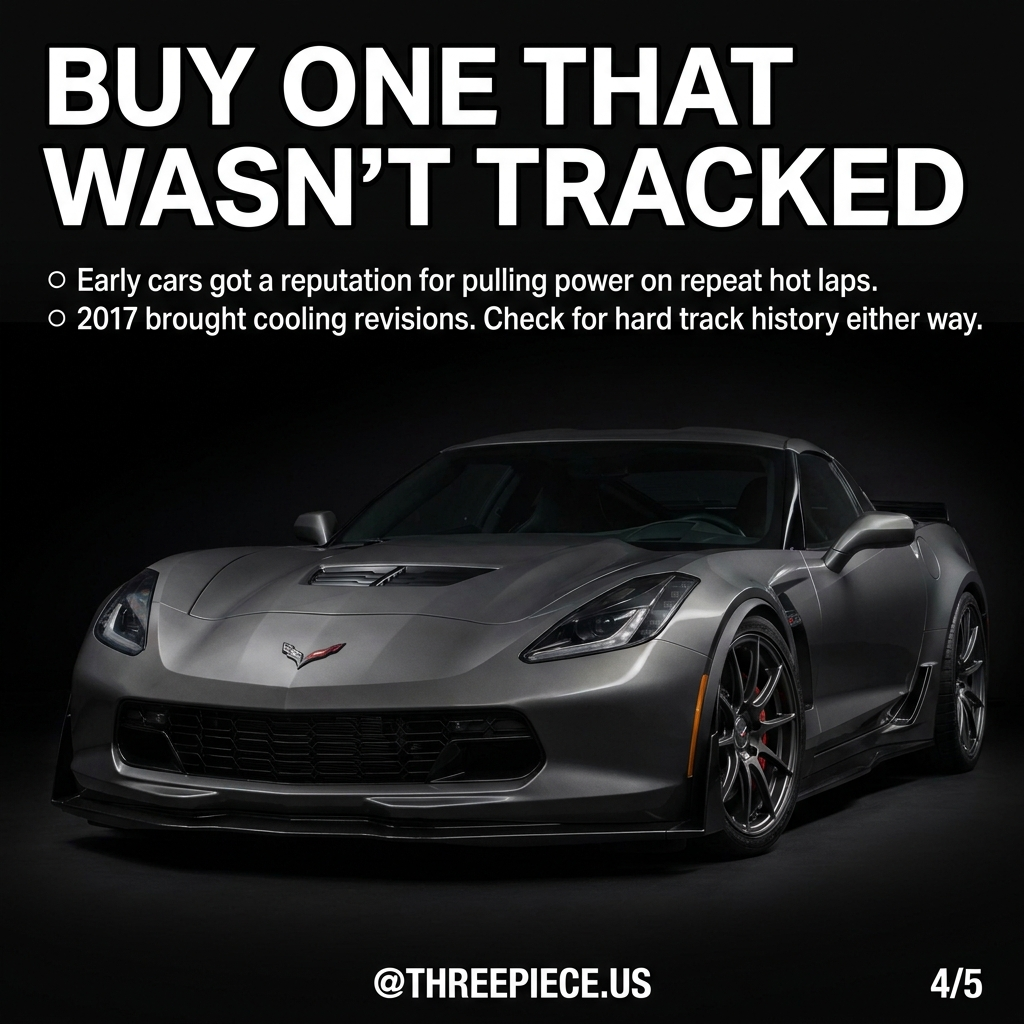
Yes, 2015-2016 cars will pull timing on lap three of a hot track day. It's real, it's documented, and it is completely irrelevant to how roughly 95% of these cars get used. Chevrolet addressed it for 2017 with revised cooling and larger front intake openings, plus supercharger and radiator changes.
So the buying rule is simple. Track the car regularly? Buy a 2017+. Street car with occasional canyon runs and a couple of HPDE weekends a year? A well-kept early car is the value buy and you should stop reading forum threads from 2016 written by people who never owned one. If you are going to run sessions, the tire matters more than the model year — our guide on picking a 200TW tire for HPDE and autocross is the honest version of that decision, and how to read UTQG and treadwear ratings explains why the sticker on the sidewall lies to you.
What to check before you wire the money
Service history beats dyno sheets. You want the garage queen, not the Z07 package car with cooked rotors and a set of shaved Cup 2s that's been through four track weekends with a rental helmet in the passenger seat. Specifically:
- Carbon ceramic rotors (Z07 cars) are glorious right up until you price a replacement set. Inspect edge chipping and get a thickness measurement in writing.
- Torque tube and clutch — heavy launch history shows up here first on manual cars.
- Magnetic Ride dampers — check for weeping. They're not cheap and a soft-riding Z06 is a leaking Z06.
- Tune history — a pulley-and-tune car isn't automatically bad, but it changes the heat story on an already-warm engine.
- Frame and underbody — aluminum chassis means repair quality varies wildly. Look at it on a lift, not in a driveway.
Same discipline we'd apply to any high-strung modern performance car. If you want a template for the mindset, read what M2 owners wish they knew first and what FD RX-7 owners learn too late — the specific failures differ, the buying discipline doesn't.
C7 Z06 wheel fitment: 5x120, 70.3 bore, deep end only
Factory Z06 fitment is 19x10 front and 20x12 rear on a 5x120 bolt pattern with a 70.3mm hub bore. Those are not casual numbers. A 12-inch-wide rear wheel wrapped in a 335/25ZR20 means anything you build for this car lives in the deep end of the catalog, and it's also why the Z06 is one of the best arguments for a true multi-piece wheel — you can spec the barrel and lip to the exact width and offset instead of settling for the closest one-piece casting.
If you're speccing a set, start with 19" wheels in 5x120 for the fronts and 20" 5x120 fits out back. This is where step-lip 3-piece construction earns its money — the Work Meister S1 3P is the reference point for how a proper 3-piece handles extreme widths, and the Work Emotion CR 3P at $895.50 shows what the modern equivalent costs. For an alternative face, the Work Emitz at $711 is a stronger fit for a wide-body American car than most people expect.
Building one? A few things you'll need regardless of face choice: hubcentric rings to bring a wheel down to that 70.3 bore, M8x32 socket cap assembly bolts in satin black at $10 each for the hardware, silicone sealant at $10.99 if you're sealing barrels yourself, and 90-degree valve stems at $3.80 because reaching a straight stem behind a 12-inch rear wheel is a genuinely annoying experience. If your existing set needs saving, our wheel refinishing service handles curbed lips and tired centers.
Want to see what extreme widths look like done right? Scroll the vehicle gallery before you commit to an offset.
Suspension, brakes and where the money actually goes
The stock Magnetic Ride setup is genuinely good, which is why the smart order of operations on a C7 Z06 is tires, then brake fluid and pads, then alignment — and only then dampers. If you're the type who does eventually go coilover, aFe's Corvette-specific PFADT program is the benchmark for the platform: the PFADT Featherlight Single-Adjustable Street/Track Coilover System for the 2014-15 Corvette runs $3,748.54, and the earlier C5/C6 version at $3,486.54 covers the older cars.
Running a C5 or C6 as the cheap entry into this world? The aFe Control sway bar set for the 97-13 C5/C6 at $670.79 is a better first dollar than almost anything else, with the Johnny O'Connell spec set at $963.79 for the track-focused version. More suspension options here. And if you're cross-shopping American V8 platforms entirely, our S550 Mustang coilover guide covers the other side of that fence.
The verdict: there is no third option
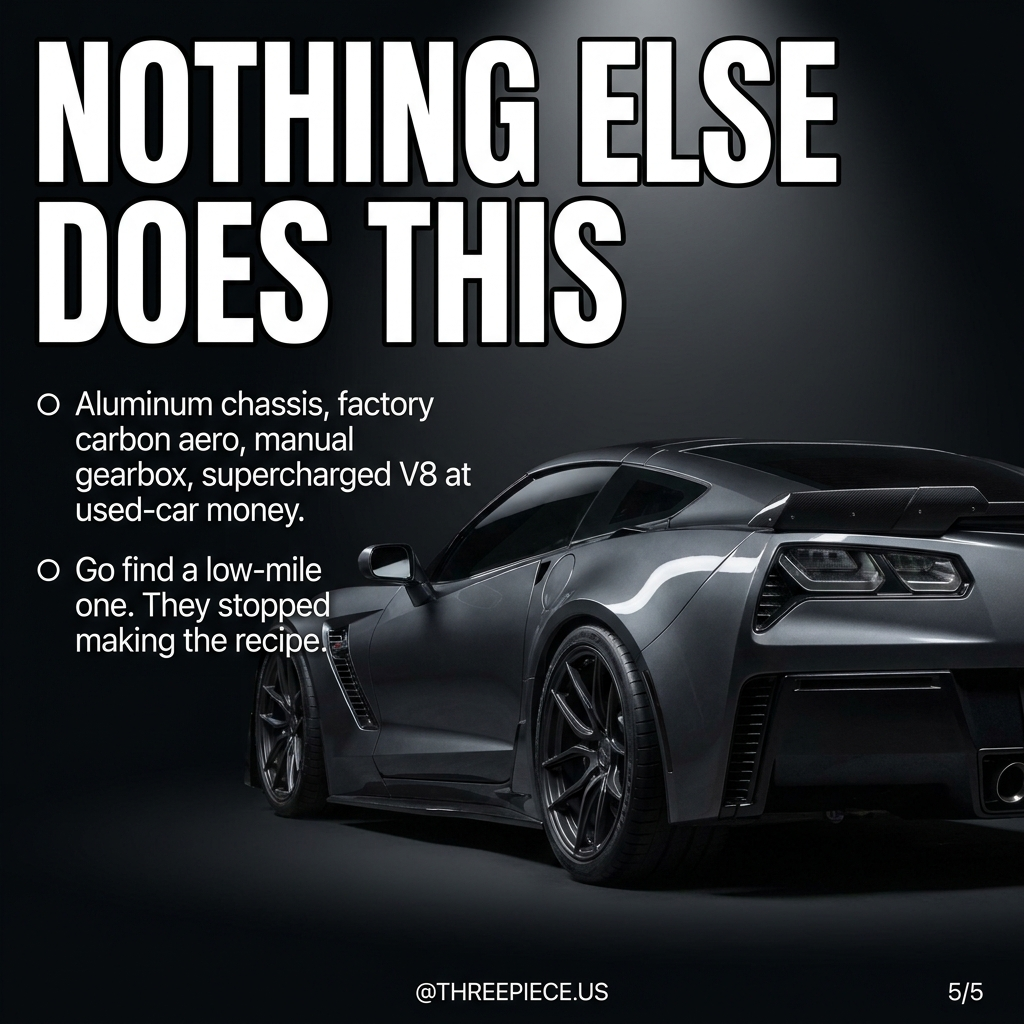
Aluminum chassis, factory carbon aero, dry sump, magnetic dampers, a supercharged V8 making 650 hp, and a clutch pedal — all at used-car money. Nothing else on the market combines those five things, and nothing else ever will, because GM already decided the next chapter is two pedals and a flat-plane crank behind your head. That's not an opinion about which car is better. It's just a recipe that got discontinued while everyone was busy quoting a 2016 forum thread.
Go find a low-mile 2017+ if you plan to run sessions, or a clean early car if you don't, then spend the savings on the part of the build people actually notice. Start with Work Wheels if you want a JDM-flavored take on an American car, grab a set of lug nuts that match, and finish with center caps that don't look like an afterthought.
Real question for the comments: if you're speccing a C7 Z06 today, are you keeping the factory 19x10 / 20x12 stagger and just going forged, or are you narrowing the rear to something sane and running a wider front for actual balance? Pick a side and tell us the offset.