E92 M3 vs E46 M3: Why the S65 Is the Smarter Buy
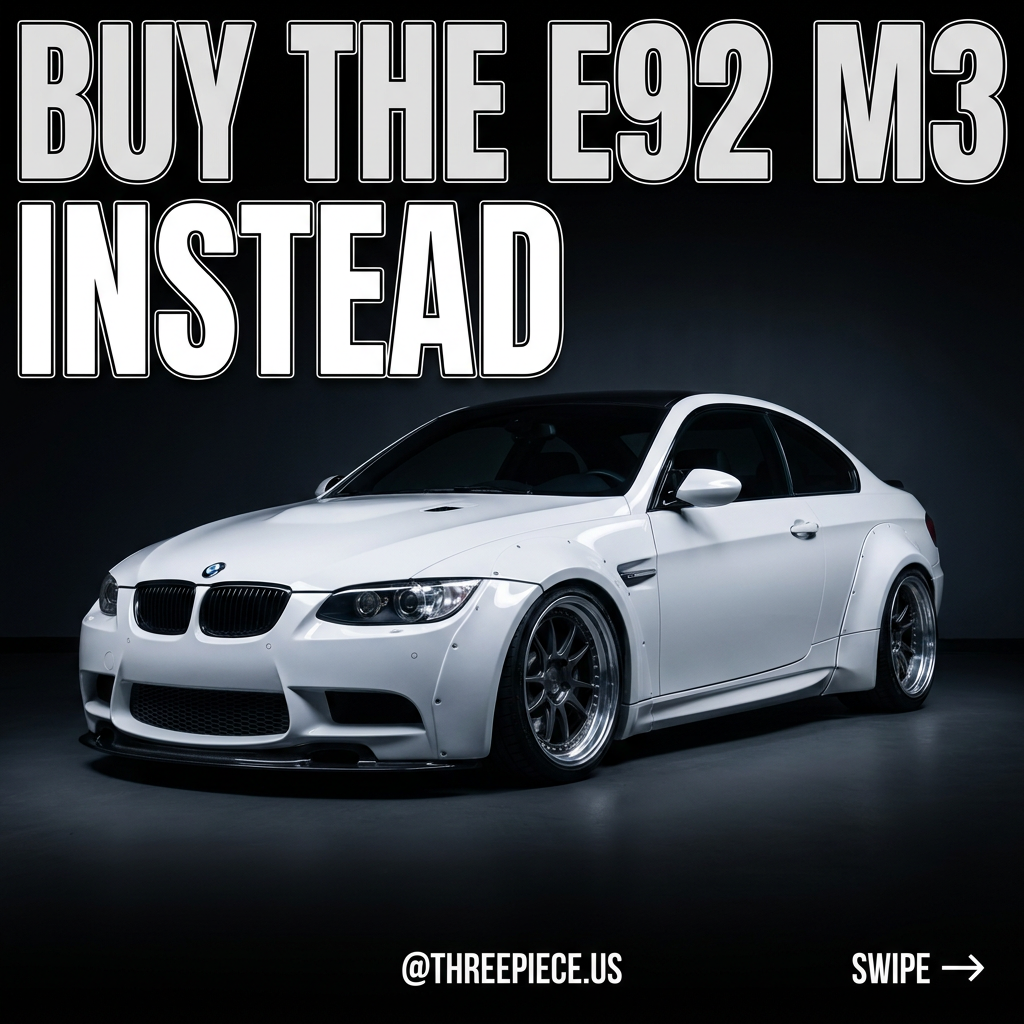
The E92 M3 is the smarter M3 money right now, and the E46 M3 crowd already knows it — they just don't want to say it out loud at Cars and Coffee. Clean E46 M3s trade at $25,000-$35,000 before you touch the subframe, the VANOS, or the cooling system. A sorted E92 6MT sits in the same window with 414 horsepower, a 4.0L S65 V8 that screams to 8,300 rpm, and one fewer structural nightmare hanging over the title. This is a BMW M3 buyer's guide for people who actually plan to drive the thing.
Quick links
- The E46 nostalgia tax is real
- Both have rod bearings — only one has subframes
- What actually breaks on an S65
- Where the E46 still wins
- Wheel and tire fitment on both platforms
- The verdict: which M3 to buy
The E46 nostalgia tax is real
The E46 M3 has become a poster car with a price tag to match. 333 hp and 262 lb-ft from the 3.2L S54, roughly 3,399 lb at the curb, and an 8,000 rpm redline that genuinely still sounds like nothing else. Nobody is arguing the car isn't special. The argument is about what you pay for that specialness in 2026.
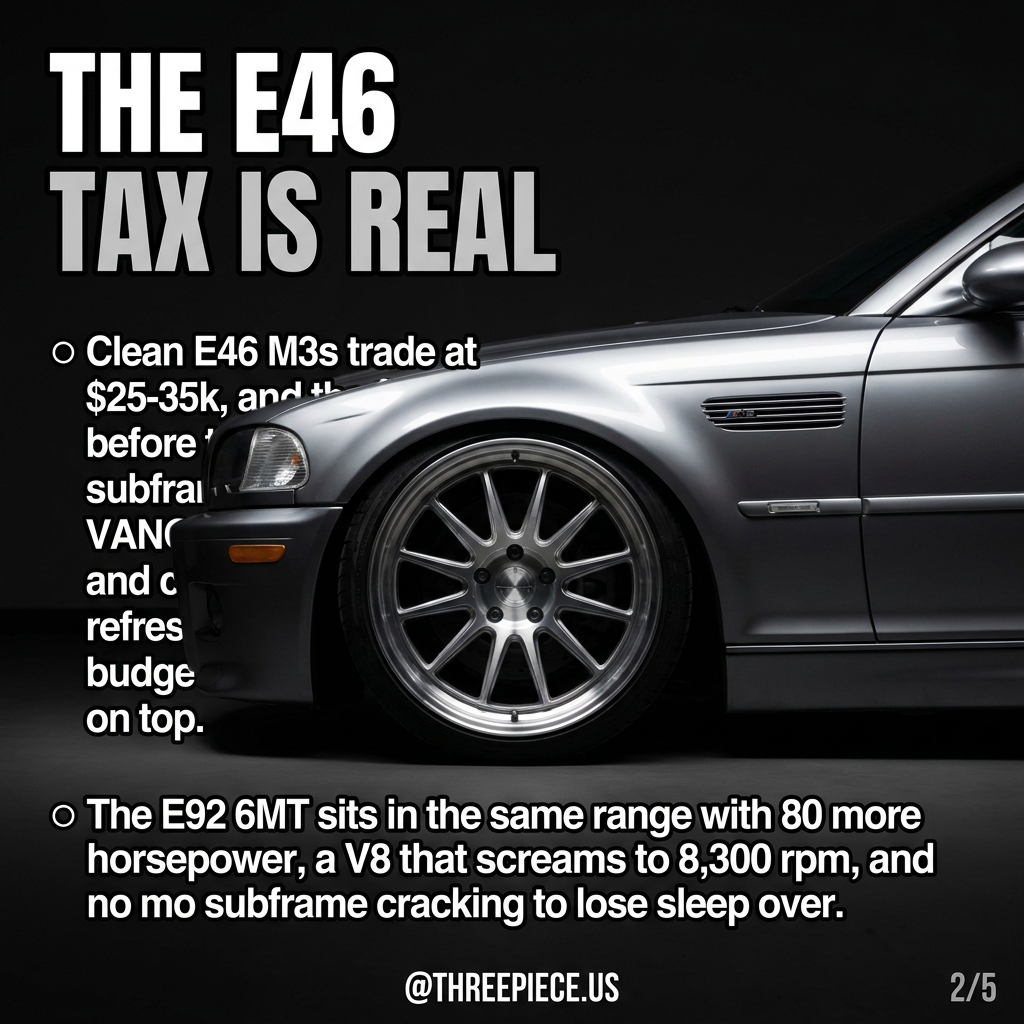
Here's the math nobody wants to do out loud. A $30,000 E46 that hasn't had preventive rod bearings is a $33,000-$35,000 E46. Add a VANOS rebuild at $2,000-$3,000, a full cooling refresh at $1,500-$2,500 because the plastic thermostat housing and water pump are aged out on every single one of them, and rear subframe reinforcement that runs into four figures fast. You are now at low-to-mid forties on a car making 333 horsepower.
The E92 6MT lands in the same purchase window with 80 more horsepower, a more rigid chassis, and modern crash structure. The same value logic that makes an N55-equipped E90 335i the smarter 335 buy applies here: the later car fixed real problems and the market hasn't fully priced that in.
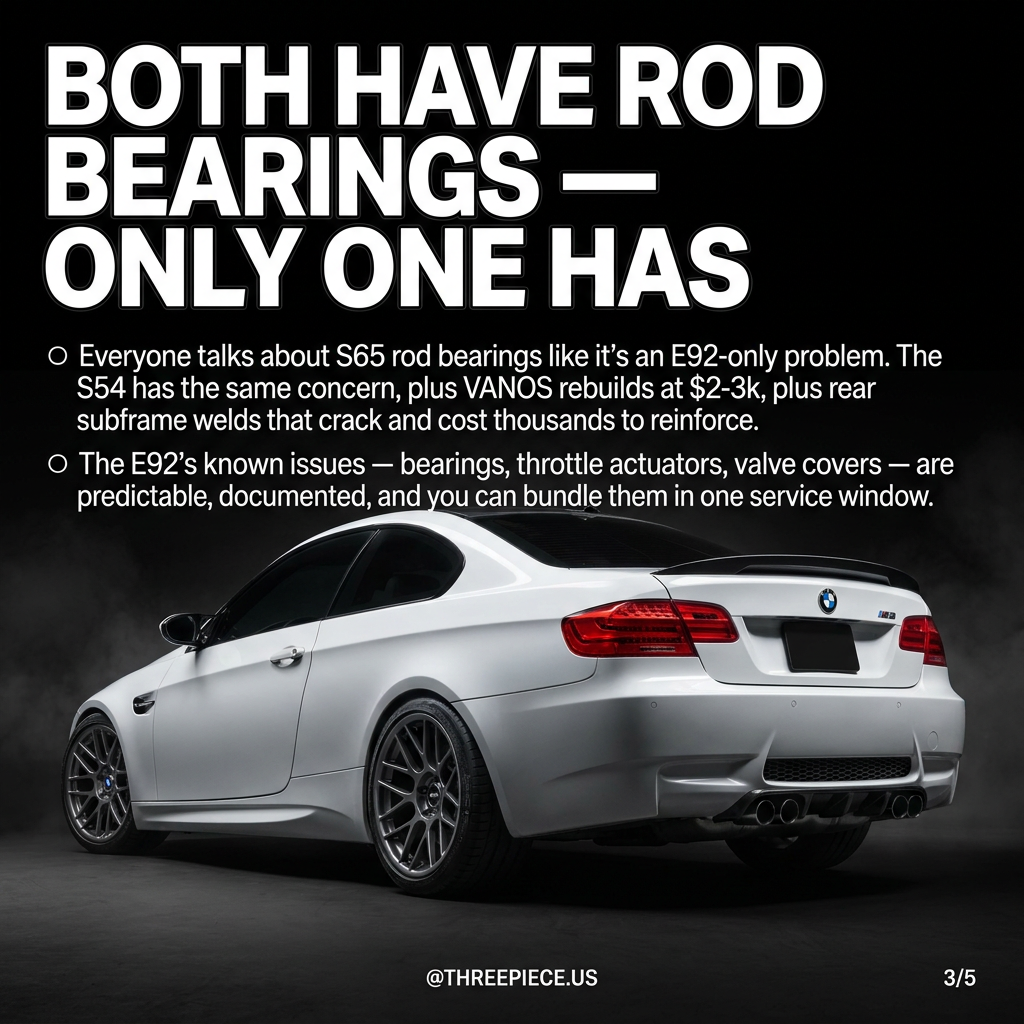
Both have rod bearings — only one has subframes
The internet has convinced itself rod bearings are an S65-exclusive problem. They are not. The S54 had a factory recall (SIB 11-04-04) for undersized rod bearings on 2001-2003 cars, and owners who skipped it have reported bottom-end failures well before 100,000 miles. A preventive S54 bearing refresh runs $3,000-$5,000. On the S65, the same job runs $2,500-$5,500 and the consensus service interval is every 50,000-80,000 miles. Call it a wash — both engines want the same maintenance and the same owner discipline.
If you're doing the S54 bottom end properly, do it once and do it with real hardware. The ARP BMW E46 M3/S54 Rod Bolt Kit (201-6103) at $228.50 is the baseline while the pan is off, and if the block is coming apart further, the ARP S54 Main Stud Kit (201-5002) at $189.43 and the ARP S54 12-point head stud kit (201-4303) at $266.30 are what separate a rebuild from a rebuild you do twice.
The difference isn't the bearings. It's the subframe. E46 rear subframe mounting points crack the floorpan itself, and owners have found it on cars with as few as 40,000-60,000 miles if the car saw hard use. That is not a bolt-on repair — it's welding, it's structural, and it affects how the car puts power down. The E92 simply doesn't have that failure mode.
What actually breaks on an S65
Being honest about the E92's flaws is the only way this argument holds up. The S65 has real, documented weak points:
- Rod bearings — 2008-2009 cars used softer copper-lead bearings; BMW moved to harder King tin-aluminum for 2010-2011+. Later cars are the safer buy.
- #1 main bearing — the genuinely scary one. Owner registries document main journal wear and spun bearings at 55,000-80,000 miles, including a well-documented 2008 manual that needed rods and the #1 main at roughly 55,000 miles.
- Throttle actuators — the S65's individual throttle bodies use one electric actuator per bank, and the internal plastic gears fail around 60,000-80,000 miles. Limp mode, remanufactured units, budget for it.
- Valve cover and oil pan gaskets — nagging, not catastrophic.
Here's why that list still favors the E92: every item is predictable, documented, and bundleable into one service window. You can walk into a shop with a list, get a number, and know what the car costs to make right. The E46's subframe question is open-ended until someone puts it on a lift and pulls the tank.
If you're in the S65 bottom end anyway, it's the right time to sort suspension too. ST XTA Adjustable Coilovers for the E92 M3 Coupe (18220857) at $1,688.86 are a proper damper-adjustable setup rather than a lowering compromise. Browse the rest of the suspension catalog if you're speccing a full corner-balance build.
Where the E46 still wins
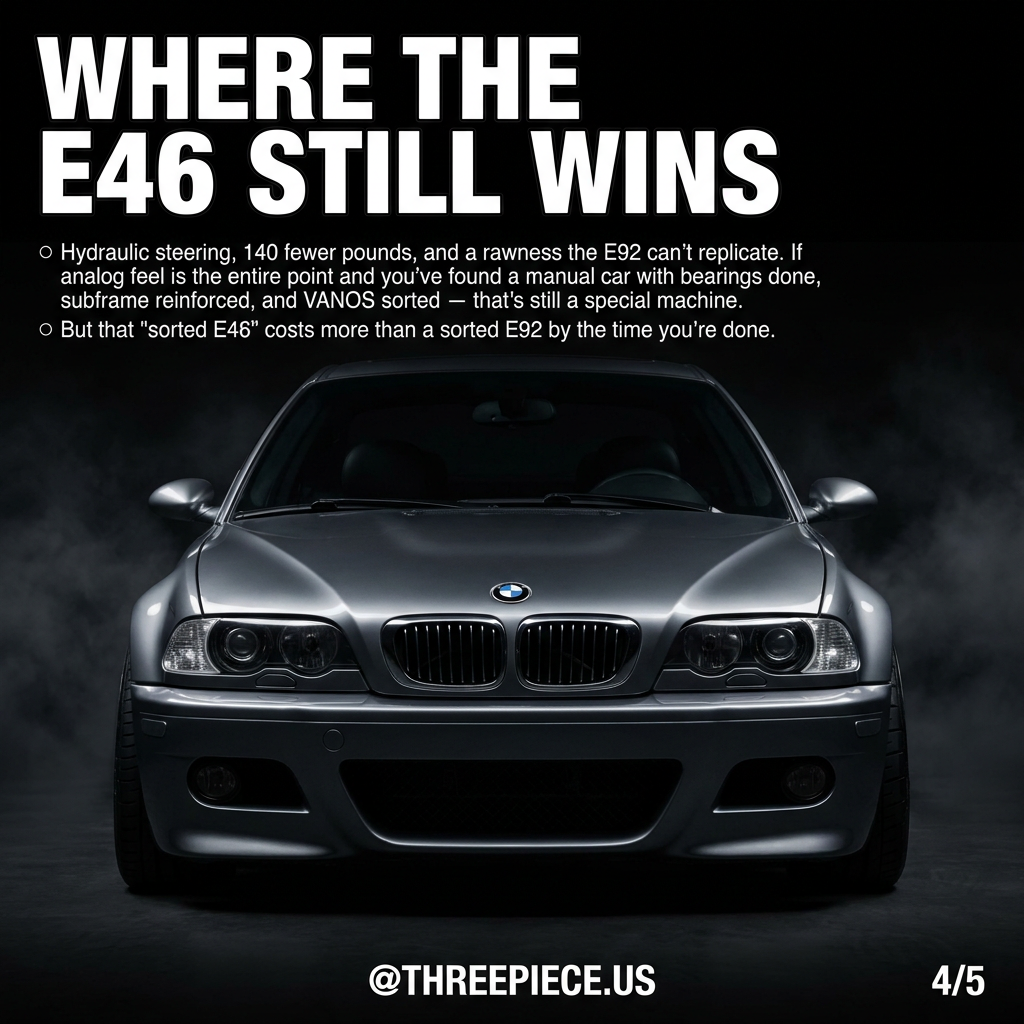
Hydraulic steering. That's the whole argument and it's a strong one. The E46 talks to you through the rim in a way the E92's electro-hydraulic setup never quite does, and at roughly 140 lb lighter it changes direction with less inertia behind it. Forum consensus across a decade of ownership threads is consistent: the E46 feels lighter than the spec sheet gap suggests.
If analog feel is the entire point of the purchase, and you find a manual car with bearings done, subframe reinforced, VANOS rebuilt, and cooling refreshed — buy it. That's a legitimately special machine and it's not getting cheaper. Same energy as the 996 Turbo argument: the pre-sorted example is worth a premium over the project every single time.
Also worth noting on the transmission split. E46 SMG-II is hydraulically fragile and expensive when the pump or accumulator goes — $2,000-$4,000+ — and plenty of owners have paid for manual swaps to escape it. The E92's Getrag DCT is a genuinely better unit. But between the two, the 6-speed manual in either generation is the resale-safe, headache-free answer. If you're refreshing an E46 pedal box, the Clutch Masters E46 Hydraulic Clutch Line (SL-E46BMW) at $43.37 is the cheapest feel upgrade on the car.
Wheel and tire fitment on both platforms
Both cars run 5x120 with a 72.5mm hub, which means the wheel market is deep and the staggered options are endless. The E46 M3 lives happily on 18x9 +30 front and 18x10 +25 rear with 245/40R18 and 275/35R18 — the classic CSL-adjacent setup. Browse 18x9 wheels in 5x120 to start, and check 275/35R18 tires for the rear.
The E92 wants a size up. 19x9 +31 front and 19x10 +40 rear is the OEM-plus target, with 245/35R19 and 275/30R19 keeping the speedometer honest and the fenders clean. Start with 19-inch wheels in 5x120 and pair them with 245/35R19 fronts.
For a car this heavy on the nose, weight matters. The Work Emotion CR 3P at $895.50 is the endgame answer if you want a true three-piece with a custom lip spec; the Work Emotion T7R 2P at $531 splits the difference for a street build. Both live in the Work Emotion series. Everything gets bolted together with M7x32 socket cap assembly bolts at $10 each, and if you're refreshing an old set, the refinishing service is cheaper than replacing barrels.
Need visual reference before you commit to an offset? The vehicle gallery has real fitment on real cars, not renders. And if you're deciding whether to spend on the wheel or the tire, our breakdown of track versus street tires settles that argument first.
The verdict: which M3 to buy
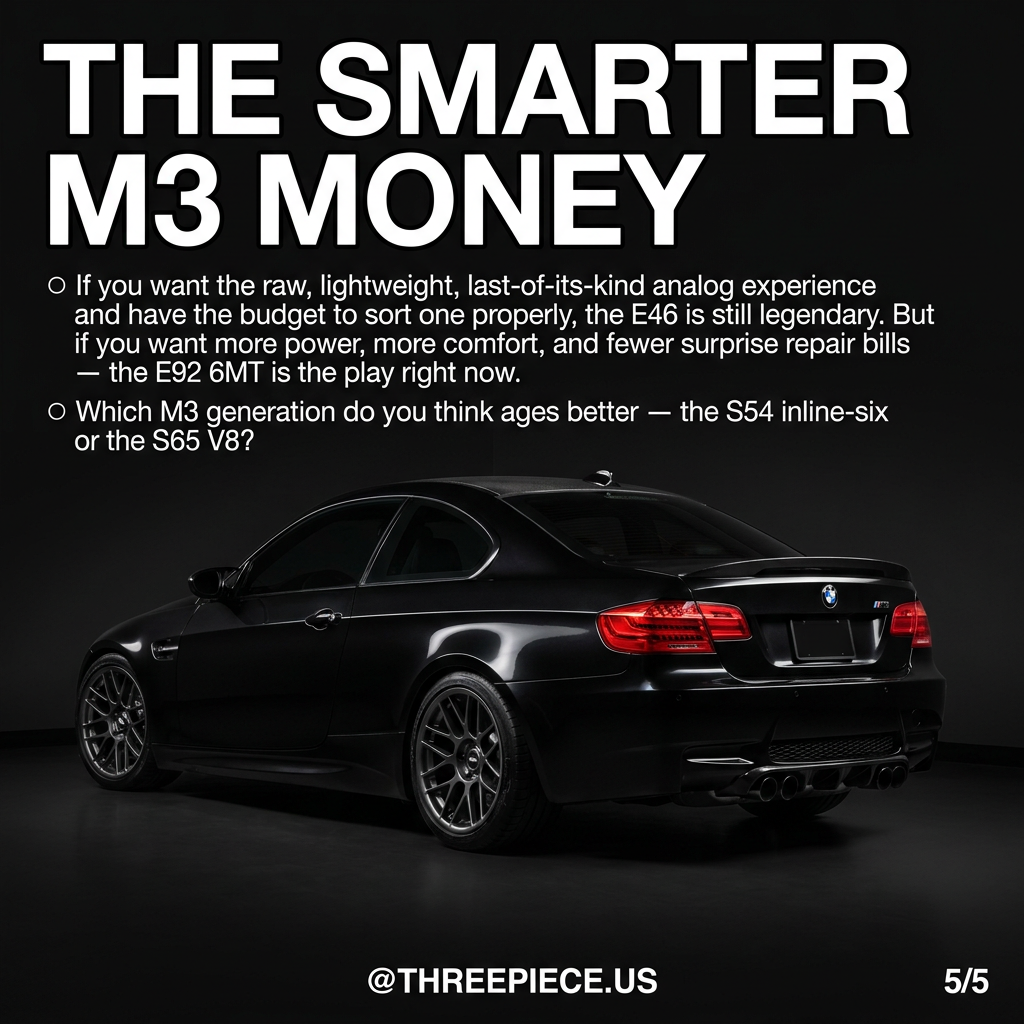
Buy the E46 if the analog experience is the entire reason you want the car and you have the budget to sort one to a documented standard. It's a collection piece with a rising floor and there's nothing wrong with that.
Buy the E92 M3 6MT — ideally a 2010-2011+ car with the harder King bearings — if you want to actually use it. More power, more chassis, more comfort, and a repair list you can price out on a spreadsheet instead of discovering with a welder. Preventive bearings on either platform, then drive it. That's the whole plan.
Ready to spec the wheels? Start in the new wheels catalog, grab hubcentric rings for the 72.5mm hub, and finish the set with Work center caps. Now settle it in the comments: does the S54 inline-six or the S65 V8 age better?