
How to Build a Honda Civic Type R FD2 (Mod Order)
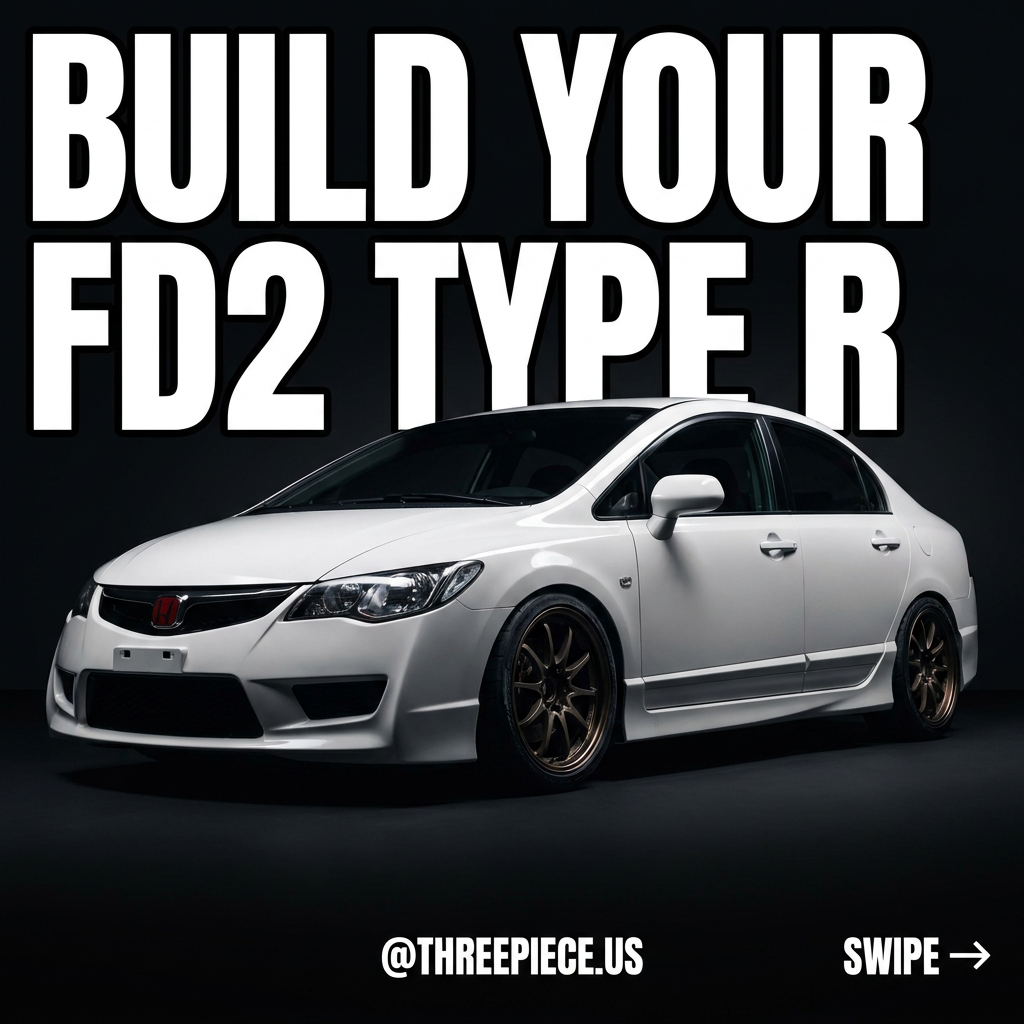
The Honda Civic Type R FD2 is the last naturally aspirated Type R Honda built before turbocharging took over, and the way you build one matters more than what you spend. Most FD2 builds go sideways for the same reason: owners throw bolt-ons at a locked ECU, get Civic Si-sized gains, and blame the car. The K20A in this chassis wants a specific mod order — tune first, airflow second, fueling third — and if you follow it, every dollar shows up on the dyno.
Quick links
- Why the FD2 is suddenly a hoarded car
- Hondata FlashPro first, everything else second
- The NA power ceiling is real
- FD2 wheel fitment: 18x8.5 +52 square
- Chassis and drivetrain: where the money actually pays
- Budget the weak points early
- The verdict
Why the FD2 is suddenly a hoarded car
Somewhere around 2019 the FD2 flipped from "the Type R they never sold here" to a car people were quietly stockpiling. Canada's 15-year import rule opened the door on 2007-2011 cars years ago, and the US 25-year clock doesn't start clearing FD2s until 2032 — which is exactly why clean examples are being bought and parked rather than driven into the ground. Scarcity plus a motor that revs to 8,400 rpm is a pricing formula that only moves one direction.
If you want context on where this car sits in Honda's own hierarchy, our Civic Si generation ranking is a useful reality check — the FD2 makes the best Si feel like a warm-up act. And if you're building on a real-world budget, the $10K Type R build covers the philosophy this article applies to a much more expensive chassis.
Hondata FlashPro first, everything else second
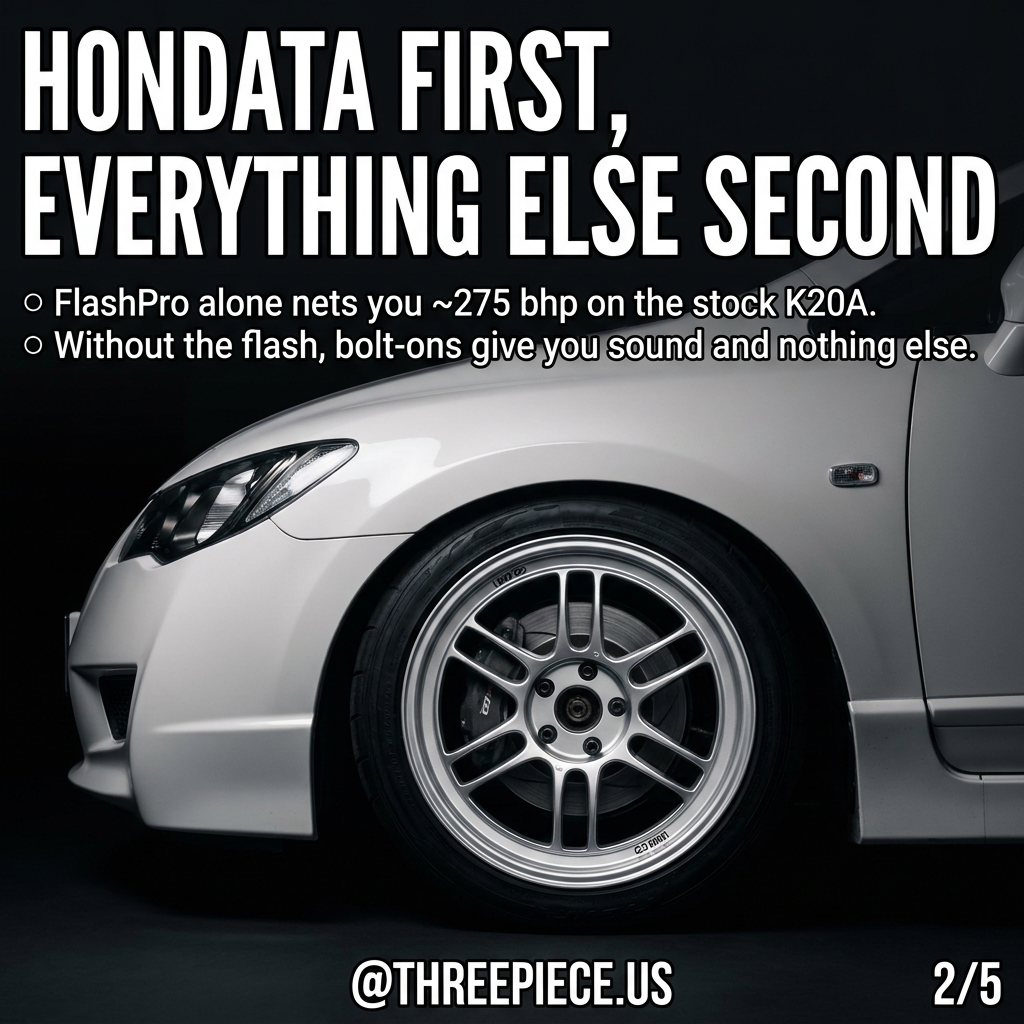
This is the part people get wrong. On the FD2, Hondata FlashPro is not the finishing touch — it's the first mod. The factory ECU calibration is conservative enough that intakes and headers mostly buy you noise until the ECU is unlocked. Owner builds on the UK and Irish forums consistently show a properly calibrated FD2 landing near 275 bhp with intake, header, and exhaust supporting a real tune, against a stock figure in the 220-230 bhp range.
Order it like this: flash, then intake, then a 4-into-1 header (Toda is the reference part here), then a 3-inch stainless system. If you're shopping intake philosophy first, our 9th-gen Civic intake breakdown explains what actually moves the needle on a Honda four versus what just makes induction noise. Same logic carries across chassis codes, and the same argument shows up in our FC1 Si mod order guide.
The NA power ceiling is real
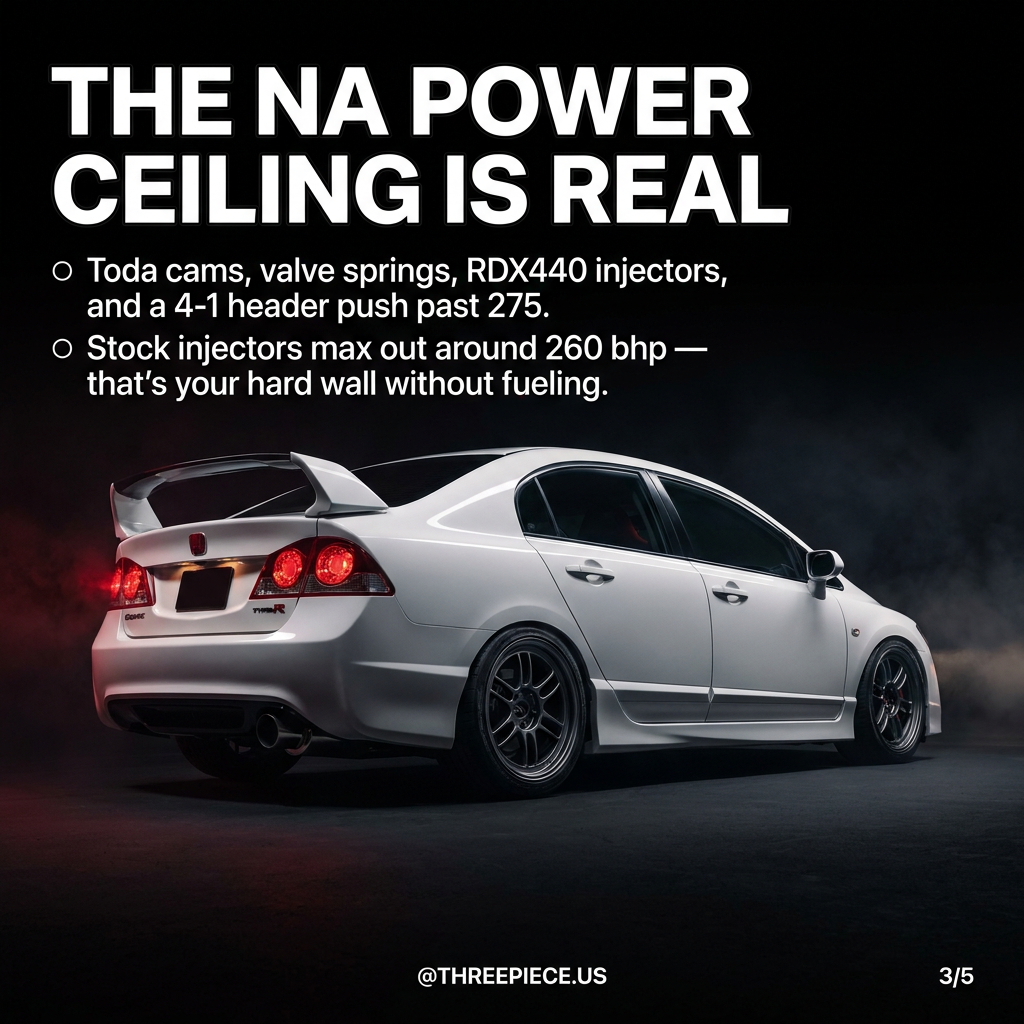
Here's the uncomfortable truth nobody selling parts wants to say out loud: the K20A has a hard wall. Full bolt-ons, cams, and a professional tune puts you around 240-250 whp. That's the ceiling for a street-driven naturally aspirated FD2, and stretching past it gets expensive fast.
Going beyond 275 bhp means the supporting cast comes with it. Stock injectors tap out around 260 bhp — that's your fueling wall, and RDX 440cc injectors are the owner-proven fix. Toda A3 drop-in cams need uprated valve springs and retainers because factory springs lose control above roughly 8,800-9,000 rpm. An 84mm throttle body replaces the factory 80mm unit. Stack all of that and you're deep into four figures for gains you'll feel more in character than in trap speed.
That's not a knock. The FD2 was never a peak-number car — it's about how it delivers across the whole rev range through a factory helical LSD in a chassis that communicates everything. If you need 350+, you're having a forced induction conversation and a completely different budget conversation.
FD2 wheel fitment: 18x8.5 +52 square
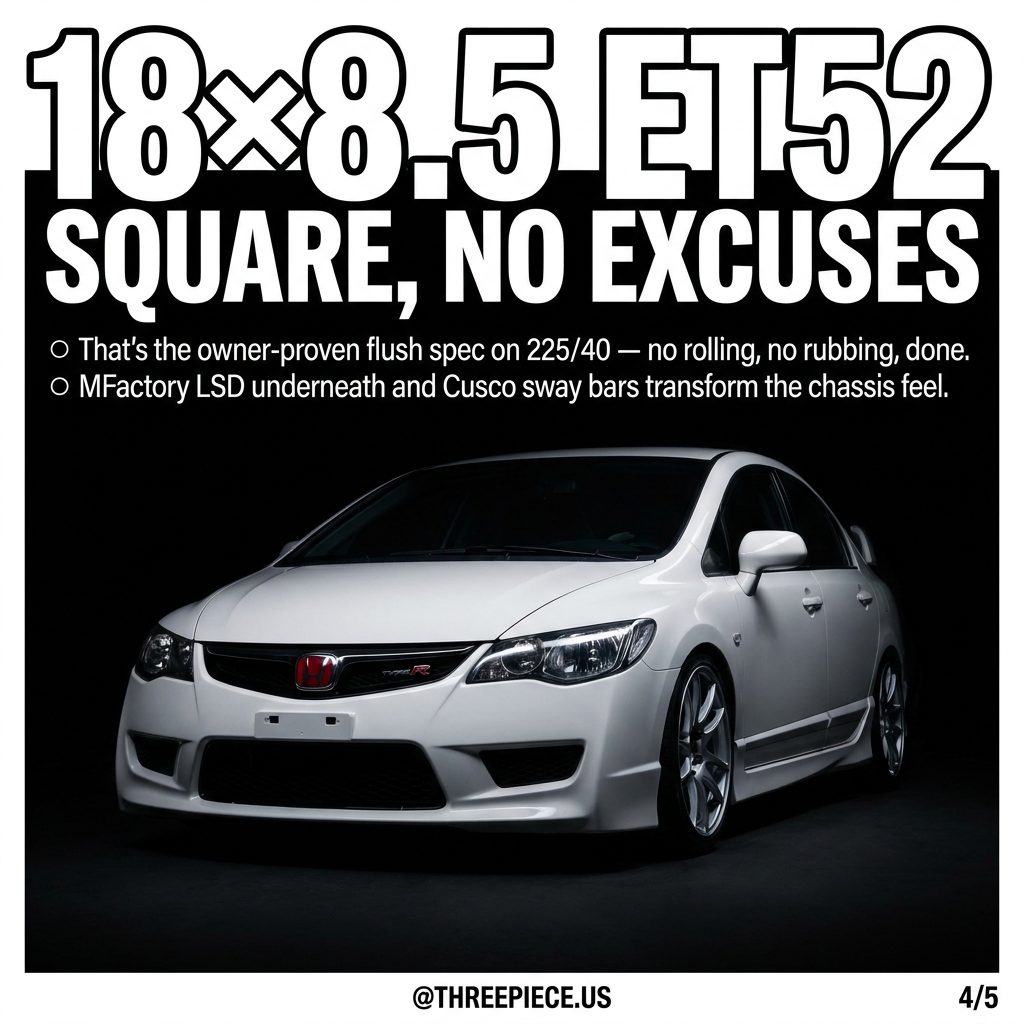
FD2 fitment is refreshingly boring, and that's a compliment. The chassis runs 5x114.3 with a 64.1mm hub bore, and the owner-proven flush spec is 18x8.5 +52 square on 225/40R18. No stagger, no spacer math, no fender rolling, no rubbing at full lock. Honda spent years on that suspension geometry — running a wildly aggressive offset undoes the work.
Browse 18x8.5 wheels in 5x114.3 and pair them with 225/40R18 tires. For a car that lives at 8,000 rpm, rotational weight matters more than diameter — our piece on what lightweight wheels actually do per corner applies directly to a 2,900-lb Honda.
Style-wise, the FD2 wears Work Emotion better than almost anything. The Work Emotion CR Kiwami at $270 is the entry point and the correct answer for a track-leaning FD2. The Work Emotion T7R at $432 is the mesh-face option, and if you're going endgame, the Work Emotion CR 3P at $895.50 puts a genuine three-piece under the arches. Finish the set with a Work VS reproduction center cap at $50 and proper hubcentric rings so nothing vibrates at speed. Need inspiration? The vehicle gallery is full of Hondas running this exact recipe, and our Work Meister S1 3P review covers the three-piece side in depth.
Chassis and drivetrain: where the money actually pays
Once the tune is done, the chassis budget outperforms the engine budget every time. The proven list from long-running FD2 builds: MFactory LSD and a shortened final drive for owners who've outgrown the factory helical unit, Cusco front and rear anti-roll bars, and poly engine mounts to stop the K20A from moving under load. Bars and mounts are the cheapest handling gains on this platform, full stop.
Dampers are the nuanced one. Factory FD2 rear damping is brutally stiff — track-biased to the point of being punishing on real roads. Owners in the UK go two directions: revalved Konis for street civility, or full coilovers for adjustability. Our suspension catalog covers the coilover side; the closest chassis match we stock is the Fortune Auto 500 Series for the 2006-2011 Civic 8 (FA/FG) at $1,799 — verify FD2-specific fitment before ordering, since the JDM Type R uses unique suspension hardware in places the USDM sedan doesn't. If you want a framework for evaluating coilovers generally, our Mk7 GTI coilover guide lays out what separates a real damper from a lowering kit with a knob on it.
Tire choice matters more here than another 10 hp. Read track vs street tires before you commit, and how to read UTQG ratings so you know what you're actually buying.
Budget the weak points early
Every FD2 build hits the same three walls, and knowing them beforehand is worth more than a header:
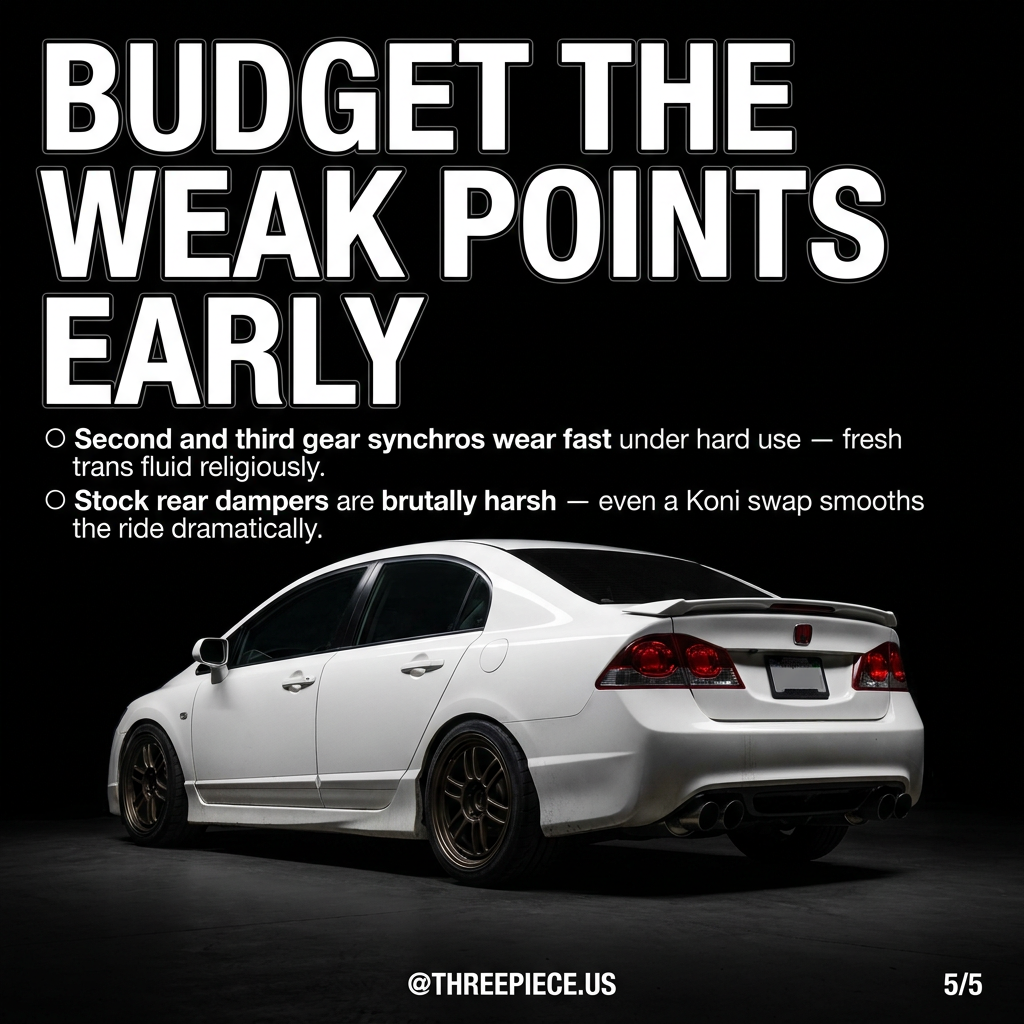
- Second and third gear synchros. They wear under hard use, especially with fast shifts at redline. Change trans fluid religiously and stop money-shifting it — replacement gearsets are import-priced.
- Rear dampers and bushings. Trailing arm bushings go soft and factory rear damping is harsh from day one. A Koni revalve alone transforms the car's road manners without softening the front end.
- The clutch. The OEM unit was engineered for stock output. Add a tune, cams, and sticky rubber and it starts slipping in third at exactly the wrong moment.
Everything else is standard K-series maintenance. If you're still shopping and want a template for what a smart JDM buyer's checklist looks like, our Evo IX buyer's guide and 350Z buyer's guide use the same framework.
The verdict
Build the FD2 in the right order and it's one of the most complete naturally aspirated front-drive cars ever sold anywhere: FlashPro, intake, 4-1 header, 3-inch exhaust, then bars, mounts, and dampers. Skip the cams unless you're committing to springs, retainers, and 440cc injectors — half-measures at that level just make an expensive, unreliable 265 bhp.
Then put it on the ground correctly. 18x8.5 +52 square on 225/40R18 is the spec, and the Work Wheels catalog is where most FD2 owners end up. Grab M7 assembly hardware if you're running three-piece, and don't forget 90-degree valve stems at $3.80 — deep-dish barrels make straight stems a chore.
The FD2 is the last analog Type R Honda will ever build. So: are you tuning yours first and running the factory helical LSD, or spending that money on an MFactory unit and a shorter final drive before you ever touch the ECU?